
liberté urbanité

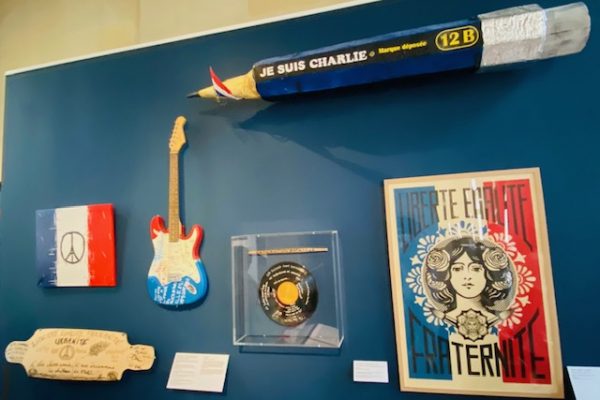
In the museum of the history of Paris “Musée Histoire de Paris Carnavalet” we find a special place devoted to the commemoration of the terror attacks in Paris in the Bataclan event location and the office of the journal “Charlie Hebdo” (see image below”. The skateboard on the bottom left of the wall raises the value of “urbanité” next to liberté, égalité, fraternité. The attack of an urban living style with youth going out as they like and journalists and caricaturists speaking their minds freely had been attacked, but continues nevertheless. This statement is part of the Paris state of mind. 
Home for dog

The places where some dogs live can be rather big. But even tiny dogs may enjoy a luxury home like their owners. This was certainly the case for the dog’s niche in a Paris home, a few years before the French revolution (1785). The exhibit is a testimony of the tough inequality of the late 18th century in Paris, where some enjoyed far reaching luxury and large parts of the population were forced to live in poverty within Paris or the suburbs with little access to basic sanitary facilities. The discrepancy between the luxurious homes of pets and the average person might serve as an indicator for income and health inequality. The Musée Histoire de Paris Carnavalet has a great stock of artifacts that can speak to the issue. Image: Musée Histoire de Paris Carnavalet dog niche 1785). 

Gentileschi Selfie

Today the production of „selfies“ is all around us. Selfies are shot almost instantaneously and several times a day by use of modern smartphones. About 400 years ago the first woman to produce a selfie was Artemisia Gentileschi. As (one of) the first female painter in art history to have created a painted image of herself (which is transmitted today) Artemisia Gentileschi made history. Her unique biography, style and craftsmanship of the early 17th century in Italy made herself a renowned painter. Her choice to depict herself rather than somebody nobel or rich was quite unusual for the time. The audacious choice of herself as her „sujet“ became even her trademark. Later paintings by her with biblical topics were also subject to her reinterpretation based on herself as the female character in the narrative and image. In this respect her work appears so much ahead of her time that her impressive work speaks to all generations today. (Image: extract of Jael and Sisera by Artemisia Gentileschi 1620, Musée Jaquemart André“ in Paris 2025-8)

Zadkine museum

In the middle of Paris you will find a small former atelier of Zadkine. Transformed into a museum, the place is a cosy place to learn about sculpture and the different materials used. The preparations in form of designs or smaller trials with other materials are common practice to arrive at the sometimes monumental pieces. The visit of the permanent collection is even free of charge. A splendid experience in a surprising spot of silence next to buzzing city streets. Depicting musicians and musical instruments has been Zadkine’s shared passion with Valentine Prax. Great that he managed to reach the USA in time before the Nazi persecution could reach him. However, exile often means hardship as well. 

Climate Awareness

The Musée d’Orsay has prepared a wonderful walk through its permanent exhibition of late 19th and early 20th century installations to reflect upon climate and climate change. Raising awareness about the treasures lost and those we are about to lose in the next few years. Impressionist painters have depicted landscapes, cities and monuments covered in snow, which the next generations will no longer be able to enjoy the same way. The roofs of Paris covered with snow has become a feature of a distant past. Additionally, the impression of the massive steam trains crossing metal bridges appear as the daunting future of technical progress. Mixed feelings of fascination and risk associated with those machines were captured by those painters’ eyes. Nowadays we are aware of the consequences of this technical progress for our planet. The walk through museum with a focus on climate related paintings is eye opening indeed. (Image: Extract of Éduard Veuillard, Le jardin des Tuileries, Musée d’Orsay, Paris) 

Museum Marketing

The century old idea of a column that keeps people informed is prominently displayed at the Musée d‘Orsay in Paris in 2025-7. The example on display demonstrates the Parisian adaptation of the „Litfasssäule“ to the local architecture. The marketing tool of a round display for posters rather than the flat depiction of images has its own „Charme“. The huge version of a sign post allows to display a lot of information and a close reading as well. The cross cultural adaptation is interesting as most people would believe it is a rather unique Paris invention, whereas it is an adaptation from elsewhere. Of course, it has the French touch to it, which makes it unique in a sense again.

History coined

It is an ambitious project to frame history of a country or continent according to the succession of coins. In the KBR such an attempt is currently on display in 2025. The history of a country in the center of Europe is reflected sometimes through different occupying forces who imposed their currency onto the occupied territories. The Greeks and Romans had an overriding impact on the development of coins in human history and society.  Precious metals were used as basis to embody lasting value into coins. The images on coins are also a way to reiterate the dominance of a new ruler or governance. From the Roman occupation there are nice specoin the KBR collection as Julius Caesar named one part of the 4 occupied territories “Belgica” beyond what we define as borders of Belgium in the 21st century. Control of your own currency means also to be able to produce unique pieces in your own foundries. The history of coins is also a history coined by those in power to enforce their political power onto the economy. (Image: KBR, The history of Belgium illustrated through coins, 2025).

Odessa Berlin Odessa

With a sense of partnership, it is possible to travel between Odessa and Berlin in the “Gemäldegalerie” in Berlin 2025. Due to the war of Putin in Ukraine the “Museum of Western and Eastern Art” in Odessa had to relocate its treasures to safe places. The Gemäldegalerie offers a chance to view the splendid collection nevertheless. The curators’ team in a spirit of “art intelligence” propose, in a splendid way, most oeuvres from Odessa next to an example by the same painter from the Berlin collection. The visitor leaves the exhibition enriched by an experience of “jumelage” (engl. sister cities) of partnerships between museums, cities and their people.
In fact, we have shared the same imagery or visual heritage in Europe for centuries . The collections of paintings ranges from the 16th -19th century art  or from Frans Hals to impressionist influences.
We shall cherish the return of the collection to Ukrainian Odessa as soon as possible. The image below shows the places of origin (yellow dots) of the art works of the Odessa collection across centuries (map from the exhibition).

Dépaysé in gallery

The installation ar the Neue Nationalgalerie in Berlin entitled „Fog Sculpture“ takes us from the sculpture garden of the Gallery into a tropical forest atmosphere. Just changing the humidity and visibility through the artificial production of fog transforms the perception of the artworks. A kind of Asian flair surrounds the western sculptures in the garden. The fog installs also a mystification whoch we know in art from the romantic painters like Caspar David Friedrich for example. All long-term followers shall appreciate the new perception of the artworks thanks to Fujiko Nakayo. It’s definitely more than old wine in new bottles. The artwork brings a more global twist to the preexisting sculptures and reminds us in Berlin even of the wrapping and unwrapping of the  Reichstag building by Jeanne-Claude Christo. We see the sculptures or architecture differently after they disappeared temporarily and reappear again.

Marx Home

The home of an influential philosopher, economist and political scientist is not easily presented like a home of a musician, a composer or an author. However, the home of Karl Marx in Trier on the Moselle river succeeds to present the biographical links of growing up in a historic city, the bourgeois upbringing of the young Marx and his formation as an independent and even revolutionary thinker of the economy and society. In 2025 the home is a museum supported by the Friedrich Ebert Foudation with a great online guide and access to additional scientific material. For authors like Karl Marx it is always of interest to follow not only the origin and evolution of the thought process, but also the shifts in the reception of his writings by subsequent generations. This part of the exhibition and an audio guide (downloadable as App).

In 2025 with an apparently ruthless capitalism at work in the biggest economy of the globe, the reminder that the economy is best to be understood as a political economy, which focuses on self-interest and profitable business deals, we find in Karl Marx still a worthwhile reminder of economic development even in the 21st century. The note-taking and studies in Exile in London are well documented in the tiny home and museum. Studying the misery of exploitation in supply chains and international commerce remains a topic of continuing interest as well.