Piano & Dance

Young talents sometimes offer innovative approaches. This was the case of Amiri Harewood in his performance of short piano pieces in the Espresso series at the Konzerthaus in Berlin. In an effort to take the Berlin audience on a lunchtime journey his program started with Schostakowitsch and Rachmaninow to move to less familiar repertoire from George Walker and Joshua Uzoigwe to “Valses Poéticos” from Granados. The live performance by Amiri Harewood in Berlin was at its best when he started to move head and shouldlers, breathe in tune and dance a bit while playing the piano. This rather unique feature of his performance is certainly different from a “stiff upper lip” or rigid posture we observe too often. This created an interesting “Kontrapunkt” for many in the audience who rather came for the espresso and to visit the building expecting some classic piano in the historic setting of the Konzerthaus Berlin. It took a while until people realized they were up to a unique piano experience. “Neuer Wein in alten Flaschen” = young, fresh music in old bottles or settings.
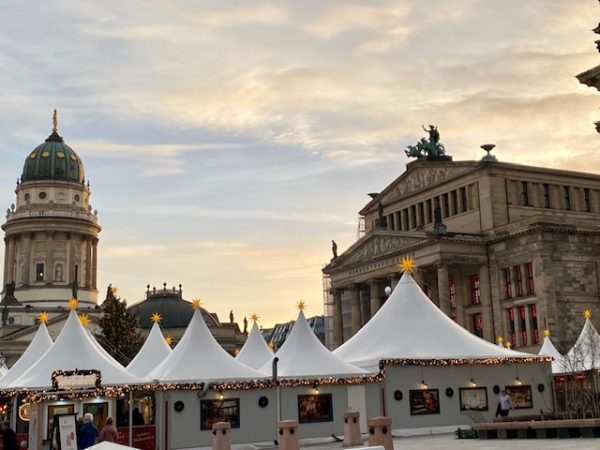
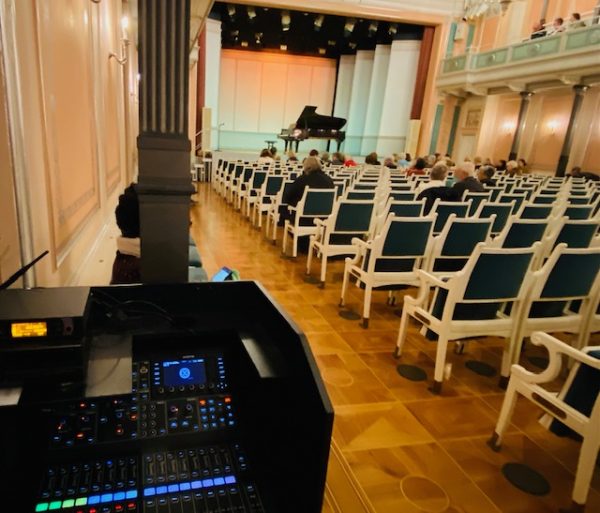
Konzerthaus Espresso

Classical music in classicist architecture sounds like a perfect match. The audience is packed with people mostly 60+ years of age. One of the spectators happily admitted that without the espresso before the concert she would have a hard time to follow closely because after lunch at 2 p.m it is time for a rest rather than excitement.
The series of short concerts at lunchtime suits particular audiences. It is probably the only concert series where the queue in front of the toilet of men is equally long than the one for women. The short concert program allows for more experimental formats as well. Musicians who develop a solo program of shorter than standard concert hall duration can appear in high reputation locations and gain experience of performing in such prestigious settings.
With a “Zugabe” from the performer, but also in form of a small piece of chocolate for the audience at the exit, 21st century, classical Berlin knows how to charm its aging audience and population. Young performers learn that the mature audiences don’t bite any more. In case the sound and peaks become too modern they just adapt sound level of their hearing aids. It is perfect for all generations.

Colette Bewitched child

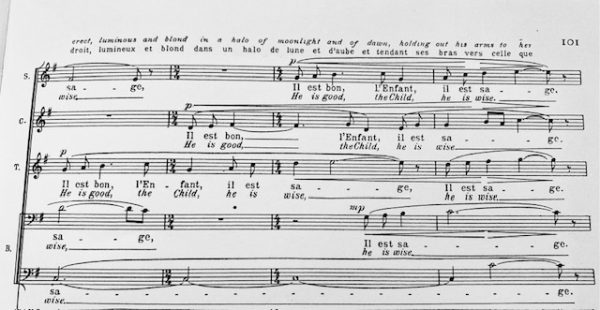
The English translation of the libretto written by Colette “L’enfant et les sortilèges” is translated to “the bewitched child”. The first representation was performed in Monte-Carlo in 1925 before it was represented in Paris at the Opéra Comique in January 1926.  The printed edition of Ravel’s orchestration classified the work as Fantaisie Lyrique based on a poem by Colette. This opus constitutes a forgotten forerunner of the much more popular musical “Cats” . In the end of Colettes narrative the animals call the child her “mama” and praise the good and wise child. It probably remains a forgotten 100’s anniversary, despite the fact that the topic of humans and animals, or nature in more general terms, have become more and more unbalanced over the last 100 years. 

Electric Fun

The 60s, 70s and 80s have been fantastic precursors of the “All electric society” because of the electric music 🎶 industry that became a mass phenomenon. First of all the electric guitar allowed a wave of new music to take hold of a whole generation and probably keeps its adepts until today. E-pianos, keyboards, drum machines and synthesizers made music playing more accessible as well. You just need to plug in your instrument and you were able to produce an overwhelming sound. Other electric pleasures might include water pumps for water heaters and sprinklers. Electronic games and gadgets soon took over in children’s rooms. Of course, calculators as precursors of mobile phones and computers were another step in the progress towards the “All electric society”. Electronics are about to govern large parts of our lives and society. We better take a serious look at what we gain and what we might lose. 

Music Lunch

The possibility to pass a lunch break with live music inspiration is, unfortunately, quite rare. The Brussels festival “midis minimes” has created a popular format for classical music to be performed in easy to reach venues in the city center. Working in the center allows to hop into a 45 minutes performance of varying artists, instruments and music styles. The “Cercle Royal Gaulois” offers enough seats. Even without a reservation it is feasible to forget about work and get inspired by musicians. and the composers and arrangements they propose. Gaëlle Solal and Juliette Hurel offered short digestible pieces by Bartok, Ravel and Piazzolla with a focus on their popular dance tunes often based on previous folk tunes. We virtually traveled from Romanian tales to La Habanera and Tango and back to work for some.

Satie Popular

Erik Satie has been quite involved with the surrealist and Dada movement of his time. He personally knew the main proponents ranging from Breton to Magritte. He became one of the major figures applying the ideas of surrealism to music. His early compositions like the Gnossienne (extract of Nr. 1 below) are admired for their simplicity. They became popular only years later and have entered popular music repertoire through many retakes of the original tune in various styles ranging from jazz to rap. Many of Satie’s formative years he spent playing and performing popular music in the animated cafés, bars and shows of Montmartre in Paris. The making of a living based on music can be a challenge. Satie had to bear the full risk of a life in poverty at times to reserve sufficient time for his creative work.
He remained very much connected to the working class as his later membership of the Communist party after the Great War testifies. Composing for children and transmitting music to the next generation was equally close to his heart and mind, especially in his later years.
For him, popular music constituted a fountain of original tunes and a test with an intuitive audience rather than the academic circles. Maybe, with this attitude, he followed the footsteps of Flotow, Offenbach, Ravel and many others later on until pop music became the vastly dominant music in the late 20th and 21st centuries.

Erik Satie Satisfied

The collection of letters from Erik Satie contains more than 1000 letters amongst them some in exchange with the best artists of his time. The range is largely due to the circle of artists who met at Montmartre in Paris before and during the Great War. We discover letters to Maurice Ravel, Claude Debussy, Pablo Picasso or Henri Matisse. For some artists there are 100+ letters preserved like to Jean Cocteau. In the 1920s he composed music for shows at Montmartre, where the scenario was painted by Pablo Picasso and costumes designed by Coco Chanel. The sculpture by Brancusi must have been familiar to him, just as much as the cubist paintings by Georges Braques, as there are also letters or references to such letters in the impressive 1000+ pages collection. Like Ravel he was rejected by the Conservatoire de Musique de Paris in his early days as student. Montmartre allowed to live and create at the same time while living on a minimal budget. Erik Satie signed his letters with ES. In German this denotes a “neutrum”, maybe, beyond male or female differentiation, but also a tonality in music (E flat). There is no trace that this was a conscious choice. It is just another unresolved puzzle about the self-declared “Gymnopédiste” and composer of the “Parade” and the popular piano music the “Gnossienne”. 100 years after his death on 1925-7-1 he (ES) could be rather satisfied with his impact on the course of music in the 20th century and beyond.

Musician Historian

Musicians are usually perceived as “part of history” rather than being historians themselves. However, recent research on Bob Dylan has extended that view to portray Dylan in his role as historian as well. The issue here is more with the historical periods and references the musician, composer and song writer builds on and interprets historical events. Thereby, his thoughts and impressions on living through historical events enter into his work as an artist. Dylan is literally “doing history”. He puts events of past and present into perspective of his own making and reached authority through the non-conformist perspective, which connected him to as a performer to his various audiences. His approach to doing history consists in the re-presentation and re-creation of historical narratives. Nina Goss (2024) in her book review highlights the “irruptions of the past into the present unique in popular culture”. The re-arrangement of fact and fiction encourages us “to inhabit, question, and revise historical narratives and tropes” (p.399). Several musicians have specific ways of reflecting, sometimes critically, on history in their artistic work. Bob Dylan certainly is a very prominent example of this an has been honoured for this by the Nobel Prize for literature. It remains an interesting perspective to review composers and their choice of libretti for operas as a way of doing history. The shifts from royal drama to revolutions and popular scenes are in this line of interpreting musicians also as historians.

Liszt home

In Budapest we can visit one of the longer living places of Franz Liszt or Ferenc Liszt as some Hungarians would insist to call him. The Beethoven trained Carl Czerny offered piano and music classes free of charge to the young Franz Liszt in Vienna at the age of 11. In the biography by Klára Hamburger she describes the Paris years of Liszt from 1823 until 1839 as the most important ones for the pianist and particularly for his later compositions. Born in Hungary, the son of 2 Austrian parents he was trained in Paris by amongst others the Czech professor of the Conservatoire de Paris Antonin Reicha just like Chopin, Flotow or Offenbach. Writing an opera was the “must do” for a composer who aimed for the highest possible career at the time. In a letter to George Sand, Liszt (published 1937) complained already about the social status of musicians in society as servants to the higher ranks of society. Similar to Ravel many years later Liszt was rejected as official scholar by the Conservatoire de Musique and his wish to marry a daughter of noble decent was rejected early in his career. Such experiences probably contributed to his leaning towards the romantic form of expressions in music during most of his compositions. Literature, paintings of the French romantic period and the traveling artist “voyages et pèlerinages” became influential in his creative process. The competition between composers must have been fierce at the time and despite ample opportunities to perform in public and private venues making a living from music wasn’t always easy at the beginning. More than 100 years after his death his compositions are still a challenge for all pianists and the Hungarian Rhapsodies probably his greatest homage to his early childhood.

Tchaikovsky home

During the time before the “Zeitenwende” it was easy to visit the home of the composer Pyotr Ilyich Tchaikovsky in St. Petersburg. Therefore, we refer to our memory of the visit and the already 10 years ago restrained liking and appreciation of the Russian officials for the aristocratic composer, even accused to not be sufficiently Russian in his music compared other Russian composers. The composer had diverse love affairs, which were also not conform to official doctrines. The world wide success of his compositions, mostly known for his ballet music, remains popular in the 21st century. Similar to Beethoven, the biography by Malte Korff (Tschaikowsky, in German), highlights the final symphony as his masterpiece. The seems to be a reason to study “the last works” of composers specifically. The mature compositions appear to reflect on previous work and build or comment on previous work. The 6. symphony “Pathétique” was completed in his last year of his life, only at age 53. The final IV-th piece of it is entitled “Adagio lamentoso” and ends in very calm tempo and almost silence like a withering away heart beat. To my surprise I found a similarly very quiet ending in one of his early piano composition when he was only 28 years old “Romance Opus 5, Andante cantabile”. This early piece also ended “più lento” and from pp to ppp. (compare extract of image of notes below).