Modern Cathedral

For a long time we have argued here that museums are the cathedrals of modernity. Maurizio Cattelan has taken this claim literally. In a bit of a cheeky way, he turned the “Neue Nationalgalerie” into a cathedral of German modernity. Who are the Gods then? Our cultural heritage comprises beyond our German language classics, the novel “Die Blechtrommel” by praised and then disgraced Günter Grass. The figure serves as the “campanile” sitting above the entry. Well, the small scale “Brandenburger Tor” serves as the entry portal into a wide open space, with past pieces of adoration in a transfigured sense. This modern cathedral holds pieces of art similar to small chapels in a cathedral dealing or inviting to remember historic events or eminent persons. The modern aspect consists in its temporality. The show must not go on forever. Like surrounding every cathedral, lots of immortalised pigeons accompany our visit, just sitting around. There is no longer just one “holy spirit” or “peace dove” but so many. Welcome to the temporary modern cathedral in Berlin.

Cattelan-Berlin-2026-9-Neue-Nationalgalerie

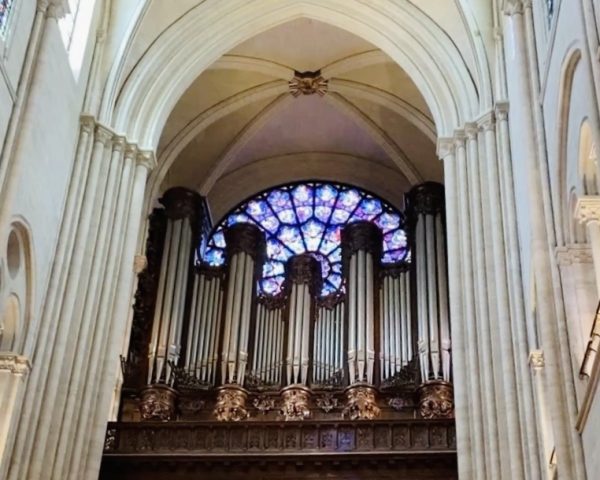
Notre-Dame Organ

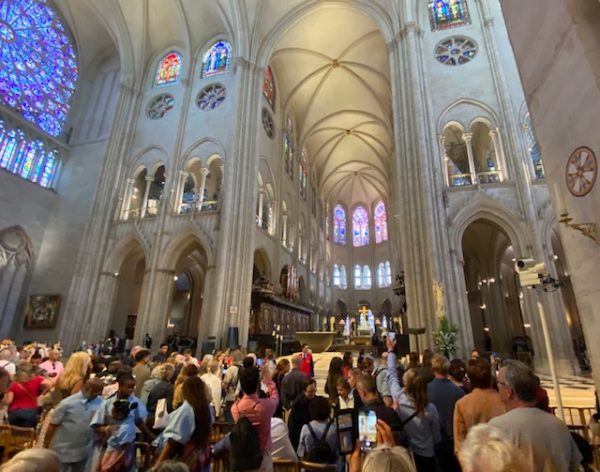
Paris, particularly Notre-Dame de Paris, is a great place to listen to pipe organs. It just needs a little preparation to find out time and place of a concerts. There are actually surprisingly many. At times of official services you might also get an impression of the capacity of organs and organists knowing how to make the pipes sound from soft, melodic to broad, majestic, even overwhelming. In Notre-Dame de Paris the original organ was built by Aristide Cavaillé-Coll and accomplished in 1868. An “electric blower” (1924) certainly enhanced and prolonged the sound capacities of the already rich orchestration features. Despite the electric enhancement the mechanics remain the primary features of the sound of pipe organs. Olivier Latry at Notre-Dame manages to the audiences into the 21st century’s sound spectrum based on traditional, but adapted variations of classical compositions. Bringing in new talent, like at the “Konzerthaus“, will guarantee that future generations can still enjoy the many worlds of sound that organs open up for us. Short sound impression Notre-Dame de Paris organ play 2026-8.

Notre-Dame de Paris Visit

We are used to pay for visits of historic monuments. For a family with 2 children 15+ years old, 40 € is to be expected. Historic Places of Worship which still serve as such, mostly refrain from such commercialization. Notre-Dame de Paris is proud to state that they have been doing so for 860 years. After the fire, the reconstruction was expensive and it could be considered a fair deal if tourists pay for visits. The visit by Pope Leo 14 in 2026-9 and television coverage could also contribute quite significantly to the maintenance of the cathedral. The orchestration of such a visit as if a pop-star was staying in Paris in a splendid location attracts huge crowds, most of them with a certain willingness to pay for participation (maybe as donation, tax refundable). The choice to keep the place accessible to all underscores the prominent place the cathedral can play as a meeting point of many visitors with different or no religious beliefs. The role to unite various Christian beliefs and practices was remarkable in 2026-8 and a message to the upcoming visit by Pope Leo XIV who shares this vision and efforts. 

Notre-Dame de Paris Visit 2026-8

War of drones

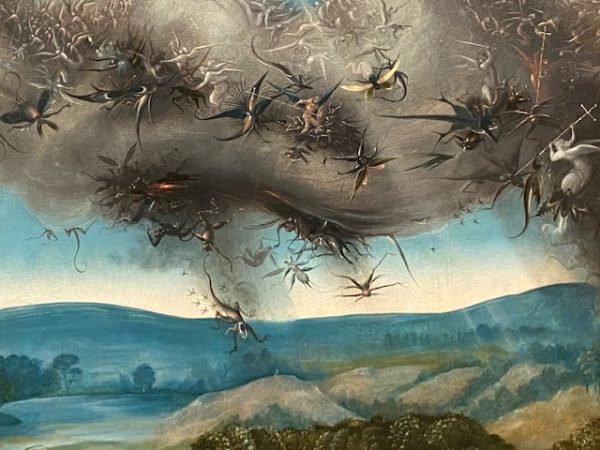
The fiction of a war of drones has been imagined, somehow, 500 years ago by Lucas Cranach. His altarpiece of the last judgment (1525) shows on the upper left corner flying little monsters that threaten humans on earth. The danger came from above and followed predefined judgments. The kind of weapon and threat were not so much different from today, but the portrayal of the person in command has changed. For the thousands of victims due to Putin’s war in Ukraine the modern scenario does not change that much. (Image: Cranach extract 1525 Gemäldegalerie Berlin)

Cranach extract 1525 Gemäldegalerie Berlin

Magnifica humanitas

With the “Encyclical Letter” entitled “Magnifica humanitas”, Pope LeoXIV puts himself expressively into a long historical tradition of the catholic belief to be not only a religious leader, but also an institution that puts humanitarian values on the top of its agenda. As the catholic church is a globally active institution, which covers the whole life-course of individuals based on defined doctrines, the massive changes that are under way in the field of artificial intelligence asked for some guidelines to frame the church’s understanding of this relatively new “Deus ex machina” of the 21st century. In the Encyclical, there are several mentions with respect to comparable socio-economic developments of the past. In choosing the name of “Leo”, the Pope referred, from the earliest days of his Pontificat, to Leo XIII as a particularly important predecessor for himself. The latter has made his reputation in the Christian Church with the Encyclical “Rerum novarum”, which raised awareness to the risks to humanity with an industrialization and capitalism being pursued at all costs. “Res novae” of our time, which is AI and all its fields of applications have a potential to affect the course of humanity for decades to come. Leo XIV doesn’t condemn it as the devil in machine form, but puts emphasis on the potential of AI to assist us to enhance the “Common good”. This is the task of many, not of only a few, as he refers to in his Encyclical of 2026-5-15.
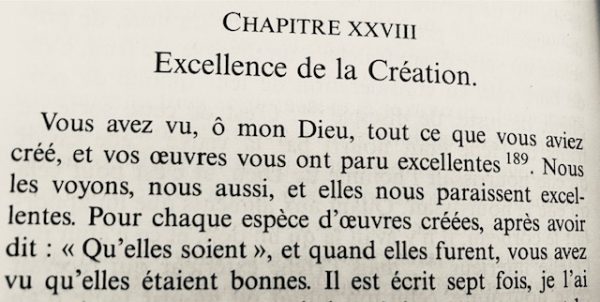
(Image: Extrait: Saint Augustin, Les Confessions, book 13, chapter 28).

Renovated sacred architecture

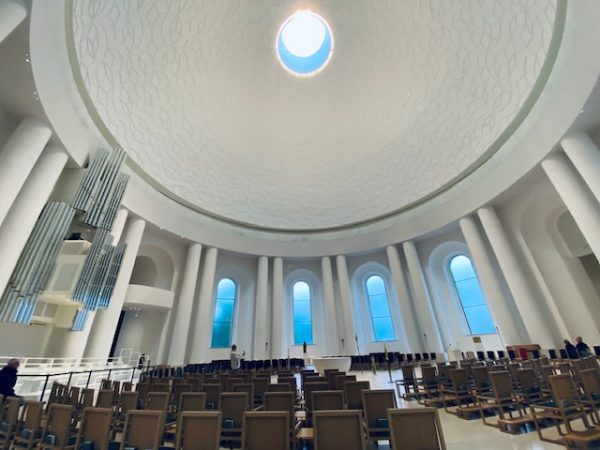
The 18th century catholic St-Hedwig Cathedral in Berlin has been renovated in the 2020s. The sacred building benefits from its central location in Berlin near “Unter den Linden”, Staatsoper, Staatsbibliothek and Humboldt University. The remarkable round shape of the church and its dome appear small from the outside between the high buildings in the surroundings. The size becomes more visible from the inside. The renovation made the choice to clearly define the center of activities again with the “altar” in the middle surrounded 360 degrees by the audience. Every visitor will be fascinated by the sound design of this renovated sacred architecture. The organ, orchestras and choirs have to handle this with care. Speech is transmitted with astonishing clarity. The sober interior focuses on essentials and might give the impression to be in a protestant church rather than a catholic one.
Silence or rain on the roof become an experience in itself, believing or not.

Post-sacred architecture

As with our human bodies, and in many instances already, sacred architecture follows a life course pattern. The thriving religious communities build and expand their faith to larger audiences. In these expansionary phases of the faith many monumental buildings, known as sacred architecture, as well as splendid interiors or artefacts enter the “built faith”. After the peak of membership and in periods of contraction, the question of how to scale down the splendors starts to arise.
Eventually, the ceding of the sacred architecture to the non-believing communities comes into consideration. The sacred architecture needs to find its place in the evolution of societies as well as urban and rural local space. Depending on the intentions and resources of communities, post-sacred architecture has to redefine its purpose for its own survival.
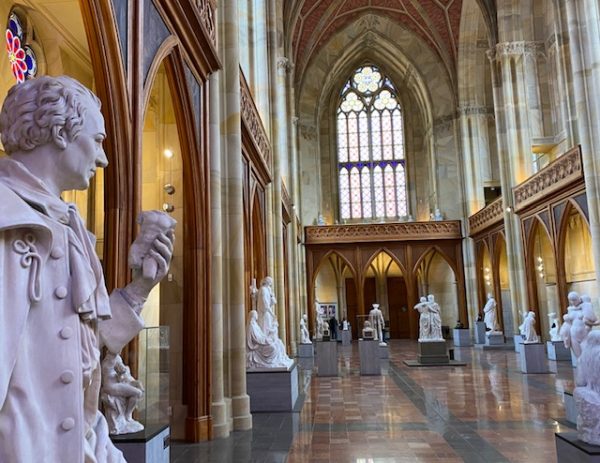
An interesting example of post-sacred architecture constitutes the “Friedrichswerdersche Kirche” in Berlin. The use as a historic exhibition space for sculptures of the 19th century works particularly well in combination with an active program on art, architecture and history. The statue by Ludwig Winckelmann (image below) depicts the reflection on and about a miniature sculpture in space. The post-sacred use of this fine and luminous architecture continues to reach an enlightened audience.

Individualism and beyond

For many social and political scientists it is interesting to look into the origins of our present day individualism. In a permanent drive to learn more about ourselves, millions of persons on social media try to visualize primarily themselves in different roles and life situations. Saint Augustine was the first philosopher who exposed his own personality and past choices of pleasures on earth in a journal like fashion named “Confessions”. Isn’t this what every person is somehow doing on facebook, tiktok or instagram? Thousands of entries deal with persons succumbing to earthly pleasures. Saint Augustine writes about his own very personal experiences and this invention of “the individual path” to philosophical, spiritual, religious ideas and convictions makes him a milestone in the history of ideas.
Maybe the original version of the text is further advanced than the Christian AI chatbot that has recently been released, because Saint Augustine proposes in the last paragraph of the Confessions 3 questions and finally 2 sentences to close his journey into his philosophical and religious mind.
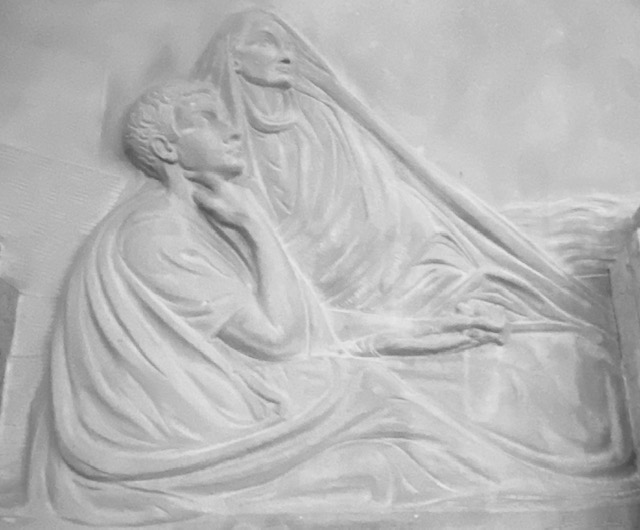
(Image: Saint Augustin & Saint Monique, by Jean Boedts on Confessions Book 9, Ch. 10 on his mother dying, Church Saint Augustin, Brussels Altitude 100)

Learning through Confessions

In the original text of the Confessions by Saint Augustine there is an interesting testimony to his personal learning style. He hated learning Ancient Greek as child, apparently mainly due to the strict teaching style, which obliged him to learn Greek and punishment for being less interested as a child (Book 1 Chapter 13). However, he explains the predilection for Latin in language and grammar in later childhood and adolescence through the encouraging teaching style. Saint Augustine has reflected on his own learning style, put it in words in order to answer primarily to himself on what made him learn. The rhetoric style, which he applied rather consistently throughout his confessions, is build around the continuous questioning of his own past behavior and convictions. This is a kind of internalised conversation, which in the Greek tradition, was centered around dialogues with other persons as in the Socratic dialogues. The questions beyond the rhetoric style are also the beginning of a learning process even if the outcome might be open and in modern times a lot of new answers have been contributed through scientific methods and continuous discourse. Multilingualism was already a practice more than 2000 years ago for the young Augustine of Hippo.

Art Utopia

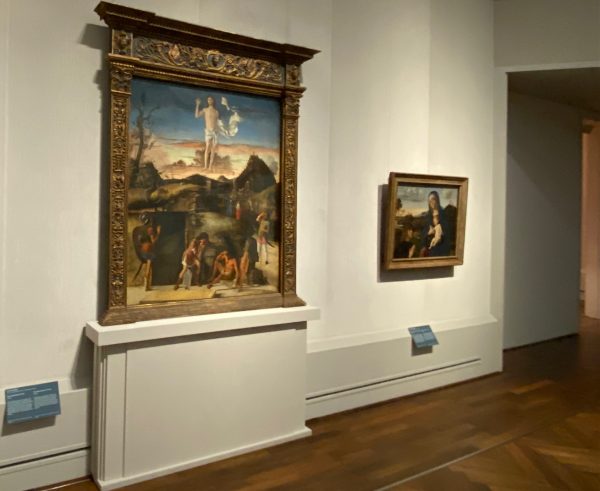
Not all art is utopia, but a lot of it. A series of talks on the issue of utopia in art  (BNF) reminds us on the utopian projects many artists have pursued in the history of art. From a non-believer’s point of view, religious depictions belong to some form of utopian art. Much later art movements proposed to bring art closer to people’s lives by spreading decorative art to objects of the daily lives, like furniture, dresses, jewelry. Different forms of experimentation with materials or art styles reveal a taste for freedom of expression, sometimes of a utopian kind, at least at the time of experimenting. Abstract art opens up thought spaces which may appear like verylong shots into a very distant future. Science-fiction is of course a well known form of dealing with and representing utopian ideas to larger audiences. Maybe it is this curated space of utopia which many people seek when going to exhibitions and galleries. (Image: Giovanni Bellini, Resurrection of Christ, Gemäldegalerie Berlin).