

Bicycle Garage

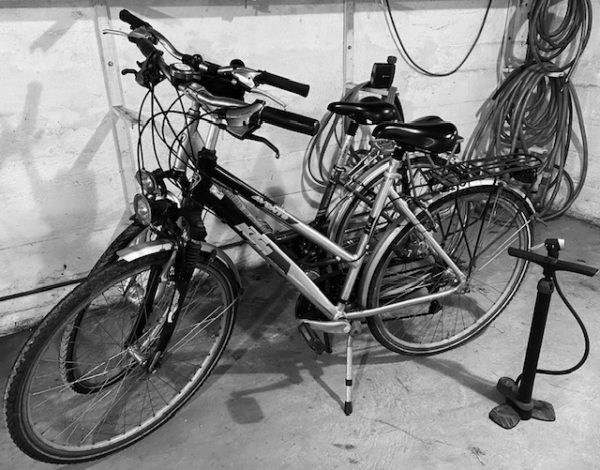
The 2020s are the years to explore sharing concepts. Beyond car sharing we have become used to share scooters and bicycles for intermodal transportation. The concepts are subject to continuous evaluation and the choice between free-floating versus fix point stations remains a hotly contested topic. Despite using either one of both sharing concepts, families and friends might practice their own sharing of modes of transportation. Whereas for cars the driving licenses and insurances might limit the sharing, for private bicycles there are no such restrictions.
A little bit of basic understanding and practice of repairs allows to share family-owned bicycles with little effort. Equipped with a GPS-tracker, even free floating might be an option in addition to theft protection. With less space taken up by cars in household garages, bicycles can occupy, at last, sufficient space including a little corner for maintenance and repairs.
Green trade flows

The statistics on trade flows reported by the UN Department of Economic and Social Affairs have a comprehensive data base in the background. The descriptive inspection of the raw data on trade flows comprising solar panels, batteries and electric vehicles shows a stark imbalance of how future-proof the trade between countries is. The New York Times (David Gelles et al. 2025-6-30) has put this information into an impressive graphical design to show the magnitude of the imbalance of how China trades in green products with the world and how the USA is losing out on future-proof low carbon emission trade. Despite the fact that China is still heavily emitting CO2 today due to burning coal for electrical power, the investments at home and trade with the world is moving into the opposite direction. We have seen many of these industries at risk in Europe, like solar panel production, batteries and increasingly electric vehicles, without the western countries getting organized to address crucial business and economic challenges. Falling behind in these industries and trade will shift global balances in the near future. Renovation through innovation is more promising than holding on for another decade to inefficient and more polluting energy sources. Repairs of homes and buildings have long lasting effects, which we can, nevertheless, change today.

Robot repairs

Robots have been used mostly in industry for assembling, transport or sorting tasks. There is also a role in disassembling to enhance circularity. To repair electric or mechanic devices there is an enhanced version needed which starts with a diagnosis of the problem. Algorithms can sort out promising from dead end routes of repairs. However, the recognition of objects into things that can be repaired and those without repair potential is a worthwhile assistance. Beyond the economic and ecological rationale for repairs, there is an emotional or nostalgic sense to it as well. Maybe, from a life course perspective any object related to the teenager years of a person qualify for nostalgic value. Even simple robots or AI-assisted objects may qualify for this in future. Artificial friends will be like tamagotchis in need of repairs.

Repairs again

Trying to repair electric or mechanic devices is confronted with multiple obstacles. Spare parts are hard to come by and many pieces needed are no longer in stock. Hence, in many instances the remaining option is to use recovery pieces from other broken or discarded devices. Whereas this is still common for repairs of vintage cars, for example, this is rather rare for consumer electronics like stereo music players or television sets. An aging clientele of the repair market is very used to a specific device and is often reluctant to change habits. 

An additional element in the repair process is access. Only in thinking repairs into the engineering and design of the device will make repairs feasible later on. An economy and business model which is based upon a high turnover as the basis for profitability has no interest in engineering for repairs later on. This makes a preservation of resources tricky. Disassembling is a necessary but not sufficient condition for the repair sector to thrive. At least the basic materials enter into a circular economy as a first step. Further steps consist in preserving the skills needed to disassemble and/or repair more. The habit „buy a new one and throw away the old one“ is hard ro change. 

Dream together

„Dream together“ is the title of the exhibition of Yoko Ono at the „Neue Nationalgalerie“ in Berlin 2025. The title is an invitation or even an incitement to dream jointly with others. We need to dream of peace on all sides or parties in a war. Start with the dream and then move on to working together on it. The participatory art projects of Yoko Ono are a recurring event in Berlin and at the Neue Nationalgalerie (Cut piece). The installation „Wish Tree for Berlin“ in front of the gallery is popular with visitors who leave hundreds of written wishes to the windy spring days. Origami folding, stone assembling or a simultaneous chessboard playing with all white pieces and fields encourage to imagine a world differently, beyond the treaded belligerent paths. For more inspiration and imagination just continue to the Martin Gropiusbau for more artworks from Ono or just watch the clouds pass by changing the lighting of the olive tree carrying lots of wishes.

Dysprosium 66

Dysprosium figures as Nr. 66 in the periodic table (short: Dy). This metal was given this Greek name, which translates to “hard to get”. Although more common than gold on earth, Dysprosium is part of the so-called rare earths on earth. Since it is very temperature resistant before becoming fluid and at the same time having good isolation properties, for example against radiation in combination with lead, the nuclear energy industry has a definite use case.
Additionally, wind turbines, electric vehicles and some smart phones use these characteristics of the metal only known to us since the late 19th century.
The major exploitation happens in China and, therefore, the recent tariffs have complicated the trading. Prices tend to rise and products that contain Dysprosium are likely to become more expensive. However, there is the other side of the coin, which means recycling and reuse of Dysprosium is also more interesting to companies. Hence, the price increase will likely enhance circularity of the metal from obsolete products into newer ones. In this respect it is good news that smartphones receive longer updates of their operating systems and security as of 2025-6-20 in the EU. This will also reduce the amount of rare earths needed in the production of the rapidly changing technical specifications of smart phones and tablets. Repairing the devices makes more economic sense before “programmed” obsolescence.
(Image: extract from Willem van der Vliet (attributed), The money counter. early 17th century, Brussels MRBAB).

Owners Dispute

Renovations of housing with distributed ownerships can be a challenging experience. In Berlin you can find a few places with visible long-term disagreement about what kind of modernization should be done. More luxurious additions like balconies or triple window isolation and so on are sometimes hotly debated and contested in courts. For most buildings you cannot spot disagreements on the outside, but some constitute exceptions to this rule. One size does not fit all preferences. In a metropolitan city there is a place and a space for all such exceptions to the rule and most people after years do no longer think about such kind of diversity in preferences or budgets available for modernization. Cities put our level of tolerance to a continuous test. You probably learn to love this or eventually you leave the inner city. There are subtle differences in urban versus rural lifestyles. In the social sciences we continue to try to understand the attraction of cities as on a global scale millions of people flock to cities.

Housing renovation

The huge amount of buildings that need renovation is a task for each generation. New constructions are relatively easy to realize even to the best available standards. Particularly energy standards asking nowadays for serious isolation of buildings are easy starting from scratch. Energetic renovations of existing buildings are much more challenging and have to take into account the various stages or predilections of previous generations. Repurposing of buildings raise additional questions like transforming a family home into a representative office building. New technologies like fiberglass instead of copper cables or copper or plastic tubes instead of other hazardous materials cause additional costs and worries. The use of asbestos for interiors of previous generations has created the greatest liability for existing buildings. Technological choices of the past and also of the present (heat pump or not) have lasting consequences and sometimes even health effects. To cherish old buildings and styles is a mixed blessing as the renovation of housing confronts home renovators with more tricky challenges than building a new home. Incremental repairs might do the trick rather than all in one go renovation, however, you might enter into a situation when renovations are always on your mind. Not only the times are a changing, but homes are a changing, too.

Design skills

The is a huge B2C or C2B market in connection with home design and adaptations. Nowadays people are inspired by instagram, pinterest, YouTube and TikTok. Additionally, many play around with Apps to create their own images of how they would like to arrange or rearrange their home. Some have taken first steps to include measurements of their home in the design. The compatibility with professional software of the construction sector, however, is a drawback that delays or leads people to go to enterprises that take into account the prior efforts of young lay designers. It is a little bit like an own contribution in home building quite popular among new home builders to alleviate the upfront cash needed for first home acquisition. The younger generation could offer some of their “digital native” skills to bridge the gap in construction and home design. Of course, reworking and precise measurements on the location will still be required as construction has a lot of legal liability issues involved. Cooperation is a form of burden sharing to advance faster and/or with lower costs.

La défense Végétale

Greening a metal and concrete block and buildings is a big challenge. The logic of unrealistic growth and big business has left liabilities for future generations. More vegetation in inner cities is part of our responsibility towards future generations. Therefore, urban planning has started in Paris to get rid of concrete walls and floors.

Eventually the district might have a more human touch which attracts citizens and new businesses and services. The adaptation of the infrastructure to facilitate mobility with bicycles and secured pedestrian paths has started but will take a lot of time before people adopt again these more healthy modes of transport. The big boulevards reserved for polluting transport is no longer adequate in combination with residential living spaces.

It will take a change of a whole generation to accomplish such a fundamental change. The reduced demand for office space due to more employees choosing to work from home contributes to such a change as well. Many other cities go ahead with similar changes (Copenhagen, Berlin). In combination with the „All electric society“ there are fundamental changes at work which will make inner cities more attractive again. Ease of clean transportation and other infrastructure for urban lifestyles ensures that cities remain strong points of attraction. They keep pulling people from nearby and far away towards them, if we like it or not.