Socio-technological obsolescence

The standard literature or AI-sytems will give you a definition of on technological obsolescence, which specifies that obsolescence does not mean that a device is broken, but that it is outdated. In computers this might be due to hardware no longer supporting newer, more resource demanding software, or newer software insisting on the use of other hardware. The seemingly rapid innovation cycles in smartphones, cars or robots might justify such technological obsolescence, but the real advances like shifts from 3G to 4G to the newer 5G mobile frequency standards have taken place rather slowly due to provider coverage of sufficiently large, particularly rural areas.
Therefore, the technological obsolescence has to be enlarged as a concept to socio-technological obsolescence as the societal, legal and economic boundaries of technological innovations have to be taken into account as well. Provisions for health concerns or CO2 saving circularity, i.e. reuse of resources have to be taken into account as part of a precautionary principle.
Computer screens have asked us to move from square designs to wide screens (watch videos) to smartphones’ standards of long formats. My 20 years old square screen has been doing a reasonable job throughout these periods, though not for serious games.
The socio-technological obsolescence relies on a “socio-technical prestige score” of products, like for luxury brands in other industries, where fashions drive obsolescence more than technology.
(Image: Robotic arm made by Kuka writes on paper sheet at Frankfurt book fair 2017)


Cut it short

The “Revue des sciences humaines” (Demanze and Gleizes, Nr. 355, 2024 pp. 7-16) provides an interesting reflection on the widespread practice to find (new) ways to cut long stories or insights short. Short by itself, this introduction to a longer special issue on the topic “Faire court” stresses 4 elements of the contemporary impetus to cut it short:
(1) The creative process may be subject to condensation of content, similar to the process of a “reduction” in the culinary vocabulary. The speed of creativity, inspiration, freedom of expression are exemplified by the twitterization of and aphorisms in literature. Roland Barthes, in his analysis of the “haiku”, raises awareness to the different associations of the short text forms in different societies.
(2) The observed shortening of time spans of attention and the competition and economy of attention have raised the stakes for longer formats and explain to a large extent the success of shorts in the digital age.
(3) The short format works to increase the intensity of the literary experience.
(4) In deconstructing the associations of long formats as “monumental” versus short formats as ephemeral, the “cut it short“ tendency serves to “demonumentalize” the big shots of literature, science and the humanities. Well, about time to cut it short, “hic et nunc”, here and now!

Popular Sociology

Sociology, like other social science disciplines, has often difficulties in reaching bigger audiences. However, in combination with a museum which specializes in the history of a big city like Paris, the insights can suddenly become very popular. The “Musée Carnavalet of the history of Paris” has mounted an exhibition, which builds on the population censuses of 1926,1931 and 1936. The access to the complete original records of 3x about 2 millions of people has become a national treasure for social scientists and the public at large.
People flock to the exhibition. Some do it to learn about the past of their districts or streets. Others to learn about historical facts, which are sometimes linked to the family anecdotes and broader historical narratives. Out of this interest grows an understanding of macro- and micro-level social processes, which makes use of basic statistics.
People ask themselves: Is your (family) story unique or is it part of a more general pattern or social process like urbanization or social mobility.
(Image: original census recording sheet – Paris)

Digital Social Networks

Social networks have become the place to be. The need to distinguish the digital social networks from the social networks of people in the analog or “real” world is important, as we realize that many young persons seem to suffer from loneliness despite a hundred personal links in the digital social networks. This paradox of digital and non-digital social networks needs careful attention of researchers because of the opportunities and risks involved in the transferability of contacts from one network to another.
There is s a kind of “conversion rate” of digital contacts into face-to-face contacts and even purchases for marketing purposes in the world of business. The sociology of the virtual has to deal with these paradoxical social relationships and study the increasing phenomenon of being «alone together». Increasingly we are alone, but together. Over the life course this phenomenon and the digital social network paradox change as well.
To research such a topic we need rather intrusive, personal data and access to the digital traces of people as they construct and deconstruct either form of social networks. 

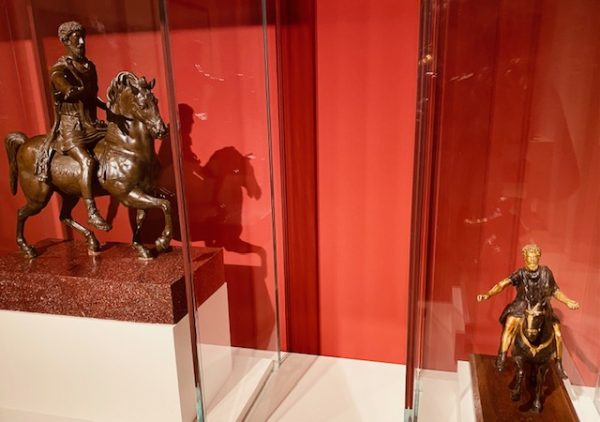
Marc Aurel Memorials

The depiction of Marc Aurel as Emperor has become a trade mark in the history of art and politics. As an emperor with good horse riding skills, Marc Aurel was the first emperor to be portrayed as riding on a horse without saddle whilst, of course, in perfect skill to master the horse and give orders or strategic commands. Many subsequent emperors, Napoleon or Friedrich have had their power positions “immortalised” as such, which served at the same time to make them appear taller and “in command” of something.
Travelling by horse has  also been for a long time the fastest mode of transport, yet another symbol of social status used in media campaigns of those times. The memorials in honour of Marc Aurel had already during the ancient time the function to transmit an image, the emperor wanted history to keep in mind, rather than the view of ordinary people in the Roman empire. Memorials of political leaders have been a demonstration of power for centuries before and for centuries to come.
(Image: Trier Marc Aurel exhibitions 2025-9)

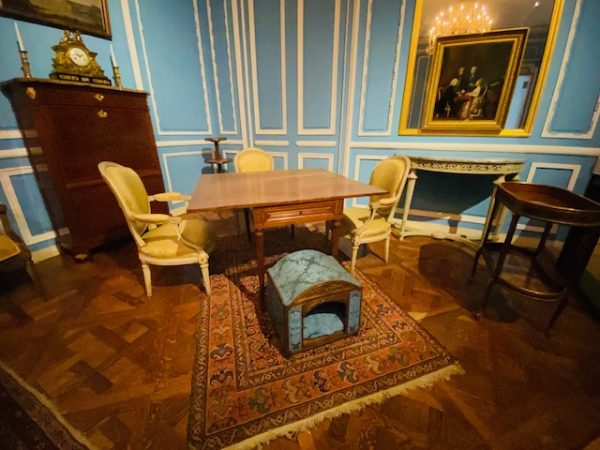
Home for dog

The places where some dogs live can be rather big. But even tiny dogs may enjoy a luxury home like their owners. This was certainly the case for the dog’s niche in a Paris home, a few years before the French revolution (1785). The exhibit is a testimony of the tough inequality of the late 18th century in Paris, where some enjoyed far reaching luxury and large parts of the population were forced to live in poverty within Paris or the suburbs with little access to basic sanitary facilities. The discrepancy between the luxurious homes of pets and the average person might serve as an indicator for income and health inequality. The Musée Histoire de Paris Carnavalet has a great stock of artifacts that can speak to the issue. Image: Musée Histoire de Paris Carnavalet dog niche 1785). 

Pervasive waste

From time to time waste from so-called highly developed countries is making headlines and then it is forgotten again. Huge amounts of plastic waste gets shipped for example from the USA to Malaysia in containers regularly (NYT 2025-7-1). The dumping of waste in other countries where it is cheaper to waste the waste is a cynical practice. Not only is the potential for reuse and a circular economy disregard, the little control that is exercised how the waste is treated afterwards is neglected. Some might just end up in our oceans later on or find its way in our food chains. The recent discovery of lots of nuclear waste at 5000 m depth in the sea in another extreme example of this practice to dump waste affecting all of is when profits have been accumulated inn the hands of a few enterprises and states. Such external effects as they are called in economic theory are part of the standard economic thinking. The challenge is to detect such behavior, persecute or better prevent it. This calls on countries who produce the waste to check for the contamination potential and treat their own waste. Fukushima has lots of barrels of nuclear waste waiting. The pervasive nature of this waste will make it last for thousands of years. “Beggar thy neighbor” with your waste is a major default of our current economic and social model. It remains an unresolved puzzle why mankind continues to work towards its own extinction. (Image: Le grisou, Constantin Meunier, MRBAB, Brussels). 

Social promise

In the beginning and middle of the 2020s the social promise to younger generations has been broken. The latest figures from the USA reveal that 2 million students (WSJ 2025-6-25 A3) who have financed their studies and potential social mobility by taking out a substantial loan are very likely to default on their credits. This observation was less a surprise to labor market analysts as the stalling of student hiring in many countries has happened for several years now. The more surprising finding is that the Wall Street Journal 2025-6-25 has been reporting on this. Banks or universities who are highly exposed to this kind of risk will themselves become downgraded for their credit rating. Higher interests for universities means higher fees and higher student loans eventually. The social promise to reach higher status and earnings through higher education as the social promise of the meritocratic society becomes an illusion. Investors in student housing might also find the sector less juicy for them. Students and their parents were taken hostage by an excessive commercialization and commodification od education. Lifelong learning is a still a promising route to revitalize the social promise.

Artist Development

For many artists it takes years before they find their idiosyncratic style. Testing different forms of art before zooming in on a particular style of art is the  common trajectory for most artists. Maybe the art marker and collectors of art are in search of a “defining style” for an artist so the uniqueness becomes more easily identifiable. Being part of a group of artists has been beneficial as well. The “Neue Nationalgalerie” in Berlin makes this development of an artist, in this case Lygia Clark transparent through the organization of a retrospective devoted to her evolution from abstract paintings towards participative and more organic forms of art. Berlin offers to interact with the pieces at the exhibition. You become part of the exhibition and the happening of art instantaneously. The form stays the same, the persons interacting change permanently. The piece of art is never the same. Just the idea of it thrives. In the Corpo Colletivo the performers wear an overall, all of them are linked to each other and movements happen organically as a group rather than individually. This is like a tutorial in sociology as individuals move as part of a collective body and feel the embeddedness and multiple links to other persons (Image: Corpo Collectivo 1970, exhibit in Berlin 2025)

Expo Disco

The combination of music and dance is a powerful, captivating experience. From folk dance traditions across the globe to ceremonial performances. In the past this combination has often related ro religious practices. Later manifestations include classical ballet, modern dance and disco music and dancing. History is full of examples that have been turned into mass culture. 

Rock on festivals and rap in clubs or hip hop outside have complemented this experience over the last few years. Each time the combination made the popular difference. Therefore the Disco exhibition in Paris just next to the Conservatoire de musique et de dance de Paris and in the building of the Paris Philharmonic is an appreciation and respect to the disco culture, popular mostly during the 70s and 80s. From a sociological perspective the throve by minorities for recognition of their cultural practices and diversity has been a driving force. Andrew Diamond has coined the expression of „disco at the intersection of minorities struggles“ (p.70 exhibition catalog). At the origin of the disco movement, there was the aftermath of the 60s power struggles. Black, women, gay and student protests asked for „all power to the people“. Music and dance were forming identities. Posing and showing off became part of disco. People created and lived their own utopia in glamorous lighting.

Image: Exhibition shop Paris Philharmonic 2025.