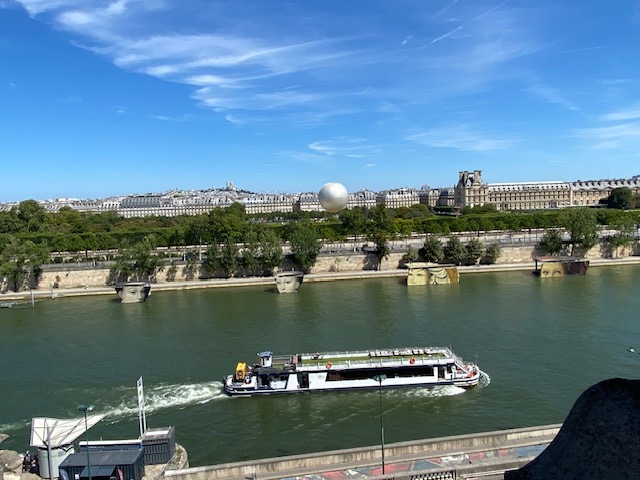
Waterfront Paris

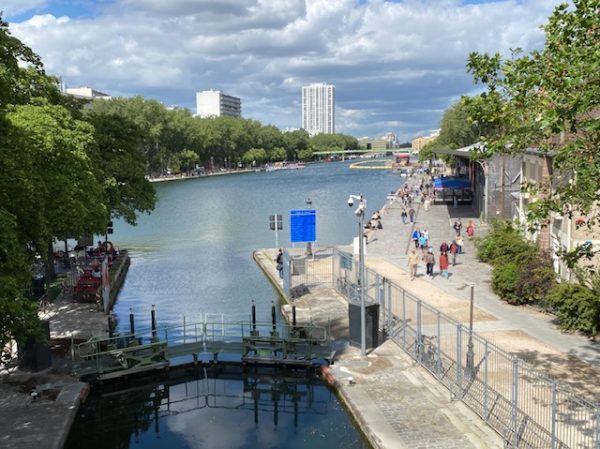
Most people enjoy the banks of the river “La Seine” in Paris. Ever since the Olympics in Paris 2024, the temptation to go swimming there or to do some other kind of water related activities, is high. Fewer people are aware of an other splendid location near the Gare de l’Est. The canal Saint Martin and the nearby end of the Canal de l’Ourcq ( image below) have much to offer for stressed people to take some time off and relax. From cinemas, cafés and bars you can choose your favorite to pass time with friends or family, alternatively just keep walking for miles to get your exercise as needed to sustain your body in good health and shape. The health impact of such cool and more humid areas has a high value to the benefit of all without forcing people to travel long distances for recreational activities or normalizing weight or heart rates. 
 

Electric ships

The transformation of mobility to an all electric mobility has been discussed mainly with regard to a narrow vision of the automotive sector. Beyond land based vehicles like lorries, buses, cars and bicycles or electrification of trains, shipping has been a niche market of the all electric society. The amateurs of silent shipping, sailing and surfing have explored and adopted the electric alternatives for quite some time. The professional ferry boats and river crossings have also opportunities to join the all electric society with a range of ships available for orders like from “Ampereship”. The increasing share of electric fun on water and electricity-propelled ships gives additional drive to the “All-electric-society”. 

Water fountain

The design of water fountains is a bit of technology and a lot of art work. The provision of water for larger basins in castles was pioneered by garden architect Le Notre in France as early as the 17th century. He took ideas from Italian designers to integrate them in his French squared designs and surprising perspectives. Vaux le Vicomte is a splendid example and a source of inspiration for many even centuries later. Listening and watching the water fall from level to level downwards calms the spirit. Worth exploring yourself.

Sedentary Lifestyle

There seems to exist a correlation between a more sedentary lifestyle and the level of industrialization. Industrialized countries have attempted to beat the running of time by faster modes of transport. From horses to cars, trains and airplanes. As a corollary of wanting to go faster the number steps walking has decreased compared to countries with less private or public means of transportation. The the time you spend sitting in transport the less we tend to walk or cycle. Obesity has become a dangerous consequence for large parts of those sedentary individuals and sedentary societies. The contribution by Paul Klotz in “Le Monde” from 2025-7-26 (p.24) highlights the bio-psycho-socio co-determination of the sedentary lifestyle. Societal developments to build entire cities more suited to car and train traffic has made walking the city a stressful task. Rebuilding our cities with a focus for a society on the move again is a challenge for more than one generation.

Pervasive waste

From time to time waste from so-called highly developed countries is making headlines and then it is forgotten again. Huge amounts of plastic waste gets shipped for example from the USA to Malaysia in containers regularly (NYT 2025-7-1). The dumping of waste in other countries where it is cheaper to waste the waste is a cynical practice. Not only is the potential for reuse and a circular economy disregard, the little control that is exercised how the waste is treated afterwards is neglected. Some might just end up in our oceans later on or find its way in our food chains. The recent discovery of lots of nuclear waste at 5000 m depth in the sea in another extreme example of this practice to dump waste affecting all of is when profits have been accumulated inn the hands of a few enterprises and states. Such external effects as they are called in economic theory are part of the standard economic thinking. The challenge is to detect such behavior, persecute or better prevent it. This calls on countries who produce the waste to check for the contamination potential and treat their own waste. Fukushima has lots of barrels of nuclear waste waiting. The pervasive nature of this waste will make it last for thousands of years. “Beggar thy neighbor” with your waste is a major default of our current economic and social model. It remains an unresolved puzzle why mankind continues to work towards its own extinction. (Image: Le grisou, Constantin Meunier, MRBAB, Brussels). 

Rainwater Use

The use of rainwater is fairly easy to realize. Most homes in Europe and beyond have a roof drainage system in place. However, for decades the only concern was to get rid of the water as soon as possible. Nowadays, we think twice about it. The recovery and storage of rainwater for a separate use in a household has become a substantial cost saving exercise. In the Paris region in France you can expect on average 650 liters of rainwater per year per square meter. For a roof size of, for example, 70 m2 this yields about 45.000 liters per year. If you take a shower using 40 liters this allows you and your household to take 1125 showers or 3 persons almost one shower every day. Average household consumption in Paris is 120L/day, which adds up to about 44.000 liters per year for washing and toilet use. On a monthly basis with a storage capacity of 4000 liters of rainwater per adult person you should be able to manage your own consumption with your own roof drainage system. It is a rather simple use case. Maybe during dry summer months the calculation is a bit too optimistic, but the potential for a water autonomy of households in Europe is an option. In addition to the dry January, the no mow May, we shall have the no shower July next. 

Aridification

Man made climate change and local policies increase speed of aridification (Link). It is not only the Sahara desert that is spreading out, but the lake Aral is another horrible example of the disrespect mankind attributes to its own resources of living. As more regions become arid due to our faults and long term consequences of industrialization we provoke human resettlement of an increasing scale. Water resources are and have been for centuries the major reason for people to settle nearby. Aridification of the soil like in California increases the risks of wild fires. The costs associated with aridification are very high and such areas can no longer be insured through normal private insurers. In most cases poor people or countries are affected the most, but we are all likely to bear the consequences in one way or another. We will have to accept that the size of habitable areas on earth decreases while the peek demography of humans is still at least a decade away from now. Not to tackle aridification is not an option. When shall we ever learn? (Image: sketch for Hagar and Ishmael in the desert, by Navez 1819, MRBAB)

Water Quality

Obviously, water is not just an issue of quantity, but also quality. The availability of sufficient quantities of water in a region depends on rain, its storage, and the use of these water resources. The quality of water is a subsidiary issue, as lack of inflow causes concentrations of nuisance in water to rise. Global warming will most likely intensity the concern for not only the quantity, but also the quality of water.
Public services are in charge to sample and monitor levels of water quality for consumers. Independent of public, private or public private partnerships in this field there is a need to check from time to time the quality of water. Public institutions do a great job in monitoring water quality, but as science progresses there are new sources of pollution that enter the already complex analysis of water quality. New chemicals and remains of medical or pharmaceutical analyses have been retrieved from water and, sometimes, they have reached critical or unhealthy levels.
More detailed monitoring is necessary and new digital tools allow to improve just this type of monitoring to inform policy makers on shifting patterns.
A project of that type “Urban Green Eye”, for example, allows to monitor the artificialization of previous vegetation to show up on satellite images of Germany. Independent groups, citizens or communities might find it useful to use their own sampling and testing to guard against abuses or dysfunctional public monitoring systems. Start-ups like “Hydroguard” offer services to support activists, communities or public services in their own efforts to ensure water quality.

Water as a Service

Most of us are happy to turn on the water tap and enjoy the bubbles of fresh water. In other parts of the world this is considered a luxury and precious good. Public infrastructure takes care of water supply and treats waste water. We hardly even notice. This is changing in many regions of Europe now and Berlin and its surroundings are a good example of the challenges of water as a service. We need to sharpen our awareness that, yes, climate change again, has changed the priorities of water supply. Some East German regions face already a water supply shortage due to lack of rain water and adequate measures to store rather than evacuate rain fall. The German weather service (DWD) offers not only the info on rain fall, but also several indicators on soil humidity from 10cm to 200cm under the surface. These measures are important for crops and agriculture, but also for trees and vegetation in general. The droughts of the last years show a lack of humidity in large parts of East Germany.
This is the starting point for the “citizen science” project in the region of Brandenburg. The “Wassermeisterei” brings together people interested in water management to monitor soil humidity with a shared infrastructure and citizen enthusiasts to raise awareness and draw conclusions on the local preconditions for agriculture and forestry. Knowing about the evolution of water availability over time allows to make more informed judgements about the need and potential of a continuous and improved “water as a service”. The presentation of the project on the e-government fair was a reminder to take water more seriously and to value this crucial resource with more respect.

Paris Parks

There are many splendid parks in Paris. They all have an important function to cool the city in summer. Good for exercise and walking all year round as well. The latest addition is the “parc suspendu” between Gare de l’Est and Gare du Nord (Jardin Marielle-Franco).
Many travellers pass there from one station to the next. The creation of this space is rather tricky and avoids the building of yet another shopping mall for tourists. The cleaning of the park and the growing of the grapes are a challenge for those in charge.
This park is an interesting melting pot of very diverse social groups. The sportspersons and walkers confront “la misère du monde” of people entering to sleep rough in the park or attempt to do or deal drugs there. Paris is fighting back for its public spaces and devotes resources to these purposes.
The “Cru bourgeois” is also challenged in this area. Living together accepting the unresolved social problems and to confront them rather than to ignore them, this creates the “metropolitan experience”. Parks in and around Paris build on a great historic tradition. “Le Nôtre” stands for the creation of Parks that were copied across the world.
The cleaning up of Paris for the Olympic games 2024 is a tremendous effort. The swimming in the Seine (rather than singing in the rain) is probably the steepest challenge of all efforts, even if in retrospect the opening ceremony happened during heavy rain.
Parks need water, rainwater is best. Hence, the alimentation of parks from sources far away from them is part of urban and landscape planning.

(Image: Jardin Marielle-Franco in Paris between Gare de l’Est and Gare du Nord)