Jury Competition

We can enjoy a lot of competitions in the field of the arts. In each of these competitions there is a different kind of rationale about how to judge the performances of candidates. The composition and competence of the members of the jury are of particular importance. We all tend to agree on this. However, the basic aim or direction of the competition needs to be defined or even redefined from time to time. Some perceive a competition useless if for example nobody takes notice of the results or the event. A good fight or drama within the jury helps to attract attention to it even if candidates suffer at times. The Belgian Music competition „Concour de la Reine Elisabeth“ has an annual major competition of young musicians competing for the beginning of a career as soloist. All phases of the competition are up for streaming so we all can watch and form our own opinions on the many candidates. It is not just the solo performance which counts but also the team performance with orchestra and the openness to new compositions in the realm of classical music. There is no vote of the public (yet?) like in the widely followed „European song contest“ but public acclaim does not leave a jury unmoved I believe. Tough work for jurors to single out small differences of fairly high standards to even enter the competition. The success of a jury has probably another evaluation criteria which consists in the follow up of candidates 5 or 10 years after the event or the awards. The making or destroying of careers as solo performers might hinge on very small differences on a single day. One competition with several prizes awarded is an encouraging way to promote musicians or other artists.

Concours de la Reine Elisabeth 2024 RTBF

Dietrich Gabin

In French cinema Jean Gabin is a much adored person. Equally, Marlene Dietrich had, probably an even more far reaching international career. Both were accomplished and successful actors long before the 2nd world war broke out. In the U.S both fell in love and had a long lasting romance together. Their war time activities and “engagement” in fighting Nazi-Germany were extraordinary. It meant that both took active roles to use their charisma to mobilize people and soldiers to fight for freedom.
Shortly after the war then, both made a last attempt to work together in a movie production, but it could not unite the couple again. The “Deutsche Kinemathek” displays currently a page from the Diary of the “Diva” to underscore to what extent “Dietrich” was depressed about the break-up of their longer lasting love affair. Some say Gabin was the only person who quit her, all (most?) other relationships were terminated by the Diva. The junctions of biographies are hard to predict. The circumstances of the 2nd world war and internalized civic obligations to fight for freedom and democracy were wholeheartedly shared by both, but eventually they grew apart nevertheless. Tough experiences even for the much adored persons on the forefront of the stages worldwide. There seem to be many instances of repetition of the same story not only in movies, but also in real life.
Image: Deutsche Kinemathek Museum 2024-5

Image History

The archives of the history of movies and/or television show to us the multiple ways how images capture our attention and memories. Visual narratives are an own category of our personal and collective memory. The wide range of visual experiences are a powerful way to influence. Not only the movies and stories matter, but the whole range of images associated with the cinema world. Poster collections, newspapers and today the so-called social media multiply the original images. The Deutsche Kinemathek allows a special, critical understanding of image history as Germany has been using and abusing images and movies in a very manipulating manner historically. The message is: do not take images for face value. The ways and techniques to manipulate images have been widely used and are all around us today. Whereas the mass media in previous decades have dominated the collective memories we have entered into an era with many more subcultures that evolve within their own bubble of images. An original attempt to cut 65 movies of German film history into less than 4 minutes is presented in the exhibition (Milkowski and Simbeni). It focuses on gestures and “les regards”, “Blicke”, how the actresses and actors seem to look at us. Eyes capture attention, and this as soon as we open our eyes as children. Our brain works as image recorder and our memory algorithms tend to favor image recognition while processing images continuously. We do not know much about our own image sorting algorithm or algorithms yet. Research on aging of the brain gives some hints. With declining short term memory the images stored in long term memory take the upper hand. This makes an understanding of the history of images even more important.

Attune Spheres

In Berlin it is easy to walk through the history of art to up-to-date contemporary art installations. Just walk from the Alte to the Neue and then to the Contemporary Nationalgalerie. With the installation and performance in the monumental Hamburger Bahnhof the artist Alexandra Pirici succeeds in an extraordinary way the combined impression of several art formats. I felt particularly attracted by the sound and resonance that the dancers achieved in the huge historical hall of the former train station. Embedded in a choreography that spans the whole hallway and the top of a sand dune, the ideas of „Attune“ bring in demonstrations of scientific experiments as well. We are reflecting on how structures, biological, physical or geologic processes coexist. It is another example of the intersection of biological, psychological and social phenomena. The links between science and art are more direct than what most people tend to believe. This encompassing experience catches all our senses and our mind. It is very likely that this intense experience in the museum space, which attunes our sensory perception of the artwork, sticks with us for longer than many other pieces of art. The 21st century will reveal an even more powerful language of art as it incorporates even more formats to grab our attention and imagination. The research of how patterns are formed is an important question for social scientists as well. All approaches to the subject are welcome and each one reveals our knowledge gaps despite remarkable progress. (Image: Hamburger Bahnhof, Berlin 2024-5-11, Alexandra Pirici)

Puccini Media

In honor of Giacomo Puccini the Media enterprise Bertelsmann features one of its treasures. In cooperation with the “Archivio Storico Ricordi” of Milano, Italy, 100 years of Puccini’s oeuvre is celebrated with this exhibition. Fans of Puccini’s operas will have to visit the archives but the interest of this small exhibition lies in the impressive success story of Puccini and his publisher (part of Bertelsmann). Continuous innovation and adaptation to new media, like disks, accompanied an extraordinary marketing campaign throughout the 100 years. Even today there are cycling tours around Puccini’s hometown for the modern eco friendly tourists. We learn a lot about how the media industry functioned in the 20th century. It was absolutely vital to fighting for the rights of authors, composers and rights to receive royalties for performances as well as for the publishing on media. The exhibition in “Unter den Linden 1” is just next door to the Staatsoper which also gave honor to Puccini’s “Madame Butterfly” in 2024. His uncompleted Opera Turandot closes the exhibition with his rough sketches of the final scene. Merchandising is not an invention of the 21st century, but almost a century old tradition. This exhibition is a great testimony for this. It remains an important effort to allow authors and composers to gain a comfortable living during their lifetime. The gains for humanity as a whole are enormous.

Bertelsmann, Berlin 2024 Puccini.

Infinite Landscapes

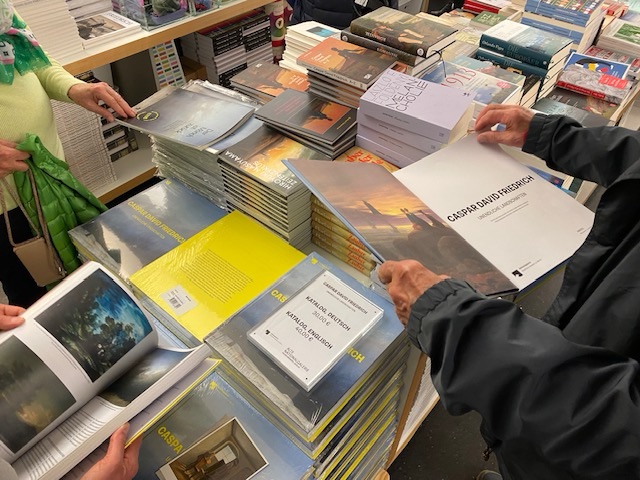
The “Alte Nationalgalerie” celebrates the 250th birthday of Caspar David Friedrich in Berlin. With a considerable effort to unite in one exhibition many paintings and drawings that stem from other collections of public and private origins. This particularly remarkable as a section of the exhibition is devoted to paintings that were intended originally to be seen next to each other (compare catalogue p. 233). Comparing 2 images from the same painter evolve into a narrative. This raises curiosity as in some instances the 2 paintings do not treat the same subject. Your very own interpretations and associations will make for an individual journey through the sheer endless spaces. The exhibition allows to grasp some of the many questions posed by the period of enlightenment not only in Germany. After “God is dead” what will happen? How is mankind defined? What is its relationship to nature? Are we just left alone or what comes after individualism? Even for painters, much like scientists, it is just as important to pose the right questions. Leaving the exhibition with more questions than answers will put you in the “Berlin state of mind” of 200 years ago. Greiswald, Dresden, Rügen and Copenhagen as well as nearby mountains were influential locations and landscapes for Caspar David Friedrich. Berlin 1906 „Jahrhundert Ausstellung“ made him famous again, despite decades of being forgotten. Yet another question to ponder and wonder about. An additional merit of the exhibition is the section on painting techniques and the use of his sketches and drawings for the preparation of the oil paintings. The final riddle to be solved is the price differential between the German and English version of the catalog in the bookshop next to the usual merchandising props.

Photos Exhibit

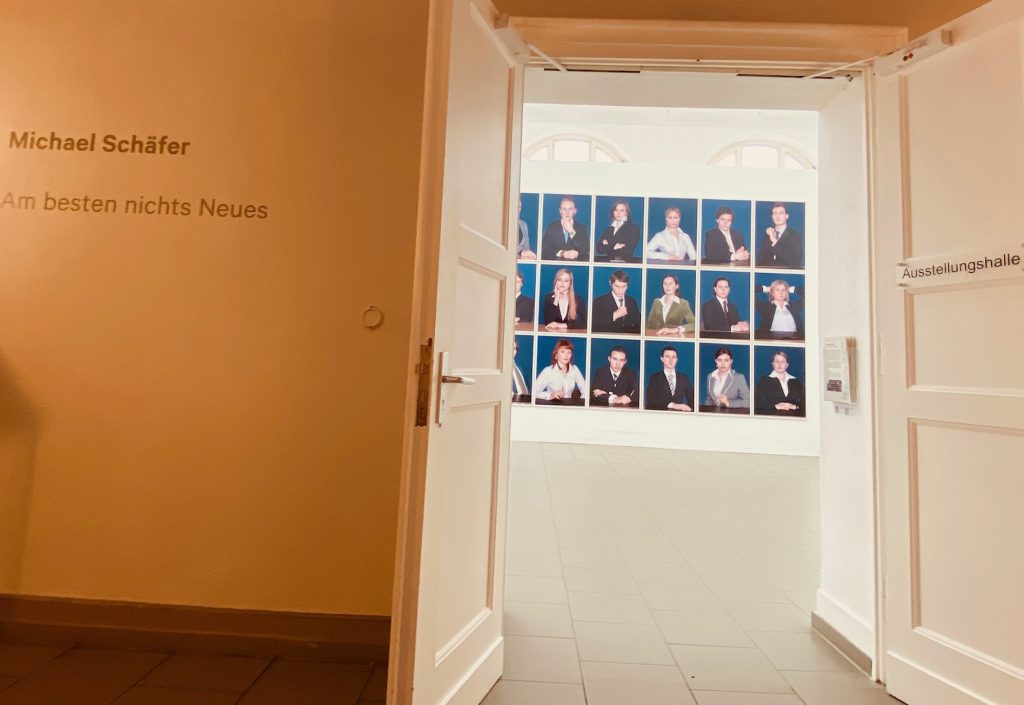
Our usual expectation of an exhibition of photography is to look at photos at a wall. Sometimes there is more it. The Exhibition Space at the “Haus am Kleistpark” features Michael Schäfer who attempts to go a bit beyond these traditional forms. In the works of photo cubes on water surfaces “2021_57”, or a dice floating on the waves of oceans, the video representation of his photographs takes the assembled images beyond their flat 2D surface. However, the 2D representation is at the origin, then transformed into a 3D dice, which then is animated as a 4D format. Moving beyond the flat screen image takes photography into the 21st century.
His work “Les acteurs 1-26” from 2007 is shown at the entry hall of the exhibition. It shows pupils of a class at an elite school who deem themselves in leadership roles in the near future. Is it acting? Is it projection into a future role they are likely to take on. They represent stereotypes, of course, but some are pretty convincing in these roles already. Some others still seem to reflect on what they are doing there. Even acting these roles, they are aware of the meaning of social rank and class in society. Without having read the sociologist Bourdieu, all are aware of the fine, little elements of distinction as they have evolved over time. We could teach an interesting sociology class in this exhibition.

Family Kafka

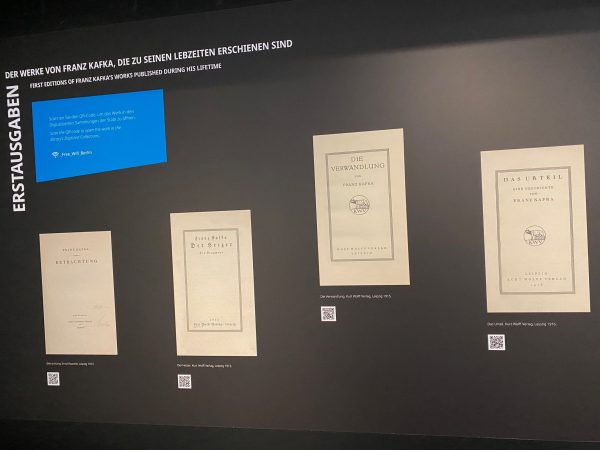
100 years after Franz Kafka’s death nearly all facets of his life and writings have been analyzed. The archives of the editor Wagenbach and the publishing house have now opened an exhibition at the “Stabi Ost” in Berlin adding a family picture book description of Kafka’s life (Curator Hans-Gerd Koch). This is of interest because Kafka himself had written an extensive letter to his father (Brief an den Vater) in which he tries to understand his intricate relationship with his father and other family members.
Nowadays, some people would try to analyze Kafka’s life through the parapsychological technique of family constellations. The far-reaching and pan-European family networks of the Kafka (father) and Löwy (mother) families were more than just an excellent source of inspiration. 2 younger brothers died in their first year. 3 younger sisters followed more traditional evolutionary patterns within families. The television series on Kafka’s life add to the understanding of his sources of inspiration and “parallel worlds” he created and lived in. The exceptional “fictionalization” of his own life and existence in the spirit of André Breton’s surrealism remains a milestone in the history of literature.
Kafka himself thought he was not really “instagrammable”at the time, but his image has reached and still reaches millions of people (Link to Picture archive). He himself would probably have defended the thesis that the most powerful images are within us. … and they are hard to escape from.
(Image from Exposition in Staatsbibliothek Berlin 2024-4, QR-code links to reading in originals!)

Opera Politics

We know that sports and international politics have ample links. This holds true for Opera performances, either due to the way they are presented or due to the content of the libretto. The opera Jeanne d’Arc (Giovanna  de Arco, Jungfrau von Orléans) by Guiseppe Verdi was composed in 1844 and had its Premiere at La Scala in Milano 1845. The libretto is based on the drama written by the playwriter Friedrich Schiller. Later in the 19th century musical pieces followed that dealt with the court judging Jeanne d’Arc. The opera by Verdi creates a strong female voice and character which outperforms men around her. Obviously, she was and remains for many a quasi-mythological heroine. In short, this constitutes great plots for drama and operas. This is centuries old despite the rare occasions of more recent performances of Jeanne d’Arc in form of Verdi’s opera or other forms.
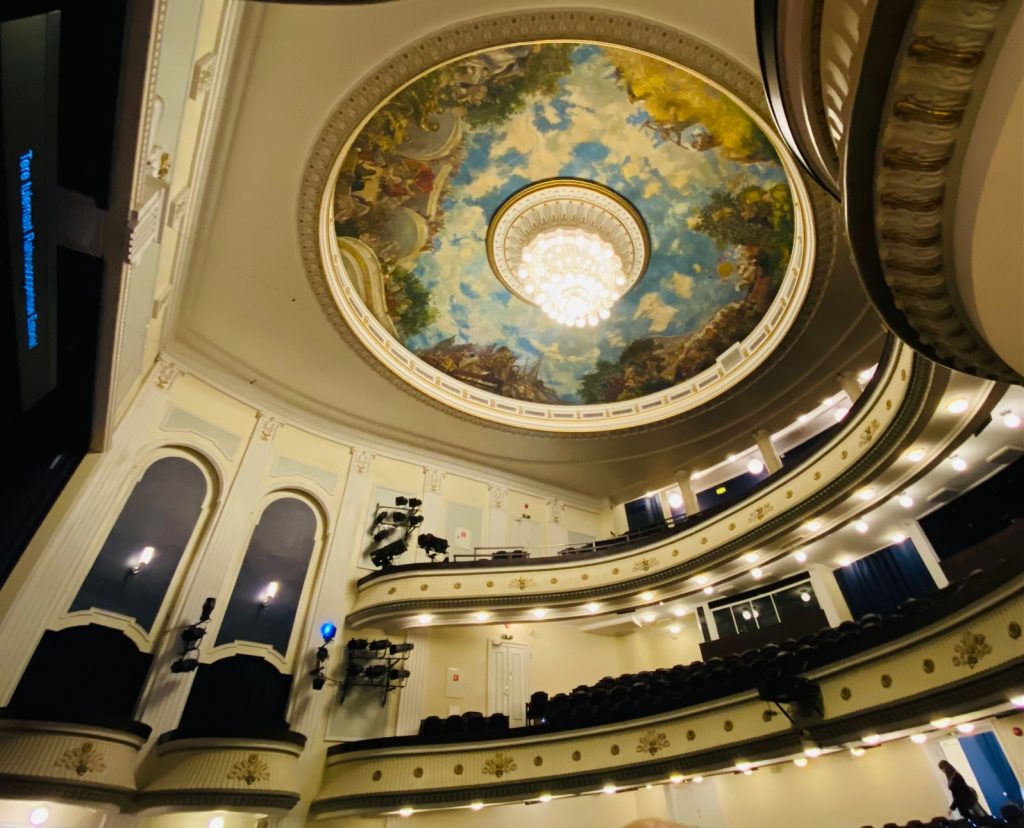
The Opera as arena of politics is currently tested in the Opera at Tallinn Estonia. Due to the aggression and occupation of Ukranian territory by Russia the plot of Jeanne d’Arc regained another European location of potential application. Ukraine pushed back the Russian invasion and struggles to win back its territory from the invaders. The performance of the Opera recreates an impressive Jeanne d’Arc in the person of Elena Brazhnyk who was trained at the National Tchaikovsky Music Academy of Ukraine. The evening inspired hope in many respects. Talents from Ukraine or trained in Ukraine reach out into to the world. Similarly, we have much reason to be inspired by courageous acts. Operas do politics. “Bravi”, as they say in Italian.
(Image: Opera Tallinn-Estonia2024-4-18)

Puppets Museum

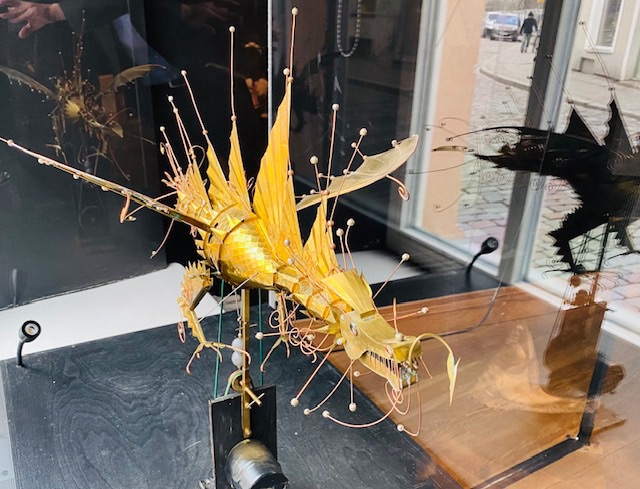
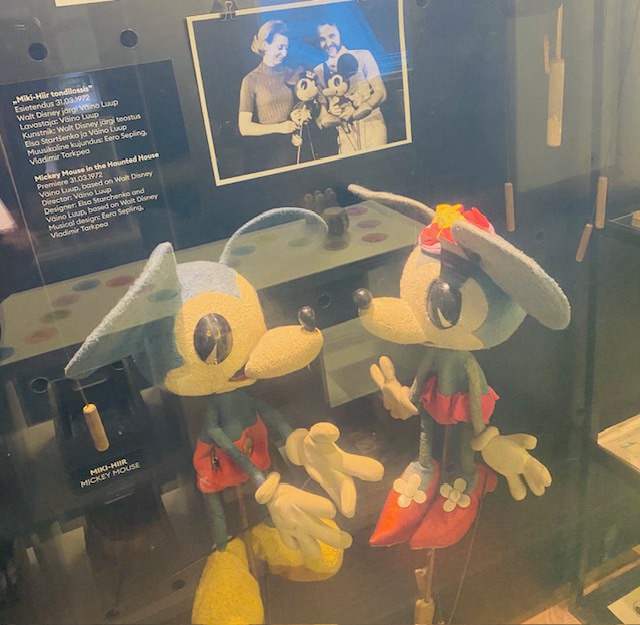
The puppet theatre is still a tiny part of the theatre world. The century old tradition has roots in all cultures across the globe. The Puppet Theatre Museum in Tallinn has a fine selection of puppets to perform theatre pieces from India, China, Indonesia and Europe. Storytelling is part of humanity and learning through narratives distinguishes us from other species. Religious traditions have appropriated these techniques just as modern performing arts. From the carnival tradition of using masks not only children adore playing with characters. The famous founder of the Estonian Puppet Theatre has his small monument outside the historic building in the old town, but a big puppet theatre with 400 seats. The adventures of Jules Verne have been played there just as most well known operas or children’s tales. Puppets comment on puppets (Mickey Mouse) just as they take on political debates. The forthcoming piece on the Ministry of Solutions sounds promising indeed. We envy the puppets that have a Ministry of Solutions rather than lots of ministries and ministers but no solutions.