Ideal City

Ideal City

Even beyond humans the issue of what constitutes the ideal city is a matter of historical as well as experimental significance. Science has recently uncovered a city like organization of habitats in the Amazon region (Link Science.org). The organization of the Greek city states has been the model for the development of democratic ideation. The Roman imperialism has thrived through the splendor of its cities and city lifestyle. No surprise that this continues to be a constant concern for humanity.
Rapid urbanization continues in Africa and Asia. Europe also struggles to keep pace with infrastructure development in every growing cities. Whereas the ideal city in the early Italian Renaissance was imagined without trees, we witness a renewed interest to bring back nature-like environments and architecture back into cities. Combining the best of 2 worlds seems possible. Redesigning inner cities remains a continuous challenge. It is much more than thinking about bricks and mortar. It is mostly about how we want to live, work and communicate together. Therefore, it concerns all of us. Paintings help us along in our ideation about where and how we want to live together. The linear views of the Renaissance appear hardly convenient after the experience of the 20th century.
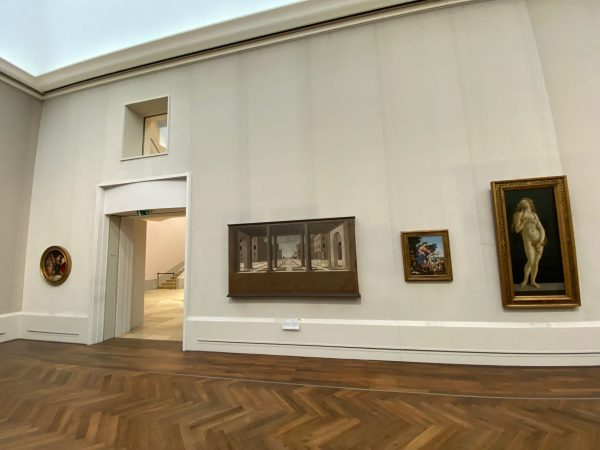
(Image Gemäldegalerie Berlin, 2024-1, Raum XVIII, Ident Nr. 1615 “Ideal city” from ca 1490 attributed to Francesco di Giogio Martini and next to well-known ideal “Venus” painting by Sandro Botticelli 1490).
Flotow CH

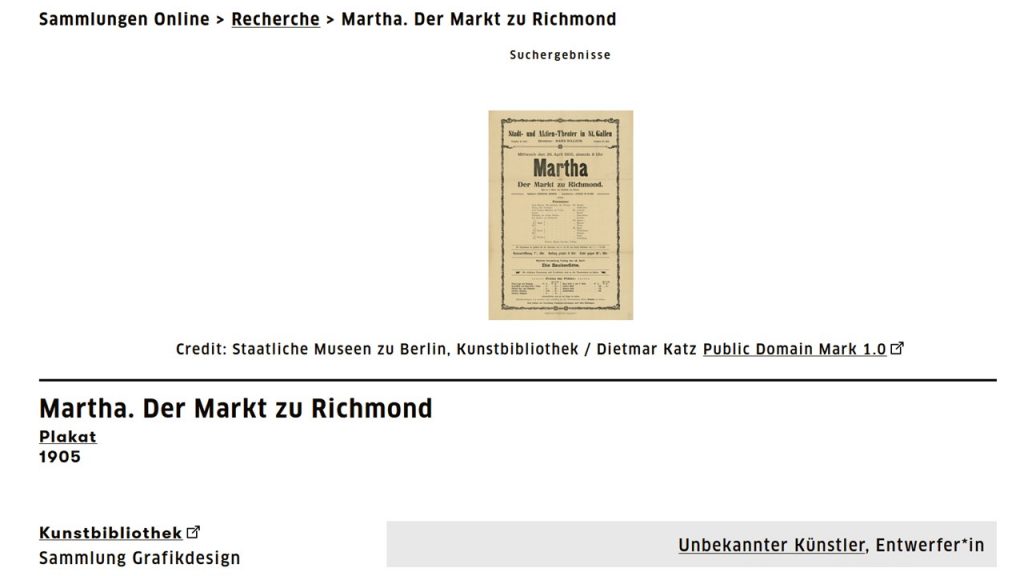
Noch 20 Jahre nach seinem Tod wurde Friedrich von Flotow recht prominent aufgeführt. Im Stadt- und Aktien- Theater der Stadt St. Gallen stand seine Oper “Martha” an einem Mittwoch 26.4.1905 auf dem Programm (Anfang 8 Uhr präzis), gefolgt von Mozarts Zauberflöte 2 Tage später.  Was für eine Konkurrenz. Das Plakat zur Aufführung ist in der Digitalen Bibliothek der Kunstbibliothek in Berlin anzusehen (Link).
Die Geschichte des Theaters in St. Gallen ist aus ökonomischen,  gesellschaftlichen und architektonischen Gründen interessant. Das Tagblatt berichtete in 2007 über den Abriss der historischen Städte und den sehr verspäteten Neubau einer moderneren, größeren und wirtschaftlicheren Spielstätte. Damals zu Beginn des 20. Jahrhunderts schon standen populäre Werke wie die Martha und die Zauberflöte auf dem Spielplan. Die Aktionäre des Stadt- und Aktien- Theaters der Stadt St. Gallen haben wohl schon immer etwas mehr auf das Geld geschaut, auch wenn es um Kunst geht. Mehr Zuschauende und Zuhörende ist demokratisch und nebenbei gut für’s Geschäft. Der Abriss war beklagenswerter Weise im Jahr 1971. Ein Neubau an anderem Ort startete bereits 1968. Dieser Bau musste ebenfalls nach 40 Jahren Spielzeit grundsaniert oder abgerissen werden.  Heute findet sich darin ein lebhaftes Programm mit Musicals als ausgezeichnetem Schwerpunkt und beispielsweise des Theaterstücks „Gott“ von Ferdinand von Schirach . Die Stadt und die Aktionäre sind wohl aus der finanziellen Verantwortung, aber das Kanton St.Gallen und der Lotteriefond sind eingesprungen. Bildquelle und Großansicht Kunstbibliothek SPK Berlin.

Stock taking

From time to time it is necessary to take stock of production and to review the material that has accumulated. As I have been working in archives, official book depositories and libraries for years, it comes almost naturally to deal with questions of how to keep track of all that content. Digital solutions are excellent devices in this regard. I do not have to deal with digitalisation, a huge issue for all historic archives and many recent small museums as well. I have to deal with backups at regular instances. To be sure, each engineer will assure you, better make a backup of your backup … . Yes, I do this as well. Now the ultimate backup of digital work is ? Got it, a printed copy of your digital work. The best advice I received on this comes from a computer magazine “ct” gadget mug with imprint advocating “No backup, no mercy“. To facilitate my printed archive I start with monthly collections of blog entries (Link to pdf-file December 2023 ->Brainstorming 23-12). The simple conversion yields 63 pages, a printer friendly version 56. Hence the expected yearly volume (60*12) will be somewhere near 720 pages. That is for the archive only or in case my eyes do no longer support online reading on screens for too long.
Digital archives have, of course, many other advantages. It is possible to reassemble my collection of entries by subject through a more thorough editing. Specific edited volumes will surface from this, which I have in my mind but only careful long-term followers of the entries might see already. Political economy and sociology are obvious candidates. Public health, labour, the world of arts and music could constitute other edited volumes. Lots of branches grow out of the trunk of content.

Poster Design

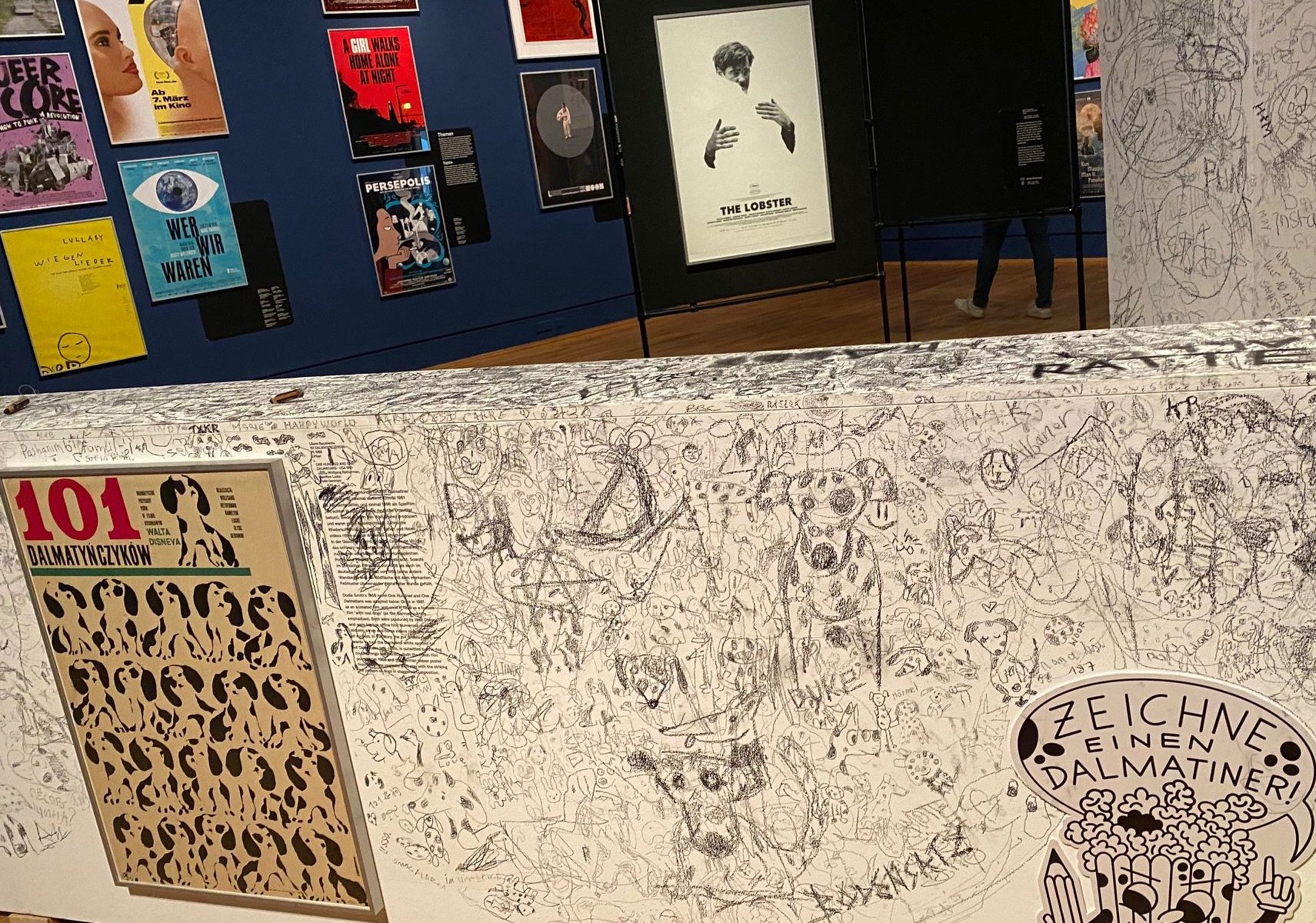
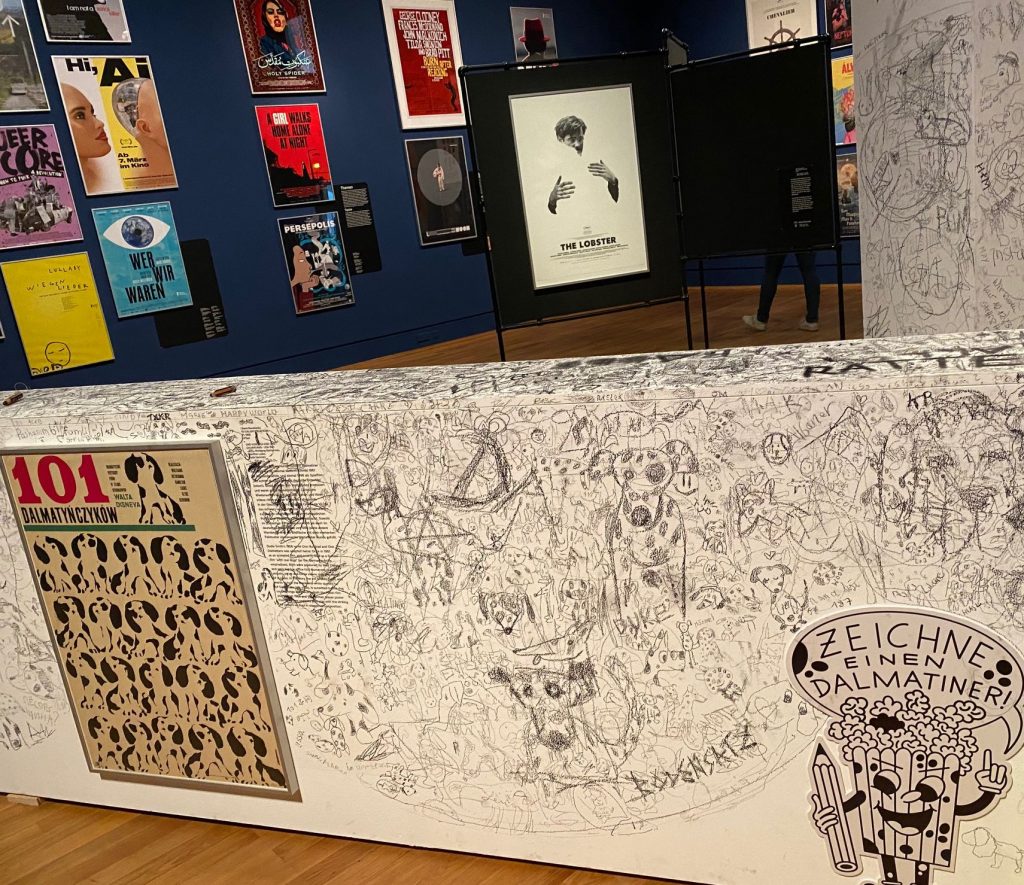
The effective use of posters in visual communication is a specific craft. Artists have been associated with poster design for more than a century. Cinemas continue this practice. For each movie produced there is an announcement posted in print or digital form. In combination with the Berlinale 2024 film festival the Kunstbibliothek in Berlin shows milestones of the history of movies and their representations in form of posters. Besides the historical approach there are many hints how to interpret the design language of posters throughout the 20th century. The encouragement to try to produce one yourself not only reserved to children is an additional activating feature of the exhibition (Link here). Cats and dogs will always catch attention and the playful approach chosen might be a start into a graphic design interest. Overall the exhibition offers a low threshold entry into the world of art and design. Instagramable image on posters evolved into short preview clips, just like instagram paved the way to tiktok video clips. In retrospect posters also provide shortcuts for our memories to recall whole movies that have accompanied us growing up and growing older.

Ethics of posterity

We have not inherited the earth from our ancestors; we are borrowing it from our descendants. (native American saying). Adeline Johns-Putra (2019) states this early in her book on “Climate change and the novel.” Her concern is how to think and write about the ethics of posterity. Approaches of ethics in the sense of parental care (for the planet) or motherhood environmentalism do not suffice in view of overpopulation of our planet. Shifting our identity away from toxic production and consumption is advocated in many novels. Science and science fiction offer many dystopian examples.
De Shalit (1995) wrote early on why posterity matters. It is not the standard of living of contemporaries that matters but we should consider ourselves as a part of a transgenerational community. The time horizon of our decisions matters. In pursuing arguments by John Rawls who re-established a contractionalist perspective on justice, we have to include future generations into our contractual obligations. Following this approach we might arrive at Brundtland’s perspective on the ethics of posterity which is called sufficientarianism in opposition to simple utilitarianism. In sufficientarianism we owe future generations a just and decent living or at least the possibility to have similar starting conditions. Shifting beyond the apocalyptic view of environmental disasters Adeline Johns-Putra (2019) brings to the forefront that we have to substantially lengthen  our time horizon both for consequences of climate change and for dealing with it, albeit the fact that most destructive practices operate much faster than the re-establishing of greater biodiversity.
P.S.:Thanks to the curators of the Lese Lounge Staatsbibliothek Berlin for ease of access to the literature.
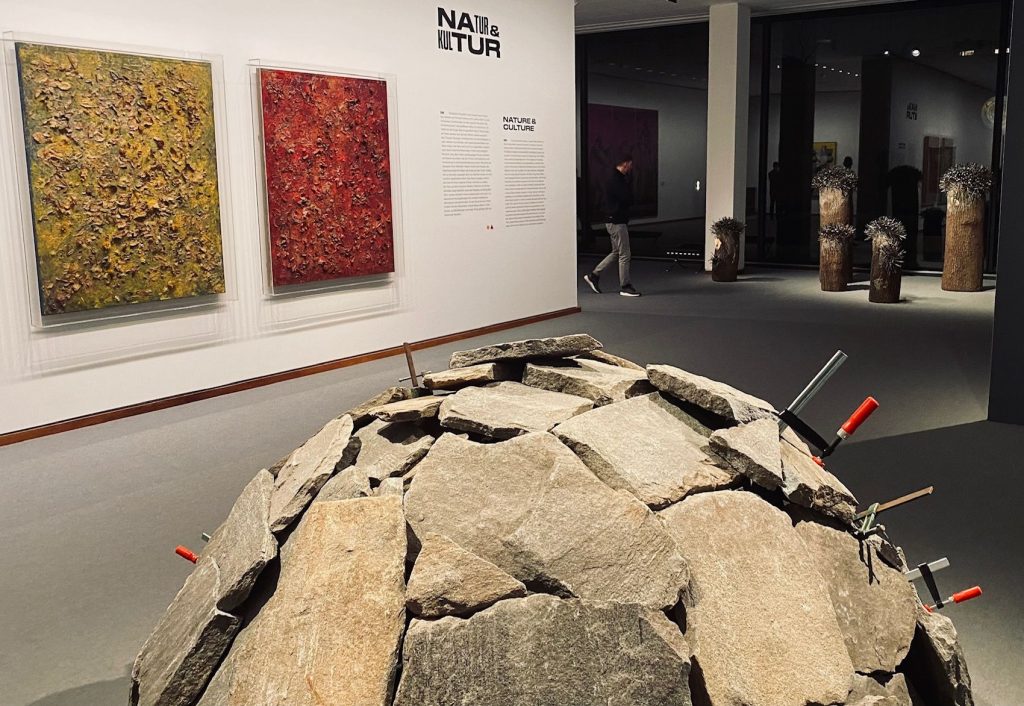
(Image: Natur & Kultur in “Extreme tension: Art between Politics and Society” Collection of the Nationalgalerie 1945-2000“. 2024-1)

Time6

Time that has passed, is subject to evalution and re-evaluation. Our memories work continuously on various representations of time in our mind. Memory management is one such example. Artist have also coined a phrase for a particular form of time management. “The assault of the present on the rest of time”  Alexander Kluge had chosen this as the title of a movie on film-making and Katya Inozemtseva had chosen this as the title for the exhibition in Berlin 2023-24. Pieces of art may serve as evidence in court as testimony for war crimes. This is one of the challenging issues of this exhibition. The present uses evidence from the past to illustrate what happened. Re-interpretations are part of this process as well. It is not too rare, that in the present a reframing of the past may occur. Some try to alter the representation of the past (crimes committed long ago) as of minor importance. Such intentional misrepresentations represent the assault of the present on the past. It may eqaually be attempted to limit the scope of future options. The diesel engine is not the best technical solution for mobility of 8 billion people living on this planet in 2024. The reflection on time needs to take care of the “back shadow” and “forward shadow” of the present. On the individual level, today’s action might be largely determined by past events, experiences and transitions, but they pre-determine to some extent also future events.
Conditionalities shall occur and accumulate, for some more than for others. Some call this scar-effects, others the narrowing down of options. Life reviews may apply a reframing exercise, sometimes even to liberate yourself from the boundaries of the past to open up new or more future options. The time-space subject which ranges from experience to fiction is the matter of literature and cinema. Some people seem to choose to live in a fictional world for whatever reasons.  Rather than a linear concept of time, the artists appear to imagine time in some form of a spiral: from the present you turn backwards in time to project yourself into the future. Maybe, we are caught up in some unresolved narration of the past, to try another projection into a different future. We see one or many movies grow out of this fictionalisation of the present.
The study of the life course remains a formidable challenge. Testing the reliability of sources to separate fact from fiction has overriding importance. Biographies derived from facebook or instagram entries over decades have to deal with this fictionalisation of the self even more than we were used to from other data sources. The basic challenge of the representation of time throughout the life course, however, remains the same.
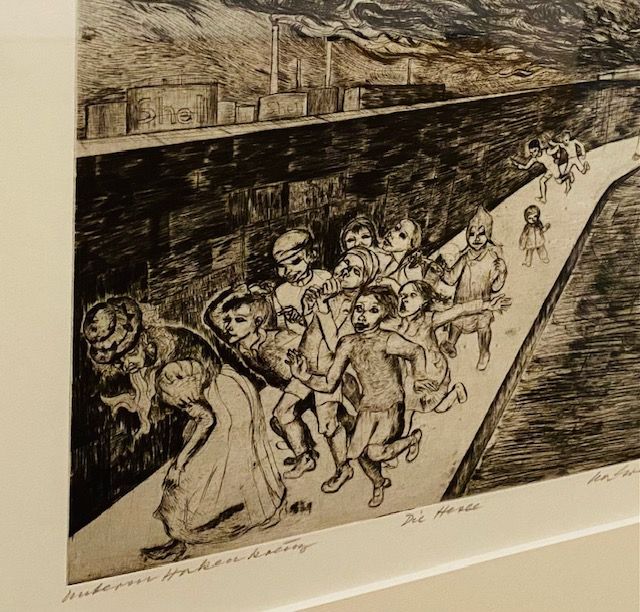
Source: Kluge, A., Evans, T., & Liebman, S. (1990). The Assault of the Present on the Rest of Time. New German Critique, 49, 11–22. https://doi.org/10.2307/488371 (Image: Exhibition Brücke Museum, Lea Grundig, Unterm Hakenkreuz: die Hexe 1935, Zentrum für verfolgte Künste, Solingen).

Richter

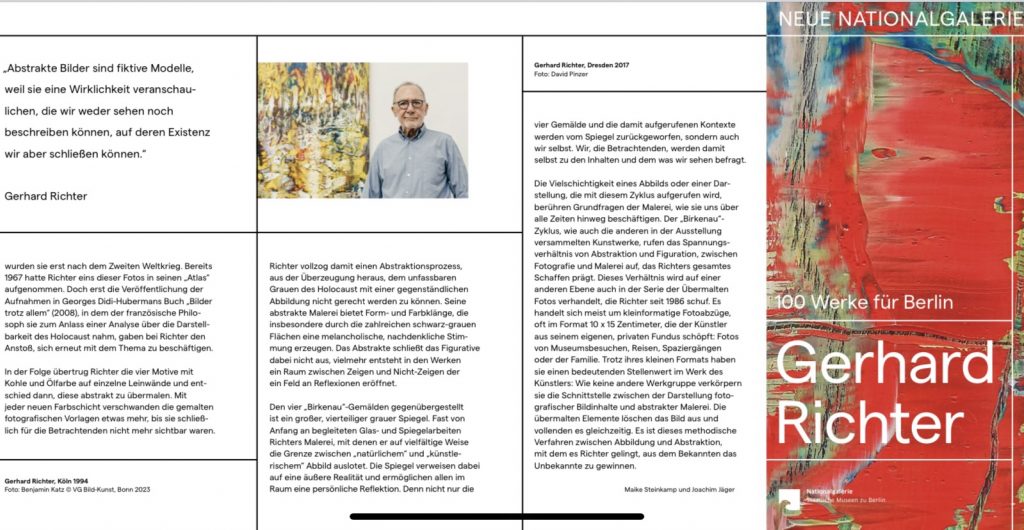
Gerhard Richter ist kein Richter. The painter Gerhard Richter is of cause not a judge. But somehow he is. In the representation of his 100 works for Berlin in the Neue Nationalgalerie he judges the horror beyond imagination of the Nazi concentration camps, reflects on the role of his own family in this and finds his own way to deal with it. Colors cover the black and white documentary fotos as if a new imaginary has to grow again to overcome the painful memories. He deals with the most difficult kind of confrontation with evil in an astonishing way. The horror as underlying fact remains present in our mind and at the same time we open up to light at the end of the tunnel and abundance of colors. Color is the way forward. Underneath, we tend to or like to forget about the many killing fields. Scratch a bit on the surface and you’ll find lots of unresolved issues again. All those fancy colors might just cover up the demons of the past and present. Maybe this is a grossly biased interpretation of his Auschwitz Buchenwald series of paintings, but only time will tell if we are successful in 2024+ to stem the tide of right wing extremism (again).

Neue Nationalgalerie Berlin 2024-1

Museum Orga

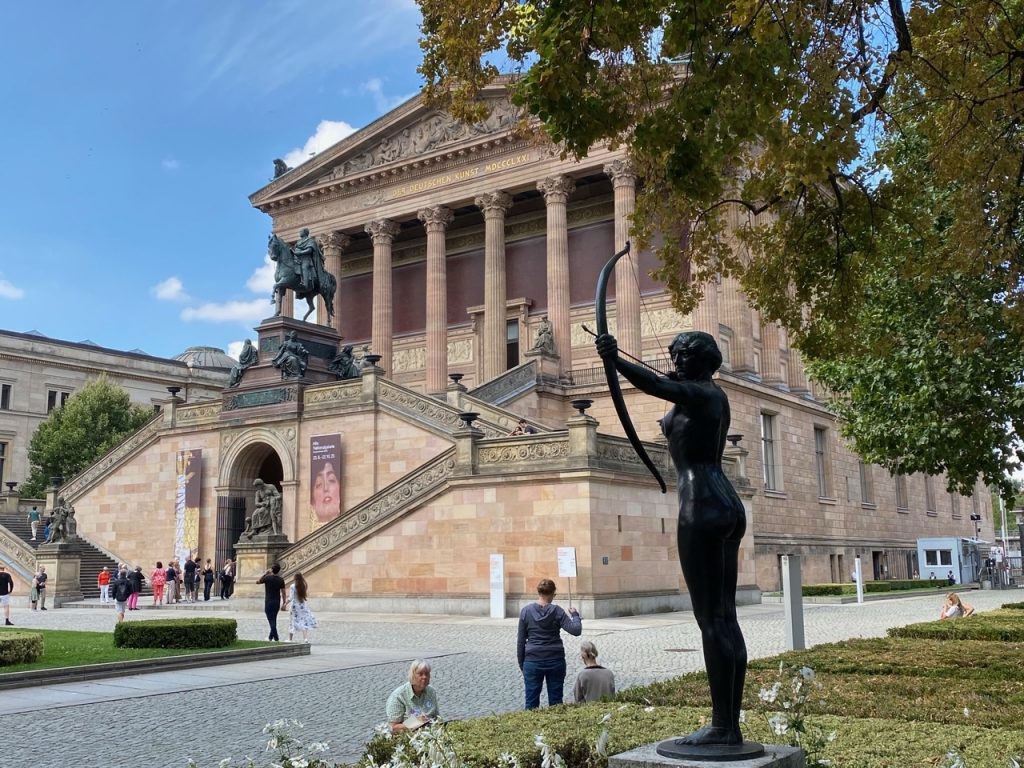
The cathedrals of modernity are under permanent scrutiny. The discussion in Germany was sparked by a recommendation of the scientific advisory council to the federal government (Wissenschaftsrat) to separate the Prussian heritage museums and institutions (SPK) in Berlin into separate entities that have higher autonomy to shape their individual profiles. Too much hierarchy blocks innovation and openness to new approaches that might not fit an overriding instance of decision making. The arts and sciences as well as their libraries need substantial degrees of freedom to flourish in their specific cultural and societal environment. The same discussion is currently occupying Paris and France, since overall the visitors after the Covid-19 crises have not yet come back to the same levels. Digitalization has opened up new opportunities and potentials to reach new audiences. This needed new resources even at a time of budget constraints. Museums have started to take their social functions more seriously besides their role to preserve the cultural heritage. Economic thinking in terms of scarcity of art works, competition between museums and cities or countries for tourism have entered the stages as well. Prices of entry and quantities of visitors have become additional concerns in the organization of the museum landscape. A lot to cope with and to balance multiple policy targets. Accessibility of those treasures is key. Opening up to broader audiences is costly but crucial to provide the justification of the public funds allocated. Great to see more complementary private investment in this exciting field. The prominent archers in front of the Berlin museums have moved ahead into a new round of competition in the organization of museums.

Flotow Hund

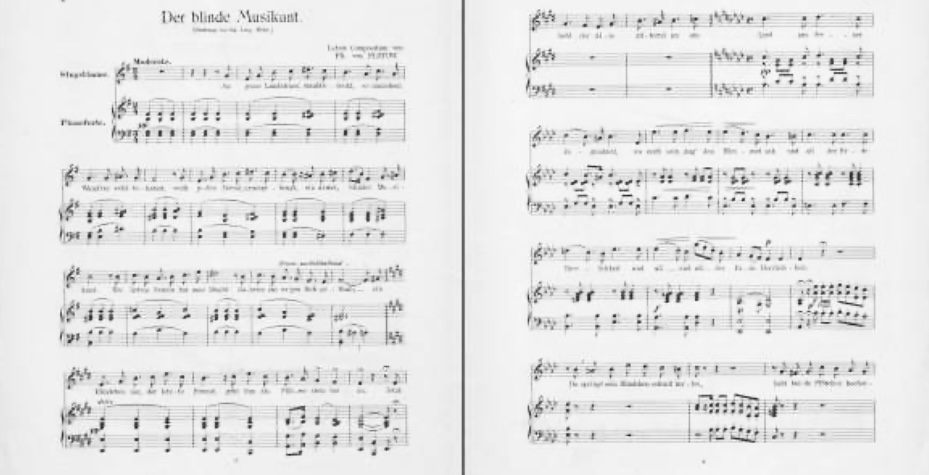
F. v. Flotow hat seine letzten Jahre in Darmstadt verbracht. Seine Kompositionen und Aufführungen seiner Werke haben ihm ein hinreichendes Auskommen an seinem Lebensabend ermöglicht. Als früher Streiter für Autorenrechte an kompositorischer Arbeit wusste er wie wichtig solche Bezüge im höheren Alter waren. Für viele in der damaligen Gesellschaft galten Komponierende als Künstler mit hohem Verarmungsrisiko. Bis kurz vor seinem Tod hat Flotow noch neue Werke komponiert. Das Lied „Der blinde Musikant“ von 1884 wird als das letzte veröffentlichte Werk bezeichnet. Den sterbenden Musiker begleitet sein Hund, der ebenfalls Teil der Aufführungspraxis war. Die einleitende und abschließende Komposition im 3/4 Takt hat eine tänzerische fast humoristische Prägung, die vielleicht eine Anspielung auf seinen Hit „Die letzte Rose“ darstellt. Eine irische Melodie zu einem vom Hund getanzten Begräbnis hätte eine opernhafte Leichtigkeit erzeugt, die nicht vielen im Angesicht des Todes gegönnt ist. Hunde mag ich nicht, aber den da schon. Flotow vertraute sicherlich selbst bis zu seinem Tod auf die Macht der Musik. Sich selbst dabei nicht zu ernst zu nehmen, nachdem sein Freund Jacques Offenbach kürzlich vorher verstorben war, lässt sich hier erkennen. Da bleibt ein gewisser ironischer Begleitton oder zumindest ein Augenzwinkern. (Image Digitale Sammlung der Staatsbibliothek Berlin Auszug Flotow Musiknoten 2024-1).

Survivors

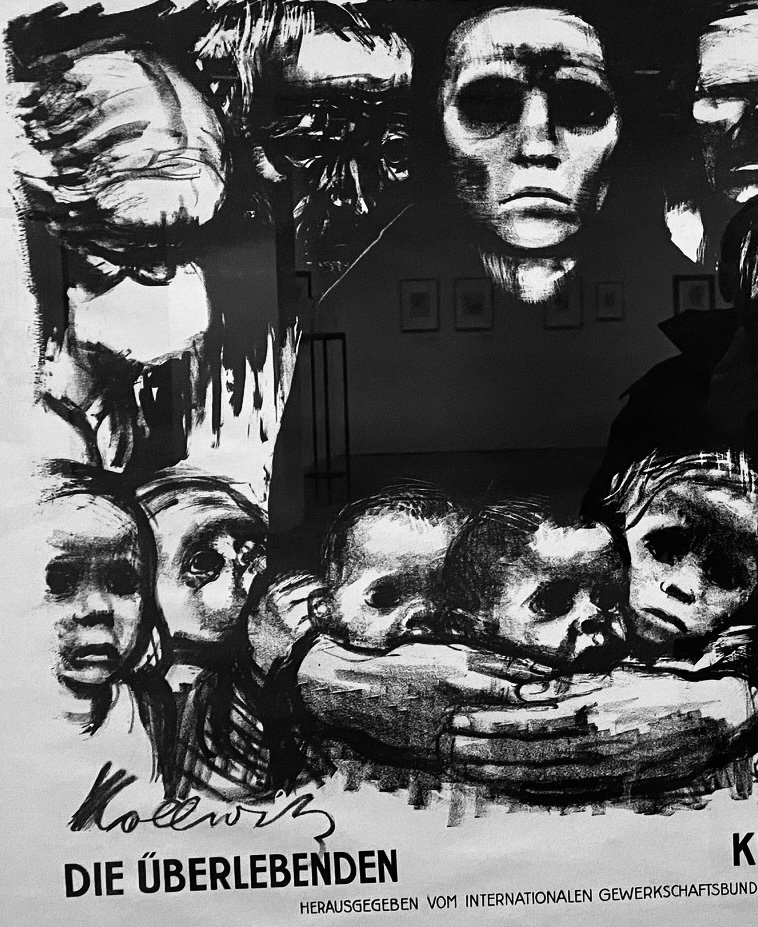
The survivors of war have experienced unimaginable violence and suffering. Once fighting ends the horrors of war live on in the memories of all survivors irrespective of which side they have been fighting. Almost all have lost someone or something they cherished before the outbreak of war. Käthe Kollwitz has depicted these horrific experiences in many examples of her art work. They speak to us today just as much as in the past. Berlin is a great place to learn more about her art. The image below is an extract from a drawing in poster form edited by the International Trade Union Federation from 1923 shown in the Brücke Museum in Berlin Dahlem in 2023.