We start to analyze the impact of AI on our behavior. It is an important question to be aware of not only how we interact with AI (Link), but also what effect the use of AI (disclosed or not) will have on our social behavior. Knowing that AI is used might change our willingness to cooperate or increase or decrease pro-social behavior. The use of AI in form of an algorithm to select job candidates might introduce a specific bias, but it can equally be constructed to favour certain criteria in the selection of candidates. The choice of criteria becomes more important in this process and the process of choosing those criteria.
Next comes the question whether the announcement includes as information that AI will be used in the selection process. This can be interpreted by some that a “more objective” procedure might be applied, whereas other persons interpret this signal as bad sign of an anonymous process and lack of compassion prevalent in the organization focused mostly on efficiency of procedures. Fabian Dvorak, Regina Stumpf et al. (2024) demonstrate with experimental evidence from various forms of games (prisoner’s dilemma, binary trust game, ultimatum game) that a a whole range of outcomes is negatively affected (trust, cooperation, coordination and fairness). This has serious consequences for society. The social fabric might worsen if AI is widely applied. Even or particularly the undisclosed use of AI already shows up as a lack of trust in the majority of persons in these experiments.
In sum, we are likely to change our behavior if we suspect AI is involved the selection process or content creation. This should be a serious warning to all sorts of content producing media, science, public and private organizations. It feels a bit like with microplastic or PFAS. At the beginning we did not take it seriously and then before long AI is likely to be everywhere without us knowing or aware of the use. (Image taken on Frankfurt book fair 2017-10!)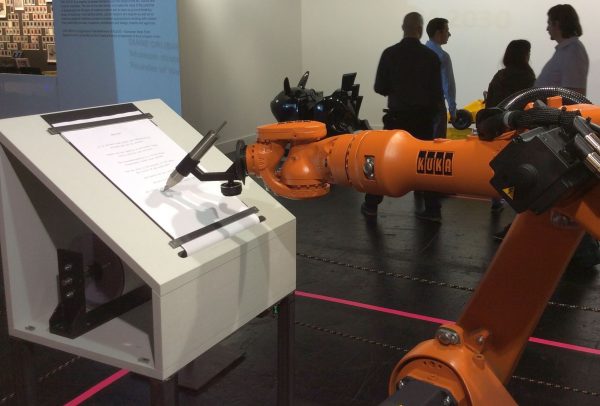
West Europe
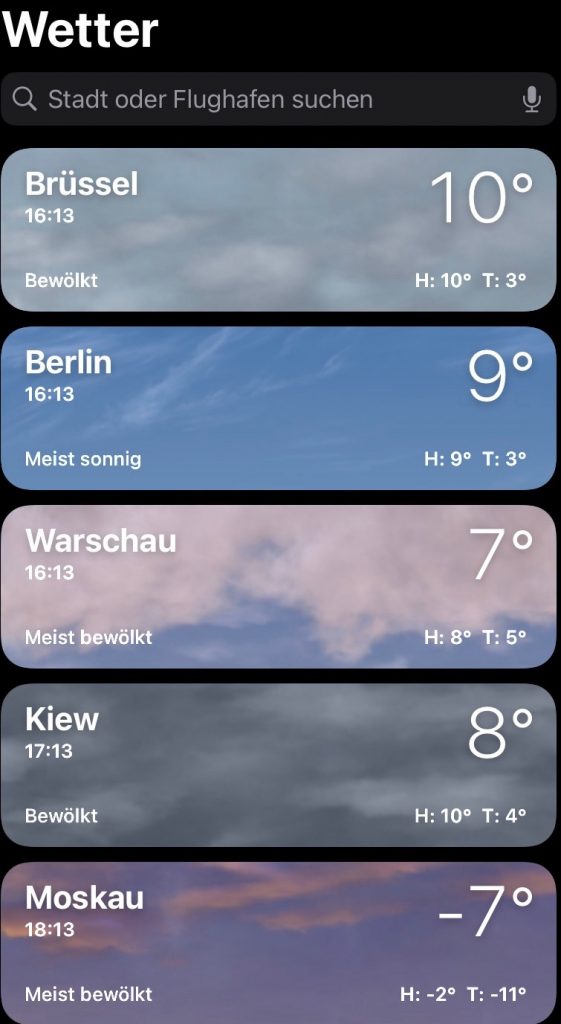
There has been a shift of political borders in Eastern Europe. Russia has been trying to shift its border further to the West by brutal force attacking Ukraine. Political defence and military action have managed to preserve western values in Ukraine. On the 13th of February 2024 the meteorological data confirm a clear belonging of Ukraine to the western climatic conditions. Temperatures in Kiev are very similar to the western hemisphere and very different from the cold in Moscow. This is just a little detail or coincidence but it bears a nice resemblance to the political weather currently in Europe. It is by all means much colder in Moscow than in western Europe. The time and the climate are a changing.
Stroke
A stroke is a very serious medical incident. The NIH defines it in easy language as the the moment in which “blood flow to the brain is blocked or there is sudden bleeding in the brain“. Thanks to a European HORIZON project forecasting models are produced to estimate the likely incidence until the year 2050 by age and gender within Europe. The good news is major regional imbalances of incidence and mortality have been reduced and will likely be reduced across Europe. The challenge remains the aging of societies which necessitates to address the issue of strokes in each single region of the European Union. We know that the shorter the time to treat a stroke immediately after its occurrence, the better the survival chances and the better the prognosis for (partial) recovery.
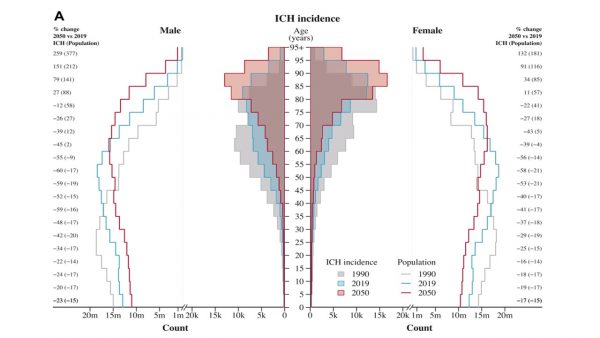
In the US the widespread use of blood thinners which tripled over 30 years has not lead to the reduction of intracerebral hemorrhage (Link to studies). High blood pressure and arhythmic heart beat are major causes of this often disabling medical event. The study by Wafa et al. (2024) uses age-pyramids to demonstrate the effect that as European societies are aging the incidence of intracerebral haemorrhage occurs with increasing age and even more so for women than men of 80 years and older.
Prevention of high blood pressure through walking or careful endurance exercise seems even more indicated for an aging society.
Image below from Wafa et al. (2024), The Lancet Regional Health, Europe.
Publishing2024
With new channels of publishing online the publishing world continues to change. Scientific research moves also online and the reach of audiences has become a much more important factor in evaluation of success. Elite circles of in-groups publishing and quoting each other have a harder time to survive. It is a form of democratising the world of research which is by very large amounts financed by public budgets. Public radio and television now start to feel the heat as so-called influencers, some working independently, challenge the world of traditional journalism. The good news is that there are many more people active to produce news and entertainment and the two separate worlds become more and more integrated. Young people who have left the “official” media world, engage with their own peer groups and make their voices heard and more influential. The quality of the provision of information is, however, a matter of concern. Audiences will have to check even more carefully than before which sources can be trusted. This is not an easy task. Speed of spreading information becomes an additional factor. It has always been like that, but the rhythm of a daily or weekly newspaper was very different from the publishing and consumption of news and information today.
The second factor that has drastically changed is the influence of “external” influences and information as well as disinformation campaigns that have an impact on “internal” reporting and commenting. What used to be the world of professional journalists has become an accessible possibility for many more than journalists. Publishing has become a very different world from the printing days and yet printing remains one important channel of publishing. (Link to own edited volumes of blog post for printing here).
Previously, we prepared the manuscript in paper, nowadays this seems to move online and the edited and sometimes corrected versions will be published in print later on. The challenge to science and journalism is ticking. Not accepting that there is a serious challenge is no solution either. (Image from Exposition “Books that made Europe”, 2016)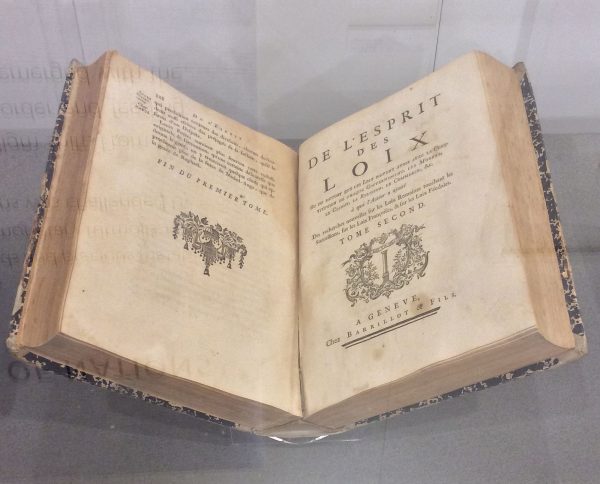
Greedflation
The teaching of economics and socioeconomic policies has to deal with the topics around inflation and economic inequality for centuries. Greedflation has become a newly coined term for the rise of inflation due to greedy firms who use a window of opportunity to achieve extra profit margins or windfall profits. At a time of perceived price rises in many sectors, sectors that have no cost increases might still try to push prices higher simply because almost everybody else does so. Higher profits then show up in the reporting season of enterprises quoted at the stock exchange and the increase in inequality between wage earners and shareholders will rise. Greedflation is a summary term for it. The ECB European Central Bank has mentioned this and Reuters has reported on it as well end of June 2023. Since then a wait and see strategy has been adopted. Now in February 2024 we witness the wider spread of extraordinary profits of big firms not only in the fossil energy sector but also bog banks. The economies and societies suffer huge losses and a massive redistribution of capital. Subsidies introduced to lower the shock of the coronavirus crisis and the Russian aggression are unpopular to be scaled back. Employees and their trade unions have a hard time negotiating adequate wage increases whereas most companies use the momentum of seemingly general price rises to push profit margins. The translation of this mechanism to the political economy risks to jeopardize the support for capitalism and market forces in general. Another wave of increasing inequality endangers the survival of democratic societies. Countries with only a short experience of the functioning of market economies are at a particular risk. Germany’s decline into dictatorship in the 1930s after the severe economic crisis should be remembered as a major threat. Greedflation is a very serious and very real threat which we have to address with economic and social policies rather than waiting until the European elections have passed. Time to act, the thinking has been done. Evidence accumulates to make the political case.
Force of dependency
Drugs have their particular strength in creating dependency. This is well known for tobacco or alcohol. Helping people to overcome the forces of dependency has its merits. At the same time it is big business. Vaping instead of smoking might be a way out one dependence but into another one. In the end it is an empirical question how many persons can escape the force of dependency of both types. Important to test the probability to get rid of the dependency altogether. With respect to hard, life-threatening drugs like Nitazene the death toll keeps rising in the UK. In the latter case changing the dependency is already a success. The sustainable deflection from drug dependency has to address underlying issues and health hazards. It is a rather individual issue. Society wide evaluation studies need to inform the debate also about placebo effects. The force of dependency might not only be physiological but psychological or linked to the social environment. All these potential effects have to be carefully sorted out before simple pseudo-solutions are implemented. Even the price and availability of drugs is part of the overall equation to solve the force of dependency.

Forced Labor 2024
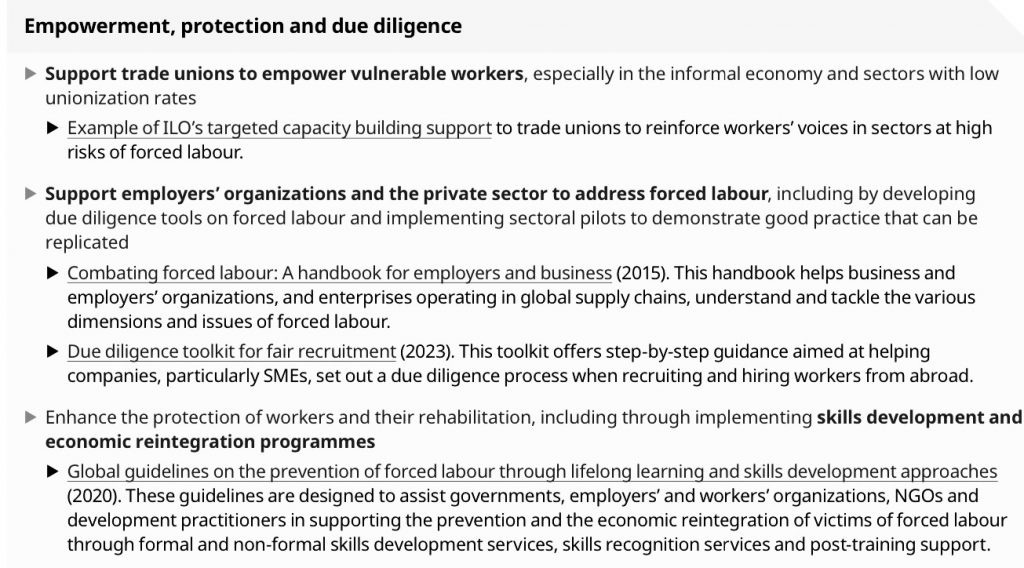
Thanks to the ILO we have recent data on forced labor across the globe. At the time when the EU struggles to tighten the rules on decent supply chains, it is important to draw attention to the already reversed trend that worldwide forced labor is on the rise again. According to latest report by the ILO 27.6 million women, men and children were in forced labor at any day of the year 2021. This is even about 10% more than 5 years before in 2016. The fact sheet from ILO highlights the region that are practicing it the most but mentions at the same time that no region in the world has completely wiped out this criminal activity. Despite the SDGs containing a goal to eradicate forced labor by 2025 for children there is little hope that this will be reached. Controlling supply chains of the rich countries could be an important factor in identifying the states or companies which built their production model on forced labor. The fight against this practice is an enduring challenge. We cannot allow to shun away from the thorny issue. The price for labor is only one argument in the reasons for the persistence of forced labor, migration is also a force at work. This asks for specific solutions to country-specific or sector-specific problems. It is a global responsibility but needs partnerships across continents to reach better outcomes in the interests of humanity. Some countries like Germany have a historical debt to invest more than others.
Skill loss
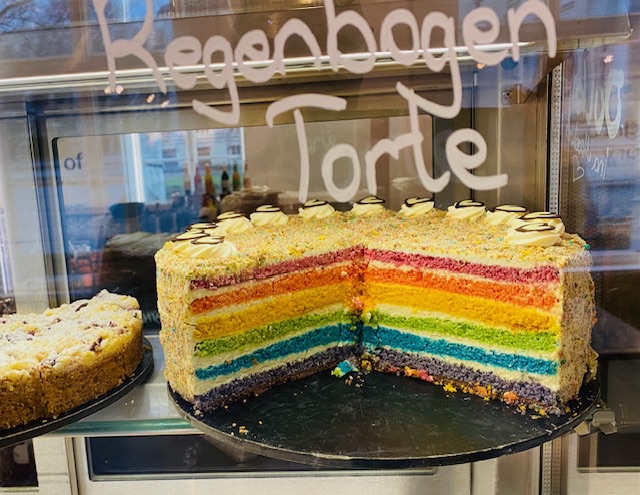
There is a sense of skill loss in watching the trends to increase comfort. We all use washing machines and maybe dishwashers. Households can save a lot of time by using those machines. Some porcelain and clothes should not be left to the machines. The need to organize traditional washing routines is almost forgotten after 1-2 generations. The same holds for many technical skills. Bicycle and car repairs or small repairs of electrical appliances are delegated to specialized repair shops. Not using or having learned these skills puts you in a form of dependency and at the risk to pay a price for specializing on other skills. Find out and focus on what you are best at. This has been the mantra of economic theory since Adam Smith. The potential value of satisfaction with an own production rather than a bought product is frequently acknowledged for baking cakes yourself rather than simply buying one in a shop. The same rationale holds for many other skills. Autonomy of own production with possibility to improve or repair are forgotten values. The have become a luxury item or a necessity for persons lacking financial spending power to buy products from others. Many skills will be lost rapidly because products have become so cheap to replace or order for home delivery. Industrial production is desperately searching for skilled persons but losing skills is pervasive at the same time. Public schools and academic curricula will not be able to stand the tide of pervasive skill loss.
NS München
The documentation centre in Munich of the National Socialist time and crimes has an encompassing collection of documents on display. As the prime centre of the Fascist movement in Germany in the 1920s and early 1930s Munich was the home to party elites from the first months of the movement that became the epicentre of the dehumanizing policies we can follow throughout Europe (Topography of Terror, Berlin). The historical research in both documentation centres complement each other in many respects. Understanding the beginnings of the Fascist movement remains important to today. Fascist movements need to be stopped before terror even against neighbours takes hold. Records of the evolution of membership, men’s and women’s movements later on, attacks of the parliamentary system all have to be taken into account to be able to stem the Fascist tide at that time and today again.
“Materializing” is the current exhibition, which can be visited in part online. How can we deal with the “Shoah“? Polish artist have a long experience to cope and deal with the unimaginable horrors, the Nazis and the “Wehrmacht” committed in Poland.
Memories have to find a place, a piece, a word, a sound or an emotion to materialize. In that sense yesterday joins today and is preserved as learning and warning for tomorrow.
In addition to the much discussed “Wehrmachtsausstellung“, the work by Jochen Böhler provides ample evidence to debunk the myths of war without crime. This holds for the past and for the present. (Source: Böhler, 2019, S. 59-68, Die Wehrmacht und die Verbrechen an der Zivilbevölkerung während des deutschen Überfalls auf Polen 1939, Image below). 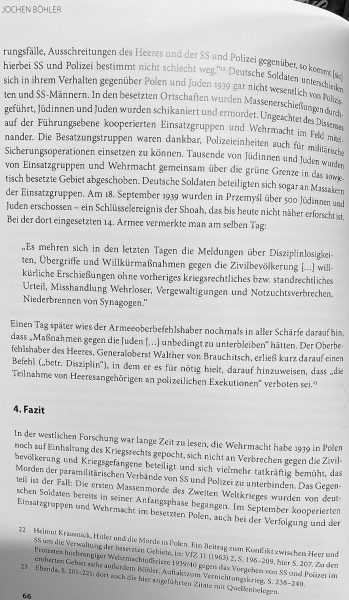
Topography of Terror
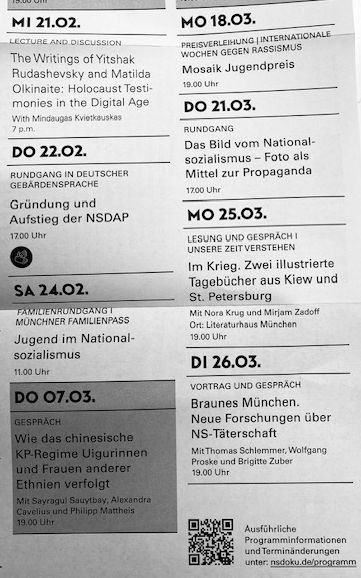
The documentation centre “Topography of Terror” in the middle of Berlin is easy to reach. The “Potsdamer Platz” is nearby and so is the “Kulturforum” with its galeries, museums and the “Berliner Philharmonie”. The documentation centre gives easy access to the historical evolution of Nazi-dictatorship from the earl beginnings, the horrific terror spread across Europe and first insights into the prosecution of criminal acts in the immediate post-war period. The Beyond the exhibition with audio-guide there is an easily accessible specialized library for personal or scientific research. The accompanying program of book presentations and discussions (image below) complements the busy show rooms. The external “walk through history” allows to grasp the main proceedings of the terror regime.
For special interest or research questions it is a very useful starting point. Hours in the library have to complement the research. Good to see that so many students walk through the documentation centre not only in groups from the neighbouring schools. The interest to understand when and how the terror started will allow us to better guard against those right-wing extremists who use a lot of techniques of propaganda well known and exposed in this documentation centre of the terror of the Nazi-regime.