Schubert Franz

Franz Schubert hatte ein kurzes Leben. Geboren in 1797 verstarb er bereits mit 31 Jahren. Seine Lieder werden nach wie vor viel gehört und aufgeführt. Mit 10 Jahren wurde er vom Hofkapellmeister Salieri in Wien bereits als Sängerknabe in die Hofkapelle aufgenommen, was gleichzeitig die Aufnahme ins Stadtkonvikt bedeutete. Seine Lieder wie „Der Lindenbaum“, „Die Forelle“ oder „Die Rose“ blieben lange Standards in den Musiksalons und Konzerthallen. Beeindruckend bleibt auch die Schaffenskraft des jungen Schuberts der in seinem „Liederjahr“ 150 Lieder komponierte. Seine Versuche eine Oper zu schreiben waren weniger erfolgreich. Das hat dann fast 200 Jahre gebraucht bis die Pariser Opéra Comique diesen Traum Schuberts erfüllt hat. Vielleicht hatte es etwas mit seinem Lehrmeister Salieri zu tun oder den hohen Ansprüchen der Wiener Klassik in der damaligen Zeit. Friedrich von Flotow hatte den Weg nach Paris gefunden und war sich der Bedeutung des ausdrucksstarken Librettos bewusst. Orchestrierung zur Verpackung der Lieder wird dabei bedeutsam. Flotow sollte das Oeuvre Schuberts bekannt gewesen sein. Erfolge mit eingängigen Melodien haben beide feiern können. Jeder auf seine Weise.
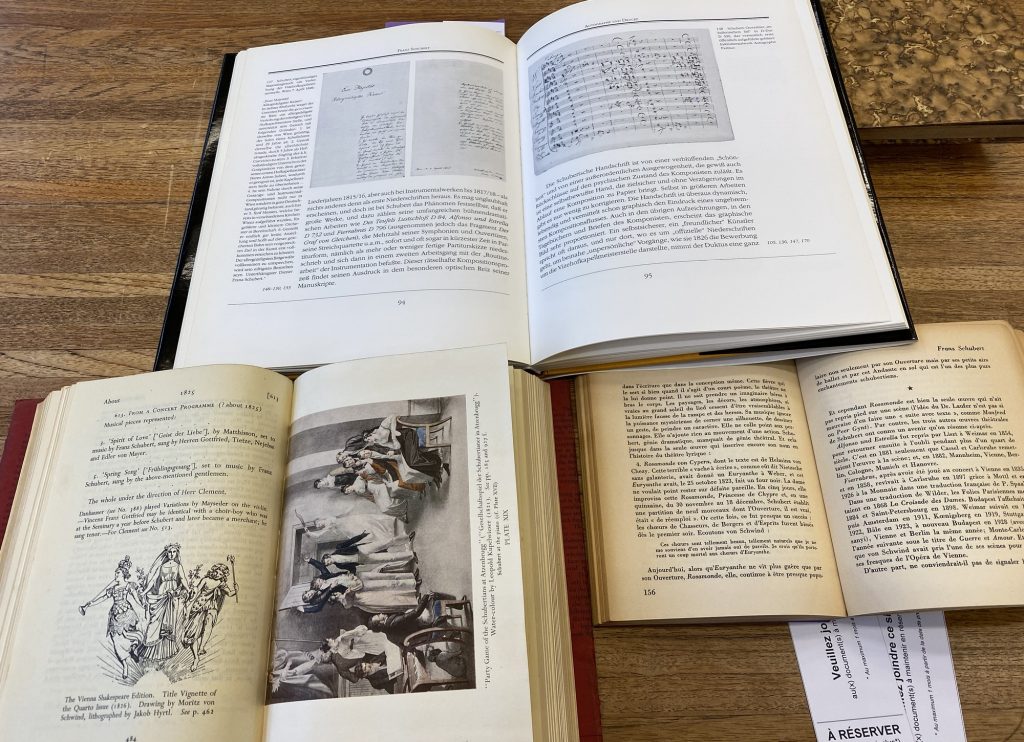
Schubert Sekundärliteratur

Cancer Inequality

Inequality is a hugely important topic for societies. Inequality has many different dimensions and differential longitudinal patterns. New data in this field of social research are helpful to inform on possible ways to prevent increasing inequality. At the same time, it is important to reflect on factors that may reduce inequality in and between societies. Inequality in health is both an outcome of inequality experienced during previous stages of the life course as well as a factor in causing inequality in the evolution of the life course later on. Disentangling the factors is a difficult research issue.
A first descriptive pattern across Europe allows to get a snapshot impression of the status quo as a first indication of what health inequality looks like. Cancer is a major cause of mortality across Europe and by 2045 it is estimated to be the leading cause of mortality.
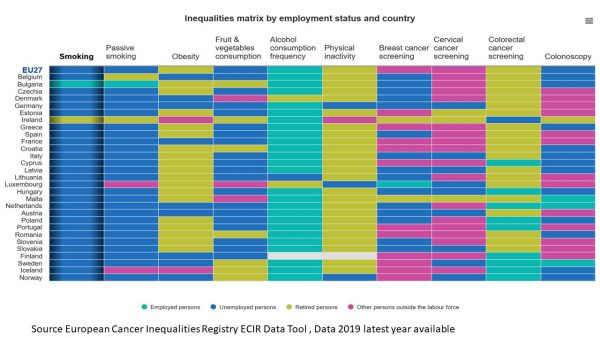
Without precisely analyzing the causal factors the overview across European countries allows to give a first impression on fields that need more policy attention and more in depth studies. The European Cancer Inequalities Registry and the ECIR Data Tool is based on data from 2019  (Link). The overview matrix by employment status reveals the highest prevalence of smoking among the unemployed (followed by the employed, not shown in figure) and the frequency of alcohol consumption is highest among the employed. Low physical activity is mostly prevalent among the retired.  This has consequences for cancer and gives hints to how an intensified prevention may work.
The OECD report (Link) based on these data and additional country case studies and policy data base reiterates the known prevention recommendations: Reduce smoking, alcohol consumption, air pollution as well as more physical activity. The dimensions of inequality are gender, age, employment status and most of years spent in education. The curing of cancer also suffers from inequities as to the amount of and access to screening of cancer. Cost coverage and shortages in medical personnel add to multiple sources of inequality in treatment of cancer within countries by regions and between nation states. The Lancet Public Health editorial contributes to the spread of the awareness among scientists and the medical profession.
(Image: ECIR data tool download 2024-2-22)

Processed food

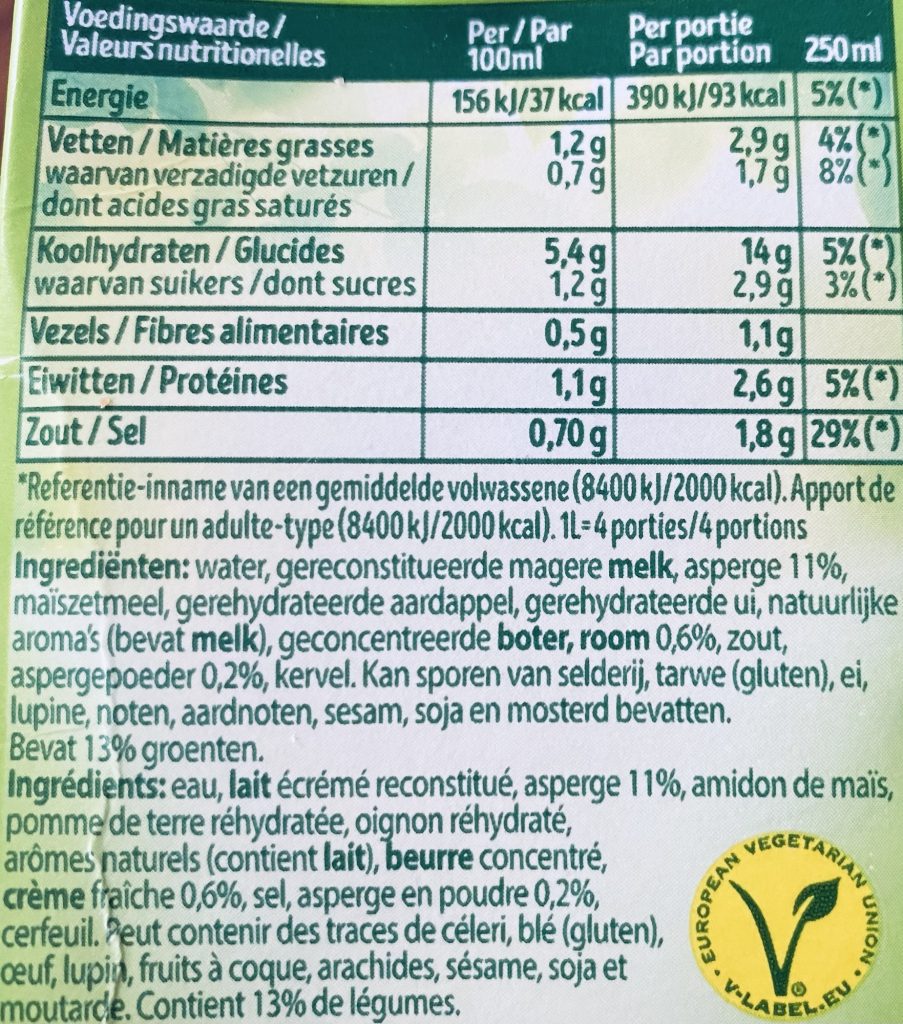
We eat a lot of pre-processed food. Our busy work schedules allow us to take only short breaks for meals in order to get more work done while in office or at work in general. The intensification of work has reached the next level and we move from pre-processed food to ultra-processed foods (UPFs). In medical journals and nutrition recommendations the warnings to not eat too much ultra-processed foods are abundant. The signs of obesity in societies reach higher levels from year to year. Especially younger people seem to be at higher risks to consume a lot of ultra-processed foods. Freisling et al. highlight the “risk of multimorbidity of cancer and cardiometabolic diseases” due to UPFs. The discussion between scientists is a lot on which UPFs are most harmful (beyond animal origin or and artificially sweetened beverages) and/or whether it is the combination of UPFs that additionally increases the danger of UPFs. Preventing the “too much of each” is probably the safest recommendation. Being able to read the nutrition information on the labels is already a difficult task. Just making the information abundant and very small print discourages most efforts to compare across products. Learning about basic human needs like food has never been more difficult. Combined with “shrinkflation” we have a hard time to make informed choices of what to buy and eat. There are many hurdles to overcome for a healthy meal.

AI and Behavior

We start to analyze the impact of AI on our behavior. It is an important question to be aware of not only how we interact with AI (Link), but also what effect the use of AI (disclosed or not) will have on our social behavior. Knowing that AI is used might change our willingness to cooperate or increase or decrease pro-social behavior. The use of AI in form of an algorithm to select job candidates might introduce a specific bias, but it can equally be constructed to favour certain criteria in the selection of candidates. The choice of criteria becomes more important in this process and the process of choosing those criteria.
Next comes the question whether the announcement includes as information that AI will be used in the selection process. This can be interpreted by some that a “more objective” procedure might be applied, whereas other persons interpret this signal as bad sign of an anonymous process and lack of compassion prevalent in the organization focused mostly on efficiency of procedures.  Fabian Dvorak, Regina Stumpf et al. (2024) demonstrate with experimental evidence from various forms of games (prisoner’s dilemma, binary trust game, ultimatum game) that a a whole range of outcomes is negatively affected (trust, cooperation, coordination and fairness). This has serious consequences for society. The social fabric might worsen if AI is widely applied. Even or particularly the undisclosed use of AI already shows up as a lack of trust in the majority of persons in these experiments.
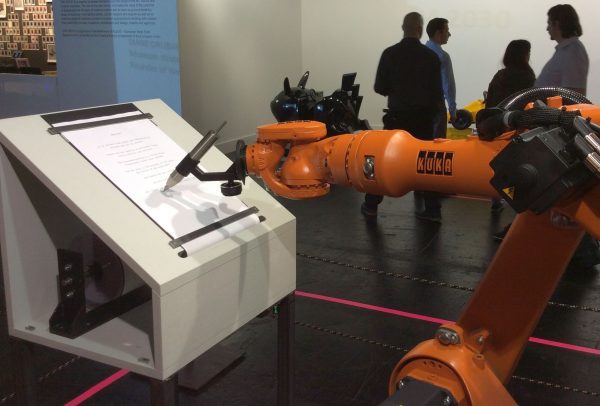
In sum, we are likely to change our behavior if we suspect AI is involved the selection process or content creation. This should be a serious warning to all sorts of content producing media, science, public and private organizations. It feels a bit like with  microplastic or PFAS. At the beginning we did not take it seriously and then before long AI is likely to be everywhere without us knowing or aware of the use. (Image taken on Frankfurt book fair 2017-10!)

Stroke

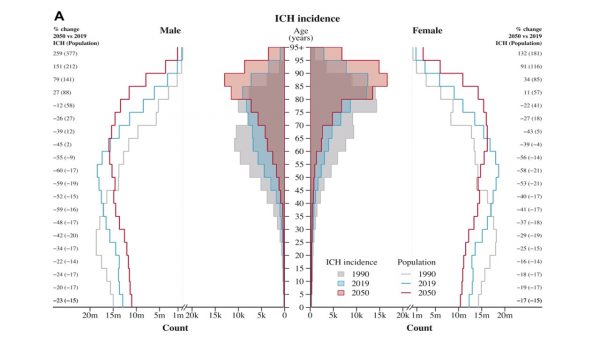
A stroke is a very serious medical incident. The NIH defines it in easy language as the the moment in which “blood flow to the brain is blocked or there is sudden bleeding in the brain“. Thanks to a European HORIZON project  forecasting models are produced to estimate the likely incidence until the year 2050 by age and gender within Europe. The good news is major regional imbalances of incidence and mortality have been reduced and will likely be reduced across Europe. The challenge remains the aging of societies which necessitates to address the issue of strokes in each single region of the European Union. We know that the shorter the time to treat a stroke immediately after its occurrence, the better the survival chances and the better the prognosis for (partial) recovery.
In the US the widespread use of blood thinners which tripled over 30 years has not lead to the reduction of intracerebral hemorrhage (Link to studies). High blood pressure and arhythmic heart beat are major causes of this often disabling medical event. The study by Wafa et al. (2024) uses age-pyramids to demonstrate the effect that as European societies are aging the incidence of intracerebral haemorrhage occurs with increasing age and even more so for women than men of 80 years and older.
Prevention of high blood pressure through walking or careful endurance exercise seems even more indicated for an aging society.
Image below from Wafa et al. (2024), The Lancet Regional Health, Europe.

Greedflation

The teaching of economics and socioeconomic policies has to deal with the topics around inflation and economic inequality for centuries. Greedflation has become a newly coined term for the rise of inflation due to greedy firms who use a window of opportunity to achieve extra profit margins or windfall profits. At a time of perceived price rises in many sectors, sectors that have no cost increases might still try to push prices higher simply because almost everybody else does so. Higher profits then show up in the reporting season of enterprises quoted at the stock exchange and the increase in inequality between wage earners and shareholders will rise. Greedflation is a summary term for it. The ECB European Central Bank has mentioned this and Reuters has reported on it as well end of June 2023. Since then a wait and see strategy has been adopted. Now in February 2024 we witness the wider spread of extraordinary profits of big firms not only in the fossil energy sector but also bog banks. The economies and societies suffer huge losses and a massive redistribution of capital. Subsidies introduced to lower the shock of the coronavirus crisis and the Russian aggression are unpopular to be scaled back. Employees and their trade unions have a hard time negotiating adequate wage increases whereas most companies use the momentum of seemingly general price rises to push profit margins. The translation of this mechanism to the political economy risks to jeopardize the support for capitalism and market forces in general. Another wave of increasing inequality endangers the survival of democratic societies. Countries with only a short experience of the functioning of market economies are at a particular risk. Germany’s decline into dictatorship in the 1930s after the severe economic crisis should be remembered as a major threat. Greedflation is a very serious and very real threat which we have to address with economic and social policies rather than waiting until the European elections have passed. Time to act, the thinking has been done. Evidence accumulates to make the political case.

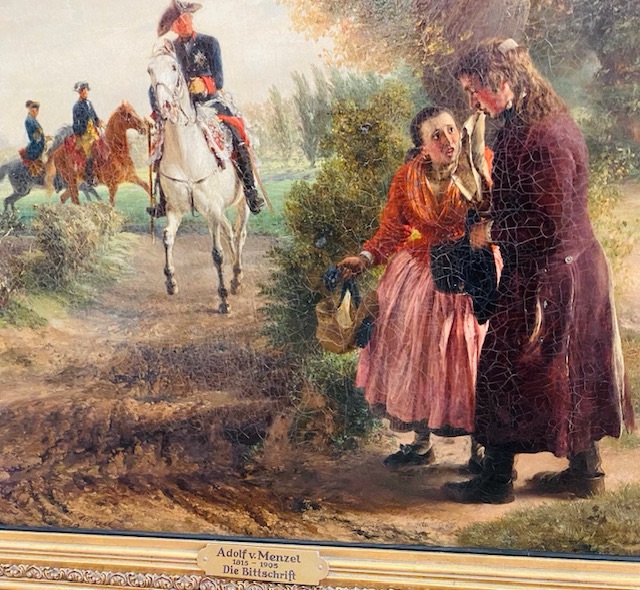
Adolf von Menzel, The Petition, Alte Nationalgalerie Berlin

Timeless Values

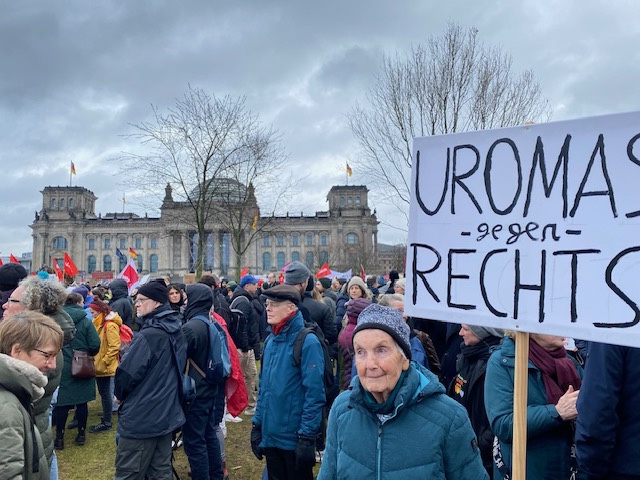
The declaration of human rights is more than 200 years old. However, the need to stand up for the defense of these rights needs many people to act accordingly. Political parties and courts are not strong enough to be the only defendants of democracy and human values. Solidarity across generations is another part of the struggle to defend democracy. In addition to the broad movement of “Omas gegen rechts”, the age distribution has been further enlarged with the “Uromas gegen rechts”. This most likely the generation with first hand life experiences from Nazi Germany and they should have reached an enlightened view of the horrors caused by the Nazi-regime. Unfortunately there are still some who continue to be prisoners in a fascist “brown” cage of mischievous memories. The great grandmother who was present at the demonstration was clear in her statement to stand up against right-wing extremism. (Image: With the permission of the lady I am happy to have evidence of the presence of super-agers at the demonstration in Berlin).

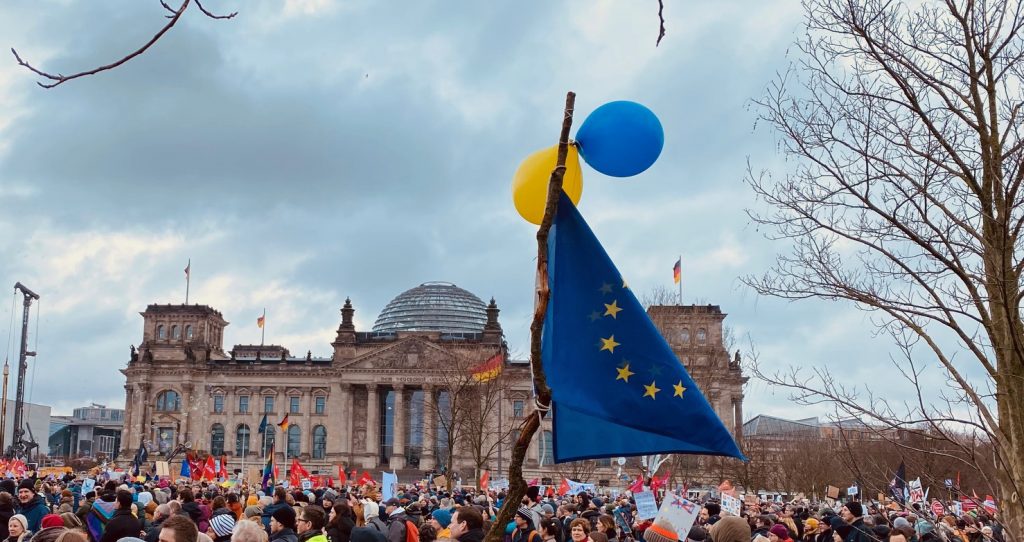
Berlin 2024-2-3. Demonstration

Fighting Fascists

On february 3rd 2024 Berlin has seen the Parliament (Bundestag in the old Reichstag building) surrounded by young and old to raise their voice against the rise of right wing extremism in Germany. The broad alliance against extremism finds grassroots support from a very broad and diverse community. 1700 organizations have joined forces to send a strong signal that they are ready to act against the inhuman propaganda and persistent hate speech. The creativity to express the discontent in clear messages is impressive. Civil society is showing that diversity offers multiple benefits to find new ways to unite people. Great that European flags and balloons in Ukrainian colors where present as well. A movement of solidarity was felt with these people and that provides a strong message for the months ahead with so many elections taking place at the local, regional, national and European levels.

Berlin 2024-2-3

Modernism

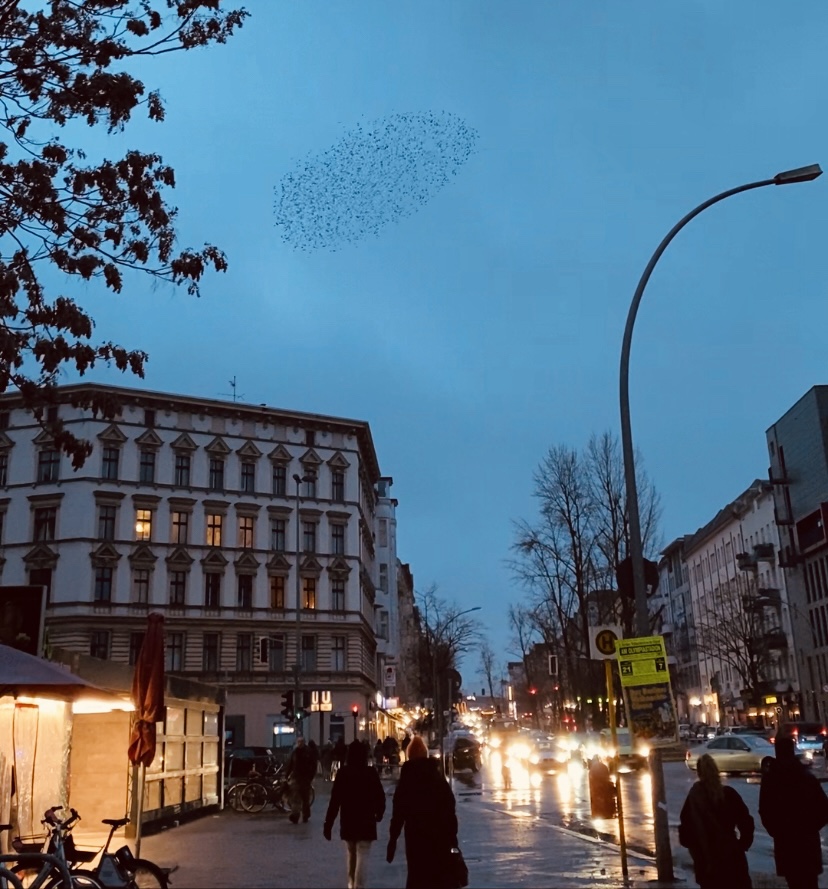
More and more people move into cities. A modern way of living is more accessible there. Besides abundant car traffic public services of transportation like buses and underground are within easy walking distance. Culture, science and education offer attractive opportunities for learning, working and leisure. Diversity is an additional asset most people appreciate of cities. The chances to live your very own way of life are much easier to achieve and thrive in as in remote or rural communities. “Birds of the same feather flock together “. It is easy to find likeminded people among a million people than among a hundred particularly if you’re a bit off the mainstream or avantgarde. The excitement of birds passing the city can reach the emotional force of Hitchcock’s famous movie “The birds”. Even in the modern world we not quite sure what these creatures are up to. Is it a swarm of drones? Are they out of control? Modernism has brought us many amenities, we have to make sure that we really are still in control.

Berlin Kleistpark 2024-1

AI and We

Research is beginning to provide empirical evidence and experimental modelling results on the widespread use of generative AI. First results by Doshi and Hauser point at the individual benefits of using artificial intelligence but the widespread use of it is likely to narrow the scope of novel content. This research is particularly interesting because it deals with the micro level to macro level aggregation effects. It is fine for me to use AI. If it becomes a mass phenomenon, we expect in sum a negative outcome for society as a whole.
The example at hand deals with the capability to innovate or to come up with novel content. As more and more texts or newspapers are published with extensive use of genAI, the real element of creation will remain the domain of humans for quite some time.
In my opinion this is due to the difficulties for algorithms to differentiate between the positive and too risky negative aspects of innovative solutions. A query for AI might ask to come up with an innovative solution for auto-mobility of short distances. A human being might propose walking due to the additional health effects the AI might propose helicopter lifts. The not so stupid machine would need a lot of additional information about circumstances to generate useful solutions. Therefore it is not surprising that sometimes public transport apps propose to walk short distances rather than waiting for “delayed or unreliable services“ they provide themselves. Personal circumstances like mobility with children, other dependents or luggage are usually beyond the scope of the information base of the algorithms.
On the other hand, if the AI knows that 50.000 persons after an event want to take public transport at the same time the indication to walk or wait solves an aggregation problem of individual preferences to adapt to available capacities. Lots of issues to solve for AI and us or better yet, us and AI.
(Image creation: AI using Microsoft Dall-E Image creator: Prompt: a person with notebook in profile and in front of 5 other persons in Office with windows 26.1.2024, 8:24 PM)