The link of maths and happiness is not straightforward. Individual accounts of a happy (euphoric) or unhappy (dismal) life are mostly referred to psychologists for treatment. The biografies (documentaries) or fictional biografies told in novels or cinema allow to trace the changing moods of the personalities over time. This resembles life course research. In happiness research social scientist ask questions like “Overall, how satisfied are you with your life“. Measured over time or coded from biografies this allows to reconstruct happiness trajectories. At this point the maths of happiness enter the stage. Long periods of observations yield interesting patterns of curved lines, rarely simple linear trajectories. Social scientist speak of within person variability in contrast to between persons variability. After all, the (short-term superior) happiness of your neighbor might simply be due to the fact that they are doing drugs.
Whatever, try to remember a bit of your high school maths and the bore to deal with “curve discussions or sketching” beyond the manifold shapes of your classmates. Lots of interesting information derives from growth or decline rates, tangent lines, stationary or inflection points. Different starting points or so-called intercepts vary between individuals as well as he potential to cross the Zero-line on one of the axes. Additionally, in geometry you would compare syncronicity of curved lines as well as forms of symmetry for the curve(s). This will simplify or comlexify your perspective on the happiness trajectories of people or characters in a novel.
We are so used to narratives or videoss with a happy end, yet we appreciate the complex trajectories and (multiple) troughs main characters have to pass. Novels teach us about tricky inflection points and subsequent trajectories as well. The maths of happiness, however, is rather simple in comparison.
(Image from Toronto District Christian High School -pdf p.207). 
Painter Sociologist
In going to a gallery and exhibition of paintings from the 17th century (Gemäldegalerie Berlin) you do not really expect to attend a class of sociology. However, this is exactly what the Flemish painter Frans Hals does with his paintings of various genres of society of his time. His sociological categories are for example unmarried young persons, married couples or pensioners living in a shared home. Other social categories of interest to him are a caregiver or, more common for the time, persons from noble or wealthy families. His painting „The Regents of the old men’s Almshouse” (ca 1660), the male pensioners home is one of his last paintings when he himself was already about 80 years old. Similar to a College of students the elderly home was run by a house father and house mother who took care of the daily living. The paintings of Frans Hals covered the entire life course with a cross-section perspective of society at his time. From few of his supporters he painted even several images moving towards a kind of longitudinal perspective on a person’s life course. Certainly, with “Oude-mannenhuis” (image below) he was interested not only in individual life courses, but of the conditions, forms or images of aging at his time. He probably was one of the first to challenge the negative stereotypes of aging.

Sports Game
Each museum in Paris gave its view on sports. There is hardly any perspective that is not represented. The link of sports to soldiers in ancient Greece or the gladiators in the Roman empire are prime examples of this. The Museum Quai Branly added an ethnographic dimension to this view showing sports traditions in African, Asian and indigenous American peoples. The bookshop of the museum added anthropological views and critical literature to the phenomenon of sport. A provocative example of critical cultural literature has in the book title the question: Is sport a game? We all have our opinions on this topic. The idea that sports remains a game is a rather naive one. Most people probably would argue that in view of the high ticket prices, sport has primarily become big business. Listings and comparisons of medals between nations have financial implications in the aftermath for disciplines and athletes. The upcoming Paralympics in Paris reframe the above question. Sports at high levels is a very serious game.

Olympic Equality
Of course, first of all the Olympic Games are about making a difference with respect to your opponent. However, there has been a thrive to achieve an equality of genders for more than 100 years as well. Women had to battle such a long time to achieve the right to participate in the Games in the same disciplines as men. For the first time in Paris2024 men and women are represented with the same amounts of athletes. Each gender is participating with 5.250 athletes and astonishing progress has been made to ensure that male and female athletes perform in the same or similar disciplines. Even if it took decades for women to run a marathon at the Olympics, the inclusion of a triathlon for women was already much more rapid.
This constitutes a real milestone in the progress towards equality in Olympics. Equal numbers of athletes is a quantitative form of inclusion, the qualitative level of inclusion remains to be accomplished. The qualitative dimension consists in the inclusion of women at equal footing in media reporting and sponsoring. On the organizational level of the IOC the organizing committee is still dominated by men and statistics on the accompanying teams of coaches, therapists and representatives a lot of progress still needs to be accomplished. Paris made already a huge difference and several exhibitions of the “cultural games” around the city during the Olympics 2024 make this point quite forcefully.
The sociology of the Olympic Games has a lot of topics. It is great to see the progress made in Paris on Olympic Equality, after all “égalité” figures prominently in the definition of modern France.
(Image: BNF 2024 exhibition “A History of Women in Sport” own translation) 
Knowledge Work
In the social sciences the term knowledge work defines the group of professions that deal with and deal in knowledge. Most of them are in academia, but there are many other professions like ICT professionals or lawyers that used to shuffle paper who now work all digital. Hence the relatively new addition to the sociological vocabulary is “mobile knowledge work”. We, and yes I am part of this group, can do our job from almost any place with a stable internet connection. Breda Gray et al. (2020, Made to work: Mobilising contemporary worklives.) highlight the importance of gender considerations when we study these new forms of work. Similarly, social class and cultures of more or less trust are thriving for independence. This will play a role in who choses these new forms of work. The digital technology enterprises, media and social media workers are and will be the forerunners of this change. The education sector and academics in general have followed suit.
The issue of autonomy has also received some attention by the authors and this is likely to be a big challenge to standard work relationships as we knew them before the digital turn and the Covid-19 pandemic. The mobile knowledge workers were the first to insist on change of work practices, there will be other professions that will strive for greater autonomy of various kinds.

Art or Profession
In political science it is a long tradition to discuss, whether politics is an art or a profession. The idealist tradition, going back as far as Plato in ancient Greek history of ideas, puts the exercise of politics near the exercise of a divine art to do justice. Much later in the history of ideas Max Weber rather bluntly defined politics as a profession (original in German) that requires to master a set of competences.
Recent elections in Europe (EU, France, UK, Belgium) and around the globe (India, USA) in 2024 add interesting case studies to the old question. Is politics an art or a profession?
In modern politics the life course or life cycle of a politician consists of at least 2 phases: (1) the electoral campaign before and (2) the potential of governing or opposition. Each phase requires a different set of competences. In phase 1 it is important to propose a new or different ideal from the previous government. Charismatic presentation of an ideal set of policies is asked for. In phase 2 it is required of the politician to forge compromises, either within the own political party or beyond boundaries of political parties. Certainly, in multi-level governance systems like the European Union additional forms of coalition building across countries is required, intercultural competence or language skills are an advantage here.
The 2 phases of the life cycle of a politician require different sets of skills. Charisma as mentioned by Plato and Weber can get a politician into power and charismatic leadership can get you through a lot of coalition building. On the other hand, modern campaigning in repeated elections is a specialized competence that resembles marketing expertise as well as “reading of statistics” and in-depth analyses of shifting or stable preferences of electorates and to succinct conclusions on this basis. Running a political party or a parliamentary group is yet another leadership skill just like communication skills that, beyond many prejudices, can be learned.
In a nutshell. Politics is an art and a profession. The art consists in the variable combination of different sets of competences. Art requires competences just as professions can be turned into art. Welcome to the hybrid world of modern politics. (Image extract from MAD Paris, Picasso, Schiaparelli) 
Co-authorship Kafka
In science Co-authorship is a tricky issue. Therefore, many higher reputation journals list precisely who has contributed what to the paper. In the teaching and supervision of bachelor, master or doctoral dissertations it is imperative to scrutinize the original contributions of authors to the subject. There are huge differences between universities to the amount of innovation or originality that is required to award degrees or the publication of the research and results. Rüdiger Safranski published with Hanser 2024 an essay on Kafka which has 224 pages, but a 16 page long list of the sources of the copy-paste citations used from the orignal Kafka writings. By scientific co-authorship practice Kafka should claim co-authorship of the book and the costs of the „Process“ should be paid by the publishing house. However, I enjoyed the many links between comments and the originals next to each other. It is like a data analysis that sticks plausibly to the original data. AI still has a hard time to rival with these skills, although AI is catching up faster than many of us might believe or want to believe. From a social science perspective we might say the original work of maybe only 180 pages is inflated to make for a longer text of 240 pages. This justifies, probably, the publisher’s price (€26) and the marketing costs. On the other hand it becomes evident that Kafka has an enormous impact on writers and seems to take possession of them in an encompassing fashion. You move with him, but rarely beyond him. Tough lessons indeed from the publishing world.

Silent Pandemic
There is a pandemic that is silently spreading across countries and continents. It only indirectly related to the Covid-19 pandemic. The medical journal “The Lancet Respiratory Health” (2024) has an editorial about the inequities of asthma as they develop over the life course. The development of asthma has pre-natal, genetic, environmental, life-style and socio-economic co-determinants. The study of respiratory disease, therefore, is a multi-factorial issue, which needs to disentangle the specific influences. Smoking as well as obesity have an impact on asthma, instantaneously or with delayed time effects of sometimes many years. Hence, it is important to take the whole life course into account, if we want to address the rising disease burden of asthma. Air pollution and heating-up of the planet are important drivers of the silent asthma pandemic across the globe. The social distribution of people working in “asthma- prone” work environments and/or living in highly polluted urban, suburban or rural areas near high frequency traffic is another latent factor causing huge costs to persons and society as a whole. Health inequity is growing over the life course. This is not easy to tackle as policy target as the onset of the disease has no single trigger, but rather a combination of influences that contribute in varying amounts to the evolution of respiratory diseases. (Image air pollution https://aqicn.org/map/germany/de/)

Photos Exhibit
Our usual expectation of an exhibition of photography is to look at photos at a wall. Sometimes there is more it. The Exhibition Space at the “Haus am Kleistpark” features Michael Schäfer who attempts to go a bit beyond these traditional forms. In the works of photo cubes on water surfaces “2021_57”, or a dice floating on the waves of oceans, the video representation of his photographs takes the assembled images beyond their flat 2D surface. However, the 2D representation is at the origin, then transformed into a 3D dice, which then is animated as a 4D format. Moving beyond the flat screen image takes photography into the 21st century.
His work “Les acteurs 1-26” from 2007 is shown at the entry hall of the exhibition. It shows pupils of a class at an elite school who deem themselves in leadership roles in the near future. Is it acting? Is it projection into a future role they are likely to take on. They represent stereotypes, of course, but some are pretty convincing in these roles already. Some others still seem to reflect on what they are doing there. Even acting these roles, they are aware of the meaning of social rank and class in society. Without having read the sociologist Bourdieu, all are aware of the fine, little elements of distinction as they have evolved over time. We could teach an interesting sociology class in this exhibition. 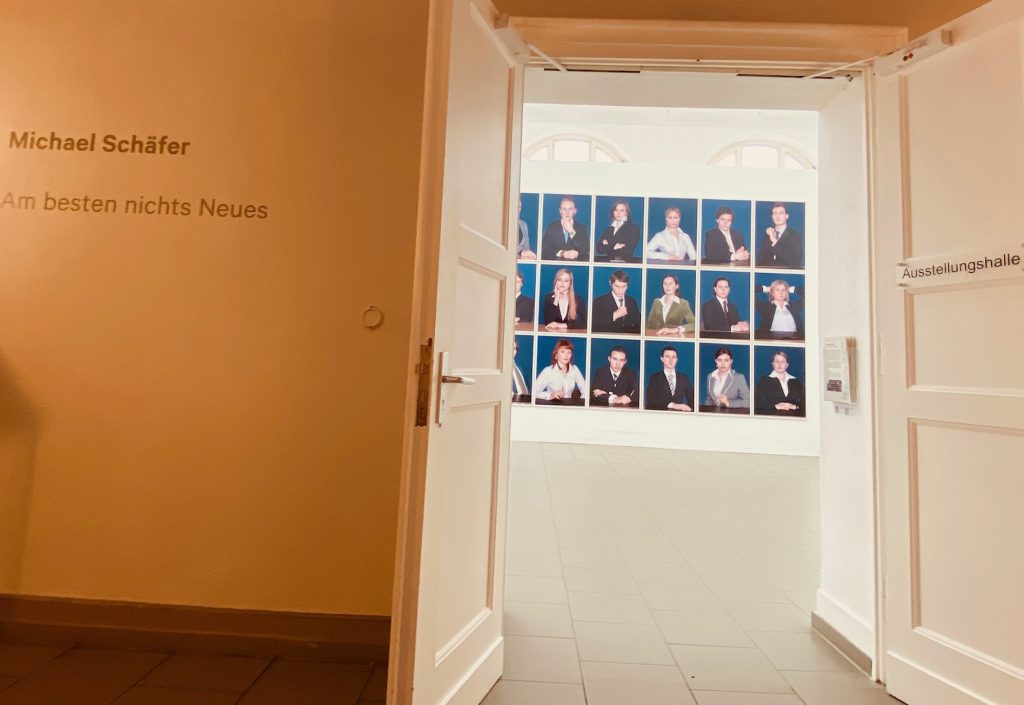
Digital Estonia
The progress of Estonia in going digital is quite advanced. The electronic identity card which allows data to be linked to health data and accounts or banking gives an impression of how far-reaching digitalization may go. Great steps have been taken to guide the population on the way to move towards the digital (only) world. Learning and coaching of a huge amount need to take place so that people do not abandon or get lost on the path towards “everything digital”. For the so-called digital natives, who have grown up with the sound of their smartphone at the bedside all the time, this move feels “natural”. Some experienced or silver workers got on track, if they were accompanied in suitable forms. The 65+ population might find it harder to adapt to the permanent use of digital devices for not only getting around in your city, but also to do your tax declaration, pay your dues and vote in elections.
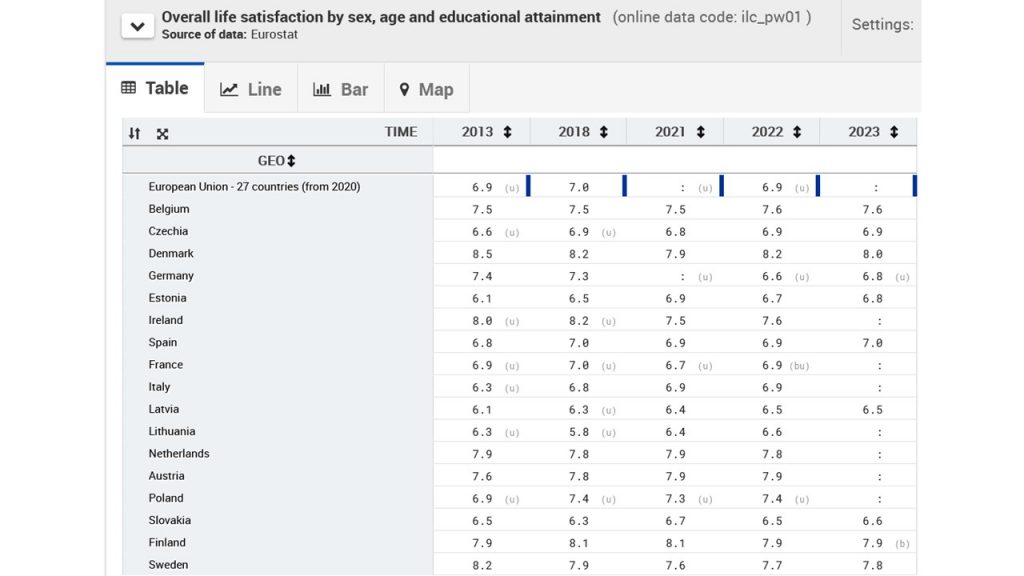
Digitalization is not a goal in itself. It has advantages to reach communities in remote places or islands, but it might alienate older persons that have no other person around to assist them in the digital only world. An easy way to get some social science data to inform the debate is to refer to Eurostat and the surveys with information about the “overall life satisfaction” of people (EU-SILC). Checking for some major countries of the EU and neighbours of Estonia with less digitalization the differences are rather small. In terms of overall life satisfaction (16+ years old) Estonia has been catching up to the EU-average mainly between 2013 and 2021. Since then, stagnation at the EU-average is what the data tell. A quick testing of the hypothesis that the older persons (65+) might not see the past evolution as rosy is reflected in the EU-data as well. Good pensions seem to drive the “happiness” of older persons in the EU more than good digitalization. Eventually the two features of a society will have to go hand in hand to improve life satisfaction to higher levels. (Image: Data Eurostat EU-SILC Life satisfaction 65+, selected countries 2013-2023, retrieved on 2024-4-23, comparison with table all ages here, Data source)