Individual and Cosmos

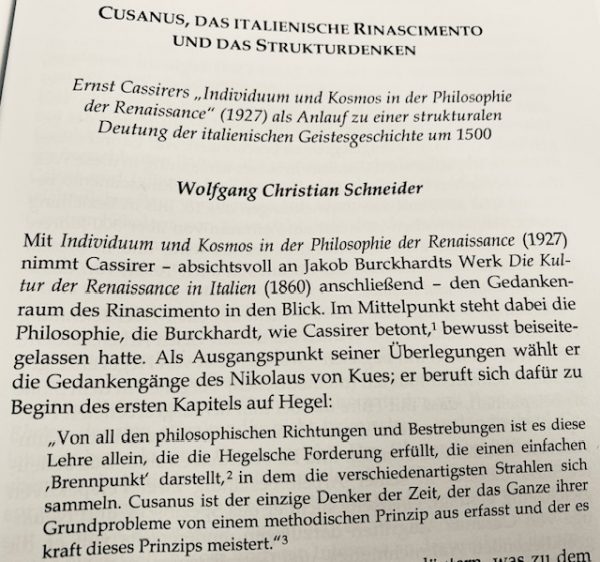
The major work by Ernst Cassirer “Individual and Cosmos” can be read from a perspective of the history of ideas (Schneider, 2024 in Coincidentia). The work of Cassirer refers back to Nikolaus Cusanus in the way that the worldly ideas concerning the sciences and everyday life of the individual are embedded into the perspective of the cosmos. The latter (cosmology) is of course at the time of the 15th century dominated by religious doctrines. Schneider highlighted the merits of Cusanus as a major contribution to the Italian  “Rinascimento” due to his ability and willingness to draw on all the best knowledge available at his time. A frequent travel to Italy and Rome including the library of the Vatican was a precondition to gather such an overview. Schneider opens up another interesting debate about the competence of Cusanus to read and write Latin and Greek. Contrary to previous statements he highlighted the fact that Cusanus created new words or notions that were unfamiliar or new at his time. Nowadays such creations are very common to express new ideas or combinations of concepts. At his time this was interpreted rather as a lack of clarity or imprecise language.  
Home for dog

The places where some dogs live can be rather big. But even tiny dogs may enjoy a luxury home like their owners. This was certainly the case for the dog’s niche in a Paris home, a few years before the French revolution (1785). The exhibit is a testimony of the tough inequality of the late 18th century in Paris, where some enjoyed far reaching luxury and large parts of the population were forced to live in poverty within Paris or the suburbs with little access to basic sanitary facilities. The discrepancy between the luxurious homes of pets and the average person might serve as an indicator for income and health inequality. The Musée Histoire de Paris Carnavalet has a great stock of artifacts that can speak to the issue. Image: Musée Histoire de Paris Carnavalet dog niche 1785). 

Gentileschi Selfie

Today the production of „selfies“ is all around us. Selfies are shot almost instantaneously and several times a day by use of modern smartphones. About 400 years ago the first woman to produce a selfie was Artemisia Gentileschi. As (one of) the first female painter in art history to have created a painted image of herself (which is transmitted today) Artemisia Gentileschi made history. Her unique biography, style and craftsmanship of the early 17th century in Italy made herself a renowned painter. Her choice to depict herself rather than somebody nobel or rich was quite unusual for the time. The audacious choice of herself as her „sujet“ became even her trademark. Later paintings by her with biblical topics were also subject to her reinterpretation based on herself as the female character in the narrative and image. In this respect her work appears so much ahead of her time that her impressive work speaks to all generations today. (Image: extract of Jael and Sisera by Artemisia Gentileschi 1620, Musée Jaquemart André“ in Paris 2025-8)

Work time reduction

One of the major elements of social progress in the 20th century consisted in the reduction of work time. Reductions from 48 hours per week in the first half of the century were largely reduced to 40 hours per week or less in some industries with strong trade union representation. State regulations also pushed in this direction with positive implications for physical and mental health as well as wellbeing. Advances in longevity of employees may be attributable to this social progress agenda of the 20th century. In the 21st century we witness a new thrust of enterprises and employees striving to implement a 4 day work schedule by at the same time organizing a further reduction of work hours. The scientific evidence which is based on pre- and post trial assessments of workers satisfaction shows rather positive results (Fan, Schor, Kelly, Gu 2025). More studies are due to accompany this potential of further health and wellbeing effects of reduced work time and the reorganization of work time in enterprises. 

Scienceploitation

Science can be exploited to make unjustified profits from referring incorrectly to it. Social sciences, like economics may be used by banks to sell you products that refer to science only as part of their arguments if the science based inference fits their purpose. Scienceploitation is very common in the field of para-medicine and para-pharmaceutical products. Health promises sell. The time until an ineffective treatment reveals the unrealistic promise to be unachievable considerable profits have accumulated on the side of the selling company. Science has a hard time to counter the perils of scienceploitation. Advanced knowledge can be used and abused as any other method of convincing people to buy or subscribe to a product. The responsibility of the scientific community consists also in finding ever new ways to counter scienceploitation. AI will pose additional challenges as well as opportunities.  

Electrifying Jobs

The transition to the “all electric society” necessitates to prepare the labor force for the upcoming challenge. The knowledge about electricity and electric appliances constitutes the basics of the knowledge base of the future. This goes far beyond the basics of physics and electrical engineering. There many processes like sharing of electric infrastructure in households, cities, in and beyond countries that have to be delt with. Investment calculations and legal issues to address the different risks involved are another area to cover in the process to prepare society for the “all electric society”.
However, the skills of professions with more direct links to the fossil fuel based technologies have a role in the phasing out of the heavy reliance on fossil fuels. Reverse engineering of such engines and heating will need people still knowledgeable of the past, when younger generations set their focus primarily on professions with links to electricity. Even using a solar powered heat pump in a home requires pipes to the existing network of radiators, for example. This will most likely be a gradual shift of the job structure and occupational requirements over at least a decade, but the shift has started already. Some might argue we need a well functioning “transitional labour market”, labour market policies and social security system for this to happen smoothly.


Ultimate Step

Reports in the New York Times, The Guardian and Le Monde in recent weeks have brought to our attention that there are shocking ultimate steps undertaken by several employees of public services. In the case of the British post office a decade long inquiry has uncovered that 13 suicides of employees occurred after they had falsely been accused of fraud. A long time ago in France Telecom a series of suicides was also attributed to a harsh personnel policy. The Office of Public Finances (DGFiP) is confronted with a series of suicides in 20025 of 12 employees who apparently made the ultimate step to put an end to their life. Not all is to be blamed on the enterprises or public services concerned, however, they failed or omitted attempts to prevent the ultimate steps. Initiatives like peer listeners as anonymous contact points or access to psychological counseling are necessary parts of a responsible human resource practice, even if it might not be a sufficient condition to avoid the ultimate step in some instances. In many cases employees go far beyond their mental capacities in terms of commitment to their work, they should not be left alone in case of severe consequences.
Burn-out, for example, needs to be tackled as part of the responsibility of enterprises and public services alike. It is highly unfair to put the costs of psychological consequences on the shoulders of families and the state. Investigations into toxic leadership styles and the current revival of “workaholic” work ethos will have serious negative consequences for families and society as whole again.

Social promise

In the beginning and middle of the 2020s the social promise to younger generations has been broken. The latest figures from the USA reveal that 2 million students (WSJ 2025-6-25 A3) who have financed their studies and potential social mobility by taking out a substantial loan are very likely to default on their credits. This observation was less a surprise to labor market analysts as the stalling of student hiring in many countries has happened for several years now. The more surprising finding is that the Wall Street Journal 2025-6-25 has been reporting on this. Banks or universities who are highly exposed to this kind of risk will themselves become downgraded for their credit rating. Higher interests for universities means higher fees and higher student loans eventually. The social promise to reach higher status and earnings through higher education as the social promise of the meritocratic society becomes an illusion. Investors in student housing might also find the sector less juicy for them. Students and their parents were taken hostage by an excessive commercialization and commodification od education. Lifelong learning is a still a promising route to revitalize the social promise.

Contextual Vision

The attempt to define a sociology of vision has had a hard time to build on hard evidence that vision may depend on context or in a broader sense your visual heritage. A standard definition of context in vision highlights the areas around a focal point. The findings by Krupin et al. (2025) show through the comparison of persons from very different populations that our vision depends on our cultural background. It is the social background and upbringing in a specific cultural setting, which determines what we see in an image at first sight.  The so-called Coffer illusion test (Deregowski 2017) reveals what we see in an image spontaneously and maybe after some longer staring at the image or doing it repeatedly, we learn to see that there is more to see than our original impression. Depending on our cultural heritage we might focus unconsciously on rectangular or round shapes in a geometric image. This fundamental finding questions the view that there is only one universal kind of vision common to all humans. In fact, there is variance around what we see and thereby how we perceive an image. This research provides a justification to delve also into the field of a sociology of the visual. Because of the common term in informatics “WYSIWYG”, (what you see is what you get), we might  spend more efforts on research of how human vision is shaped over generations or according to social background. We know that in some images different people see different things. What appears as a splendid opportunity for some, is a very risky situation for others. Eyes are so closely wired to our brain that inscriptions of vision on the brain functioning are quite likely. The plasticity of this process over the life course remains a crucial topic to understand the process(es) of how a person’s social background shapes her/his vision.

Fertility Fecundity

The scientific debate around changes in fertility has focused on social, economic and cultural factors to explain the drop in total fertility rates in OECD countries. The baby boom years of the 1950s and early 1960s had come to an end following the spread of new forms of birth control like contraception from the late 1960s onwards. The trend is very obvious and yet, the explanations of the trend might lack a more profound analysis of fecundity in addition to the socio-economic explanations. Shakkebaek et al. (2025) point for example to the little known effects of environmental (pollution) factors on the biological reproduction capability of humans (men and women).
Additionally, psycho-social factors like “the German Angst” fear about future developments in many social and economic fields might have direct effects, but also indirect effects on human biology. We know still very little about such feedback loops or feedback effects. We are more convinced, than we actually have hard evidence, that the BSP, SPB or PSB (B=Bio, S=Social, P=Psycho) spheres are interwoven, but an ambitious research agenda is called for to enlighten the issue. The big invisible elephant in the room might be environmental issues that enter into the fertility equations more than we have expected for many years. A nice working hypothesis for an ambitious and overdue research agenda.