Sociology in Theatre

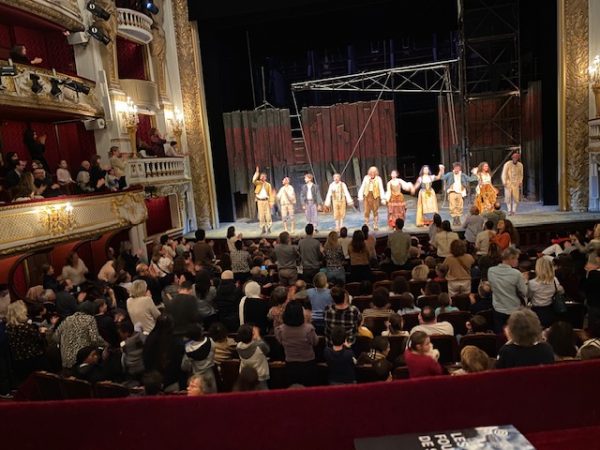
Thanks to the inspiring direction by Denis Podalydès of Molière’s “Les fourberies de Scapin” we can experience the fruitful application of sociology to classical theatre production. This combination of thoughts has been performed at the “Comédie Française” for more than 7 years in 2025-11. The accompanying booklet of the performance mentioned the ample inspiration of Denis Podalydès by the French sociologist Pierre Bourdieu. Personalities in Molière’s theatre are represented as incarnations of the “habitus” each character stands for. Such an interpretation of the roles in the theatre play, raises awareness about the subtle differences between personalities. Even two rich men may differ in their habitus, because their fortunes are of different size or kind, yet they may share even more personality traits. Molière was a particularly crafted author, director and actor to stage such subtle differences, which are embedded into societies often across generations.  

Polypharmacy issues

As we age, we become more likely to confront polypharmacy issues. Polypharmacy is defined as taking 5 or more medications per day. The study reported in The Lancet healthy longevity by Payne et al. 2025 had participants with a median of 4 health conditions and a median of 8 prescriptions. Even a comprehensive set up which involved several experts from medical doctors and pharmacists did not manage to achieve a significant improvement in polypharmacy outcomes in this experimental study with otherwise carefully matched intervention and control group. However, the mental health (measured in patients as “health-care-related quality of life”) slightly increased and the “treatment burden” experienced by patients was slightly reduced.
In combination with a previous study the probability of errors in nurses, who are the prime persons responsible for the administration of medications in institutionalized settings, the reduction of potentials for errors like they are to be found in polypharmacy should continue to be a prime target of this research in future. Together with the knowledge about the prevalence of functional illiteracy at older ages, polypharmacy remains a critical issue on the public health agenda beyond the experimental settings in this study.

Codes of Emperors

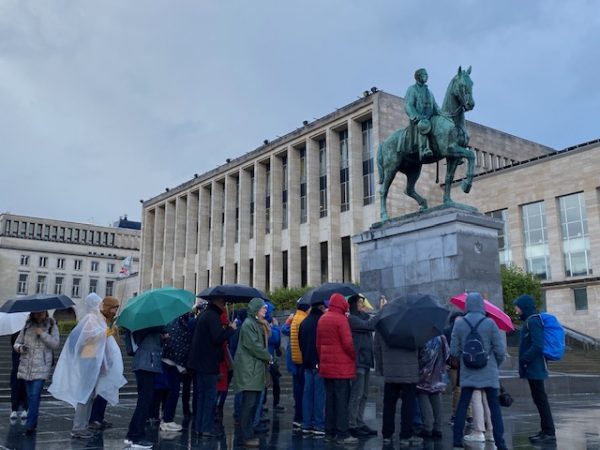
Even in the 21st century we spot the ancient codes of emperors. In Brussels the statue of King Albert, who ruled until 1933 and celebrated the first centenary of the Kingdom of Belgium in 1930, shows the Emperor riding a horse without saddle. This iconic position was started as a symbol of a powerful leadership by Marc Aurel and continued by Napoleon’s reign as well as several other ones.
The position on the elevated podium of the emperor on the horse, which further raises him beyond the level of the people, all contribute to the idealized perception of the king above the people. Such a vertical or hierarchical perspective on society or even mankind, including the colonial approaches of the emperors, are the lasting attributes of those times.  According to Els Witte et al. who wrote on the political history of Belgium, King Albert I was also named King Knight by some.
The portrayal and self-portrayal played an important role already centuries ago. No surprise that democracy has brought about an avalanche of idealized self-portraits or “selfies”.

Popular Sociology

Sociology, like other social science disciplines, has often difficulties in reaching bigger audiences. However, in combination with a museum which specializes in the history of a big city like Paris, the insights can suddenly become very popular. The “Musée Carnavalet of the history of Paris” has mounted an exhibition, which builds on the population censuses of 1926,1931 and 1936. The access to the complete original records of 3x about 2 millions of people has become a national treasure for social scientists and the public at large.
People flock to the exhibition. Some do it to learn about the past of their districts or streets. Others to learn about historical facts, which are sometimes linked to the family anecdotes and broader historical narratives. Out of this interest grows an understanding of macro- and micro-level social processes, which makes use of basic statistics.
People ask themselves: Is your (family) story unique or is it part of a more general pattern or social process like urbanization or social mobility.
(Image: original census recording sheet – Paris)

Opera design

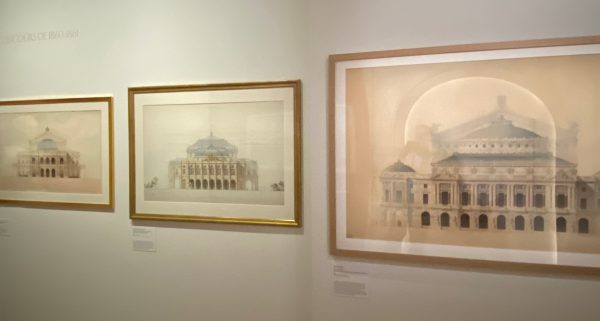
France celebrates 150 years of the National Opera Garnier in Paris. The exhibition in the splendid building traces the history of the building from the competition for the design to the legendary performances and celebrities attending. The stairs outside and even more so inside are built to enhance the glamour around operas and dance. The drawings by Garnier are a highlight as much as the videos about celebrities walking up the stairs of an Opera building.
Charles de Gaulle, as many French Presidents before, dressed and took the famous stairs to impress the official invitees. The image of de Gaulle together with Konrad Adenauer is another interesting example of opera politics showing the authentic friendship after the fierce fighting of the 2 WW, the Nazi-terror and Shoa.
The design of the Paris Opera 150 years ago made for an impressive ritual performance of state diplomacy enhancing international reputation.
(Images: 150 years of Opera Garnier Paris – 3 designs, winning design by Garnier on the right).


AI as individualizer

In a one pager in the journal “Rolling Stone” (2025, p. 9) Bruno Patino writes about the legendary David Bowie who was the first rock musician to launch a new song on the internet before it became available as CD (Telling Lies, 1996). As a pioneer in co-creation, Bowie anticipated somehow the trend and wish of people to personalize preferred songs even further and distribute such versions among friends. In this process, AI has become a powerful tool to push individualization even further and the digital social media allow even broader audiences beyond a more narrow circle of friends. Music maybe setting the trend  for some in the same field, other creative fields might follow the footsteps. The need to co-create collective experiences and participate in collective musical moments is likely to rise again as well.
Good news for music festivals across the world. Live concerts are the new form “collective individualism”.

Digital Social Networks

Social networks have become the place to be. The need to distinguish the digital social networks from the social networks of people in the analog or “real” world is important, as we realize that many young persons seem to suffer from loneliness despite a hundred personal links in the digital social networks. This paradox of digital and non-digital social networks needs careful attention of researchers because of the opportunities and risks involved in the transferability of contacts from one network to another.
There is s a kind of “conversion rate” of digital contacts into face-to-face contacts and even purchases for marketing purposes in the world of business. The sociology of the virtual has to deal with these paradoxical social relationships and study the increasing phenomenon of being «alone together». Increasingly we are alone, but together. Over the life course this phenomenon and the digital social network paradox change as well.
To research such a topic we need rather intrusive, personal data and access to the digital traces of people as they construct and deconstruct either form of social networks. 

Social Anthropology

Dina Dreyfus, married several years to Claude Lévi-Strauss, has shared with Claude the long anthropological expedition to Brazil in the 1930s. They jointly studied the social organization of indigenous people across Brazil. Their abundant notes of field studies have now been digitized and the BNF is making this accessible.
Additionally, an exhibition on these field studies reveals the close collaboration of both partners. Returning to France in 1939 meant that soon after the return due to their Jewish decent had to interrupt their academic careers in France and some notebooks were lost during the Nazi occupation of France. After the war both separated and Claude Lévi-Strauss embarked on the drafting of the structuralist theory, Dina became influential in the field of the philosophy of education and teaching philosophy herself.
Besides all these lasting achievements, the exhibition shows the typewriter which had accompanied them for many years. The German language layout is quite remarkable as this asked for an additional mental versatility in putting their thoughts and experiences into the form of a manuscript. According to Claude Lévi-Strauss the use of this technical device allowed him to detach himself emotionally from his analytical work.
(Image: Exhibit: typewriter Claude Lévi-Strauss, BNF 2025-10)

Ethics in Photography

Yes, you read this correctly. This entry is about the ethics in photography, not about the much more popular discussion about the aesthetics in photography, which fills thousands of books on fashion, architecture, minerals, flowers, animals, landscapes and … you name it. Sensationalism works in photography. The more spectacular an image, the more likes you’ll get in any media, social or so-called social as well as traditional ones. Sex and crime are popular subjects, better framed as objects, as well. The basic idea of what constitutes unethical imagery or photography is broadly defined by the principle of exclusion, i.e. what is not ethical in photography. Let’s add to this inventory the conditions of production: exploitation of the subjects, be they persons or animals or even authorship like violations of intellectual property rights by AI.
Regulations and legal frameworks clarify many of those issues, enforcement of these rules are yet another element related to the ethics in photography. Global warming and the loss of biodiversity has made us aware that the respect of natural resources is also an aspect in the ethics in photography. Travelling long distances by plane just to get a few shots in the Himalaya region, if there have been thousands of (better?) images produced, printed, distributed before, is not sustainable for our planet as a whole. Invading protected areas, like natural bio-reservoirs, to take a few shots especially of rare plants and flowers maybe nice to look at, but the longer-term consequences add up to a loss of biodiversity for us all, in particular for later generations.
These considerations are different from “aniconism”, because they originate in a humanist foundation of ethics not concerned with any depiction or idolatry of images. The historical roots of any ethics in photography have long shadow into today’s practice of photography as well.
(Image: The framing of ethics of photography with reference to John Cage “Silence“)


Individual and Cosmos

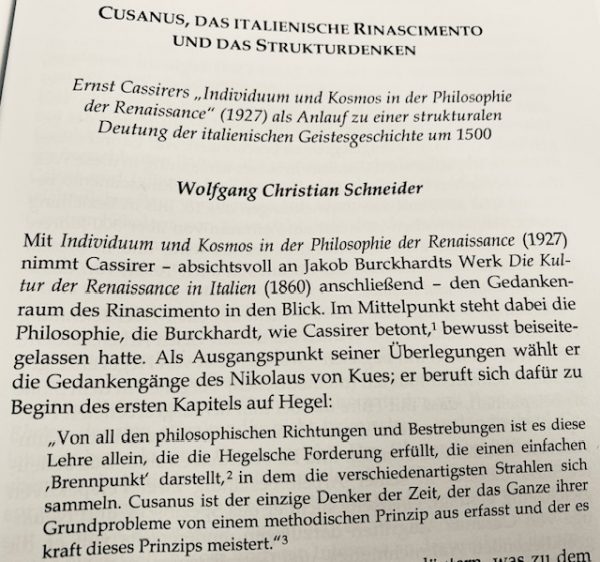
The major work by Ernst Cassirer “Individual and Cosmos” can be read from a perspective of the history of ideas (Schneider, 2024 in Coincidentia). The work of Cassirer refers back to Nikolaus Cusanus in the way that the worldly ideas concerning the sciences and everyday life of the individual are embedded into the perspective of the cosmos. The latter (cosmology) is of course at the time of the 15th century dominated by religious doctrines. Schneider highlighted the merits of Cusanus as a major contribution to the Italian  “Rinascimento” due to his ability and willingness to draw on all the best knowledge available at his time. A frequent travel to Italy and Rome including the library of the Vatican was a precondition to gather such an overview. Schneider opens up another interesting debate about the competence of Cusanus to read and write Latin and Greek. Contrary to previous statements he highlighted the fact that Cusanus created new words or notions that were unfamiliar or new at his time. Nowadays such creations are very common to express new ideas or combinations of concepts. At his time this was interpreted rather as a lack of clarity or imprecise language.