Democracy celebrates

With all the bad experiences of Nazi-Germany and the failure to defend democracy in Germany against its fascist enemies in the 1930s, it was a pleasure to celebrate democracy in Germany together with a huge crowd. 3 days of information and party around the major institutions of democracy Parliament, government, federal governments, constitutional court and all ministries joining in with pavilions in the parks nearby allowed a bottom up feeling of democracy. Visiting the chancellery as well as the parliament in a single day shows the openness of these institutions and the ease of access to our political system. People of all ages and all walks of life strolled around and enjoyed the day. Freedom to voice your opinion was easy and many took their time to do it. Civil society organizations were a natural part of the show. We seem prepared to stand up for our democratic values and principles. This will be tested in all the forthcoming elections.

Competence Gardening

Primary Schools in Berlin have the possibility to participate in the “Gartenarbeitsschule”, the school with learning goal of gardening. It is an interesting option to go out into the real world and deal with nature, sustainability, consumption, climate and many other topics. Voltaire could complement the curriculum in philosophy with his biographical links to gardening. The access to the fields is easy next to one of the central train stations and a larger urban reforestation project as just one example of the 15 overall in Berlin in 2024. (Südkreuz, Südgelände). Hands-on experience of gardening can address multiple forms of problem-solving competencies. Beyond the use of AI, a major advantage is the possibility to train collaborative problem-solving. Beyond the multifactorial approach in determining what to plant, the organization of the implementation and individual contributions towards the realization, all these elements are learning goals. The scope of learning qualifies gardening for learning well beyond primary school as well. It is a nice example of lifelong and lifewide learning even a hundred years after their wider applications in Berlin.

Gardening School, Berlin 2024

Competence Handwriting

The acquisition of handwriting as a competence has been important for centuries. In primary schools this technique is exercised as a foundation for the performance in other cultural techniques like language writing and even calculus. Therefore, it has been beneficial to make sure children acquire basic competences in handwriting. This has not changed much, although the time devoted to perfection of the technique has been reduced over generations. We still have some memories of people who have made the handwriting or the pencils used a case of distinction. At the enlightenment period a lot of authors drafted their thoughts and manuscripts in handwriting and our museums or biographies are proud to show off handwriting of authors, artists or composers. In some of those we are able to retrieve the thought process behind the writing. The editing, crossing out, adding sentences or correcting words are traces to dive deeper into these creative processes.
Currently, we are less sure, whether in the age of AI we should still rely much on this old technique of handwriting. If we just treat it as one of many competences to be or become creative yourself, we are on the right track. The PISA studies by OECD include problem-solving as a crucial competence. Handwriting or drafting first steps of a solution might still be useful. A handwritten sketch of a solution might guide the elaboration of the more encompassing solution.
Another interesting feature of handwriting is the cross-cultural element of it. We feel easily compassion for a handwritten document. The psychomotor competence of handwriting is fascinating across continents. It has distinguished us from other species as well. The evolutionary steps are important elements of a learning process. Nostalgic feelings about handwriting do not help anybody, but children are well-advised to still keep an eye on their handwriting competence as part of or first step in problem solving, even if it is just to formulate the question they are interested in.

Patient Empowerment

The empowerment of patients is a well-established practice in the treatment of diabetes. Measuring your own blood sugar and adjusting your medication to the self-monitored data is common practice. For patients with high blood pressure this patient empowerment is less prevalent. A medical study carried out in Valencia (Spain) by Martínez-Ibáñez et al. (2024) has tested the effects of such a self-monitoring and self-medication experiment.
The results publishes in (JAMA) gave rise to considerable attention in the profession as the empowerment of patients is one way out of the likely increasing shortage of medical professionals in aging societies. Whereas other studies found that total costs to the medical system might increase, the study in Spain provides evidence of the cost-reduction effect of such an empowerment. 24 months after the beginning of the trial. After the establishment of a “medication based on an individualized prearranged plan used in primary care” the self-administering participants achieved a significant decrease in their blood pressure that lasted until the end of the study after 2 years. The drop-outs of the study seem to follow a random pattern.
The conclusion gives support to the potential of patient empowerment in the widespread treatment of higher blood pressure beyond the regular visits of medical doctors. The monitoring of changes in lifestyle add to this to keep the costs of health care under control in aging societies.

Image History

The archives of the history of movies and/or television show to us the multiple ways how images capture our attention and memories. Visual narratives are an own category of our personal and collective memory. The wide range of visual experiences are a powerful way to influence. Not only the movies and stories matter, but the whole range of images associated with the cinema world. Poster collections, newspapers and today the so-called social media multiply the original images. The Deutsche Kinemathek allows a special, critical understanding of image history as Germany has been using and abusing images and movies in a very manipulating manner historically. The message is: do not take images for face value. The ways and techniques to manipulate images have been widely used and are all around us today. Whereas the mass media in previous decades have dominated the collective memories we have entered into an era with many more subcultures that evolve within their own bubble of images. An original attempt to cut 65 movies of German film history into less than 4 minutes is presented in the exhibition (Milkowski and Simbeni). It focuses on gestures and “les regards”, “Blicke”, how the actresses and actors seem to look at us. Eyes capture attention, and this as soon as we open our eyes as children. Our brain works as image recorder and our memory algorithms tend to favor image recognition while processing images continuously. We do not know much about our own image sorting algorithm or algorithms yet. Research on aging of the brain gives some hints. With declining short term memory the images stored in long term memory take the upper hand. This makes an understanding of the history of images even more important.

Deutsche Kinemathek

Just in the vicinity of the Potsdamer Platz in Berlin you’ll find the Deutsche Kinemathek, the museum movies, actors, actresses, directors and the history of cinema in Germany. There is a small specialized library in the Kinemathek that allows to dive not only into journals and books, but also video material, scenarios and accessories. Of course, you will find a lot of material on all sorts of movie stars (heroines) over more than a hundred years. The “Divas” of the industry take up a large part of the exhibition. “Marlene Dietrich” much more than “Hildegard Knef“, the former born and the latter lived for a long time in Berlin-Schöneberg (Berlin-Pretty-Hill as some locals call it nowadays). The 2 Divas probably caused the funny translation. Anyway, the hall in the Kinemathek which is exclusively devoted to Marlene Dietrich impresses with a lot of glamour and mirrors around.
For those with not only a biographical, but also life course interest in cinema cherish the public access to the library. The most impressive table there is the desk with access to the Ukrainian movies and about cinema in Ukraine. A list with QR-codes allows you to readily approach the recent developments before and during the Russian aggression on Ukraine (See image below). After all Potsdamer Platz in Berlin was a hot-spot of the cold war period in the divided Berlin. A little bit of a “Metropolis-atmosphere” can still be felt. The Kinemathek explains well what this is all about.

Killing me softly

The problem with pollution is, it is killing you softly from inside. It is almost impossible to escape air pollution as it is pervasive in cities, but also in the countryside where you do not expect it that much. This is the result of the study by Kuzma et al. (2024) published in “The Lancet Regional Health Europe”. Based on a data set of 8 million persons from Eastern Poland the effects of air pollution on myocardial infarction incidence was analysed. The use of the “European Union’s Earth Observation Programme” contributed data on air pollutants like PMs, BaP (benzo(a)pyrene), SO2 and NO2 concentrations. The multi-level data of 5 voivodeships, 101 counties, and 709 communities in Poland allows to differentiate the effects of damage to the heart tissue on cardiovascular disease. The other well-known factors are arterial hypertension, diabetes, obesity, chronic kidney disease, hyperlipidaemia, and smoking as most of us know already. The effects of  BaP (benzo(a)pyrene) is shown for rural areas despite the lower observed traffic density in these areas. The killing occurs softly from within our bodies by just breathing in and out, and in and out continuously. The disease burden in these regions is observed with “recorded 63,154 hospitalizations and 5921 in-hospital deaths (9.4%) due to STEMI; and 76,543 hospitalizations and 4079 (5%) in-hospital deaths due to NSTEMI”. In short, the need to reduce air pollution further is an urgent demand that saves lives eventually.
(Image from public domain wikipedia or “do-it-yourself” here).

Attune Spheres

In Berlin it is easy to walk through the history of art to up-to-date contemporary art installations. Just walk from the Alte to the Neue and then to the Contemporary Nationalgalerie. With the installation and performance in the monumental Hamburger Bahnhof the artist Alexandra Pirici succeeds in an extraordinary way the combined impression of several art formats. I felt particularly attracted by the sound and resonance that the dancers achieved in the huge historical hall of the former train station. Embedded in a choreography that spans the whole hallway and the top of a sand dune, the ideas of „Attune“ bring in demonstrations of scientific experiments as well. We are reflecting on how structures, biological, physical or geologic processes coexist. It is another example of the intersection of biological, psychological and social phenomena. The links between science and art are more direct than what most people tend to believe. This encompassing experience catches all our senses and our mind. It is very likely that this intense experience in the museum space, which attunes our sensory perception of the artwork, sticks with us for longer than many other pieces of art. The 21st century will reveal an even more powerful language of art as it incorporates even more formats to grab our attention and imagination. The research of how patterns are formed is an important question for social scientists as well. All approaches to the subject are welcome and each one reveals our knowledge gaps despite remarkable progress. (Image: Hamburger Bahnhof, Berlin 2024-5-11, Alexandra Pirici)

AI Racing

AI has entered the racing of cars after we have been racing horses, dogs and camels for many decades. The fact behind all these races is the huge market for gambling. Anything you can bet on will do for juicy profits in that industry. The recent “Abu Dhabi Autonomous Racing League” is the latest addition to the racing craze. Moving online with 600000 spectators at its peak on video and gaming platforms the investment seems promising. The only problem, AI is not yet ready to really compete with the world of real drivers. The progress, however, is astonishing. Just one lap of 2 minutes on the circuit yields 15 Terrabyte of data from 50 sensors. These are closed circuits so no person can enter or animal can get in their way. The challenge to integrate more data and faster processing as well as algorithms for fast decision making is steep. Great learning opportunities for advances in robotics. The hype has not been able to live up to the expectations as no real racing took place yet. We have replaced the gladiators of the Roman empire with Formula 1 drivers. It is only fair to retire those drivers soon and let AI race cars against each other. It feels like a computer game on screen and it is as we shall most likely watch these races on a screen as well. Hence, what is the point. Watching youth on TWITCH play racing games will probably not change the viewing behavior of the masses. The programmers have nevertheless great learning opportunities and will find their way rapidly into the job market. The other challenges of ASPIRE seem more important for humanity like human rescue and food for the growing world population. In the meantime let the boys play around with cars and learn about potentials as well as failures of AI-programmers and dealing with both.

Screening Paradoxon

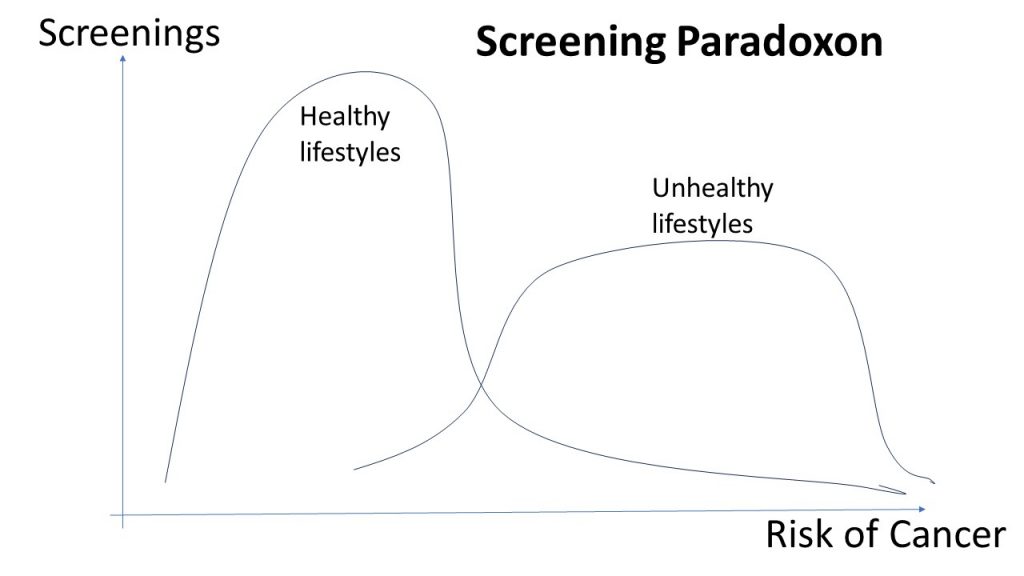
In the field of public health the screening paradoxon is a well-known feature of large scale programs to check for and contain the large increases in cancer among populations. A recent medical study underscores the necessity to curtail the screening paradox in Europe. The screening paradoxon is defined as “the underuse of screening by those with unhealthy lifestyles and high risks”. The opposite cases, “the overuse of screening by those with healthy lifestyles and low risks” only cause a problem for the costs of the health system as those unlikely of attaining a form of cancer make extensive use of screening. In terms of social inequality we have to be concerned about both ends of these distributions. The publicly available screening programs are skewed towards the higher educated with risk awareness as well as healthy life styles. More of them participate in screening. The other distribution of actual risks and detection of cancer is skewed towards the other end of the risk distribution. The 2 probability distributions overlap to an extent that is most likely co-determined by cultural factors like general attitudes towards prevention.
With the increase in cancer rates generally and due to demographic aging of societies, we shall need to target our resources devoted to health more precisely rather than spending too much on screening of people with very low risks. Increasing the duration between screenings might not impede detection rates of those with healthy lifestyles, but could allow to devote more resources to those people who are hard to reach by screening programs so far. Evaluations of such programs are necessary to judge the need for more targeted programs.(Image own representation inspired by Ola et al. 2024)