Research is beginning to provide empirical evidence and experimental modelling results on the widespread use of generative AI. First results by Doshi and Hauser point at the individual benefits of using artificial intelligence but the widespread use of it is likely to narrow the scope of novel content. This research is particularly interesting because it deals with the micro level to macro level aggregation effects. It is fine for me to use AI. If it becomes a mass phenomenon, we expect in sum a negative outcome for society as a whole.
The example at hand deals with the capability to innovate or to come up with novel content. As more and more texts or newspapers are published with extensive use of genAI, the real element of creation will remain the domain of humans for quite some time.
In my opinion this is due to the difficulties for algorithms to differentiate between the positive and too risky negative aspects of innovative solutions. A query for AI might ask to come up with an innovative solution for auto-mobility of short distances. A human being might propose walking due to the additional health effects the AI might propose helicopter lifts. The not so stupid machine would need a lot of additional information about circumstances to generate useful solutions. Therefore it is not surprising that sometimes public transport apps propose to walk short distances rather than waiting for “delayed or unreliable services“ they provide themselves. Personal circumstances like mobility with children, other dependents or luggage are usually beyond the scope of the information base of the algorithms.
On the other hand, if the AI knows that 50.000 persons after an event want to take public transport at the same time the indication to walk or wait solves an aggregation problem of individual preferences to adapt to available capacities. Lots of issues to solve for AI and us or better yet, us and AI.
(Image creation: AI using Microsoft Dall-E Image creator: Prompt: a person with notebook in profile and in front of 5 other persons in Office with windows 26.1.2024, 8:24 PM) 
Ideal City
Ideal City
Even beyond humans the issue of what constitutes the ideal city is a matter of historical as well as experimental significance. Science has recently uncovered a city like organization of habitats in the Amazon region (Link Science.org). The organization of the Greek city states has been the model for the development of democratic ideation. The Roman imperialism has thrived through the splendor of its cities and city lifestyle. No surprise that this continues to be a constant concern for humanity.
Rapid urbanization continues in Africa and Asia. Europe also struggles to keep pace with infrastructure development in every growing cities. Whereas the ideal city in the early Italian Renaissance was imagined without trees, we witness a renewed interest to bring back nature-like environments and architecture back into cities. Combining the best of 2 worlds seems possible. Redesigning inner cities remains a continuous challenge. It is much more than thinking about bricks and mortar. It is mostly about how we want to live, work and communicate together. Therefore, it concerns all of us. Paintings help us along in our ideation about where and how we want to live together. The linear views of the Renaissance appear hardly convenient after the experience of the 20th century.
(Image Gemäldegalerie Berlin, 2024-1, Raum XVIII, Ident Nr. 1615 “Ideal city” from ca 1490 attributed to Francesco di Giogio Martini and next to well-known ideal “Venus” painting by Sandro Botticelli 1490). 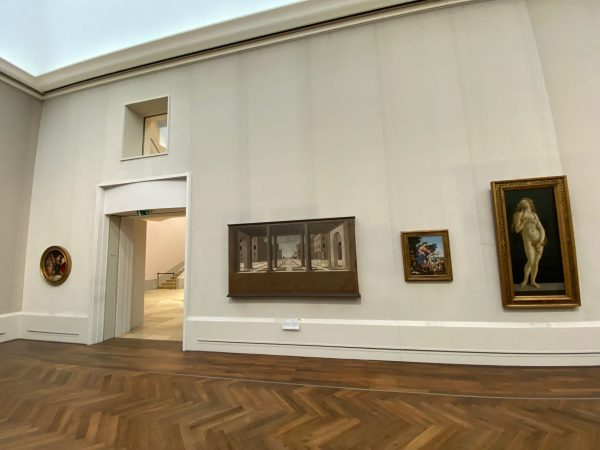
Stock taking
From time to time it is necessary to take stock of production and to review the material that has accumulated. As I have been working in archives, official book depositories and libraries for years, it comes almost naturally to deal with questions of how to keep track of all that content. Digital solutions are excellent devices in this regard. I do not have to deal with digitalisation, a huge issue for all historic archives and many recent small museums as well. I have to deal with backups at regular instances. To be sure, each engineer will assure you, better make a backup of your backup … . Yes, I do this as well. Now the ultimate backup of digital work is ? Got it, a printed copy of your digital work. The best advice I received on this comes from a computer magazine “ct” gadget mug with imprint advocating “No backup, no mercy“. To facilitate my printed archive I start with monthly collections of blog entries (Link to pdf-file December 2023 ->Brainstorming 23-12). The simple conversion yields 63 pages, a printer friendly version 56. Hence the expected yearly volume (60*12) will be somewhere near 720 pages. That is for the archive only or in case my eyes do no longer support online reading on screens for too long.
Digital archives have, of course, many other advantages. It is possible to reassemble my collection of entries by subject through a more thorough editing. Specific edited volumes will surface from this, which I have in my mind but only careful long-term followers of the entries might see already. Political economy and sociology are obvious candidates. Public health, labour, the world of arts and music could constitute other edited volumes. Lots of branches grow out of the trunk of content. 
Poster Design
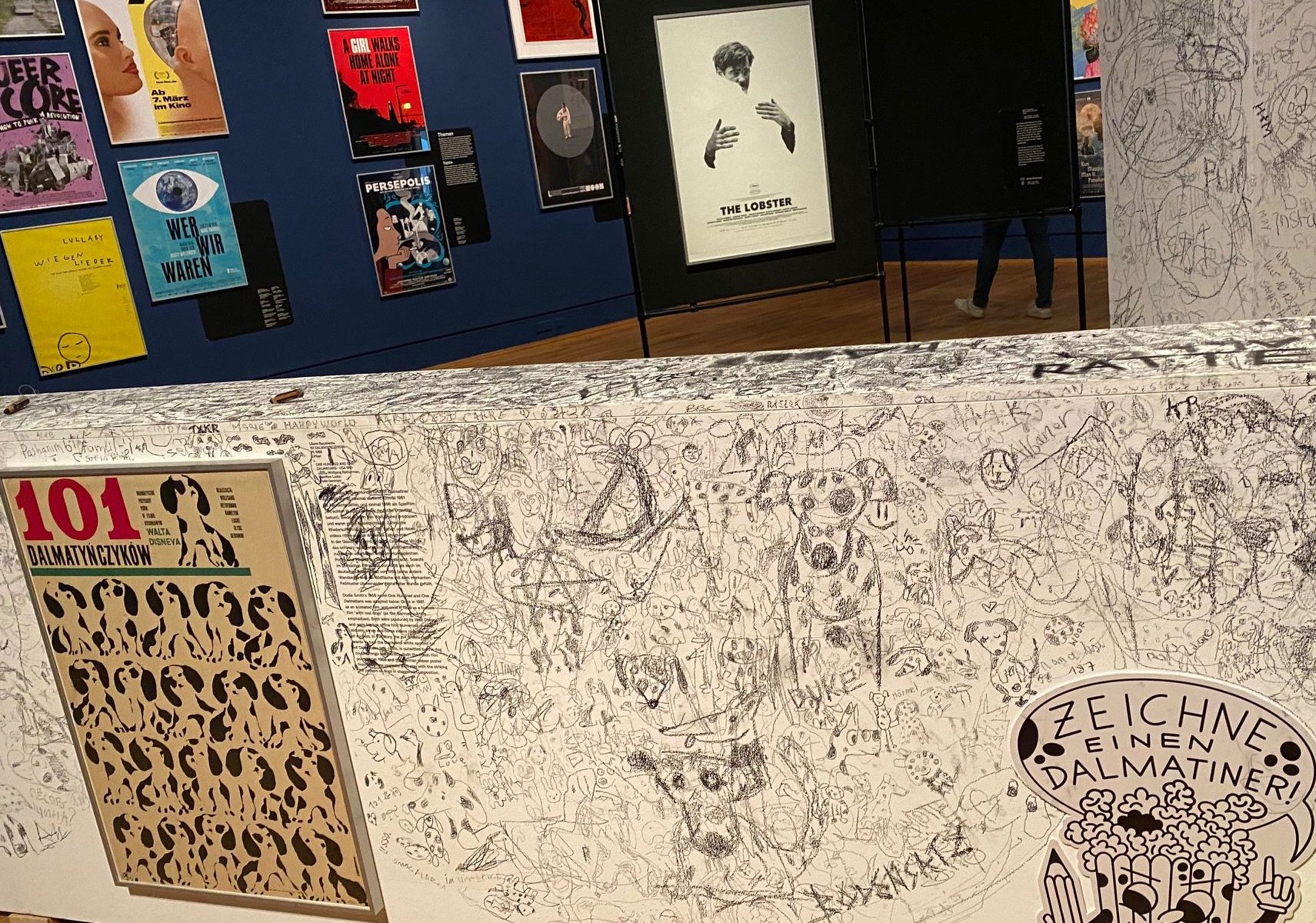
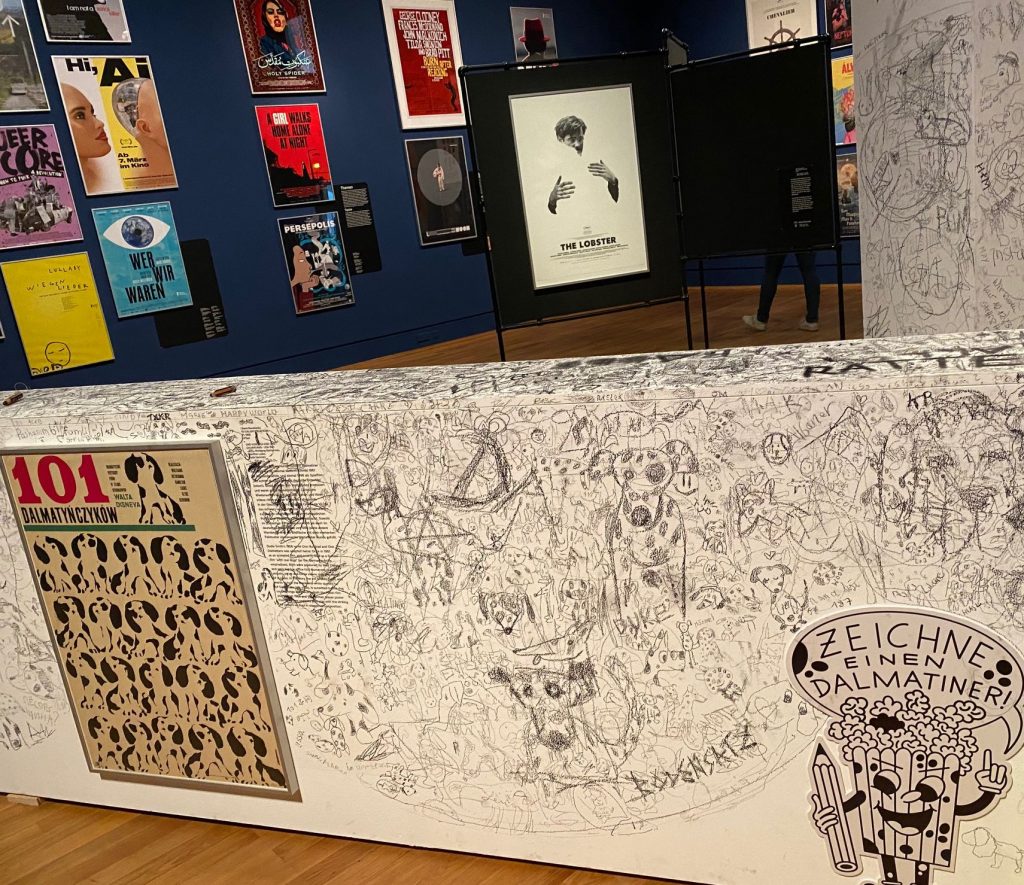
The effective use of posters in visual communication is a specific craft. Artists have been associated with poster design for more than a century. Cinemas continue this practice. For each movie produced there is an announcement posted in print or digital form. In combination with the Berlinale 2024 film festival the Kunstbibliothek in Berlin shows milestones of the history of movies and their representations in form of posters. Besides the historical approach there are many hints how to interpret the design language of posters throughout the 20th century. The encouragement to try to produce one yourself not only reserved to children is an additional activating feature of the exhibition (Link here). Cats and dogs will always catch attention and the playful approach chosen might be a start into a graphic design interest. Overall the exhibition offers a low threshold entry into the world of art and design. Instagramable image on posters evolved into short preview clips, just like instagram paved the way to tiktok video clips. In retrospect posters also provide shortcuts for our memories to recall whole movies that have accompanied us growing up and growing older.
Flooding
Flooding after abundant rain fall is an almost worldwide phenomenon. This is why research has taken up the issue for some time now. 2 recently published papers hint at direct and indirect consequences of excessive rain and flooding which usually are not taken into account. The Lancet respiratory medicine has highlighted the second round effects of flooding which consists in the latent danger of mould creeping into buildings even after the immediate effect of the flood has vanished. It is the mould with its longer duration that causes major respiratory health and safety hazards on top of the instantaneous casualties and epidemic health risks (Link to study 2024).
The second study focuses on “the need for more systematic understanding of how societal structures and vulnerabilities moderate disaster risk” (Link to study). In wealthy countries the flood mortality is substantially lower than in comparatively poor countries. More sophisticated anticipation systems play a major role in reducing casualties. Flood-induced displacements remain hard to predict despite a reasonable explanatory power of the statistical model as the authors point out. Additionally it remains an important question to estimate the share of people who (want to) return after being displaced due to flooding. The frequency of flooding plays a role in combination with the severity of flooding. Climate change might be an additional hazard in the sense that more frequent flooding will change the propensity of people to permanently relocate rather than returning after displacement. Social networks, support and solidarity with the victims of flooding as well as reconstruction efforts will play a crucial role in dealing with these environmental hazards.
Building higher dikes is a worthwhile solution in regions that can afford them (Rotterdam example). It is hardly a solution for countries with little resources to invest in protection in face of an already suffering and displaced population. Dealing with mould after the flooding only adds yet another health hazard to an already difficult situation. 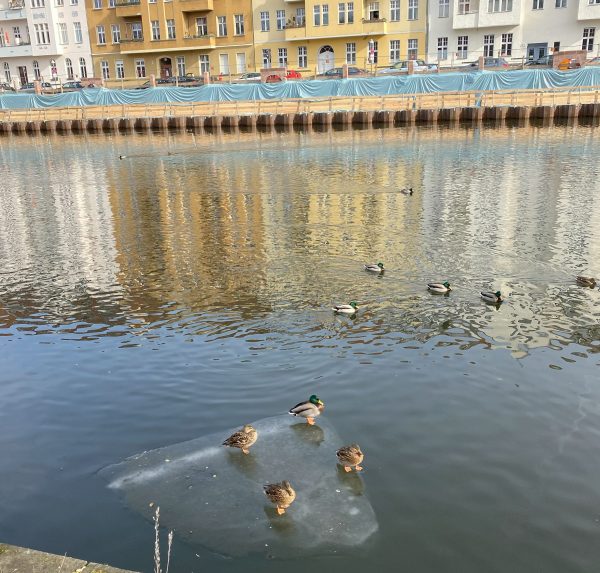
Water fountain
We are lucky that in Berlin not all water fountains have disappeared from the public space. Some might remember that in schools it was usual to have a source of water free of charge for refreshments during breaks. Others cherish public places where there was a water fountain nearby.
Rather than looking where to buy refreshments, usually in plastic bottles nowadays, it was easy to hydrate yourself or the whole family from such a public source. Of course, these sources became the enemies of private companies cashing in extra profit margins the higher your urgency for water is. Hygiene is manageable, if a little bit of care is exercised. In periods of droughts such sources become an asset beyond the benefits for human beings (see image below, bees refreshing). In France, a law which prescribes that public institutions who receive visitors have to offer a point of access to fresh, drinkable water, is badly respected (Link to study). The result is more water in plastic bottles and the transport of those to inner cities. Plastic bottles contain thousands of micro- as well as nanoparticles of plastic which we are likely to digest (LINK to PNAS study). Having your own device ready to be refilled from a public source in inner cities is a healthy alternative.
Sustainability science has studied the issues and delivers solutions. It is societies and policies that have to (re-) implement these solutions. Here again we are back to political science and public health coordinators to raise awareness for these “blue solutions”. 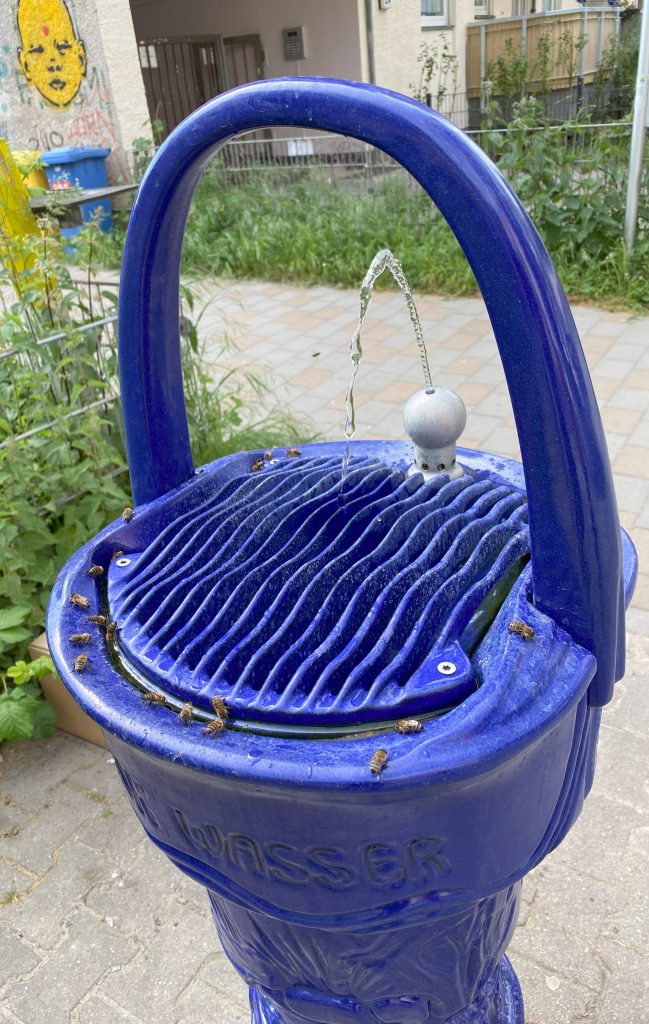
Ethics of posterity
We have not inherited the earth from our ancestors; we are borrowing it from our descendants. (native American saying). Adeline Johns-Putra (2019) states this early in her book on “Climate change and the novel.” Her concern is how to think and write about the ethics of posterity. Approaches of ethics in the sense of parental care (for the planet) or motherhood environmentalism do not suffice in view of overpopulation of our planet. Shifting our identity away from toxic production and consumption is advocated in many novels. Science and science fiction offer many dystopian examples.
De Shalit (1995) wrote early on why posterity matters. It is not the standard of living of contemporaries that matters but we should consider ourselves as a part of a transgenerational community. The time horizon of our decisions matters. In pursuing arguments by John Rawls who re-established a contractionalist perspective on justice, we have to include future generations into our contractual obligations. Following this approach we might arrive at Brundtland’s perspective on the ethics of posterity which is called sufficientarianism in opposition to simple utilitarianism. In sufficientarianism we owe future generations a just and decent living or at least the possibility to have similar starting conditions. Shifting beyond the apocalyptic view of environmental disasters Adeline Johns-Putra (2019) brings to the forefront that we have to substantially lengthen our time horizon both for consequences of climate change and for dealing with it, albeit the fact that most destructive practices operate much faster than the re-establishing of greater biodiversity.
P.S.:Thanks to the curators of the Lese Lounge Staatsbibliothek Berlin for ease of access to the literature.
(Image: Natur & Kultur in “Extreme tension: Art between Politics and Society” Collection of the Nationalgalerie 1945-2000“. 2024-1) 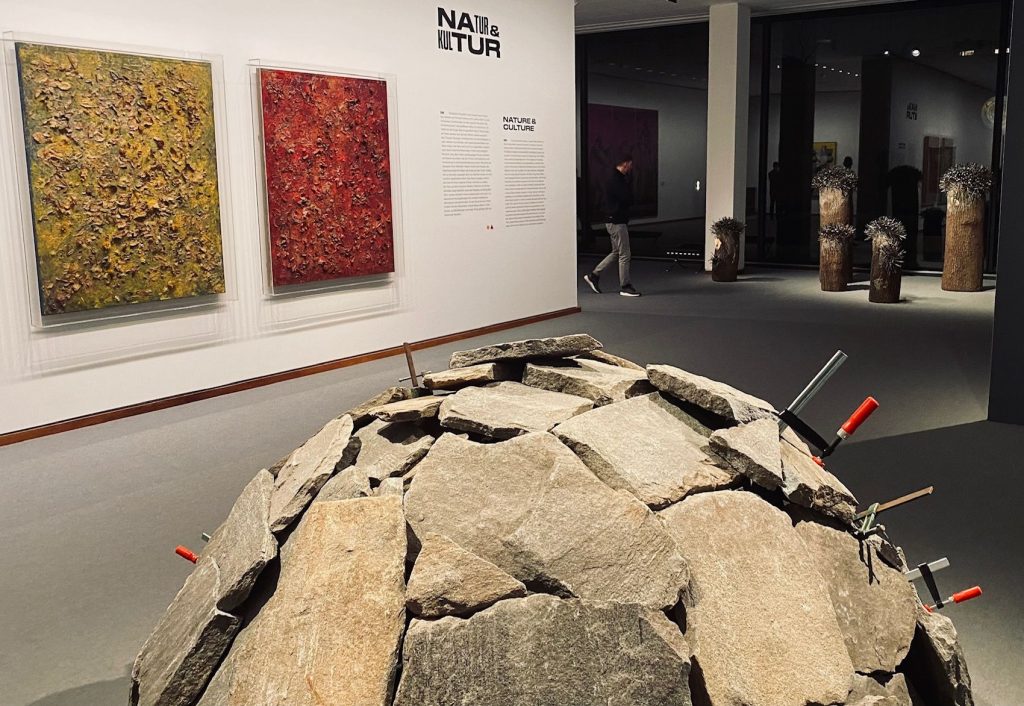
Air quality EU
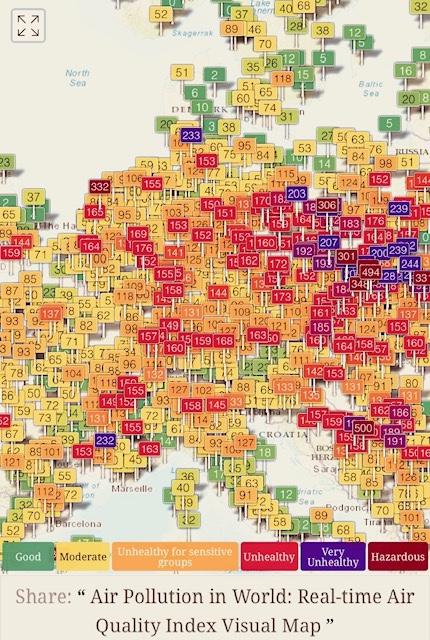
On some days of the year there is a cumulative effect of bad influences on air quality in Europe. Cold winter temperatures increase emissions from heating. Outdated heating with coal, still important in Eastern Europe, causes high amounts of extra particles in the atmosphere. In January 2024 a train conductor strike in Germany irrespective of the good reasons for it, makes people take their cars. Road blockades by opponents to reducing diesel subsidies to agri-business add to the pollution situation on a specific day. Overall the population suffers and breathes additional amounts of cancerous particles. Particles settle as dust on crop producing soil, of which we all feed ourselves. This is a vicious circle, which we need to break in the interest of all of us, particularly for the more fragile people and children. The latter start to crowd the medical doctors with sometimes lacking the delivery of crucial medicines for this target group. Where do we go from here? Compromises are key, security of supply chain and allowing, not too much, time for transition periods.
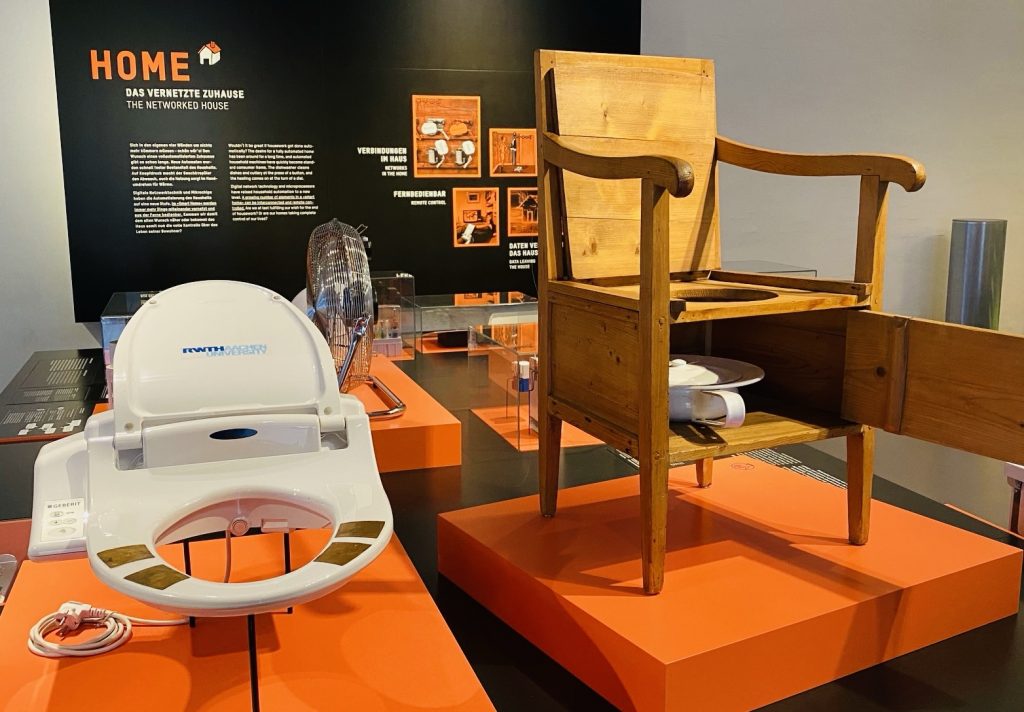
Throne
In continental Europe some people say they are going to sit on their throne for a while if they are going to the toilet. Previous furniture built for that purpose almost resembled a throne. Nowadays the comfort has increased and most households have an excellent WLAN connection in the tiny place, automatic ventilation and heating comfort. Linked to the throne, the issue of the smart home comes back into our mind. Besides the increased comfort we generate abundant amounts of data. Sensors of all kinds can track lots of information that may reveal quite intimate details which we did not intend to share. The movement pattern of mounting your throne might be easily identifiable by your smartphone. Such data could be added to assess your health status in your dedicated health app. Anonymized data could give early warnings about a local outbreak of diarrhea. Do we want this? Probably not. In countries where thousands die from diarrhea, probably yes. It is a matter of balancing the pros and cons. Health data are thought to be particularly sensitive information about us. It certainly is the new luxury to keep your health data private. Even if you measure and capture a lot of information in your smart home, make sure your smart home is sufficiently secure. For the benefit of all of us.
Renewables
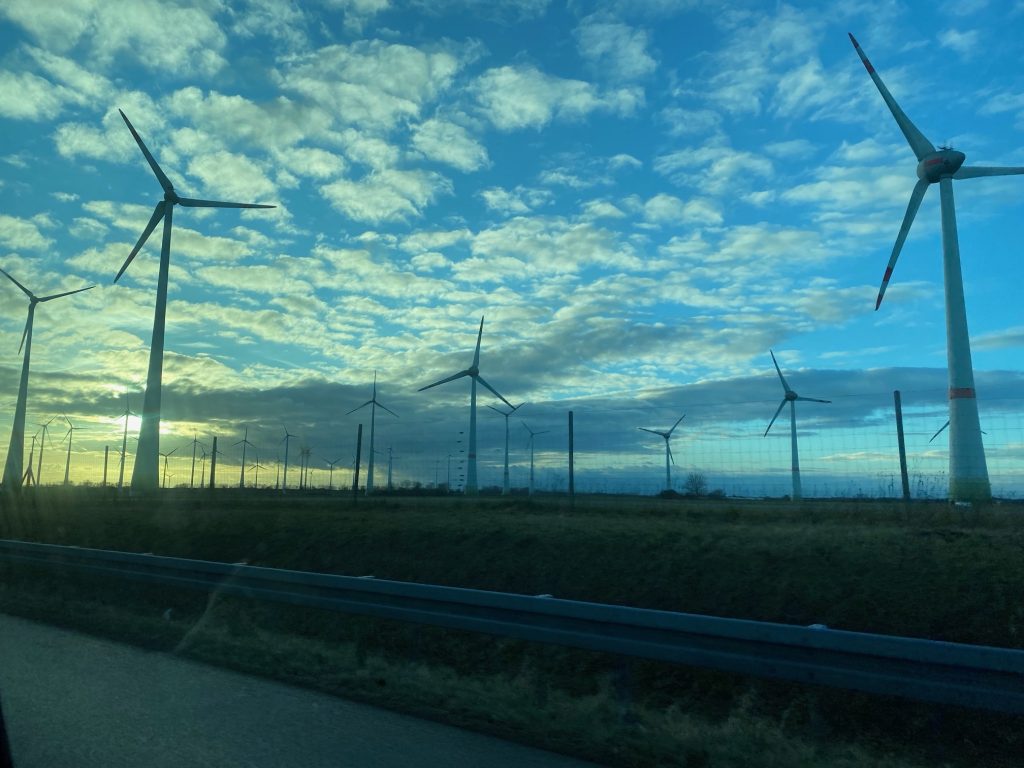
Renewable energy has reached for the 1sr time a share of more than 50% in Spain and Germany in 2023. This is an astonishing milestone in the energy transition of both countries. For Spain a report from Red Energy Espanola attributes the Spanish success story to the expansion of mainly wind energy (Link). The increase of renewable energy in Germany is due to a more rapid expansion of solar energy (Link). In any case a continued expansion of both forms of renewables allows to reduce the share of fossil fuel even more rapidly than previously estimated. Good news for the planet particularly to phase out energy from coal due to its highly polluting side effect. Countries with faster trajectories shall serve as examples that it is feasible to manage the energy transition also for large countries. Political instability might be a price worth paying considering the positive effects for future generations. Managing the transition in a just way which means to assist poorer households, ensures the respect of social policy targets at the same time. With this in mind the energy transition can be perceived by all as an opportunity rather than a threat to their welfare and wellbeing.