Utopian Mobility

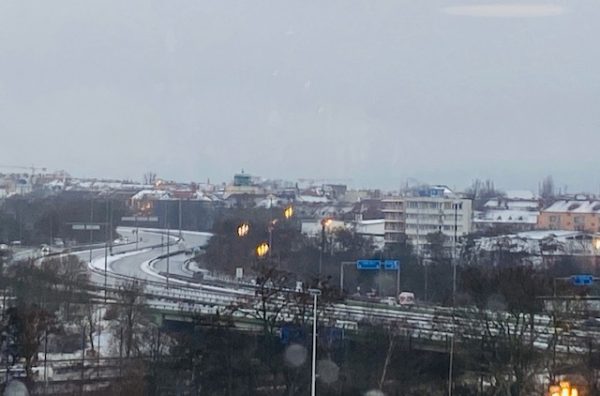
From time to time we have to reconsider our investments in mobility infrastructure. What seemed to make sense in the 50s,60s or 70s often makes no sense 60 years later. Highways, which separate city districts like walls belong to rather utopian visions about City life and mobility, progress and living conditions. These utopian individualized mobility solutions don’t seem to serve us as well as we believed, or were made to believe, more than half a century ago. Empty highways midday at the turn of 2025/26 tell their own story about liabilities from the past and outdated ideas of technical and social progress. Sharing solutions have become very popular and the younger generations adopt already different mobility patterns than older generations. Each generation adheres to its own more or less utopian mobility model, adjustments are likely to be made accordingly. 
Utopian Antifascists

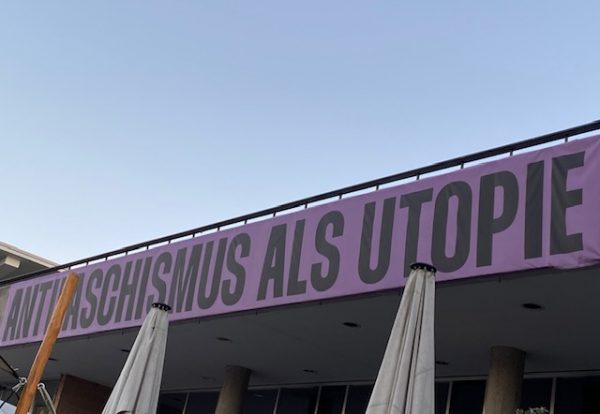
Next to the exhibition on “Global Fascism” in Berlin in 2025-12 there was a banner on the wall, which stated “Antifascism as Utopia” (see image below). This statement invites the question, whether an antithesis can serve as a positive utopian idea guiding large numbers of people. It is certainly necessary that all people who subscribe to democratic principles and human values should be able to unite under the banner of antifascism, but the ways to pursue this goal are manifold. This makes the claim of an utopian objective a bit more obvious and, at the same time, more plausible as a potentially overarching objective. The statement might well turn out to be the defining statement or key visual of the year 2026 with rising nationalist and in some places also fascist ideas and rhetoric. Thoughts and words might be only precursors of more such actions in the coming months. 

Saint-Simon Utopia

Towards the end of the 18th century and during the early 19th century, the early signs of what the industrial revolution would mean for the working people became visible. Saint-Simon had lived through the ups and downs of the French revolution himself and had been to the Americas with La Fayette before he developed his utopian socialist vision of a unified class of working people, which for him included blue as well as white collar workers. At the advent of the 2nd industrial revolution through general and agentic Artificial Intelligence (AI) in 2025, we shall most likely witness a renewed interest in utopian scenarios and grand ideas of what the future of technology, society and humanity might be like. In 2026 we shall re-read Saint-Simon quite a bit in order to learn about ways to make sense of arising trends and how to come up with a positive utopia that can motivate people to thrive again for more equality within and between societies. 

Q Q Utopia

Projections into the future, the painting of a futuristic image or an utopian narrative can be based on a quantitative or a qualitative approach. A quantitative projection into the year 2100, for example, is form of creating an utopian vision of quantitative developments. Projecting the small reduction of working hours into a very distant future will eventually approach zero hours (tous sublime). Alternatively, utopian scenarios for qualitative characteristics of work and employment range from full health and safety or “cure yourself by work” (?really, “Arbeit macht frei”) to AI and robots designed to solve major laborious tasks and challenges for us. It is important to differentiate between the qualitative and quantitative forms of utopian visions. The time frames matter, too. In politics various combinations of utopian perspectives have frequently been combined. The human mind’s capability to project itself into the future explains our tendency to come up with utopian ideas or scenarios irrespective of our ability for rationality. We better acknowledge these human characteristics rather than insist on an either, or image of ourselves.  

Positive negative Utopia

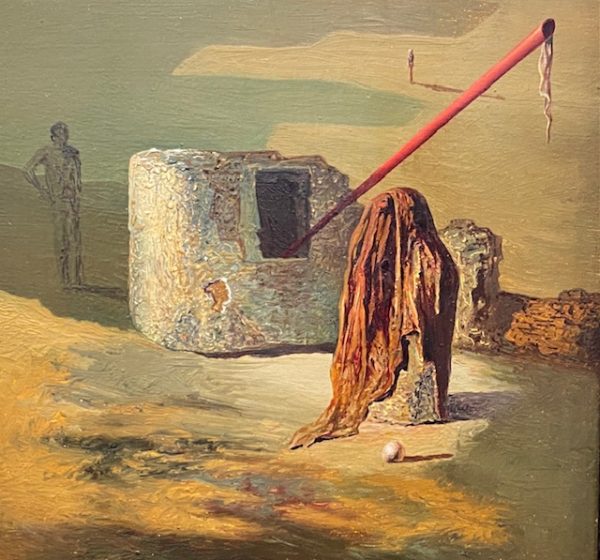
We have been used to distinguish between a positive or a negative utopia. The idea of a paradise is usually associated with a positive utopia, however, from the perspective of mankind being unable to live together without the idea of God being the ultimate arbitrator, this is more like a negative utopia. The industrial revolution and communism as the utopia to spread wealth equally across generations and all people, have been turned into negative utopia by dictatorships and authoritarian regimes. The fascist ideas of superiority of a race has also turned into negative horror and Nazi-terror. Hence, skepticism is in order, if either form of utopia is advocated. There are numerous examples of unintended or not explicitly stated consequences that have to be considered as well. (Image: Extract from Salvador Dali, Looming Danger Alarm, 1934, Neue Nationalgalerie, Stiftung Pietzsch)  

Future of work

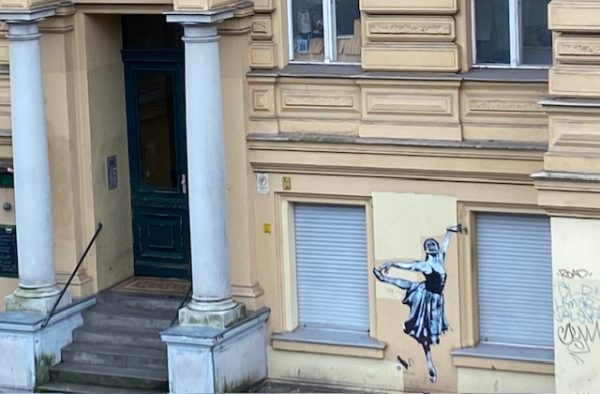
The beginning of the 3rd millennium has brought about several fundamental changes of work and employment. What had previously been thought of as utopian in the realm of work, has become a normal feature of work. Just like in the historically grounded, utopian perspective described by Bernard Gazier “Tous sublimes” (2003) we have a growing group of employees and self-employed persons who enjoy privileged positions on the labor market with sufficiently high salaries and access to mobility on the labor market at their own discretion. In addition to these examples described in Gazier’s utopian perspective, the 2020s added permission of remote work from anywhere and use of AI-assisted technology and robotics. A previously utopian view of the future of work has become a reality for many more people nowadays. The utopian element no longer is the how this world of work might look like, but how many people will enjoy the benefits of the technological progress. With a substantial increase of the efficiency and productivity of work, the distribution and sharing of the fruits shall become even more important. We have entered into a new phase of “the brave new world” of work as of 2025. (Image: Graffiti Berlin 2025-12).

Europe x.0

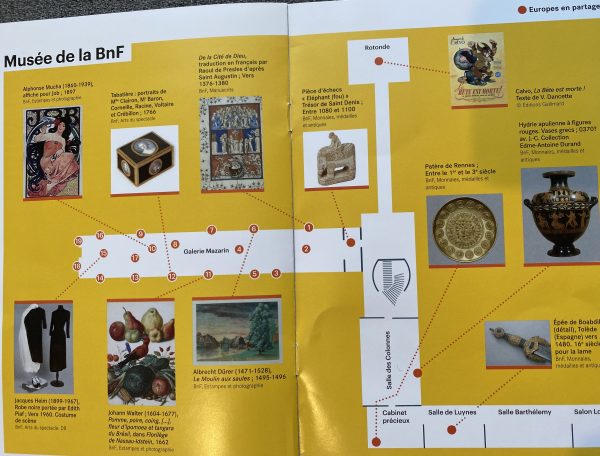
There are many places to ponder, think or dream about Europe. The centre of Paris is certainly a great place for this. More precisely, the “Galerie Mazarin” invites us to pass the centuries looking and reading about artefacts that made Europe or all different versions of it across history and geographic spaces. The short extracts of chansons that we share and shared across Europe are presented in their original language, which highlights the multilingual heritage of the different versions of Europe. There are parts of the heritage, which have fallen into oblivion like the customary use of tobacco exposed with a “tabatière” and a poster advertising paper for your cigarettes. Of course, the “Robe noire portée par Edith Piaf” on a stage is another highlight of the visual and audio joint European heritage.
Where do we go from here? Image Europe with an emphasis on its shared culture. There is so much diversity to be found in each country and regions within countries, but a shared appreciation of the valuable contributions to the whole. This builds a shared European strength, which has proven to overcome several fierce wars. This is the future-oriented version of Europe xx.0. (Image: BNF Musée Europe en partage, 2025)

Installation Guide Linux

Use the info available in various help forums, maybe videos.
Optional: Check size of your hard disc for backup.
Why not renew your backup on an external drive or USB-stick now?
Test your system loading interruption key combination.
Upon RESTART on most systems you use press Power-up key, follwed by either ESC or DEL or F1, F2, F10, F11 key, while power-up runs to load your BIOS.
Have an empty! USB sticks (4 GB+) ready.
Download the for example the latest Linux Mint 22.2 on it (and flash it using etcher on USB from hard drive, if downloaded to hard disk).
Power-up computer with loading system from USB-key not hard drive. (Select option!)
Remember it has English keyboard as default when you connect your WLAN.
Basics are ready!
Keep starting from USB or after some further tests of components install Linux to the hard disk and say goodbye to a slow and costly Windows and Office packages.
Donate to whoever supported you. Perhaps your local repair shop.
Spread the word and help others.

Bulimia Capitalism

Each time a wave and speculative bubble in the economy is building up or even bursting there are thousands of people who become drawn into chaos. Let us quickly review: Oil bubbles in the 70s, financial crisis and  subprime lending in housing markets, 1st internet bubble and the year 2000 bugs, AI excesses in 2025. These boom and bust cycles resemble the medical and psychological patterns of a bulimia nervosa. The overly optimistic outlook for AI companies’ future profits and shifts in the size of office space needed for companies announce bulimic behavior when at the same time vomiting by the same companies occurs with regard to investments in nuclear energy plants even in the sites like Fukushima in Japan or Three Mile Island in the USA. Bulimia Capitalism seems to be eating its own children. The upcoming year 2026 will be full of revelations in this respect. (Image: collection of about a hundred barbies exposed on a flea market in Brussels on 5 levels).

Socio-technological obsolescence

The standard literature or AI-sytems will give you a definition of on technological obsolescence, which specifies that obsolescence does not mean that a device is broken, but that it is outdated. In computers this might be due to hardware no longer supporting newer, more resource demanding software, or newer software insisting on the use of other hardware. The seemingly rapid innovation cycles in smartphones, cars or robots might justify such technological obsolescence, but the real advances like shifts from 3G to 4G to the newer 5G mobile frequency standards have taken place rather slowly due to provider coverage of sufficiently large, particularly rural areas.
Therefore, the technological obsolescence has to be enlarged as a concept to socio-technological obsolescence as the societal, legal and economic boundaries of technological innovations have to be taken into account as well. Provisions for health concerns or CO2 saving circularity, i.e. reuse of resources have to be taken into account as part of a precautionary principle.
Computer screens have asked us to move from square designs to wide screens (watch videos) to smartphones’ standards of long formats. My 20 years old square screen has been doing a reasonable job throughout these periods, though not for serious games.
The socio-technological obsolescence relies on a “socio-technical prestige score” of products, like for luxury brands in other industries, where fashions drive obsolescence more than technology.
(Image: Robotic arm made by Kuka writes on paper sheet at Frankfurt book fair 2017)