Droplet physics

For people with a penchant to physics or engineering, taking a shower is not only a cleaning procedure. Have you ever asked yourself why sometimes you spill water droplets all over the place whereas at other instances the water just flows down the walls? Well, droplet physics or engineering will provide you with an answer. The speed of the water and droplet beam, the size and angles and, maybe, the kind of soap or lotion you apply have a decisive impact. If you have sufficiently investigated this question, you can turn to the acoustics of droplets falling down and the rebound on the floor. We do not know, whether Jean Sibelius, the Finnish composer did such studies in his shower or Finnish sauna before he composed his water droplet duo. We can only encourage to take water and liquids more seriously in our daily lives. (Image and Instructions for experiments under Rainfall Shower) 

Deus ex machina

The term “deus ex machina” used to be applied more in its figurative meaning. With the rise of digital tools like chatbots, facilitated and enhanced through AI, God is speaking to us not only in multiple languages, but also from our pockets through our smartphones and headsets. This is a rather recent form of “deus ex machina”, which we did not expect some years ago. The bible as e-book or pdf-file has been around for some decades, but only more recently we can enter conversations with God through chatbots as another version of “deus ex machina “ about almost everything (and pay for it via digital credit card). Programming of such an AI-tool is easily achieved. AI will prepare a weekly or daily sermon or prayer for you, following your predilections of your favourite quotes of the bible. An interesting twist to the programming is to use authorized as well as unauthorized translations of the bible across several centuries.
Another interesting enlargement of the input data base is the inclusion of interpretations and discussions not only within your own religious community, but beyond. Maybe the discussion of several different religious chatbots with each other could prevent aggressions due to differences in basic beliefs. These “dei ex machina” might further our understanding of what makes us humans different from machines and machine-based solutions of human conflicts.
As genetic clones of ourselves have become already technically more feasible, our digital alter-egos (the comprehensive collection of traces in the internet and digital images, plus social scoring) help to empower those “dei ex machina”.
This kind of “Brave New World” asks us to be rather brave ourselves.
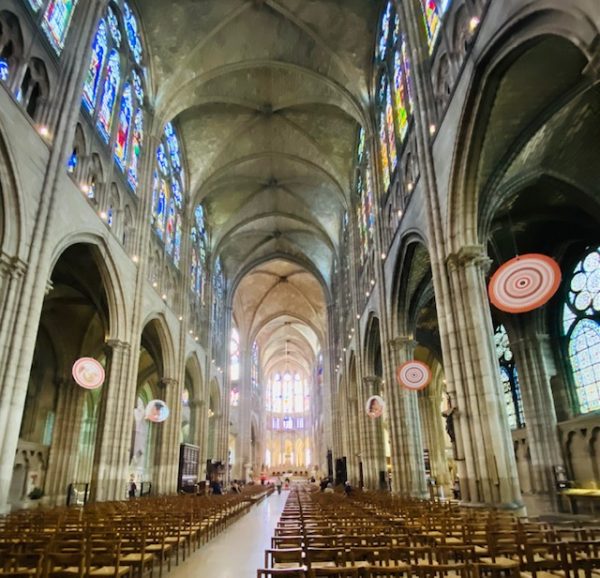
(Image: interior St Denis Basilique Cathedral Paris 2024)

Political Economy 2025

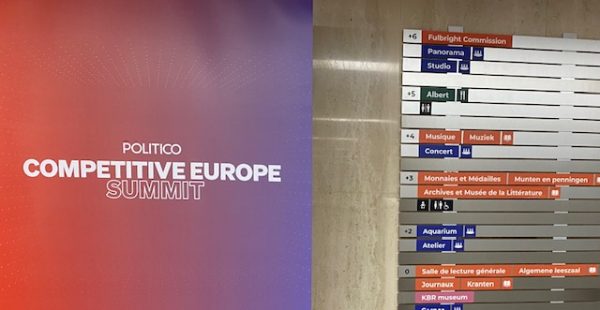
As the global markets have moved from an international economic system based on competition to a world of protectionism based on arbitrary tariffs and restrictions, it feels strange to spot banners in Brussels in 2025-10 entitled “Competitive Europe Summit”. Participants at the conference appear to be “barking up the wrong tree”. In industries, and even more so in most services, access to markets is the necessary condition to embark on competition. No access, no competition. Tariffs or taxes are created to stifle competition.
All this has multiple reasons. One reason is to create an equal playing field among countries. Previously, we thought exchange rates of currencies and eventually purchasing power parities would shift following changes in competitiveness. This mainstream economic thinking has been disrupted through Putin’s war on Ukraine territory. The MAGA political economy narrative has impacted the competition between countries as well, (1) with its rhetoric and (2) back and forth changes in tariffs. Competition with countries which do not respect basic principles of fairness in competition can no longer be confronted with a mantra of a “competitive Europe”.
A more unified Europe could deal with the “politico-economic” fact that the global economy is much less concerned with the idea of competitiveness than in the last few decades of the last millennium (70s, 80s, 90s). Powerplay between nations maybe regarded as a kind of competition for dominance, but a sole focus on economic competition is grossly misleading nowadays after 3 years of the Russian aggression, at least with a focus on the short and middle distance run.

Unexpected effects

It is, unfortunately, a rare event in science to publish unexpected effects of an experiment. Sometimes, results even turn out to be the opposite of what to tried to show with the use of an experimental setting. The learning for the science community, however, is bigger in such cases. Why? A carefully designed experiment (Oliveira et al. 2025) to measure the effects of 2 different 12 month long yoga trainings to prevent falls in 60+ persons (mean age 67) revealed that the less challenging “seated yoga” was better in preventing seniors from falls.
Participants in the more challenging Iyengar yoga-based sessions reported more falls in the 12 months follow-up period. Due to Covid-19 the trainings took place as an online course, which might have reduced the influence of a coach in correcting positions and observe other physiological or psychological issues with participants.
However, the insights are a great lesson for experiments to produce opposite results of expectations with the lesson that human beings can be rather complex. From a health psychology perspective, it might be the case that participants in the more challenging yoga classed became also more daring in balance as well as other exercises.
Just being overly confident compared to their positive improvements, which might turn around an initially positive effect on balance and falls. From a socio-economic perspective, we would question the implicit assumption of the study that participants have a random distribution or underlying tendency towards risky behaviour. The longer the observation window (post-intervention) is, the more intervening socio-economic factors enter into the physiological-behavioural equation. Hence, expect unexpected effects.

Inclusive images

In the last 2 decades we can observe a strong concern among photographers to broaden the spectrum covered by images beyond well established imagery of non-binary gender. Diversity in imagery has taken a broader scope to extend, for example, the age range of people who are portrayed as central topic of exhibitions. The topic of mental diversity is more recent and needs a similar or even increased sensitivity to do justice to the whole spectrum of people. The photography of people with mental challenges necessitates a much more careful approach to the persons and complex personalities the photographer intends to portray. Trust and the development of trust of more vulnerable persons is a time sensitive process. The work by Charlotte Abramow “Maurice, Tristesse et rigolade” is a fine example of a photographer who portrayed over a long time of taking care of her father, previously a medical doctor, The years of the final stages of the life course of her father have been the subject over many years as the survivor of an extended medical coma had to struggle with the tough challenge of re-learning basic life skills again.
Abramow portrays her father as an actor of his “second life”, where the borders between reality, reconfigurations of his memories,   and “mise en scene” to co-produce the images. The images go far beyond the portrayal of aging and mental challenges as a deficit of persons. Yes, it is an integral part of these persons, but there is so much fun and positive emotions that derive from the intensive collaboration of actor, father and photographer that the images stick with us for a longer time. The presentation of props along with the photos creates an immersive installation, which strengthens the emotional bonding with the inclusive images of the later phase of the life course of Maurice.

Ethics in Photography

Yes, you read this correctly. This entry is about the ethics in photography, not about the much more popular discussion about the aesthetics in photography, which fills thousands of books on fashion, architecture, minerals, flowers, animals, landscapes and … you name it. Sensationalism works in photography. The more spectacular an image, the more likes you’ll get in any media, social or so-called social as well as traditional ones. Sex and crime are popular subjects, better framed as objects, as well. The basic idea of what constitutes unethical imagery or photography is broadly defined by the principle of exclusion, i.e. what is not ethical in photography. Let’s add to this inventory the conditions of production: exploitation of the subjects, be they persons or animals or even authorship like violations of intellectual property rights by AI.
Regulations and legal frameworks clarify many of those issues, enforcement of these rules are yet another element related to the ethics in photography. Global warming and the loss of biodiversity has made us aware that the respect of natural resources is also an aspect in the ethics in photography. Travelling long distances by plane just to get a few shots in the Himalaya region, if there have been thousands of (better?) images produced, printed, distributed before, is not sustainable for our planet as a whole. Invading protected areas, like natural bio-reservoirs, to take a few shots especially of rare plants and flowers maybe nice to look at, but the longer-term consequences add up to a loss of biodiversity for us all, in particular for later generations.
These considerations are different from “aniconism”, because they originate in a humanist foundation of ethics not concerned with any depiction or idolatry of images. The historical roots of any ethics in photography have long shadow into today’s practice of photography as well.
(Image: The framing of ethics of photography with reference to John Cage “Silence“)


Sink / Rise

Nick Brandt presented his engaged photographic projects “The day may break” in Brussels at the Hangar Gallery space in Brussels (2025-9-21). The photographic work spans the globe to document and tell the story of a an endangered planet. The environmental and social fabric is at risk of an unprecented scale in the 21st century. Rather than producing hours of documentation, Nick Brandt focuses on images that stick. His “mise en scene” is meant to haunt us. And it succeeds in it. In the best sense of a tradition of a “photographe engagé” he intends to convey messages, even whole narratives to us about and from people in remote places, who are endangered through our inaction or paralysis in front of the challenges posed by global warming and climate change as well as the social and societal consequences.
We can save people from drowning in floods and rising sea levels. The chapter Sink / Rise of this project was produced with people from the Fiji islands who participated in the futuristic scenario of a sunk island. Without accusations, these people question us. Why? How? What for? Where to? – without speaking a word. They spend time in on a sunk island, surrounded, submerged by beautiful, but morbid, turquoise water and the graveyard-like remainders of a broken coral reef. These are photographs not of these people, but about them, about their likely fate, and (very important) produced with them as empowered actors. May they have a chance to rise like a phoenix from the ashes from these photos.
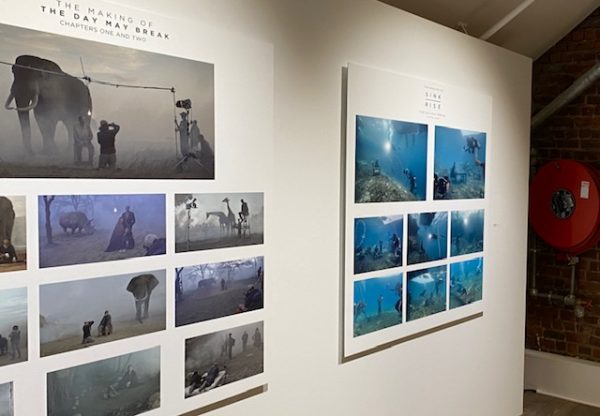
The documentation on the “Making of …” (image below) as part of the same exhibition allows transparency and additional insights into the artist’s work and proceedings.
(Image: Hangar Gallery, Brussels 2025-9-21, On the making of Sink / Rise by Nick Brandt)


Marc Aurel Memorials

The depiction of Marc Aurel as Emperor has become a trade mark in the history of art and politics. As an emperor with good horse riding skills, Marc Aurel was the first emperor to be portrayed as riding on a horse without saddle whilst, of course, in perfect skill to master the horse and give orders or strategic commands. Many subsequent emperors, Napoleon or Friedrich have had their power positions “immortalised” as such, which served at the same time to make them appear taller and “in command” of something.
Travelling by horse has  also been for a long time the fastest mode of transport, yet another symbol of social status used in media campaigns of those times. The memorials in honour of Marc Aurel had already during the ancient time the function to transmit an image, the emperor wanted history to keep in mind, rather than the view of ordinary people in the Roman empire. Memorials of political leaders have been a demonstration of power for centuries before and for centuries to come.
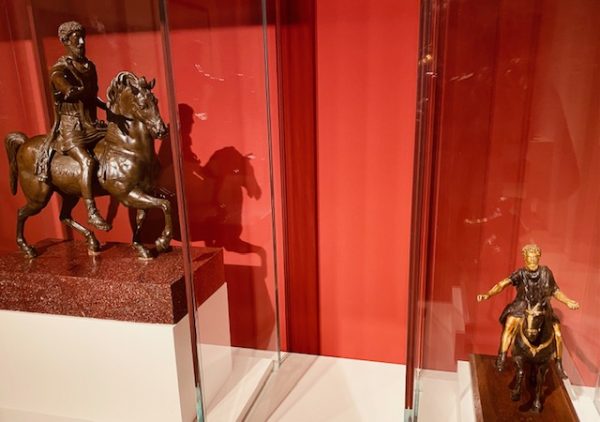
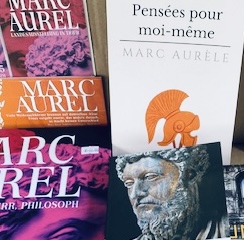
(Image: Trier Marc Aurel exhibitions 2025-9)

Marc Aurel critics

In the literature on and about Marc Aurel (Brenan 1882, pp. 484) the end of the ancient world is mentioned frequently. This refers to the beginning of the end of the Roman empire and the rise of Christianity to be become more influential. What caused the decline? The nepotism in the governance structure through the placement of family members to influential positions and as successor alienated many followers who previously believed in the high moral standards advocated by Marc Aurel.
Justifications of superiority by social origin are standard at the time of writing, but Marc Aurel did not see the potential of a more equitable distribution of offices. Women were relegated to subordinate or no public positions and are not mentioned with respect to  the importance of reasoning or social competence either, none but one in his acknowledgements (Book 1). The discrepancy between the formulation of virtues as well as ideal standards versus own practices of hierarchical leadership, recourse to slavery and brutal upholding of the empire should not go unmentioned.

Marc Aurel Advice

The study of Marc Aurel’s Meditations offers advice on how to conduct one’s private and public life. The role as advisor or teacher is an important part of his writings, albeit quite indirect. In going back to Book 1 and his acknowledgements of his own advisors, teachers and good examples indicate the motivation and intention to write down his meditations. “People exist for one another. You can instruct, or endure, them” (Book 8, paragraph 59, see also Barrientos 2020). Marc Aurel does not shrug away from the treatment of general concepts of humanity like justice. In his view “… justice entails the exercise of wisdom, kindness, and fairness in our relationships with others both individually and collectively.” This includes already tolerance as a part of justice as in Book 4 paragraph 2, according to Robertson (2020). The idealistic view of humanity, following Platon’s philosophy and other Stoic authors, still serves as a benchmark against which many leaders are measured today (compare Le Monde 2025-9-25 p. 26).