Chatbot Me

Chatbots are helpful to allow queries to larger data sets like the blog entries here. So here is a try of a Chatbot to query all entries on AI using ChatGPT to create a Chatbot that uses and references it source from www.schoemann.org/tag/ai and the AI reader in pdf-format.
Please send me an email if the hallucinations of this Chatbot 1.0 on AI from a social science perspective are giving strange results. I’ll get back to you. Please use at your own risk as I cannot guarantee for all answers. The usual disclaimer applies here.

ChatGPT proposed the following set of Questions and Answers on the blog for an entry into the chat: Example Q&A with the chatbot

Q: What are the social science concerns with AI?
A: Bias in results, job shifts, democracy risks, privacy, and new inequalities.

Q: What does the text say about reinforcement learning?
A: It’s seen as the next step for AI: focusing on learning and reasoning, not just predicting text. It also uses fewer resources.

Q: How are robots described in the document?
A: Robots are mostly assistants. They can follow people or carry small items, but more complex tasks need sensors and AI training.

Q: What about biased results?
A: Studies can be misleading if control groups are flawed. AI faces the same challenge — social scientists warn: “handle with care”.

Q: What is Schoemann’s blog view on AI?
A: He links AI to energy use, fairness, and its role in the “all-electric society” — stressing efficiency and responsibility.

More on the chatbot (in testing phase) and the Link to the coding help received from ChatGPT on this mini-test-project :
https://chatgpt.com/share/68c1d160-0cc0-8003-bf04-991b9e7c3b24
 

AI Podcasting Me

Content producers have lots of tools at their disposal to get their content across to very different audiences. For some time the traditional media of newspapers, radio and TV were the prime outlets for content distribution. Social media have changed this to many more senders of content than before.
In the 21st century, AI allows to automate media productions. In a trial run I just used Google’s NetbookLM to generate 3 podcasts based on my own writings on AI over more than a year by now. The result is available and using artificial voices it is possible to broadcast yourself without revealing your own personal voice. I am not done with the evaluation of the outcome(s) yet, but the first impression is an interesting other form to spread content.
More tests are necessary to check for hallucinations as well.
Here are the links to my virtual podcasts:
AI, intimacy and insecurity

AI, Society and the Human Spirit

AI and the Human Mosaic: Navigating Our Interconnected Future

Video Doku by AI

Based on my own blog on this webpage “schoemann.org” Google NotebookLM creates a video of about 7 minutes. Using Microsoft Clipchamp automatic subtitles with a slightly different storyline are produced based on the video data. In the end, the blog entries are re-modelled into something like a lecture on “AI in a wider social context” (see and play below). No voice layover so far, read by yourselves. A podcast format is another option.
It feels like walking across landscapes in my own mind. Content creators of today or the past never imagined the impact they might have through the powerful tools of AI. The only caveat, jokes I incorporated into the texts cannot really be handled by AI tools unless they are explicitly designated as such. These AI tools take me much more seriously as I do myself. This is serious.

Mind Map Me

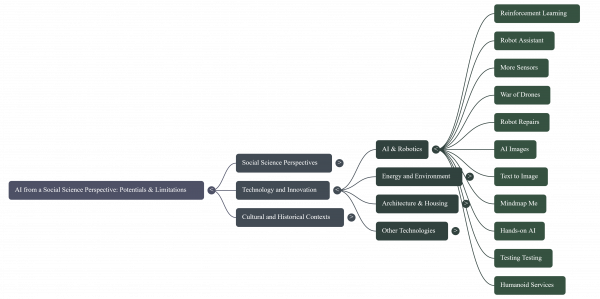
AI tools are great to assist learners in the task to get more structure into larger documents or books. It is up to the teachers or lecturers to use the tools themselves to pre-structure content they want other persons to learn. Mind maps are useful to summarise larger content and offer a tree-like structure to a text moving from the general to more specific content and then into details by at the same time not loosing sight of the overall structure of the content. Basics can be provided by Google’s NotebookLM and you may rework this basic structure yourself linking the mind map to the detailed content. Learning may start with a comprehensive mind map at the beginning to move on to details. Alternative versions of a mind map are equally feasible to come up with new combinations of subjects. This can be done using the tags of the blog entries in addition to the categories and fast search keywords.
It is a fascinating way to mind map yourself based on longer texts written by yourself. This clarifies a bit what potential readers or learners are likely to retain from reading your document(s) or blog entries.
Its worth trying, as others will most likely use these tools from now onwards anyway, whether we like it or not.
Image: Google NotebookLM Mind Map of my AI blog entries 2025-9-9.

Own AI related entries

The digital drafting of blog posts facilitates the publishing of volumes based on a selection of entries. Pdf-files, or EPUB formats are quite common. The choice of a flipbook is more suitable for larger screens of tablets or notebooks. It also serves as a rapid stock taking of entries and missing topics to cover a broader field. In some fields AI is not yet popular, for example in agentic home applications, whereas in other fields text, translation or image production AI has grown into a threat to professional fields. Even computer languages are a major field of application with substantial negative employment effects.
Hence, enjoy the latest comments on AI towards the end of my latest Flipbook.
Just click here.

ChatGPT provides a summary of my AI-reader as follows:

From the uploaded text AI from a Social Science Perspective (Dr. Klaus Schoemann), social science concerns with AI focus on potentials and limitations of how AI interacts with society:

  • Labour and employment: AI impacts jobs, but adjustment processes are slow. For example, there’s a shortage of engineers and care workers, while robots are still limited to simple assistant tasks. This raises concerns about who benefits and who is left behind.
  • Bias and fairness: The book highlights issues of biased results in research and decision-making. When AI systems rely on incomplete or selective samples, results can be misleading — a challenge also familiar to social scientists.
  • Democracy and accountability: Journalists and scientists are framed as part of a “checks and balances” system. AI adds complexity here, as the fast spread of information without accountability can weaken democratic processes.
  • Human–machine relations: Topics like intimacy, housing, and memory are re-thought in the context of AI and digitalization, raising questions about privacy, social norms, and cultural heritage.
  • War and security: AI-driven technologies like drones change the nature of warfare, raising ethical and political questions.

On his blog, Schoemann also stresses the energy and resource costs of large AI models and how reinforcement learning offers a more efficient alternative. He warns that AI should be understood not just technically, but as part of an “all-electric society” where social sciences help assess risks, inequalities, and long-term consequences.

👉 In short: AI raises social science concerns about equity, bias, democracy, labour, cultural shifts, and global risks.

Marc Aurel AI

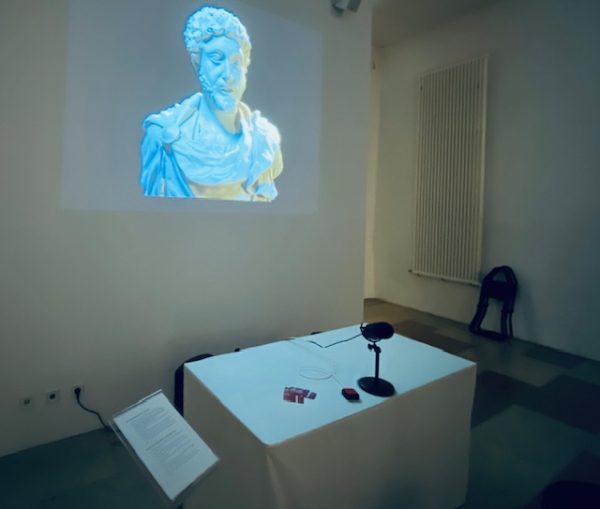
In the 21st century it is possible to chat with Marcus Aurelius. Part of the exhibition at the Simeonstift is a chatbot you may freely consult and questions with or about Marc Aurel. Based on your questions the animated screen image of Marc Aurel will reply based on his own writings like the Meditations and (probably) other secondary literature on Marc Aurel. Questions about feminism or slavery are answered based on the original texts. Some of these answers  appeared rather modern like the basic equality of all including women or slaves. The Meditations are an idealistic vision of mankind in the stoic tradition. In practice such ideals have proven very ambitious for the many and growing temptations in the day-to-day lives of ordinary people including their political, religious, business and military leaders. The AI is confronted with the issue to give answers to ethical questions which refer to the time of the author, but not all can apply to today’s ethical standards and basic human rights. Reading the original source, therefore, remains the preferred choice. 

Marc Aurel Philosopher

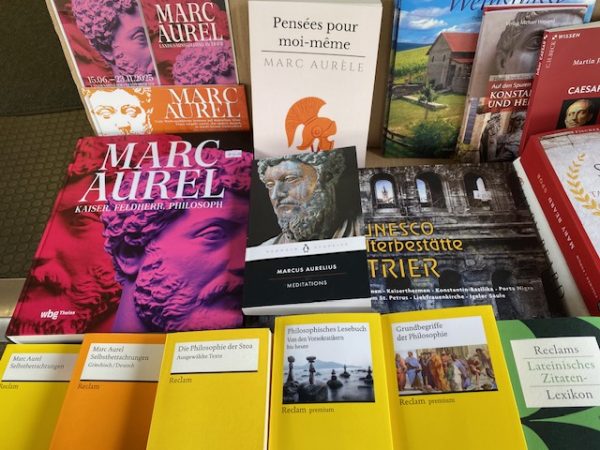
2025-9 marks an additional landmark in the achievements of the late Marc Aurel. In the Roman built city of Trier, 3 museums offer exhibitions on the life, ideas and imperial governance style of Marc Aurel. Libraries and bookshops around the city portray a wealth of books and studies by and about Marc Aurel as well in many languages (image below 2025-9). The stoic author and practitioner has served as an example of a leadership style which became for many subsequent leaders a hard-to-achieve precedent. The writing style of Marc Aurel in short paragraphs and aphorisms proved highly accessible, although his readership swell only after a Latin translation of his Greek original appeared in the 16th century. The title “Meditations” in English, “Pensées pou moi-même” in French or “Selbstbetrachtungen” in German demonstrate the difficulty to get to grips with the author’s intention and objectives in writing down these reflections on life, ethics, humanity and good governance. Through the use of Greek rather than Latin he puts himself in the line of Greek philosophers rather than the succession of Roman emperors. As the numbers of bad leaders still outnumber the good governance style advocated by Marc Aurel, these exhibitions in the Simeonstift, the Landesmuseum and the Stadtbibliothek are a perfect opportunity to demonstrate that good governance is something that can be studied and learned even in the distant Roman history.  

Individual and Cosmos

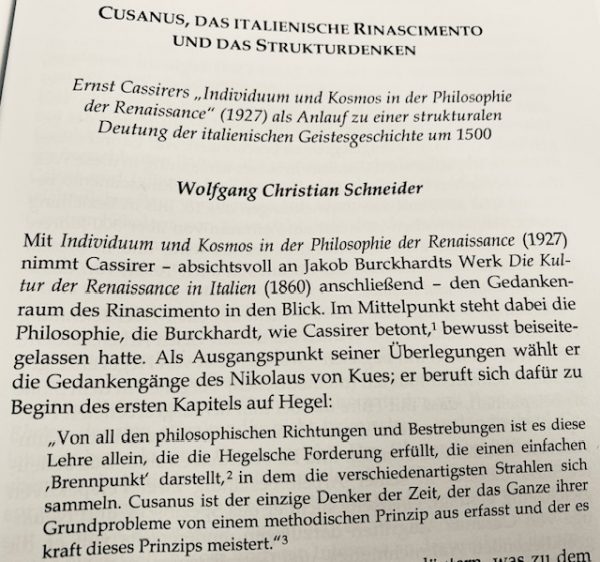
The major work by Ernst Cassirer “Individual and Cosmos” can be read from a perspective of the history of ideas (Schneider, 2024 in Coincidentia). The work of Cassirer refers back to Nikolaus Cusanus in the way that the worldly ideas concerning the sciences and everyday life of the individual are embedded into the perspective of the cosmos. The latter (cosmology) is of course at the time of the 15th century dominated by religious doctrines. Schneider highlighted the merits of Cusanus as a major contribution to the Italian  “Rinascimento” due to his ability and willingness to draw on all the best knowledge available at his time. A frequent travel to Italy and Rome including the library of the Vatican was a precondition to gather such an overview. Schneider opens up another interesting debate about the competence of Cusanus to read and write Latin and Greek. Contrary to previous statements he highlighted the fact that Cusanus created new words or notions that were unfamiliar or new at his time. Nowadays such creations are very common to express new ideas or combinations of concepts. At his time this was interpreted rather as a lack of clarity or imprecise language.  

Former Crypto currency

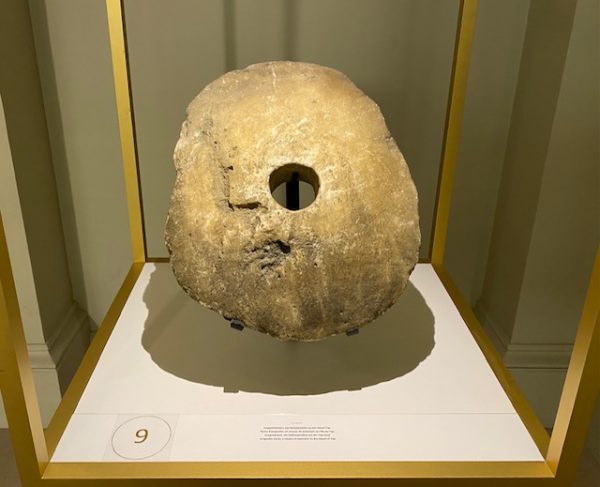
The rationale behind a Crypto currency is quite an ancient idea. In the absence of a central bank or in addition to it, people may choose to establish their own currency or currencies. The central idea is to secure assets (currently and in the future) as well as to enable an exchange between a community of people. The Museum of the National Bank of Belgium (image below) has a “Yap stone” on display which originates from the Pacific Yap Islands. Even very heavy and big stones served as wealth storage. The idealistic value of a particular stone conveyed additional value. In the true value of the word these people were banking on stone money in a way not to distant from what Crypto currency embodies today.

AI in Central Banks

Yes of course, Central Banks will use AI, and some do so already (Kazinnik and Brynjolfsson, 2025). Beyond the standard application of AI by its employees, there are many potentials to use AI to analyse and publish data at a faster rate or in order to detect financial crimes. Similarly, data collection based on webpage harvesting might yield new indicators of inflation, expenditure for environmental risks (heat waves, flooding etc.) earlier and in addition to the normal set of indicators. Hence, Central banks might be better and faster in forecasting inflationary tendencies using more AI tools in their daily routines. Of course, it is difficult to predict a disruptive tariffs policy of a major economic player in the world economy, but the calculation of more, even hallucinatory scenarios become more feasible. It is feasible to weigh overall risks of different scenarios to the economy.
(Image: Celtic coins, Museum of the Belgian National Bank)