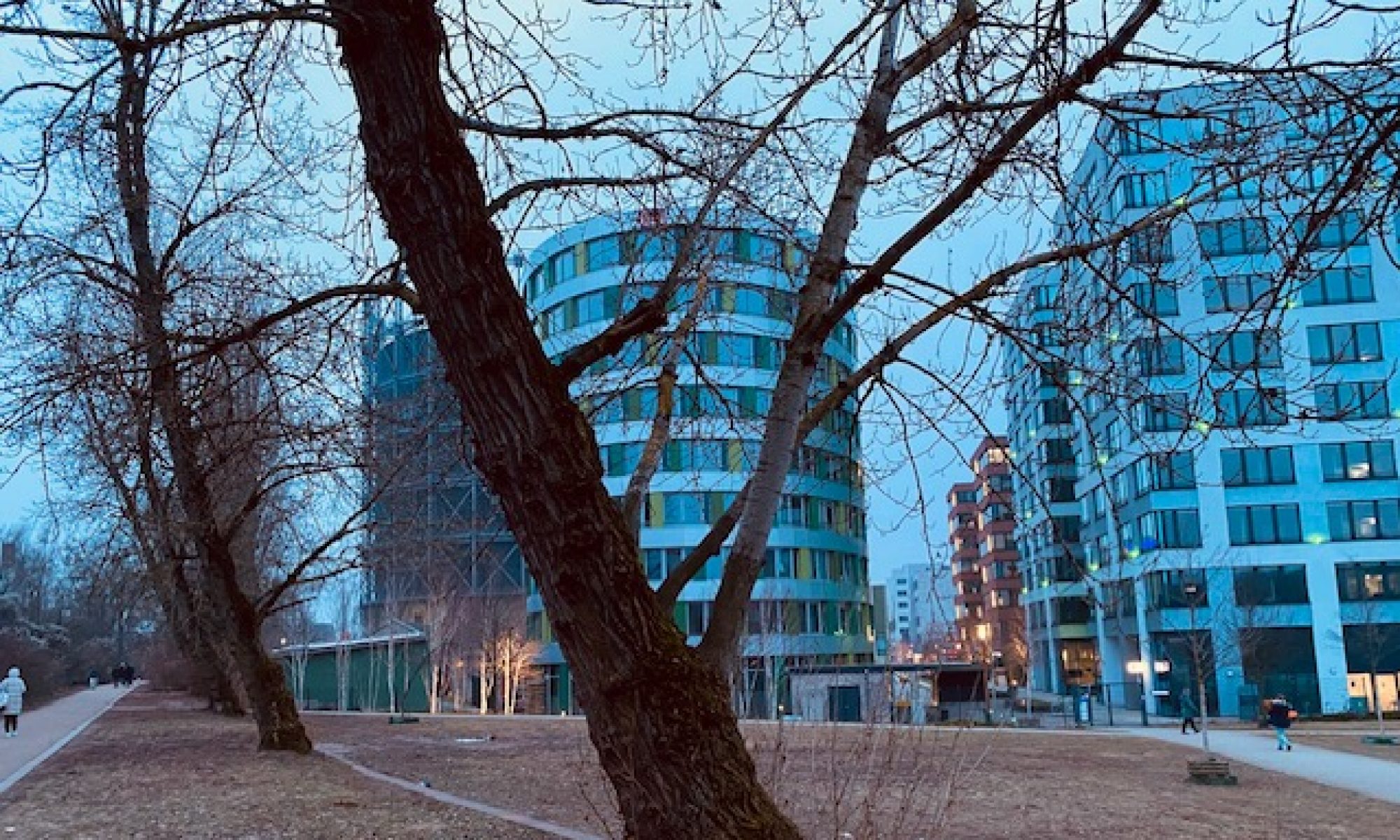
In some cities, “I love Paris” (Jazz Song), we admire the “breath-taking” large corridors, right in the centre of the city. This has been the outcome of the urban planning in the 18th century. Haussmann designed large parts of Paris with huge corridors despite the medieval narrow streets in some of the arrondisements”. Ease of traffic, fewer riots and representative housing became the new mantra of urban planning and superb boulevards.
In the 21st century it is about time to question the notion and social process of corridorisation. This has been accomplished in a paper by Fatima Tassadq et al. (2025). Modern infrastructure like fibre-optic cables, energy or water networks are easiest to deploy in urban spaces with large corridors than the complex narrow inner cities with supposition of different kinds of network layers. The grand ideas of the 18th century should be questioned from time to time and some districts that have escaped the corridorisation might well have a particular charm about them, maybe just because they seem to escape the rational approach of making and structuring space by means of large corridors. Large corridors separate city districts and they are a major driving force of gentrification.
The rationality of corridors has some roots in maths or physics of complexity. A recent paper by Shanshan Wang et al. (2024) reports the surprising finding that the transport corridors in several cities across the globe allow for a 1.3 times the distance of transport networks compared to the so-called direct linear “bird’s flight line”. Hence, corridorisation is (has been) a rather pervasively applied model of urban planning.
Alternative approaches advocate in favor of the 15-minutes walking distance city. All amenities like shops, schools, maybe work and services should be reachable within a 15 minutes walk. This does include “walking corridors” that facilitate (social) connectivity in inner cities. Cyclists also claim their corridors or fast lanes across cities, which underlines the pertinence to take corridorisation seriously and apply the concept with care.
In any case, social connectivity is key. The big social media platforms operate similar to the traffic infrastructure in the 21st century and provide huge corridors to knowledge and people. We only realize this once a service (for example tiktok) or the internet altogether gets disconnected. We have moved from (social) categorisation to (social) corridorisation as technology and rationalisation have taken the upper hand to structure our (social) lives. 
Cheatflation
There are many ways to study inflation. You may start by looking through your collection of bills. Economists like to swear by the consumer price index or indices, if you are even more into inflation. In textbooks like “economics for dummies” we learn about rational behavior and price adjustment mechanisms through the “invisible hand” to find some sort of equilibrium.
Advanced economics courses will teach you about strategic behavior inspired by game theory and the effectiveness/ineffectiveness of cheating. For advanced economists it is, therefore, inevitable that “cheatflation” should be part of the economists’ vocabulary. Of course, a profit maximizing entrepreneur is likely to way the risk of being found out contributing to cheatflation against the potential gains.
How to cheatflate? Too easy. Any producer of a product can cheat by using, for example, other ingredients than those printed on the product label, usually cheaper ones. Instead of fruit juice (wine) you may just sell colored water with lots of sugar (ethanol) in it, but still label it fruit juice (wine) and get away with this, until a consumer protection group makes a fuzz about it. A more sophisticated way is to sell investments in ESG-rated funds, but then include dirty stocks without proper notification in the fund, which probably increases profits based on wrong labels.
There is a specific quality to cheatflation, which makes it different from shrinkflation or enshittification. The drive to “obtain unfair advantages” through cheating across a whole country or region makes cheatflation an economy-wide process and subverts general fairness rules as well as trust in a society.
(Image Saccharometer, DTM Berlin 2024) 
Obesity Revised
The scientific paper on a revised definition of obesity was produced by the special Commission on Obesity. It appeared in The Lancet Diabetes & Endocrinology in 2025-1. The previously common practice by medical doctors was to classify person in the obesity category based mainly on the simple calculation of the body mass index (BMI = weight/height²). A BMI > 30 put persons into the obese category and stigma.
Since the Covid-19 society-wide testing experience, we are all familiar what it means if you get misclassified and have to live with the consequences (exclusion from work or events etc.). The simplifying and summarizing BMI calculation and classification has also produced many wrong classifications. For example, persons with a lot of muscles (just watch this at any fitness studio) will have a high weight relative to their body height², but they are likely to be more healthy than many other light weight, but seriously stressed persons.
In empirical test theory such cases are the so-called false positive cases, i.e. classified as obese, but not a medical problem at all. Medical doctors and health insurances should not finance special treatments for these persons, which foregoes treatment of other more needy persons.
With new expensive drugs on the market to treat obesity it is even more important to test with more precision the normal, pre-clinical and clinical status of obesity. Fatty tissue or muscles, that is the relevant question. Fatty tissue in muscles is the next level testing issue. 
Covid Literature
In 2025 it about time to evaluate the medium term impact of the Covid-19 crisis in Europe and world. The various lockdowns caused unexpected “spare time” or time in isolation. Some otherwise very busy persons embarked on literary projects during these months. Most of the outcomes have now been published. Most authors would not label their writings as “Covid literature”, since they do not deal with the Covid pandemic in any sense. However, only due to the additional time resources, and maybe writing as a creative coping mechanism, some persons became and dared to become authors eventually.
For some isolation from the usual work context was a lonesome experience, others realized literary projects. Camille Paulhan (edition Sombres Torrents) for example used freed up time to write “Couper à travers les ronces” published in 2021. Her short stories, like narrative clips, range from introspection to memorable encounters with art works and artists. As an expert on “perishable art” Camille Paulhan is particularly sensitive to the “fleeting moments” of encounters and maybe of life itself. The Covid-pandemic has certainly reminded us on the increased risks to our existence during a pandemic. The literature originating during these months and years might reveal specific virtues only ex post.
You might still be able to buy a copy at the publisher. The bookshop and gallery Yvon Lambert (online retrieved on 2025-1-20) says sold out, but shows several pages online. Although books may become a perishable product, some copies will survive due to the efforts of fans of perishable art and moments. 
Ukraine Poets
Difficult times have a long history in Ukraine. However, literature and poetry have flourished since the Ukrainian independence from the Soviet domination in 1991. Periods of hunger under Stalin, Nazi crimes in the 2nd World War, Tschernobyl radiation, Annexation of Crimea and now Russian war on Ukrainian territories, the endurance of hardship is part of Ukrainian culture and society. This has created a strength of resistance and resilience which is exemplary for all countries. The democratic countries stand firmly on Ukraine‘s side and support not only military defense efforts, but also artists and poets in such difficult times.
A collection of translated poems from Ukrainian into English has been published in 2027/2018, showing the horrors of the large scale war that was to come a few years later. In fact from the Ukrainian perspective the annexation of Crimea was the first war initiated by Russia although the Western world did not want to see this as a brutal aggression, which it was. The poems in the anthology are available online for everyone to read and understand that war changes personalities. Suddenly, dying of old age becomes a blessing as many young soldiers and people die on the battlefields (Died of Old Age, by Lyuba Yakimchuk translation by Anatoly Kudryavitsky) .
7 years after the translations where published the poems have kept their sorrow and the reminder for us to continue our support for Ukraine‘s fight for democracy, independence and freedom of speech and the arts. (Image: Front: from War Diaries, Brussels 2025, shown in Gallery of Katarzyna Napiorkowska).

Artists networking
Creating a network between rather idiosyncratic artists is no easy task. The more they develop a unique style separate from other painters mixing with other artists can be a challenge because you might find yourself in the position to continually defend your new style. Therefore, building a network of artists that understands the concept or emotion that drives you is a great advantage. In the catalog of the Caillebotte exhibition in the Musée d’Orsay Paris the map of living and working spaces of Caillebotte and his artists’ friends like Claude Monet is a great way to demonstrate the degree of networking and creative spaces that propelled the impressionist movement. The galleries and greater exhibitions of the impressionists took place in the vicinity of the established art institutions, but were not admitted into the traditional exhibition centers like the Louvre. The map from the catalog provides insights into the cognitive map of Paris which Caillebotte had in mind at his time. Artists see cities as opportunity spaces which facilitate or impede the creative processes. 
Politician Cycles
In a bookstore which sells books in English or American language we find lots of biographies or autobiographies of politicians. As a politician you don’t even have to be out of politics when your biographical account or your own view is published, let alone be written. Publishers seem to hunt politicians who made headlines, no matter good or bad. Outside the EU you can always sell biographies at half price, if the volumes sit for too long on the precious shelves of bookstores. Most of the biographies are found in the history section of shops or libraries, however some show off in sections like politics (if not dead for too long) or in the business and management sections. Leadership is a big issue in the latter disciplines, but the psychological or sociological literature starts to meddle with the received wisdom of how single person leadership is in fact facilitated with the many great people around the sometimes outstanding single person. Maybe the focus on a single person is an easily understood and simplifying concept of leadership. In the case of Obama (2x) two single historical accounts complement the one person focus. In 2025 Michelle Obama skipped the funeral of Jimmy Carter where she would have had to sit next to Donald Trump (according to the Daily Telegraph and probably endure small talk). Politics appears to move in circles and politicians might find themselves encircled. 
Space Missions
As we realize that critical infrastructure on earth is not safe in times of military conflict, space missions have become an additional form of competition between countries, continents and alliances. India has accomplished in January 2025 the coupling of 2 space satellites. The level of technological knowledge to achieve the coupling and decoupling of satellites included among other competences the mastering of algorithms that control sensors and propulsion. Beyond the communication cables on earth, satellites can assure telecommunication services, if other networks are interrupted.
The Indian Space Research Organisation (ISPO) has announced the successful “space docking experiment” (SpaDeX) and joins the other 3 countries US., Russia and China as the 4th country to achieve this. The race in space and to space beyond earthly competition shifts attention also to the additional category of a race to technological innovation and applications of those. Since the war of Russia in Ukraine we know about the “dual use” factor (civil and military) of satellite technology. Satellite images of your own country are helpful in many respects ranging from weather forecasts, rain, draughts and habitat changes or population movements. Early warnings of flooding are surely important civil applications. Movements of military equipment by potential enemies are much needed early information, which increases warning time spans. With more satellites in space the good as well as the dangerous potential is expanding. Sovereignty in the 21st century certainly has a technological dimension. Therefore, the demonstration of satellite coupling in space accomplishes not only a dual use achievement, but also fulfils a triple use or ambition. The 3rd one is political. Hey, look we are also watching you, or might do so.
(Image: Robert Indiana “Imperial Love” 1966/2006 in Berlin Neue Nationalgalerie) 
Indigenisation
In reading up on the « all electric society » it is useful to see what the international market has to offer in innovation of electronics, but also to understand the potential of mass production. In this little research the came across the „Electronics for you magazine“ (LINK) from India is a great source. Trends of miniaturization of electronics and power savings for consumer products as well as some high tech space and wave technologies receive systematic coverage.
The November issue 2024 (p. 63) used the term „ Indigenisation“ to refer to the process of a country’s own technological development to ensure independence from being cut off from advanced technologies. Producing in India for Indian use seems to be an answer to economic and technological risks. India‘s space exploration program builds on own supply for civil and probably military purposes as well. Indigenisation of production, therefore, is an adequate term for own indigenous production of specific advanced components.
Contrary to the trend of globalization, which dominated the 2nd half of the last century, „Indigenisation“ is likely to dominate numerous sectors of the economy in the coming years. Made in India is, of course, a brand. Small countries might find indigenisation more difficult to achieve. It needs to be checked, whether indigenisation or „self-reliance“ (Atmanirhbar Bharat) implies plural societies and identities to the same extent. 
Drawing Drafts
The exhibition “Drafts – From Rubens to Khnopff” at the MRBAB offers an art historian’s view on the role of drafts in the creation of art across centuries. You will not be surprised to discover that drafts played and play a crucial role in creative works. With a restriction to drawings, paintings and sculptures, the exhibition highlights the “creative gesture” originating in a sketch of a detail of a body, a face, the body, compositions of forms or perspectives on space. In some instances, infrared reflectographic camera technology or similar techniques were used to reveal the so-called underdrawing of a painting to allow the comparison of a draft with the “finished” or “published” version as an oil painting. The time span across centuries allows to stress the importance of drafts and drawing rather than the spontaneous creation of a unique piece of art. The 20th and 21st century saw this process of creation challenges by several artists and performative versions of art. The basic creative process, however, remains an important pedagogical access to better understand art and its creation.
The curators of the exhibition Bücken and Maréchal (MRBAB) encourage visitors to use pencils and paper to try out the technique of pencilling or just to try to a sketch of something of interest. This certainly contributes to let the message and encouragement to create yourself sink in to the memories of visitors. All in all a very modern view on old and not so old masters.
(Image: Triple view of Jacques Jordeans, Allegory of fertility of the earth, 1623-25 MRBAB).