
Image History

The archives of the history of movies and/or television show to us the multiple ways how images capture our attention and memories. Visual narratives are an own category of our personal and collective memory. The wide range of visual experiences are a powerful way to influence. Not only the movies and stories matter, but the whole range of images associated with the cinema world. Poster collections, newspapers and today the so-called social media multiply the original images. The Deutsche Kinemathek allows a special, critical understanding of image history as Germany has been using and abusing images and movies in a very manipulating manner historically. The message is: do not take images for face value. The ways and techniques to manipulate images have been widely used and are all around us today. Whereas the mass media in previous decades have dominated the collective memories we have entered into an era with many more subcultures that evolve within their own bubble of images. An original attempt to cut 65 movies of German film history into less than 4 minutes is presented in the exhibition (Milkowski and Simbeni). It focuses on gestures and “les regards”, “Blicke”, how the actresses and actors seem to look at us. Eyes capture attention, and this as soon as we open our eyes as children. Our brain works as image recorder and our memory algorithms tend to favor image recognition while processing images continuously. We do not know much about our own image sorting algorithm or algorithms yet. Research on aging of the brain gives some hints. With declining short term memory the images stored in long term memory take the upper hand. This makes an understanding of the history of images even more important.

Deutsche Kinemathek

Just in the vicinity of the Potsdamer Platz in Berlin you’ll find the Deutsche Kinemathek, the museum movies, actors, actresses, directors and the history of cinema in Germany. There is a small specialized library in the Kinemathek that allows to dive not only into journals and books, but also video material, scenarios and accessories. Of course, you will find a lot of material on all sorts of movie stars (heroines) over more than a hundred years. The “Divas” of the industry take up a large part of the exhibition. “Marlene Dietrich” much more than “Hildegard Knef“, the former born and the latter lived for a long time in Berlin-Schöneberg (Berlin-Pretty-Hill as some locals call it nowadays). The 2 Divas probably caused the funny translation. Anyway, the hall in the Kinemathek which is exclusively devoted to Marlene Dietrich impresses with a lot of glamour and mirrors around.
For those with not only a biographical, but also life course interest in cinema cherish the public access to the library. The most impressive table there is the desk with access to the Ukrainian movies and about cinema in Ukraine. A list with QR-codes allows you to readily approach the recent developments before and during the Russian aggression on Ukraine (See image below). After all Potsdamer Platz in Berlin was a hot-spot of the cold war period in the divided Berlin. A little bit of a “Metropolis-atmosphere” can still be felt. The Kinemathek explains well what this is all about.

Deutsch Deutscher

In English grammer we use comparative adjectives to express that something or someone has changed or undergoing change. Germany might have become more German. The second usage is to make comparisons not only between two points in time, but between two statuses or of two artefacts more generally. The statement “Deutschland wird deutscher”, therefore, intends to describe an ongoing process or the transition process from one state to the other. This statement as such does not offer any explanation or definition of the original state, nor of the second point of reference. It might just describe the dynamics or the direction of the dynamics. In this example it deals with social dynamics. Germany in the 21st century is posing more questions about its identity and future directions than some time ago. The artist Katharina Sieverding has put up this reflection as a poster on walls to provoke discussions about the way to identify and deal with German identities in the early 1990s, shortly after re-unification of the 2 parts of Germany (Image below from “Nationalgalerie für Gegenwartskunst, Hamburger Bahnhof, Berlin” 2024-5).
30 years later we are scared by a ruthless right-wing extremist and brutal movement that takes to the streets and commits crimes.
It is no surprise that the Higher Administrative Court in Cologne has confirmed that the “BfV’s classification of the party AfD and of its youth organisation as a “Verdachtsfall” (subject of extended investigation to verify a suspicion) as well as the publicising of this classification to be lawful“.
It is a step ahead to become “deutscher” if we battle out such decisions in courts rather than by force on the streets, although this has failed once in German history already. The poster action by Katharina Sieverding is a reminder to monitor and deal with these topics continuously, albeit the knifes may be coming in closer than before. Being frightened is no option in order to defend democratic values. 

Camparing Covid-19

In the middle of May 2024 we tend to believe the Covid-19 pandemic is over. However, towards the beginning of the year 2024 in the U.S. we observed at the peak about 2500 deaths per week. In Germany deaths/week amounted to 250. Compared to the overall population size killing is more pervasive in the U.S. than in Germany. The map of the specialized agency “Centers for Disease Control and Prevention” (CDC) in the U.S. shows the coastal regions to be more affected than the center. Population density seems to be still a driver of the spread of infections, illness and deaths. The timeline of deaths due to Covid-19 infections for Germany follows a broadly similar pattern, albeit on a lower level even if roughly accounting for population size (RKI-data). As we tend to forget what the pandemic caused as social and economic disaster in societies, we have to stay alert as the major prevention of Covid-19. Learn to live with the virus around us. This means to keep up our preventive levels of hygiene as well as monitoring of trends.
Many thanks to all those who do the sometimes boring number crunching for us. This includes the medical doctors who bother to do the timely reporting of new infectious diseases on a regular basis.

Killing me softly

The problem with pollution is, it is killing you softly from inside. It is almost impossible to escape air pollution as it is pervasive in cities, but also in the countryside where you do not expect it that much. This is the result of the study by Kuzma et al. (2024) published in “The Lancet Regional Health Europe”. Based on a data set of 8 million persons from Eastern Poland the effects of air pollution on myocardial infarction incidence was analysed. The use of the “European Union’s Earth Observation Programme” contributed data on air pollutants like PMs, BaP (benzo(a)pyrene), SO2 and NO2 concentrations. The multi-level data of 5 voivodeships, 101 counties, and 709 communities in Poland allows to differentiate the effects of damage to the heart tissue on cardiovascular disease. The other well-known factors are arterial hypertension, diabetes, obesity, chronic kidney disease, hyperlipidaemia, and smoking as most of us know already. The effects of  BaP (benzo(a)pyrene) is shown for rural areas despite the lower observed traffic density in these areas. The killing occurs softly from within our bodies by just breathing in and out, and in and out continuously. The disease burden in these regions is observed with “recorded 63,154 hospitalizations and 5921 in-hospital deaths (9.4%) due to STEMI; and 76,543 hospitalizations and 4079 (5%) in-hospital deaths due to NSTEMI”. In short, the need to reduce air pollution further is an urgent demand that saves lives eventually.
(Image from public domain wikipedia or “do-it-yourself” here).

Attune Spheres

In Berlin it is easy to walk through the history of art to up-to-date contemporary art installations. Just walk from the Alte to the Neue and then to the Contemporary Nationalgalerie. With the installation and performance in the monumental Hamburger Bahnhof the artist Alexandra Pirici succeeds in an extraordinary way the combined impression of several art formats. I felt particularly attracted by the sound and resonance that the dancers achieved in the huge historical hall of the former train station. Embedded in a choreography that spans the whole hallway and the top of a sand dune, the ideas of „Attune“ bring in demonstrations of scientific experiments as well. We are reflecting on how structures, biological, physical or geologic processes coexist. It is another example of the intersection of biological, psychological and social phenomena. The links between science and art are more direct than what most people tend to believe. This encompassing experience catches all our senses and our mind. It is very likely that this intense experience in the museum space, which attunes our sensory perception of the artwork, sticks with us for longer than many other pieces of art. The 21st century will reveal an even more powerful language of art as it incorporates even more formats to grab our attention and imagination. The research of how patterns are formed is an important question for social scientists as well. All approaches to the subject are welcome and each one reveals our knowledge gaps despite remarkable progress. (Image: Hamburger Bahnhof, Berlin 2024-5-11, Alexandra Pirici)

Silent Pandemic

There is a pandemic that is silently spreading across countries and continents. It only indirectly related to the Covid-19 pandemic. The medical journal “The Lancet Respiratory Health” (2024) has an editorial about the inequities of asthma as they develop over the life course. The development of asthma has pre-natal, genetic, environmental, life-style and socio-economic co-determinants. The study of respiratory disease, therefore, is a multi-factorial issue, which needs to disentangle the specific influences. Smoking as well as obesity have an impact on asthma, instantaneously or with delayed time effects of sometimes many years. Hence, it is important to take the whole life course into account, if we want to address the rising disease burden of asthma. Air pollution and heating-up of the planet are important drivers of the silent asthma pandemic across the globe. The social distribution of people working in “asthma- prone” work environments and/or living in highly polluted urban, suburban or rural areas near high frequency traffic is another latent factor causing huge costs to persons and society as a whole. Health inequity is growing over the life course. This is not easy to tackle as policy target as the onset of the disease has no single trigger, but rather a combination of influences that contribute in varying amounts to the evolution of respiratory diseases. (Image air pollution https://aqicn.org/map/germany/de/)

AI Racing

AI has entered the racing of cars after we have been racing horses, dogs and camels for many decades. The fact behind all these races is the huge market for gambling. Anything you can bet on will do for juicy profits in that industry. The recent “Abu Dhabi Autonomous Racing League” is the latest addition to the racing craze. Moving online with 600000 spectators at its peak on video and gaming platforms the investment seems promising. The only problem, AI is not yet ready to really compete with the world of real drivers. The progress, however, is astonishing. Just one lap of 2 minutes on the circuit yields 15 Terrabyte of data from 50 sensors. These are closed circuits so no person can enter or animal can get in their way. The challenge to integrate more data and faster processing as well as algorithms for fast decision making is steep. Great learning opportunities for advances in robotics. The hype has not been able to live up to the expectations as no real racing took place yet. We have replaced the gladiators of the Roman empire with Formula 1 drivers. It is only fair to retire those drivers soon and let AI race cars against each other. It feels like a computer game on screen and it is as we shall most likely watch these races on a screen as well. Hence, what is the point. Watching youth on TWITCH play racing games will probably not change the viewing behavior of the masses. The programmers have nevertheless great learning opportunities and will find their way rapidly into the job market. The other challenges of ASPIRE seem more important for humanity like human rescue and food for the growing world population. In the meantime let the boys play around with cars and learn about potentials as well as failures of AI-programmers and dealing with both.

Puccini Media

In honor of Giacomo Puccini the Media enterprise Bertelsmann features one of its treasures. In cooperation with the “Archivio Storico Ricordi” of Milano, Italy, 100 years of Puccini’s oeuvre is celebrated with this exhibition. Fans of Puccini’s operas will have to visit the archives but the interest of this small exhibition lies in the impressive success story of Puccini and his publisher (part of Bertelsmann). Continuous innovation and adaptation to new media, like disks, accompanied an extraordinary marketing campaign throughout the 100 years. Even today there are cycling tours around Puccini’s hometown for the modern eco friendly tourists. We learn a lot about how the media industry functioned in the 20th century. It was absolutely vital to fighting for the rights of authors, composers and rights to receive royalties for performances as well as for the publishing on media. The exhibition in “Unter den Linden 1” is just next door to the Staatsoper which also gave honor to Puccini’s “Madame Butterfly” in 2024. His uncompleted Opera Turandot closes the exhibition with his rough sketches of the final scene. Merchandising is not an invention of the 21st century, but almost a century old tradition. This exhibition is a great testimony for this. It remains an important effort to allow authors and composers to gain a comfortable living during their lifetime. The gains for humanity as a whole are enormous.

Bertelsmann, Berlin 2024 Puccini.

Infinite Landscapes

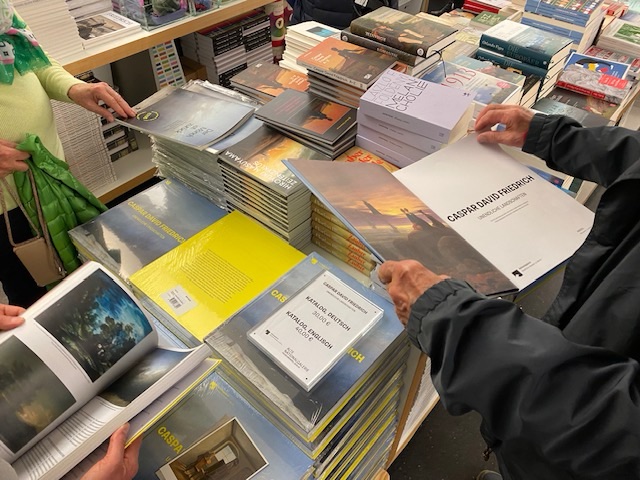
The “Alte Nationalgalerie” celebrates the 250th birthday of Caspar David Friedrich in Berlin. With a considerable effort to unite in one exhibition many paintings and drawings that stem from other collections of public and private origins. This particularly remarkable as a section of the exhibition is devoted to paintings that were intended originally to be seen next to each other (compare catalogue p. 233). Comparing 2 images from the same painter evolve into a narrative. This raises curiosity as in some instances the 2 paintings do not treat the same subject. Your very own interpretations and associations will make for an individual journey through the sheer endless spaces. The exhibition allows to grasp some of the many questions posed by the period of enlightenment not only in Germany. After “God is dead” what will happen? How is mankind defined? What is its relationship to nature? Are we just left alone or what comes after individualism? Even for painters, much like scientists, it is just as important to pose the right questions. Leaving the exhibition with more questions than answers will put you in the “Berlin state of mind” of 200 years ago. Greiswald, Dresden, Rügen and Copenhagen as well as nearby mountains were influential locations and landscapes for Caspar David Friedrich. Berlin 1906 „Jahrhundert Ausstellung“ made him famous again, despite decades of being forgotten. Yet another question to ponder and wonder about. An additional merit of the exhibition is the section on painting techniques and the use of his sketches and drawings for the preparation of the oil paintings. The final riddle to be solved is the price differential between the German and English version of the catalog in the bookshop next to the usual merchandising props.