Since 2010 and with 18 volumes the documentation of perpetrators assistants free riders during the Nazi rule in Germany has been valuable and reliable source of information (Kugelberg Verlag). The book series defines the perpetrators as the persons excuting crimes themselves or were in command of those who committed the crimes or gave orders to do so. It is not surprising to find evidence of many crimes, but rather that it took such a long time until the documents were published and the descendants were confronted with the facts and the difficult heritage. There are still many who undertake all efforts to deny the facts or try to minimize the guilt of perpetrators. With the real dangers of new right-wing extremism on the rise across Europe and even beyond, it becomes more important to uncover the strategies and biographies of the perpetrators. Certainly the members of the SS were executives and in command of atrocities, so-called NSDAP party officials were also mostly convinced followers of Nazi doctrines and instrumental in the implementation of crimes. Additionally, several professions (line soldiers or medical doctors) were key in the process to ensure the power of the totalitarian regime until the final days. Some persons were cumulating roles and became thereby inescapable spiders in a web of control and crimes. The lessons for today consist in hindering excessive cumulation of mandates, political, professional, military and in other work or civil society related functions. Distribution of power is one form to safeguard the survival of democratic structures. 
Victim Perpetrator
Research on the Shoa and the Nazi crimes has a clear cut separation into millions of victims and millions of perpetrators. There is only a very small group of persons who risked their lives in their attributed or chosen role of perpetrators and saved lives. Most of those persons received recognition later, some decades later. The vast majority of persons were oblivious to their prior roles and some even tried to defend them themselves through a variant of victim blaming in recurrent attempts to reduce their guilt. Another frequent excuse is to recur to a perpetrator’s own experience as a victim of abuse or tough childhood. In a static perspective this might work, but the learning and reflection ability of humans apply to all persons irrespective of age, if they show the willingness to do so. victimization is powerful tool to justify a role as perpetrator later on. Criminal courts assisted by psychologists statements accept guilt reduction. After all those considerations the basic classification into victim or perpetrator remains a valid differentiation, only very few cases allow for a more nuanced assessment of the case. (image extract of Rachel Baes MRBAB Brussels) 
Commemoration
In The month of November we commemorate those who died and particularly all those who died in the combat for freedom and democracy. The Russian aggression does not show many signs of ending the killing of soldiers and civilians on both sides. Ukrainian forces struggle to resist the Russian occupation of its territory as Russia is sacrificing thousands of lives for small gains of territory it is unlikely to defend in the coming months if Ukraine possesses longer reach weapons. A new spiral of an apocalypse is most probably the result of the Russian insistence on external aggression to cover up more internal problems. A lost generation of young soldiers who died in combat or suffered mutilation will be the outcome of these atrocities. The inflationary effects of wheat and energy prices globally have caused additional casualties in countries that had absolutely no stakes in this war. Russia is to blame for those additional casualties as well as the adverse effects on the world‘s climate due to the fighting and destroyed materials that need replacing later on. The young Russian generation will have to stand up against Putin‘s call to war and put down their weapons. This is one way to end the spiral toward yet another apocalyptic experience in Europe and the silent killing through hunger beyond Europe. (Image: BNF Paris, Apocalypses 2024)

NS München
The documentation centre in Munich of the National Socialist time and crimes has an encompassing collection of documents on display. As the prime centre of the Fascist movement in Germany in the 1920s and early 1930s Munich was the home to party elites from the first months of the movement that became the epicentre of the dehumanizing policies we can follow throughout Europe (Topography of Terror, Berlin). The historical research in both documentation centres complement each other in many respects. Understanding the beginnings of the Fascist movement remains important to today. Fascist movements need to be stopped before terror even against neighbours takes hold. Records of the evolution of membership, men’s and women’s movements later on, attacks of the parliamentary system all have to be taken into account to be able to stem the Fascist tide at that time and today again.
“Materializing” is the current exhibition, which can be visited in part online. How can we deal with the “Shoah“? Polish artist have a long experience to cope and deal with the unimaginable horrors, the Nazis and the “Wehrmacht” committed in Poland.
Memories have to find a place, a piece, a word, a sound or an emotion to materialize. In that sense yesterday joins today and is preserved as learning and warning for tomorrow.
In addition to the much discussed “Wehrmachtsausstellung“, the work by Jochen Böhler provides ample evidence to debunk the myths of war without crime. This holds for the past and for the present. (Source: Böhler, 2019, S. 59-68, Die Wehrmacht und die Verbrechen an der Zivilbevölkerung während des deutschen Überfalls auf Polen 1939, Image below). 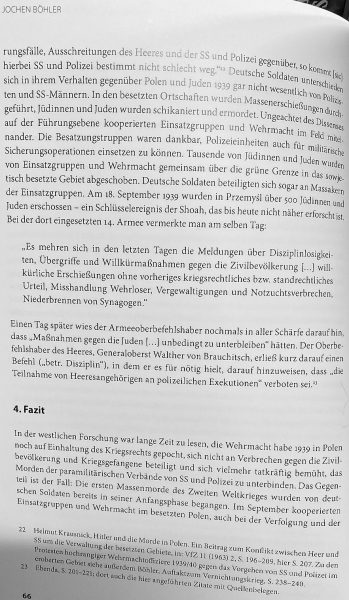
Timeless Values
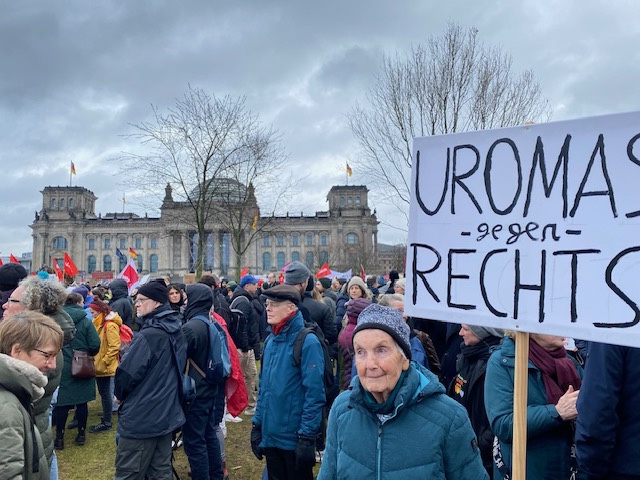
The declaration of human rights is more than 200 years old. However, the need to stand up for the defense of these rights needs many people to act accordingly. Political parties and courts are not strong enough to be the only defendants of democracy and human values. Solidarity across generations is another part of the struggle to defend democracy. In addition to the broad movement of “Omas gegen rechts”, the age distribution has been further enlarged with the “Uromas gegen rechts”. This most likely the generation with first hand life experiences from Nazi Germany and they should have reached an enlightened view of the horrors caused by the Nazi-regime. Unfortunately there are still some who continue to be prisoners in a fascist “brown” cage of mischievous memories. The great grandmother who was present at the demonstration was clear in her statement to stand up against right-wing extremism. (Image: With the permission of the lady I am happy to have evidence of the presence of super-agers at the demonstration in Berlin).
Memory Flashes
The title of the exhibition in the Museum of Photography in Berlin was “Flashes of Memory”. The collaboration of the Kunstbibliothek with the “Yad Vashem – The World Holocaust Remembrance Center” prepared a photographic memorial of the murder of 6 million of human beings with Jewish origin or family ties. The images represented in the exhibition constitute a carefully curated selection of the photos taken as part of Nazi propaganda, the secretly produced photos by inmates and the Sowjet and American soldiers who prepared documentation of the horrors. It becomes clear throughout the different sections of the exhibition that the motivation of the photographer introduces more than just an individual perspective on the scene.
In the age of fake news and fake images it becomes more and more important to be able to read and interpret photos, taking into account the motivation of the photographer and its influence on the photo taken. In order to limit the spread of mischievous representation of the past, it is good to know that the use of AI as image creation does not allow with simple prompts to produce false documentation. It needs more sophistication and more human intervention to trick the algorithms. Additional use of photoshop will, however, increase the risks of abuses. Hence, it will be more important as of now to be able to differentiate images according to sources and authors. Our trust in photos has been shattered, and this is an important lesson in itself. It is a huge task for schools and adult learning to re-build the competence to distrust photos and images at first, then deconstruct the messages and motivations.
“Flashes of memory” is in some way linked to the “struggle of memory” exhibition. Both, obviously deal with the way historical events are and have to be present in our “collective” memory. Memories come back in flashes, sometimes, certainly for victims. Conscious and unconscious selections of images might come back at times and haunt victims for years. The correction of biased messages, is an important task for historians, social scientists and artists alike. It is all too easy and common to forget (Luhmann, 1996 Reality of mass media) and the difference between “Documentation” and “Decoration” (Lewis, 2001) or simply illustration needs to be scrutinised always anew. “Bildung” has some common roots (only four letters really) with “Bilder” in German language. It may be “une liaison dangereuse”, but the spurious link can also be turned into an educational or learning approach.
A permanent exhibition based on the material used in the exhibition would be a real asset to accompany and learn about the flashes of memory. A reading list of literature was also available at the exhibition (see image below) encouraging to dig deeper into this immensely important topic. 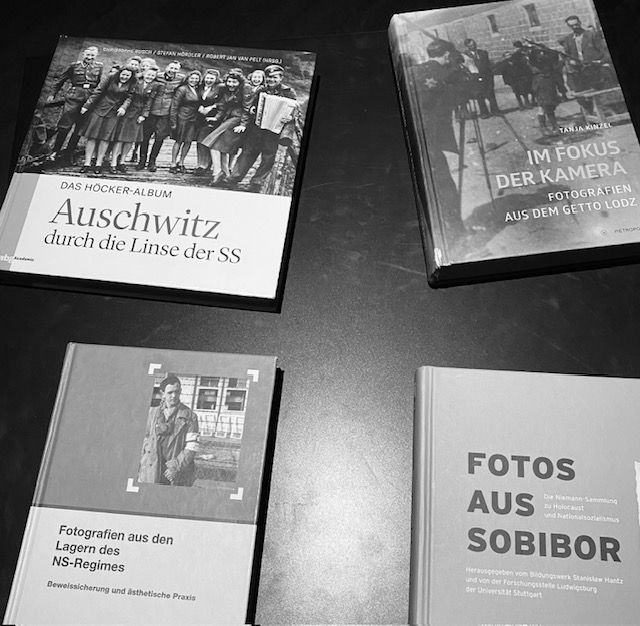
100 x 100
It is the horrible tragedy that Hamas terrorists after more than 100 days hold still more than 100 hostages. We shall never forget. Just like the terrorists taking hostages 51 years ago during the Munich Olympic games 1972. I believe it is about time to remember Winston Churchill’s famous words with a few changes, if I maybe allowed: “We shall never surrender. We shall fight terrorists on land and on sea. We shall fight them in the air and underground, in space if we need to.” This is part of not forgetting terror and staying alert to looming risks. For some the painful memories last their whole life long. Others, far too many, just forget, or worse, deny the facts. 
Finding Peace
In international conflicts it the task of diplomacy to find or negotiate peace agreements. Monitoring of the evolution and progress is part of the deal. For societies internally it is equally important to find peace again. Totalitarian regimes are characterized by terror and intimidation of its own citizens. This holds true today as much as in the past. Finding peace, however, necessitates to prosecute criminals and this irrespective of their previous or current status in society. The American authorities after the 2nd world war have held more than ten thousand prisoners due to their commanding functions in the NS-time. After 3 years of imprisonment and attempts of so-called re-education the evaluation of the results were of very modest success. Most prisoners would find excuses rather than admit to their participation in the killing machine of the Nazi throughout Europe and over more than a decade.
The study by Christa Horn (1992) “Die Internierungs- und Arbeitslager in Bayern 1945-1952” comes to the same sobering conclusion (p. 127 extract below). This bears the danger that the totalitarian ideology continues to have supporters and even the transmission to other generations might be attempted. This highlights the importance of reconciliation in the lengthy process of finding peace. It far from easy to resolve who is guilty and of what. The Americans started the process before handing over responsibility to the regional judicial system. More than 75 years after 1945 we still have to name and insist on the criminal behavior of the totalitarian regime with millions of party officials and even more followers. Finding peace is a protracted process if not a struggle that involves 3 and maybe 4 generations by now. 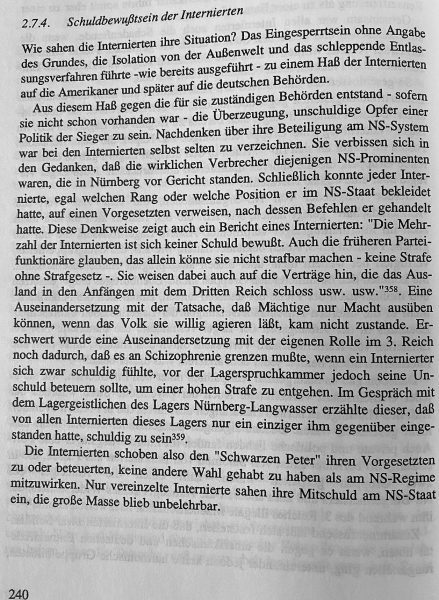
Winning Peace
Most analysts of international conflicts deal with winning or losing a war. At best they deal with short-term versus long-term versions of winning and losing. However, the question of how to win or achieve a lasting peace is rarely researched. Research on the 2nd World War reveal as soon as the turning point of the war was achieved the preparation of what will come after defeat. Organising humanitarian relief is part of warfare. The U.S. has set a good example of how to organise humanitarian aid as well as ensuring a lasting peace in Europe after the 2nd World War. Lots of books have been written on the Marshall Plan to get the economies in Europe (Western Europe) back to producing. Much less attention has been devoted to the important element of “de-nazification” of whole societies.
To win peace after the monstruous crimes of the Nazi-regime and the millions of followers and ruthless fighters was a challenge without precedents. The U.S. gave a good example of how to handle the process of winning peace in the regions under its military authority. In the following I shall refer to work published by Christa Horn (1992) “Die Internierungs- und Arbeitslager in Bayern 1945-1952”. The Allies had agreed upon to pursue war criminals. In April 1944 the Supreme Headquarters Allied Expeditionary Forces published the “Handbook for Military Government in Germany”. It was deemed important to detain “certain government and party officials and members of police and para-military formations” (p.17).
Common to demilitarisation efforts after a war, it is the primordial function to reduce the risks of a renewed uptake of guerilla-like attacks due to the amount of arms still widely available or hidden on the enemy’s territory. The document specified further that the continued presence of Nazis in government and other exposed positions “might be a threat to the security of the Allied Forces or an impediment to the attainment of the objectives of Military Government in Germany” (Arrest Categories Handbook, P.2). Denazification was a means to an end. The size of the task was, however, underestimated at several instances. For example, the organisation of the arrest and detention of more than 100.000 persons was a difficult task. After the end of fighting the transition to peace is not instantaneous. Hierarchical military and party structures had to be dismantled. The so-called “automatic arrest” issued on 13.4.1945 included all grades from the NSDAP down to the “Kreisleiter” or even “Ortgruppenleiter” as well as SS members and their “Helferinnen” (Horn, 1992 p.21). These arrests without judicial procedures came under critic as not-American in the U.S., but it took until 10.10.1948 to abandon this procedure. The literature on the issue refers more to the lack of adequate judicial procedures to handle such so many legal procedures with qualified persons as well as the difficulty to organise detention camps for more than a hundred thousand persons that should deserve to be prosecuted. Handing over to the national or regional judicial instances was, therefore, an important step. The risk to abandon the process of “denazification” was evident, but it was equally important to counter the expansion of the Russian-domination in Eastern Europe with the help of a strengthened Western Europe. Winning peace is a delicate balance of prosecution through the winners of the war and the subsequent prosecution of criminal actions through the indigenous population and its new institutional and judicial setup.
Social Sciences have a lot of solid insights to offer to win peace. With careful consideration they are helpful to learn from even for current international affairs and raging wars. Demilitarisation is only a small part of winning peace. Changing mind sets to internalise humanitarian values remains the biggest challenge and involves more than one generation. 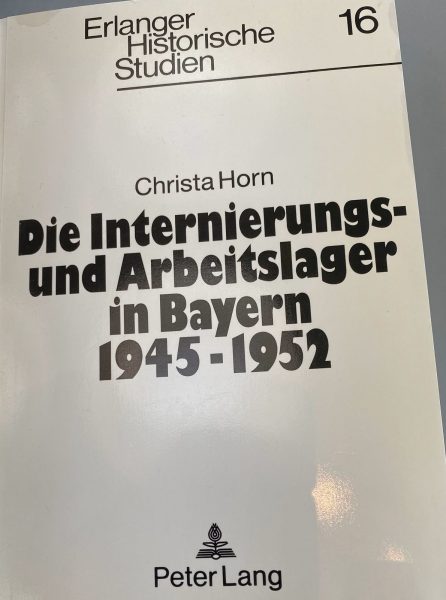
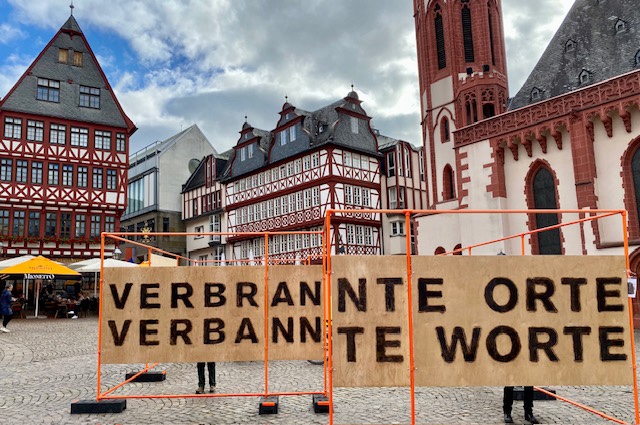
Verbannte Worte
Die Ausstellung Verbannte Worte im historischen Zentrum von Frankfurt trifft auf viele Besuchende der Messe aus der ganzen Welt, die oft nur ein bisschen Rathaus, Marktplatz oder Paulskirche sehen wollen. Aber unbefangen kann keiner an der Geschichte dort vorbeigehen. Neben den Millionen an gedruckten Worten muss es eben einen würdigen Ort geben, der den
verbannten Worten gewidmet ist. Viele Kunstschaffende und Schreibenden konnten bestenfalls im Exil überleben. Das ist heute in großen Teilen der Welt weiterhin so. Der PEN International listet erschreckende Zahlen dazu. Das erneute Post-COVID Wachstum der Frankfurter Buchmesse erfreut alle, die sich unermüdlich für das freie Wort einsetzen. Jedoch auch klare Worte finden denen gegenüber, die das freie Wort menschenverachtend missbrauchen. Dazu leistet die kleine Ausstellung ein sehr wichtigen Beitrag, der über die Buchmesse kraftvoll in die Welt getragen wird.