The long-term view of sectoral change in France, for example, from 1800-2022 (Cagé and Piketty, 2023 p. 128) allows us to zoom out of our narrow focus of the last few years of economic change. The decline of agriculture is the most remarkable. The reduction of employment in industry and construction has been an ongoing trend as well. Banking, insurances, property and consulting have seen remarkable expansion over these years. Public services, security and legal affairs are still on a moderate rise. Other sectors like education, health, commerce and transport manage to grow equally.
The merit of the comprehensive volume by Cagé and Piketty (2023) is that it is thoroughly data driven and based on quite unique long data series. The data on structural change and just the employment trends depicted below refocus our attention on likely consequences of these changes.
For the 2 authors we should redirect our attention much more to the implications of these trends (like rising inequality) on political conflicts and power struggles. Democracies are at risk, if we continue to ignore these seminal changes of industrial structures and shifts in employment. The traditional strongholds of trade unions and progressive forces in the manufacturing and construction industries as well as in public transport seem to have unaccounted implications for our political systems as well. The volume by Cagé and Piketty (2023) will soon be available in English and reach broader audiences just-in-time for the European Parliament elections in June 2024. Particularly the spatial implications and how the neglect to take into account the fundamental differences between the rural development and structural change needs urgent reconsideration. After the time for reading and working with the data (LINK) is the time for action to preserve our European Dream of peace and social development. 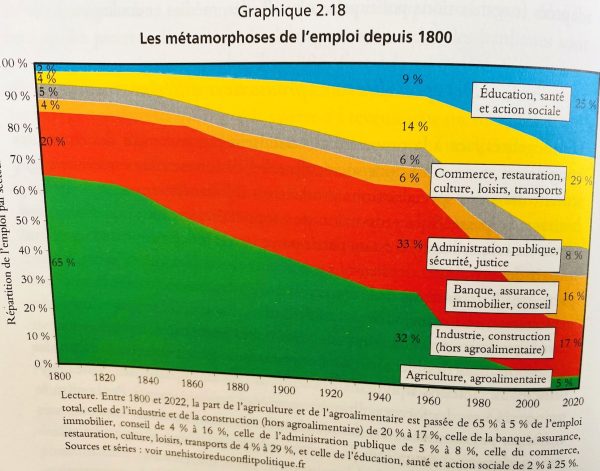
Arms trade
The sustainability of war depends a lot on the availability of arms. The Stockholm International Peace Research Institute (SIPRI) publishes regularly updated data on arms trade. The report ranks countries who are the most important exporters as well as importers of arms (from 2018-2022). The lists show for exporters that the U.S has been at the top of exporters with 40% of the global export share followed by Russia with 16%. France 11%, China 5.2, Germany 4.2 come next on the list. Taken together Italy, Spain and the U.K. reach another 10% jointly of global exports. South Korea and Israel come in with shares of 2.4 and 2.3 respectively. The top ten serve allies but also more broadly the world arms trade and race. New dynamics have started to come into force. The Russian aggression and war on Ukraine territory will have an impact to the extent that Russia is probably exporting less and shift to a more importing state.
Among the importing countries India is leading the ranking followed by Saudi Arabia and Qatar. More generally Asia and the Middle East were the most important buying countries. Importing arms might be interpreted as an indicator of perceived threat to a country. Long cycles of arms renewal may also drive statistics of arms trade, but new threats like cybersecurity and space technology have created new fields of potential attack and defence.
All in all, yet another rationale attributed to Clausewitz seems to play a role in driving the arms trade. “If you are perceived to be weak, an enemy will use this to attack”. Well, this also means that buying arms, producing or importing them, could deter a military aggression. That form of deterrence of aggression is known from the nuclear arms race as well. In the realm of conventional weapons, we have thought, it would no longer apply. We were mistaken in this respect. The dividend of peace has come to an end for many countries. The SIPRI report (2003, summary p.9) shows the continued rise on the global level of the arms trade. Why are we so scared of each other? Russia has reverted to imperial politics using conventional weapons. Containing such disrespect of internal law needs our full attention to avoid a spreading to other areas. The link of diplomacy and trade needs close scrutiny. 
Preference
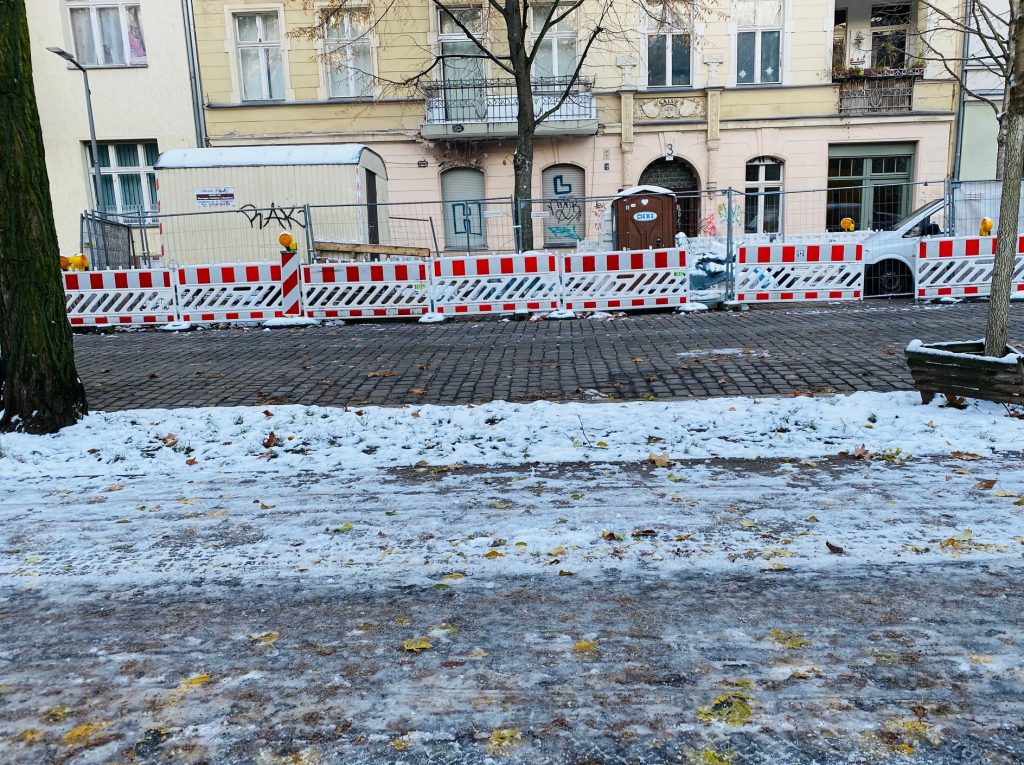
In societies it is not easy to derive collective preferences of citizens. Elections every 4 years tell sometimes nothing on specific issues which were not debated or of sufficient relevance at the time of the election. Dealing with snow and slippery sidewalks is hardly an issue at all. However, the preference to clear roads meticulously rather than bicycle and pedestrian paths in a dead end road reveals preferences for „s‘heilig Blechle“ the holy tin box (car) in many cities. Our orthopedic units in hospitals are crowded at such times and those costs are hardly attributed to the source of human negligence for fellow humans. We would expect that aging societies start to address such topics but little change has occurred so far. Hence we claim airbags for pedestrians and cyclists😂. Preferences probably have changed already but implementation is slow and faces strong opposition as well. It’s always easier to lock frail persons into their apartments at such snowy times. It feels a bit like corona where it was also easier to restrict mobility for pedestrians and children than to deal properly with the virus. Aggregation of preferences in societies remains a challenge and sociology has a lot to offer in this regard.
Energy Storage
News agent Reuters has published an analysis of the setback for short peak coverage of electricity by power plants fueled with gas. Conclusion: economically no longer viable. Investors draw back even from contracts already signed. What is the game changer technology here. Batteries that store energy just like the batteries of millions of cats that have a storage capacity to supply energy for a whole household for more than 2 days. Other giant batteries cost only half the price compared to 5 years ago equal to $150 per kwh. In five years solar energy doubled its share of energy production to now reach the same amount as energy provision by gas.
Reaching a critical turning point in energy generation, investors flock to the more profitable medium or long-term investment. Good news for the planet. Wind and the sun are all around us. We have only started to cover roof tops of office buildings, car parks and other shelters. Start thinking about your energy storage as of now and reserve a suitable space for it. Costs are coming down rapidly in a few years or maybe only a few months. 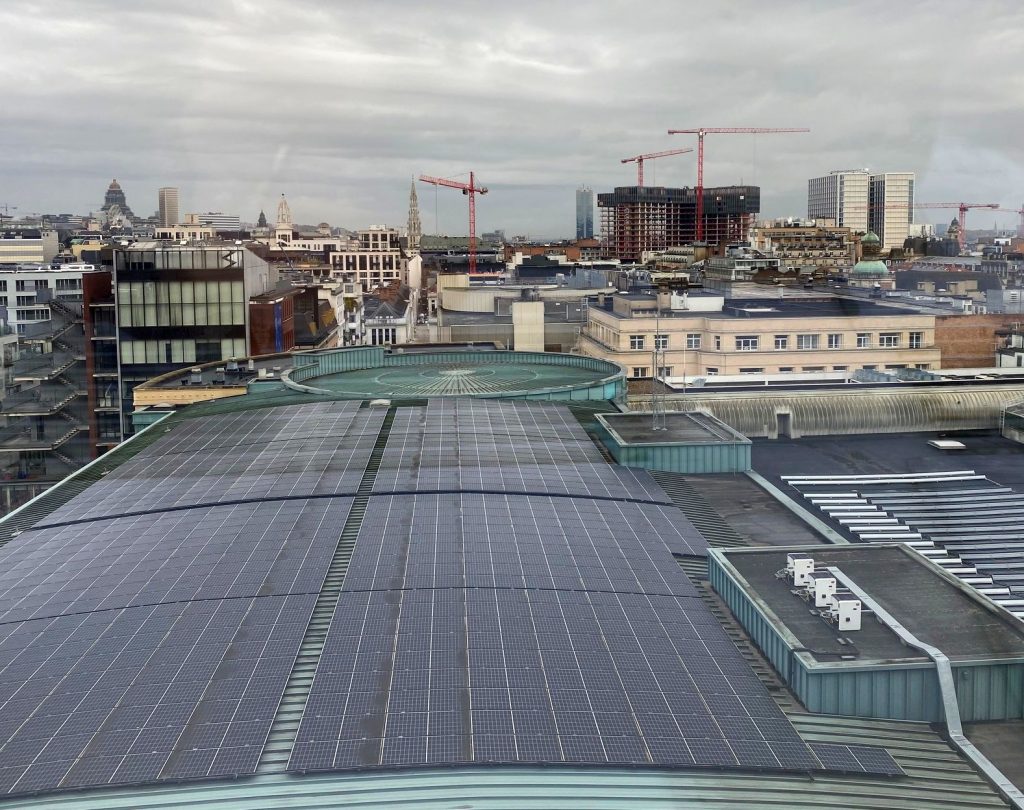
Beer Temple
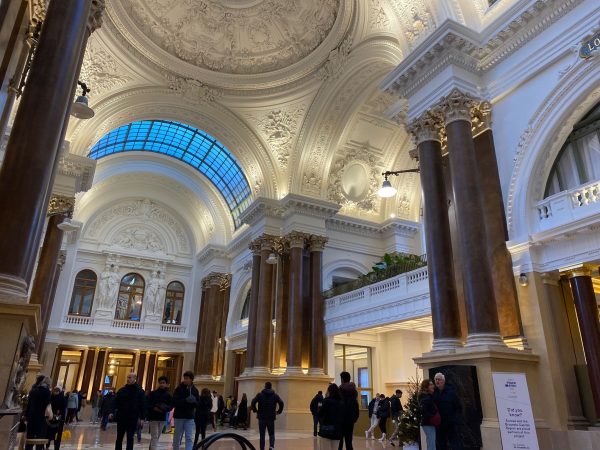
Brussels has recently opened a new attraction. A splendid temple-like building devoted to the unnamed God of beer-drinking. The renovation over several years of the centrally located “Bourse” has created a new popular attraction right in the centre of Brussels. From the outside the building reflects the classical temple architecture from Greek and Roman times. Although the building was for a long time the trading place of shares, obligation and currencies and thereby very closely linked to a country’s wealth and economic fate, it has found a new destination to represent the diverse and spirited culture of the people or peoples of Belgium through the lens of a beer glass. Of course, this is surrealism à la Magritte et al. (Museum and galleries within walking distance). The shifting fate after a financial crash to transform the “Stock Exchange” into a temple of surrealistic experiences is great idea and its realisation as popular move to transform the stock market into a temple to worship beer, beer drinking and conviviality a great idea. Without joking, the restaurant in the temple proposes good food that can be matched with a selection of 30+ kinds of Belgian beer (including 4 non-alcohol-containing beers).
Framing beer drinking culture differently from the image of beer and football hooligans is hard to achieve. Public images of beer drinking on television are all around us, anew every weekend. The Brussels stock exchange is a great place to reflect on shareholder versus stakeholder issues. Brussels has opted for a popular conversion of the building. Paris has gone for the upmarket more exclusive transformation of the previous stock exchange (Bourse commerciale) into a gallery of modern art from the private Pinault foundation.
The museum of beer in the upper ranks of the building in Brussels offers even tastings we were told. Well, beer drinking and stock trading (gambling) have both addictive potentials. Ruining yourself, the one or the other way, is equally disastrous not only for yourself but potentially others.
Know your limits is easier said than done. It is a behavioural phenomenon for individuals as well as regions or whole countries. With the apparent “Limits to Growth” for our planet or our ways to trade, even praying in the renewed beer temple is unlikely to solve the bitter-sweet issue. Perhaps discussions in the new Brussels temple will spur new coalitions and stimulate new ideas to overcome the locked-in political trading positions. Maybe the European Parliament should have a futuristic surreal session in the historic site. The only problem is, they would no longer want to return to their usual forum for debates. 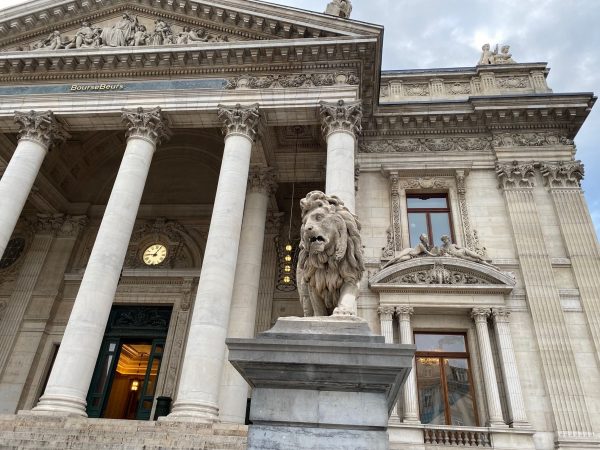
CO2 Footprint of Books
In view of the worldwide size of book publishing we should also keep an eye on the CO2 footprint of book publishing. The Italian association of publishers gave a brief overview of the likely CO2 footprint the printing of a book causes. Their best guess is at ½ a kilo of CO2 on average. For simplicity of calculation and assuming that an editors’ association is unlikely to overstate the amount, let us assume it is 1 Kg CO2 per book. The most CO2 is consumed not in the book production but in the transport of the items, machinery and personnel involved in producing, editing, selling etc. Of course, paper is recycled to a large amount. Certified sustainability of paper from trees has become a standard in most countries.
Nice twist to the issue: your own library at home has become a CO2 storage, if you keep them or lend them or pass them on to others. Reading can be a little bit addictive and buying books as well. Reading online or electronic books reduces your CO2 footprint. The best way to imagine the reduction of your CO2 footprint, however, is to buy or to borrow a book on travelling which replaces the actual journal by reading on the couch. Yes, being a couch potato is good for the planet, and if you want to buy a book, walk to the book shop or the library if possible. If you enjoyed flying previously shift over to buying books on planes, airports, clouds in images or stories that involve extensive travelling instead for the sake of your own CO2 footprint and future generations.
Even a book will need somehow wood as input, many alternative ways of leisure time or professional activities are worse in terms of CO2 footprint. Any e-book, e-journal or e-newspaper is even better for the planet, especially if we think of the millions of paper copies across the world that are printed but never sold. Knowing your market is crucial to reduce misallocation of ressources. E-books are so much easier to store as well using regenerative energy for the content servers around the world. 
Book traders
Some book traders have a mission. They assemble little corners on their book shelves or in tiny cupboards reserved for their passion or mission. In some book shops you’ll find a corner devoted to a specific language or translations, in some a world region is represented as a specific predilection. The choises are as numerous as there are books. Of course, from an economic point of view national and international bestsellers will be shown in the most prominent places. Second come books for children, cooking, life and travel guides. All those are the cash cows for book shops and traders.
But beyond those, it is always worth the effort to search for those little carefully curated corners in a good bookstore that derive from the vision or mission of the book trader, employed or owning the shop. In some areas this contributes even to a small community building. Readings of authors add to the function of book sellers to build a relationship to their non-random book buyers. I keep going back to my favourite book stores and libraries with those curated corners for decades and across countries to find inspiration and updating of special topics.
There is a danger that we are going to lose all this professional work of thousands of well-trained book traders that guide readers in addition to publishing houses, literary critics, numerous awards and huge marketing campaigns of derived products (as with Harry Potter). Living up to your mission while running a book store must be a great experience. If is really increases the buyers and readership for the topic, would be a great result. However, I suppose many bookshops manage to keep their little curated areas despite economic pressure to go with the mainstream marketing campaigns and top selling books and gadgets.
With the decline in the number of smaller book shops (in Germany from ca 5000 to 3000 in about 20 years) we see a parallel increase in number of franchises of the big book sellers (Thalia.de 500 stores in D). Big chain increase seems to cause fewer professionally trained book traders (-10% in D) within a country. For younger generations TikTok (BookTok) has taken over large parts of the “book counselling” of book traders previously. This was a big event at the Frankfurt Book Fair 2023 as well.
Time to rush to your local bookstore and book trader before it is taken over by a big chain or simply disappearing silently. We are likely to lose many of those book traders with a mission to make this world a better, more beautiful, more tasty, enjoyable or inclusive place. 
Taxing Europe
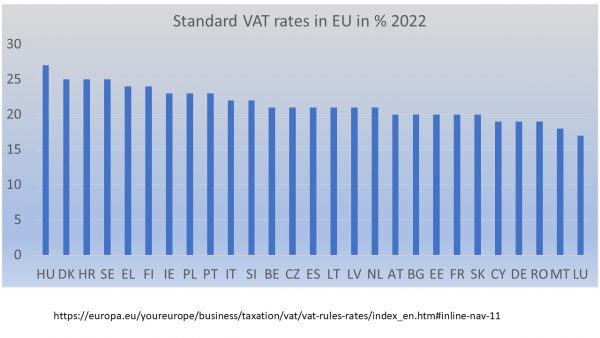
From time to time it is helpful to compare basic tax rates, for example value added tax, across the EU to understand the different economic and social policy approaches. The range of VAT from Hungary 27% to Luxembourg 17% is astonishing and it does not really feel like we are together in a common market. Okay, the illiberal, authoritarian state of Hungary is taxing the most, a clear message to visitors from another European country that this authoritarian state is relying on tax on consumption of its own people and visitors to foot the bill of state expenditure.
It is also interesting to realise that some countries with lower VAT rates have disproportionate public debates about supposed tax burdens. Tax levels are a political choice and much depends on redistributive appropriate use of tax receipts to the benefit of all or specifically those most in need. The potential for redistribution to parents, children, pensions, the poor or green investments also relies to some extent on the overall budget. The most surprising thing is the absence of a debate about tax rates, the size of the tax base and the ample exemptions or reduced rates. Of course, most of us complain about income taxes, but we all agree that it is nice to see that someone is taking care of the abundant autumn leaves or lighting of streets in the darker seasons. Even Adam Smith wrote in favour of the “night-watch state” that assures sufficient security levels. Taxing Europe to ensure that this role of the state can be taken seriously is still a common denominator across Europe.
Image: own presentation based on EU-data from 2022 LINK.
Bidenomics
Some American presidents become famous due to specific economic policies they managed to formulate, get approved and implemented them. Reaganomics, of previous U.S. president Ronald Reagan, was coined in connection with an open market doctrine, favouring monetary policy instead of fiscal stimuli. Bidenomics, of incumbent president Joe Biden, is characterised by his “produce in America”, Inflation Reduction Act, and fiscal stimulus provided for green and social investments.
Whereas Reagon sat more with bankers and central bankers, Biden is keen to stand with unionised workers even on the picket line. Investments that favour good jobs, jobs that apply pay scales agreed upon through collective bargaining are part of the Bidenomics that seems to work to raise the wages of the middle-class people. In the medium-term there might even be effects to lift the lower wages in other sectors of the economy as well. However, this is the tricky part of the equation to support the middle-classes and somehow the median voter.
American elections are won in so-called swing states that have voted democrats or republicans by narrow margins. Many of these states are in the “Rust-belt” states that have or had a strong manufacturing base. Bidenomics works hard to make the economy work for those people in these states, who have felt threatened by declassification, job loss and undercutting of wages due to migration. Substantial wage gains from $32/h to $40/h over 4 years is a landmark achievement in the U.S (see New York Times below). Non-unionised firms like Tesla, Hyundai or BMW and Mercedes in the U.S. will be isolated if they do not follow General Motors, Ford and Stellantis in the coming months or years.
It is not just about cars and trucks and wages, but about the chances of Biden and the Democrats to stem the renewed populist tide in the U.S. German car makers appear to be in the camp with the Tesla X-Man avoiding to negotiate with trade unions in the U.S. If Biden stays on as president after the next election, Bidenomics will gain further support and production of batteries and cars will be favoured locally with good paying, unionised jobs. Despite the high interest rates currently it is astonishing to many economist that the U.S. has not fallen into recession like for example Germany in at least 2 quarters of 2023. (Image: extract of Ney York Times 2023-11-2)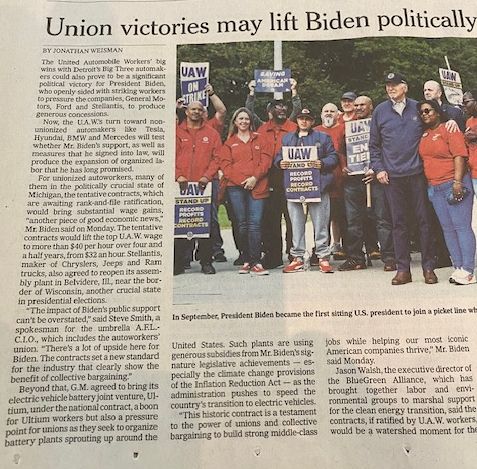
Nobel Literature2023
Jon Fosse has been awarded the Nobel prize for literature in 2023. Alfred Nobel donated the original funds out of his entrepreneurial empire build on the patents for dynamite. The explosives have ample use in peaceful times, but especially at times of war with noisy and destructive explosions. Experiments, with the tragic outcome killed together with 4 other victims his own brother. It did not stop him to pursue his entrepreneurial endeavour. In 2023 the Russian aggression continues to use explosives to kill innocent civilian victims. The sound of bombing continues to traumatise or destroy existences. The Nobel Prize for literature awarded to Jon Fosse does not bring those killed to live, but it is yet another reminder that silence or the absence of Alfred Nobel’s noise is invaluable. Norwegian Fjords and the water all around surely inspired Jon Fosse.
The scope of his writing ranging from theatre, prose to poetry and children’s books is comprehensive and impressive. This is probably all well known to many theatre-goers and readers beyond their mother tongue. For Germany there is an additional feature to the literary work of Fosse. Hinrich Schmidt-Henkel is the almost exclusive translator of the German language editions. This is already an impressive amount of work and long-term commitment to and from a translator as well as the publishing house Rowohlt. The Wikipedia entry for Hinrich Schmidt-Henkel shows the numerous works as translator of Jon Fosse as early as 2001 and still more to come. Additionally, Hinrich Schmidt-Henkel translates other classic authors from Norwegian into German in collaboration with the publishing house Guggolz located in Berlin-Schöneberg.
Besides the passion for translation Hinrich Schmidt-Henkel is active to defend the rights and salaries of translators. The threat to professional translation work by AI-programmes is imminent and just like authors and actors (not only in the USA) face continuing challenges for proper remuneration of their work. Being the German “voice” of Jon Fosse, it depends very much on specific contractual arrangements, whether a translator will also benefit not only from the popularity, but also in financial terms from the “windfall” profits reaped by authors and publishers. This constitutes probably a rather explosive issue, but worthy to be addressed eventually by the Nobel Committee. It is a “winner takes all” system just like with explosives, at least until next year’s awards. (Image Hinrich Schmidt-Henkel presenting Biermann in Staatsbibliothek Berlin 2023-9).