Rainwater Use

The use of rainwater is fairly easy to realize. Most homes in Europe and beyond have a roof drainage system in place. However, for decades the only concern was to get rid of the water as soon as possible. Nowadays, we think twice about it. The recovery and storage of rainwater for a separate use in a household has become a substantial cost saving exercise. In the Paris region in France you can expect on average 650 liters of rainwater per year per square meter. For a roof size of, for example, 70 m2 this yields about 45.000 liters per year. If you take a shower using 40 liters this allows you and your household to take 1125 showers or 3 persons almost one shower every day. Average household consumption in Paris is 120L/day, which adds up to about 44.000 liters per year for washing and toilet use. On a monthly basis with a storage capacity of 4000 liters of rainwater per adult person you should be able to manage your own consumption with your own roof drainage system. It is a rather simple use case. Maybe during dry summer months the calculation is a bit too optimistic, but the potential for a water autonomy of households in Europe is an option. In addition to the dry January, the no mow May, we shall have the no shower July next. 

Owners Dispute

Renovations of housing with distributed ownerships can be a challenging experience. In Berlin you can find a few places with visible long-term disagreement about what kind of modernization should be done. More luxurious additions like balconies or triple window isolation and so on are sometimes hotly debated and contested in courts. For most buildings you cannot spot disagreements on the outside, but some constitute exceptions to this rule. One size does not fit all preferences. In a metropolitan city there is a place and a space for all such exceptions to the rule and most people after years do no longer think about such kind of diversity in preferences or budgets available for modernization. Cities put our level of tolerance to a continuous test. You probably learn to love this or eventually you leave the inner city. There are subtle differences in urban versus rural lifestyles. In the social sciences we continue to try to understand the attraction of cities as on a global scale millions of people flock to cities.

Housing renovation

The huge amount of buildings that need renovation is a task for each generation. New constructions are relatively easy to realize even to the best available standards. Particularly energy standards asking nowadays for serious isolation of buildings are easy starting from scratch. Energetic renovations of existing buildings are much more challenging and have to take into account the various stages or predilections of previous generations. Repurposing of buildings raise additional questions like transforming a family home into a representative office building. New technologies like fiberglass instead of copper cables or copper or plastic tubes instead of other hazardous materials cause additional costs and worries. The use of asbestos for interiors of previous generations has created the greatest liability for existing buildings. Technological choices of the past and also of the present (heat pump or not) have lasting consequences and sometimes even health effects. To cherish old buildings and styles is a mixed blessing as the renovation of housing confronts home renovators with more tricky challenges than building a new home. Incremental repairs might do the trick rather than all in one go renovation, however, you might enter into a situation when renovations are always on your mind. Not only the times are a changing, but homes are a changing, too.

Private Intimacy

Intimacy has been reserved for private affairs for centuries. Although in the medieval ages formally the right of so-called noble men could be very far-reaching into intimacy of families when the permission to marry was quite restrictive. The private intimacy is the central theme of the Paris exhibition at MAD (Link) « Private Lives ». The organization into 14 almost private rooms around a larger center piece on design leads us through the major topics of intimacy. Maybe as a surprise to some, the exhibition starts with the major actors of change related to privacy and intimacy, i. e. women. Opening up enclosures gave women more room for intimacy and at the same time it made intimacy a conscious choice and decision. “A room of one’s own” is an important step in personal development of children particularly with respect to one’s intimate life. Restrooms are another issue of intimacy, just consider recent adaptations tor m/f/d people. A whole set of accessories are on display which previously were intimate products or even secrets prepared for public viewing. Of course odors are part of the experience with a test space of noble perfumes. The various manifestations of sexuality has brought about a growing number of pleasure objects, which might also be criticized as a growing commodification of intimacy as well. The connected bedroom and the risk of surveillance are raised to warn on overexposure on social networks. Intimacy in prisons or community shelters closes the exhibition before the final highlight the room on “conversations with oneself”. A whole literary form of keeping an intimate journal has arisen from the conversations not intended to be shared with others, at least not during one’s lifetime. After a person’s death for some persons of public interest even their private intimate journals will be published shifting the balance between the private and public parts of intimacy. (Image below from exhibition, photo bottom left, Matisse painting on wall while in bed in old age). 

Design skills

The is a huge B2C or C2B market in connection with home design and adaptations. Nowadays people are inspired by instagram, pinterest, YouTube and TikTok. Additionally, many play around with Apps to create their own images of how they would like to arrange or rearrange their home. Some have taken first steps to include measurements of their home in the design. The compatibility with professional software of the construction sector, however, is a drawback that delays or leads people to go to enterprises that take into account the prior efforts of young lay designers. It is a little bit like an own contribution in home building quite popular among new home builders to alleviate the upfront cash needed for first home acquisition. The younger generation could offer some of their “digital native” skills to bridge the gap in construction and home design. Of course, reworking and precise measurements on the location will still be required as construction has a lot of legal liability issues involved. Cooperation is a form of burden sharing to advance faster and/or with lower costs.

Greening Interiors

The greening of facades of houses is an old tradition in many western countries. The outside of a home then changes colors with seasons. The home for insects and birds feeding on them makes a small contribution to biodiversity as well. Greening interiors is a more rare instance. Of course flowers and plants can contribute a lot, but there is yet more scope to green entire walls inside your home or office.
Moss has advantages to add humidity to the air. You might like the acoustic effect as well in busy environments. Taking care of moss is not easy. Professional assistance (Link) or renting options might be a good option for office buildings. The wellness enhancing effects are also interesting for some people who susceptible to the calming effects of a more natural environment. It is a matter of care and respect for air quality that is reflected in the design using green interiors.
Circularity is another advantage of the materials. We can so a lot for biodiversity if we really wanted to even in urban spaces. Global warming will force us to think more and more, and sooner than later to make use of such innovative solutions. For the time being they remain a luxury option. For the wealthy, greening interiors is easy, it much less an option for restricted budgets and people who are obliged to focus on short-term survival. However, we have to get started with the greening of our planet again, any way.

Birds again

There are many ways to have more birds again in inner cities. Less pollution and poison are part of the solution. Second, increase the food available to birds. Some plants or vegetation is more suited than the other one. Combined with the question of cooling houses in summer and more isolation in autumn and winter, the greening of facades in cities has a simple effect to provide hiding, nesting and feeding spaces for birds. Birds will discover this vegetation as their natural habitat offering relatively safe shelter and food. It is an incredibly simple way to catch 22. Your new shelter is selective in the choice of birds that it will house. Singing birds seem to value the places most. Other predators may follow. At least in late autumn and early winter the energy rich power food is a welcome addition of the diet. Nesting in spring and summer might be another option to have more birds again. We shall need many very small steps again to keep biodiversity or bring back some of it. Birds again is a small initiative.

Forced Living Space

The „Topography of Terror“ hosted the book launch of the research project on „Zwangsräume“ (forced living space or forced homes). The cooperation of an impressive network of organizations (Aktives Museum Faschismus und Widerstand in Berlin e.V., Koordinierungsstelle Stolpersteine Berlin, Alfred Landecker Foundation, Metropol Verlag) has achieved to uncover the forced relocations of thousands of German jewish people from rented place to another one, thereby regrouping and cramping Jews into ever smaller living spaces in predetermined houses within Berlin. Through this horrible step by step expropriation and extermination terror was present and visible all over Berlin. The online documentation and data access allowed citizen science projects to accompany the research and actively contribute to enlarge the data investigated, analysis and dissemination of the findings. The continuation and extension of the project is already in preparation and seeks additional funding and volunteers. The traditional book publication helps to provide an insight into the thorough historical research which started with a more adequate definition „Zwangsräume“ than the previously used term of so-called „Judenhäuser“, since the houses had and kept a mixed population sharing the living spaces until deportations of the jewish persons forced into ever smaller living spaces before. The property of the deported persons was recovered by officials from sealed apartments and sold mostly as bargains on auctions or just redistributed among officials in need or with special merit for the Nazi-movement. This adds an intergenerational dimension to the project that is also worth looking into in the next phase of this extremely valuable project based on large online archives from original register information and other documents. (Image: The map shown below in the presentation has blue signs that have already been traced and hundreds of red signs where the histories are not yet retrieved).

Couch Cottage

As vacation time is approaching, we ask ourselves, whether to choose the comfortable couch or the remote cottage. This is the proposition of Roger-Pol Droit in “Le Monde Livres” (“Sagesse 2024: cabane ou canapé“, 28.6.2024 p.36) based on the reading of “Ma cabane sans peine” by Alain Guyard and “Philosophie du Canapé” by Stefano Scrima.
The couch stands for the lazy life or “vita contemplativa“, thinking about philosophical topics that need a certain form of laid back behaviour to allow your brain to sort out tricky questions or to ask yourself, what is, was or will be important questions. Many academics shut themselves away from the busy life outside to reserve more time for couch thinking. The usual products of this activity practised on chairs and couches is more or less digestable books. Some make a comfortable living out of this active inactivity.
The cottage approach follows another longstanding philosophical tradition associated with Dionysos. Living a simple life in a remote place, but full of life’s enjoyment allows to exalt in the dithyrambic atmosphere of the countryside.
Rather than the either, or issue: couch or cottage, I go along with the dialectics of Hegel, who forms out of thesis and antithesis the synthesis. In our example this is obviously equal to “take the couch to the cottage“, problem solved. Additionally Nietzsches version of “Die fröhliche Wissenschaft” seems to prolong the dialectic experience of going beyond the “neither, nor” dichotomy to combine both couch and cottage.
You sensed it. It will be a rather exciting summer break to pursue on the many roads to “Sagesse 2024” (Wisdom 2024).

Corbusier ZH

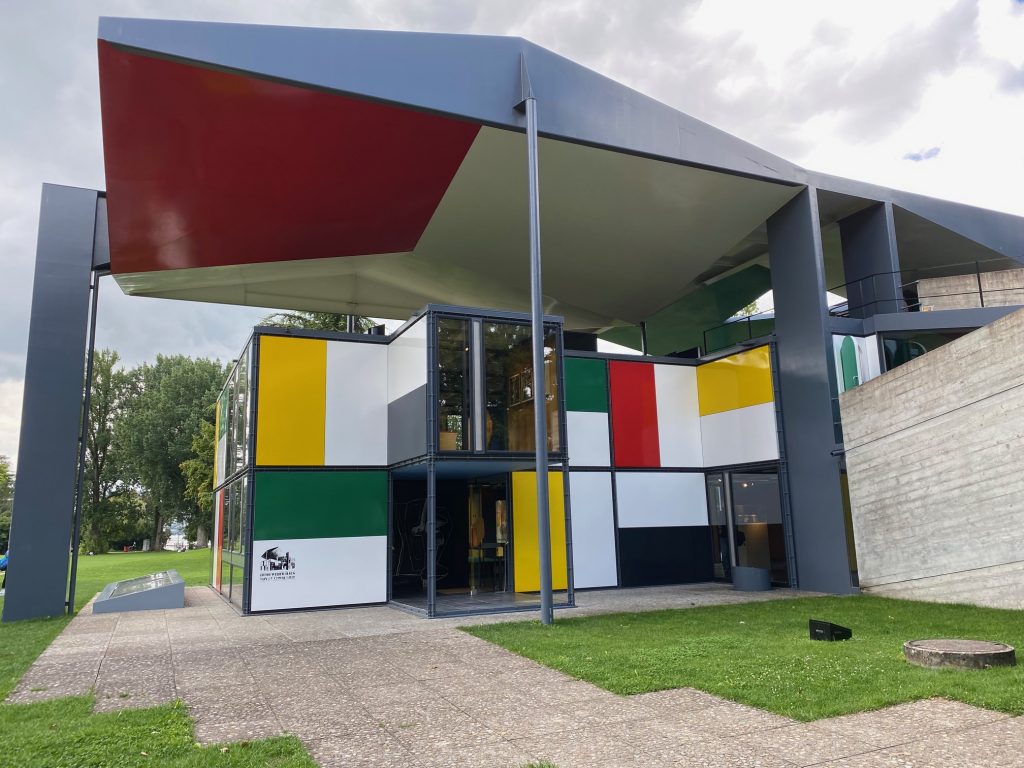
Realizations based on the theory of architecture by Le Corbusier are always worthy of visit. Passing through Zurich (CH) allows to discover another fine example of a villa he designed in the neighborhood of the old town. Within walking distance from the lake Zurich the spacious building allows just like the Paris example for an exhibition of art work within the villa. Horizontally stretched windows and a terrace on the roof make these villas look very modern. Rooftop bars and restaurants just stage a revival in inner cities as cool locations. Le Corbusier anticipated this long ago. Theories can have a long half value time of lasting.

The materials applied in the realizations were obviously less durable. This is the reason why the villa had been closed for renovations for many years. The reopening now shows the splendid views from inside out as well as from the outside. Colors are especially interesting in this example. Nothing is left to or build by chance. The Design language is spelled out in each detail down to door handles. An ongoing exhibition about the deterioration of materials and in some cases even toxic materials helps to understand the necessity to be aware of material science in construction. This makes visits even more informative. The confrontation of vision and sustainability becomes an additional topic also for the theory of architecture.

Le Corbusier Villa Zürich CH