Nature as a concept

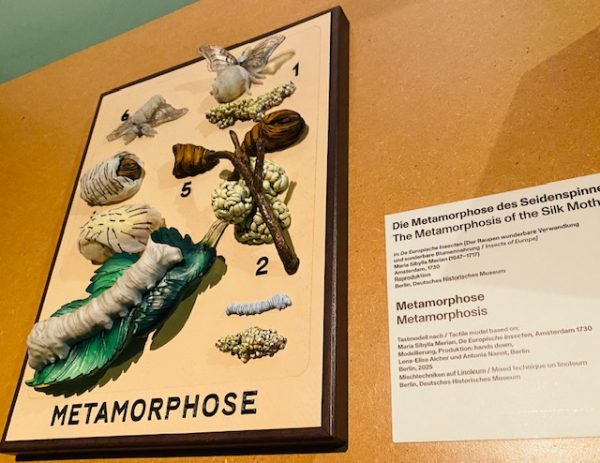
We all hold implicit or explicit concepts of nature in our minds. There are few countries that have “battled” over the course of history with changing and often “politicised” concepts of nature. The exhibition in the DHM “Deutsches Historisches Museum” on “Nature and German History, Faith – Biology – Power” is convincing with this cross-disciplinary approach to the subject. The chronological structure of the exhibition starts with Hildegard von Bingen’s vision of nature embedded into the huge diversity of plants with almost spiritual power. Admiration of plants and the animal world, however, became an economic resource just like gold and slavery during colonization, being followed by industrialization as the epitome of man’s power over nature. Counter movements have been on the rise in the 2nd half of the 20th century. Another power struggle over how and who defines the dominant concept of nature in the 21st century. As nuclear energy, bombs and waste redefined the long-term consequences of “treating” nature, the battles about the prevailing concept of nature intensify. The exhibition in Berlin 2026 is a fine example of a historical perspective on the relationship between society, nature and technology, where the concept of nature becomes a malleable concept between the other two players or systems. (Image: Metamorphosis of the silk moth, DHM 2026-5)

Artificial flowers

The craft to imitate the beauty of flowers is in fact at least 200 years old. The skill linked to the production has been documented in a manual which seems to be forgotten by today. Real as well as artificial flowers have been an accessory in fashion for centuries. In 2025-26 they return again in high fashion in all shapes and colors. The technique has also been documented in textbooks that explain the “how to…” the craft and professionalism (see image below). The time consuming activity has been outsourced from Europe long ago, but the basic techniques still were refined and mass production prepared for the sharing of the pleasures. It is an interesting case study of the sociology of technology or the rise and fall of an industry which occasionally has a surprising comeback. To follow parts of the trajectory just visit the Musée de la Mode in Paris, Palais Galliera.

Short circuit electrification

The electrification of the automotive industries is well under way. However, there is still the resistance of a few warriors from a village called “Gaulle” that fight the imperial forces that dominate these markets. The abundance of cars with batteries and electricity-based traction keeps growing, More utility vehicles shift over to this technology as well. With India and China making significant shifts in this direction, the market has made a significant technological shift until the beginning of 2026. The share of hybrid or solely electric power in cars has risen sharply, but a small segment (10% of diesel engines seems to survive or is only slowly petering out in the coming decade. The publication by Béla Galgóczi (editor) demonstrates the challenges this poses to the companies, their employees and the automotive sector as a whole, as it comprises a large amount of employment and technologies in the traditional supply chain as well. The need for a substantial and costly shift has started, but the downsizing of companies, as electric cars need far fewer pieces than conventional ones, could offer an opportunity, if the skilled employees can be converted to other productive use.
A single sector study offers a lot of “deep” insights into a sector, but the opportunities and openings in other not to distant sectors tend to be overlooked. The European sovereignty in the area of military, standardised technology, which is also still based on many precision and metal components might come as a rescue not only to Ukraine, but to Europe as a whole.

Saint-Simon Utopia

Towards the end of the 18th century and during the early 19th century, the early signs of what the industrial revolution would mean for the working people became visible. Saint-Simon had lived through the ups and downs of the French revolution himself and had been to the Americas with La Fayette before he developed his utopian socialist vision of a unified class of working people, which for him included blue as well as white collar workers. At the advent of the 2nd industrial revolution through general and agentic Artificial Intelligence (AI) in 2025, we shall most likely witness a renewed interest in utopian scenarios and grand ideas of what the future of technology, society and humanity might be like. In 2026 we shall re-read Saint-Simon quite a bit in order to learn about ways to make sense of arising trends and how to come up with a positive utopia that can motivate people to thrive again for more equality within and between societies. 

Pepper and Nao

We have seen many persons that became somehow emotionally touched when addressed by Pepper or Nao. These 2 versions of a humanoid robot have served for thousands of persons as the first welcoming moving information desk. I have been guided through museums (DTM, Berlin) and exhibitions by this robot guide with a friendly outlook. Beyond those experiences there is a lesson in industrial policy to be learned from this innovative French humanoid robot. The start-up enterprise was founded as early as 2005. With a substantial funding of ½ billion € from Softbank the enterprise could develop robots for the fields of personal companionship, education, restaurant services or personal care for the elderly.
We have seen the robots at international fairs in several countries, but the prohibitive costs have limited the rapid spread of the robots to broader applications. Subsequently, the decline of the enterprise, or not reaching financial targets fast enough, caused the loss of financial support for the enterprise. In 2025, Aldebaran filed for bankruptcy and the patents will be sold to the best offers. The employees received generous packages of departure and will most likely find rapidly jobs in other robotics, IT or AI related fields.
The loss is probably greatest for the persons who were serviced by Pepper or Nao in elderly homes or the Swiss hospitals, as spare parts or updates will no longer be available. The humanoid robot story is yet another case where the social, economic and financial context of technology is overriding the technological innovation process.

Tariffs trumped

Economists are used to differentiate between micro-and macro-level effects of tariffs. For each buyer of a car, import tariffs raise expectations about prices for a product. Many consumers will then decide to buy lower quality at the same price or postpone buying a new or replacement product for some time. For cars it might mean that many people will then decide to buy rather later than sooner. If thousands of people do so, the market will fall into recession overall and it will take months or years to come back to the same or a higher level. A political economy perspective has taught us that eager politicians are in favor of a short recession immediately after an election which increases the chances of re-election once the economy gets back to normal or catches up on lost growth. 

The US under Trump apparently gambles with such an economic rationale. Short term inflation is already rising, interest rates stay high before the upheaval caused by tariffs starts to settle. 

There is, however, another alternative mechanism at work as well. Thorstein Veblen long ago hinted towards what is not called in economics the Veblen effect. Some fancy cars for example can raise prices well above others because of their cleaving image. Just because they get even more expensive the buyers of such products gain additional attention as part of a social class which does not have to care much about their additional spending. The consequences of tariffs will most likely widen the gap between those saving dearly and those able to splash out cash despite increased tariffs. The most felt consequences, therefore, will be on social inequality within the US (compare WSJ 2025-4-24 A2 by Juliet Chung, “Richest of Rich Gain §1 Trillion”).

Sport Fashion

Sport is fashion and fashion is sport. Not only in the Euro 2024 the teams make a big fuzz about the design of their sportswear, but certainly the Olympic games in Paris 2024 will demonstrate the close links between the 2 worlds. We might say playing football is a bit like a fashion catwalk. Keep going right on target, despite obstacles, when thousands of people are watching your performance and potential failures very closely. Making a “bella figura” is a must in both spheres. There is also a strong tendency for “the winner takes all”, that s/he takes the trophy and the jackpot.
Both worlds are also big business in their own right. It is at least 100 years old that sport and fashion got married. The “Musée des arts décoratifs” in Paris had an excellent exhibition on the combination of sport and fashion (booklet link). According to the curators both spheres have always been interlaced. High-level performance and specialized fashion just made for a splendid combination. As the rich and wealthy had more than a penny or two to spend on their leisure activities the combination of sport and fashion soon became itself a big business, beside the visible beauty of the bodies, movements and dresses. Just watch the breakdance fashion as the latest addition to the repertoire of olympic disciplines. In a recent article in “Le Monde” (2024-7-11) the value of the market of sports including its fashionable merchandising is estimated to reach a turnover of € 500 billion in 2022.
The competition of sports has been turned into a competition of the best images and videos. Fashionable as well as functional clothing can assist in climbing the podium. In the Euro 2024 Football Final the teams equipped with Adidas (Spain) and with Nike (England) compete for the trophy. Changing equipment sponsorship from one to the other can raise substantial amounts for a team (€ 100 million/year for the German national team). Big business seems to take over sports and fashion after the century-old marriage of sport and fashion. Since then, they have jointly been on an extended honeymoon. (Image from www.emptyspacetm.com 2024-7)

Beggar thy neighbour

Modern economics has developed the concept of so-called external effects. The oldest version of it might also be referred to as “beggar thy neighbour”, as it was coined by Adam Smith the founder of classical economics. This describes an economic policy which does not care to make your neighbours worse off by enriching yourself. Applied to environmental economics or to regions, cantons or neighboring countries, this means a ruthless pursuing of investments, which are known to shuffle a large part of the costs onto other regions through damages, might be pursued nevertheless. This might be a valid hypothesis to test how the investment in skiing at high altitudes, increases the risks of flooding at the lower altitudes of rivers or valleys. There is scope for a redistribution of wealth from one region to another. The poor neighbor, however, is in a rather weak position to claim compensation as the link between the 2 events is hard to establish scientifically and mediated by an abstract form of overall climate change. The recent example from Switzerland adds to an increasing number of natural disasters, which are in fact man-made following a beggar thy neighbor rationale. (Image newspaper reading room in Stabi Berlin with NZZ from 2024-6-24).

Betting vice

Betting is considered a vice. The industry has moved from the local bookmakers to the internet and is spread across countries and continents. Some legal advisers have classified betting as the fastest growing vice industry and it is about time to launch a wake up call for more oversight of what is going on in the sector. As betting like gambling seems to be working in conjunction with other addictions the potential of cumulative risks is quite high. Our brains tend to wire things together which frequently occur jointly. It is difficult to disentangle these co-occurrences later again. The major angle of attack is prevention.
Health journals start warnings of the detrimental effects persons and observe that the industry follows similar strategies as the tobacco industry to address as many people as possible. And this is very successful and profitable for them. Hence, prevention strategies should also follow what has been applied to smoking like the ban from restaurants and bars as well as the restrictions on advertising. We will have to accept that betting and gambling should not be as easily accessible as it is currently. Age restrictions have to be applied stringently. I bet this will take quite a long time until Europe and elsewhere the regulations will change. Some of the young get interested in even more stimulating activities like exploring arts (image below class at Neue Nationalgalerie Berlin 2024-6) rather than betting on who is going to win the Euro 2024 football matches.

Hannover Fair

The annual science fair at Hannover is a kind of a show of things to touch and of those things that come to the public market in the near future. Most of the annual hype is about potentials of production. Rationalization, using few resources or innovative solutions of digitization are high on the agenda. Create your digital twin, save energy, make production more safe or cyber secured.
Robotics is another reason to visit the fair. Some 7 years ago I had my Sputnik experience there. The robotics company KUKA had demonstrated live the that assembling a car from pre-manufactured components takes just 10 minutes for the robots. Shortly afterwards the whole company was bought by Chinese investors. Roughly 5 years later we are swamped by cars from China. It was not that difficult to predict this at that time. Okay, we need to focus on more value added production and take our workforces (not only) in Europe along on the way. Reclaiming well-paid, unionized jobs in manufacturing, as Joe Biden does, will not be an easy task. Robots and their programming is expensive, but skilled workers, too. Hence, the solution is likely to be robot-assisted manufacturing as a kind of hybrid solution for cost-effective production systems.
Following the proceedings of the 2024 fair we are astonished to realize that visiting the fair is still a rather “physical exercise” walking through the halls. After the Covid-19 shock we expected a lot more “online content”. Instead we keep referring to webpages and newletters rather than virtual visits and tours. The preparation of the visit in advance remains a laborious adventure. However, the in-person networking activities in the industry are largely advanced by ease of exchanging virtual business cards and the “FEMWORX” activities.
This year’s Sputnik moment at Hannover is probably most likely related to the pervasive applications of AI across all areas of the industry and along the whole supply chain. Repairing and recycling have become mainstream activities (www.festo.com). Robotics for learning purposes can also be found to get you started with automating boring household tasks (www.igus.eu).
Visiting Hannover in person still involves lengthy road travel or expensive public transport (DB with ICE). Autonomous driving and ride sharing solutions might be a worthwhile topic for next year’s fair. Last year I thought we would meet in the “metaverse fair” rather than in Hannover 2024. Be prepared for another Sputnik moment next year, maybe.
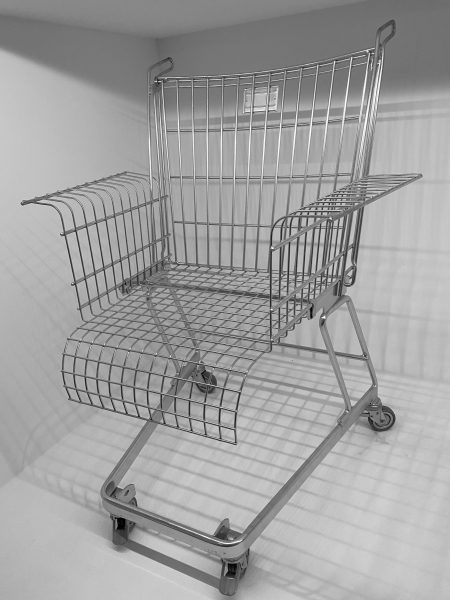
(Image: Consumer’s Rest by Stiletto, Frank Schreiner, 1983)