There exists a rather complicated relationship between law and nature. It is part of constitutional law to check whether nature figures at all in a state’s constitution as part of the fundamental legal principles. On a global scale the nations or people living in the closest relationship with nature most often do not have written constitutions. In the same vein, animals or biodiversity do not figure in most constitutional documents (nice project to substantiate this claim). The philosophy of law has line of literature devoted to “Naturrecht” which is more concerned with human beings and their differentiation than the millions of other species.
Administrative law is probably the domain with most of the legal judgements with relevance to nature or the environment as for example any larger scale construction is either land, water, air or biodiversity grabbing. Rights and limits need to be defined precisely. In this field the role of law as “appeasement” is widely applied. However, this is more complicated in cases when a whole population of an island in the ocean is threatened to disappear due to the rise of the sea level like in the case of the Torres Strait Islands, next to and part of Australia.
The UN Human Rights Committee (UN-HRCee) in Geneva has made a decision on the claim of these people to have rights that the nature of the islands as low-lying islands is threatened by disrespect of their fundamental rights of existence and survival. The claim has been received by the court, but the court deems that the threat to their culture and survival is not imminent. In practice, therefore, the sword of law is rather weak and time until the disaster is used as a right to continue the usual economic exploitation of earth as before despite the deferred consequences for the planet in a rather unequal way.
(Image by AI copilot designer 2024-6-2 “5 judges in red gowns sit in a flooded courtroom”, 2 propsitions) 
Silent Pandemic
There is a pandemic that is silently spreading across countries and continents. It only indirectly related to the Covid-19 pandemic. The medical journal “The Lancet Respiratory Health” (2024) has an editorial about the inequities of asthma as they develop over the life course. The development of asthma has pre-natal, genetic, environmental, life-style and socio-economic co-determinants. The study of respiratory disease, therefore, is a multi-factorial issue, which needs to disentangle the specific influences. Smoking as well as obesity have an impact on asthma, instantaneously or with delayed time effects of sometimes many years. Hence, it is important to take the whole life course into account, if we want to address the rising disease burden of asthma. Air pollution and heating-up of the planet are important drivers of the silent asthma pandemic across the globe. The social distribution of people working in “asthma- prone” work environments and/or living in highly polluted urban, suburban or rural areas near high frequency traffic is another latent factor causing huge costs to persons and society as a whole. Health inequity is growing over the life course. This is not easy to tackle as policy target as the onset of the disease has no single trigger, but rather a combination of influences that contribute in varying amounts to the evolution of respiratory diseases. (Image air pollution https://aqicn.org/map/germany/de/)

Screening Paradoxon
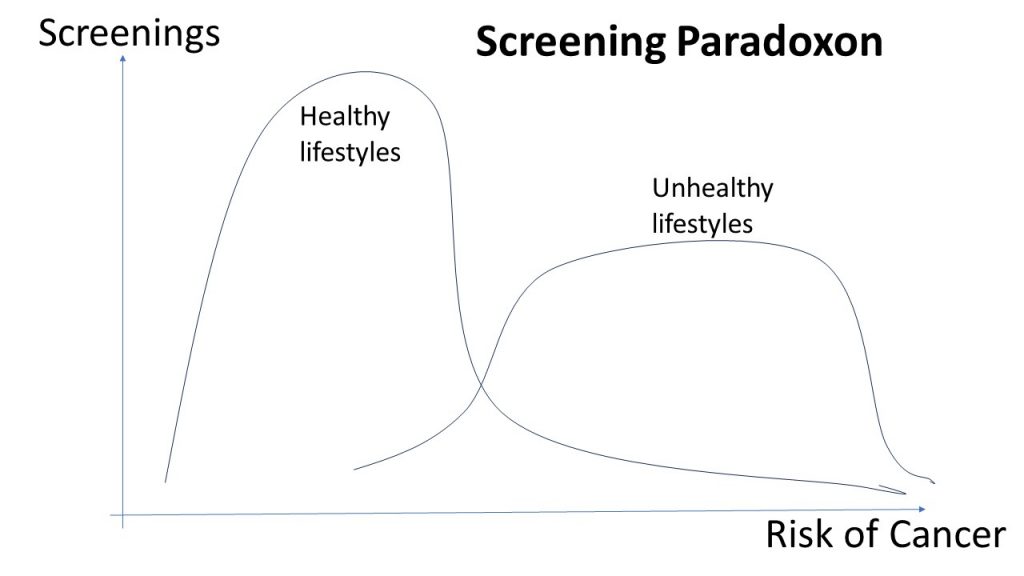
In the field of public health the screening paradoxon is a well-known feature of large scale programs to check for and contain the large increases in cancer among populations. A recent medical study underscores the necessity to curtail the screening paradox in Europe. The screening paradoxon is defined as “the underuse of screening by those with unhealthy lifestyles and high risks”. The opposite cases, “the overuse of screening by those with healthy lifestyles and low risks” only cause a problem for the costs of the health system as those unlikely of attaining a form of cancer make extensive use of screening. In terms of social inequality we have to be concerned about both ends of these distributions. The publicly available screening programs are skewed towards the higher educated with risk awareness as well as healthy life styles. More of them participate in screening. The other distribution of actual risks and detection of cancer is skewed towards the other end of the risk distribution. The 2 probability distributions overlap to an extent that is most likely co-determined by cultural factors like general attitudes towards prevention.
With the increase in cancer rates generally and due to demographic aging of societies, we shall need to target our resources devoted to health more precisely rather than spending too much on screening of people with very low risks. Increasing the duration between screenings might not impede detection rates of those with healthy lifestyles, but could allow to devote more resources to those people who are hard to reach by screening programs so far. Evaluations of such programs are necessary to judge the need for more targeted programs.(Image own representation inspired by Ola et al. 2024)
Hospital Bias
Asking people about differences between private and public hospitals, you are most likely getting answers that the private hospitals deliver superior patient outcomes. Whereas private hospitals seem to have a positive stigma attached to them, public hospitals commonly have a negative stigma. Scientific evaluations are helpful to set the record straight again. The study published in “The Lancet Regional Health” in 2024 shows that in the simple descriptive statistics on several patient outcome indicators, this is what the data showed between 2026 and 2019. However, a more precise statistical analysis reveals that there is also a selective admission to the private and public hospitals in England. Using so-called instrumental variables approaches that account for the selection process between admission to the 2 types of hospitals (private versus public) most of the differences between the hospital types disappear. The underlying mechanism is a sorting of different patients into the private or public hospitals. Put in easy words, for a routine intervention people tend to chose the private hospital, but the more rare and difficult operations were more likely admitted to public hospitals. The number of co-morbidities (heart disease) is also of importance as they might negatively affect patient outcomes. Jumping to conclusions and reinforcing stigma about public or private provision of services hinders progress and an equitable provision of services.
The analysis of a potential selection bias can reveal the “creaming” effect of private provision of (health) services. Just caring for the “easy” or routine cases and avoiding the more difficult and costly cases has economic advantages, but for society as a whole the costs overall remain the same. A good public service in health is a definite asset.
(Image: Exposition Isa Genzken 2023 in Neue Nationalgalerie Berlin)

Digital Estonia
The progress of Estonia in going digital is quite advanced. The electronic identity card which allows data to be linked to health data and accounts or banking gives an impression of how far-reaching digitalization may go. Great steps have been taken to guide the population on the way to move towards the digital (only) world. Learning and coaching of a huge amount need to take place so that people do not abandon or get lost on the path towards “everything digital”. For the so-called digital natives, who have grown up with the sound of their smartphone at the bedside all the time, this move feels “natural”. Some experienced or silver workers got on track, if they were accompanied in suitable forms. The 65+ population might find it harder to adapt to the permanent use of digital devices for not only getting around in your city, but also to do your tax declaration, pay your dues and vote in elections.
Digitalization is not a goal in itself. It has advantages to reach communities in remote places or islands, but it might alienate older persons that have no other person around to assist them in the digital only world. An easy way to get some social science data to inform the debate is to refer to Eurostat and the surveys with information about the “overall life satisfaction” of people (EU-SILC). Checking for some major countries of the EU and neighbours of Estonia with less digitalization the differences are rather small. In terms of overall life satisfaction (16+ years old) Estonia has been catching up to the EU-average mainly between 2013 and 2021. Since then, stagnation at the EU-average is what the data tell. A quick testing of the hypothesis that the older persons (65+) might not see the past evolution as rosy is reflected in the EU-data as well. Good pensions seem to drive the “happiness” of older persons in the EU more than good digitalization. Eventually the two features of a society will have to go hand in hand to improve life satisfaction to higher levels. (Image: Data Eurostat EU-SILC Life satisfaction 65+, selected countries 2013-2023, retrieved on 2024-4-23, comparison with table all ages here, Data source)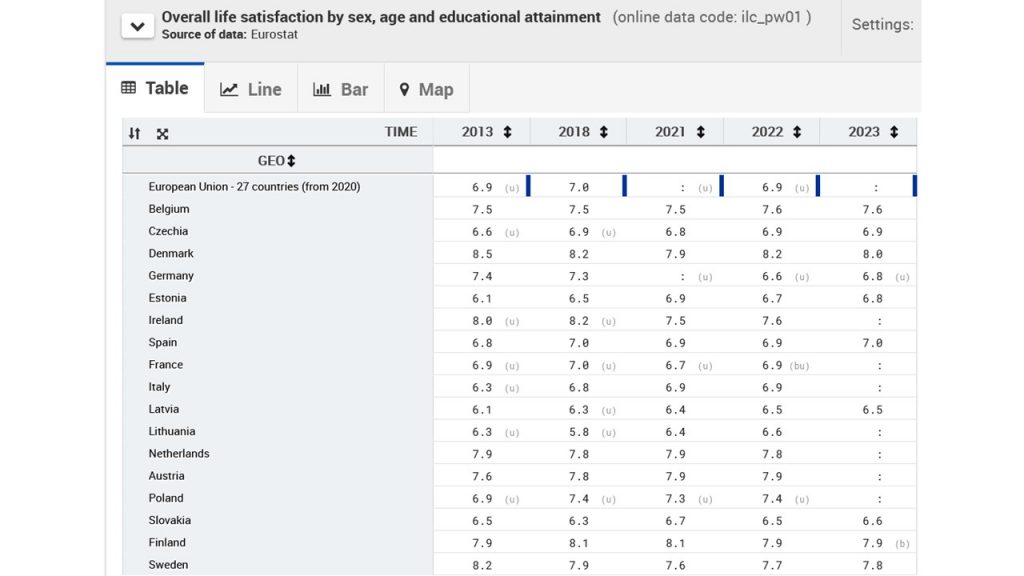
Heroines
In youth we are open for a wide range of influences. Heroines in children’s literature, picture book or cartoons look back on a long history as successful influencers. Creation, transmission and criticism of stereotypes are all part of the scientific reflection on heroines and heros. Nowadays, influencers have taken over picture books through the use of more compelling videos.
In the 1950s,1960s and 1970s picture books or cartoons dominated the influences before mass media like television became more absorbing, addictive and powerful influencers. Children’s books are passed on from one generation to next generation. The French-speaking world (and beyond BBC reference) has witnessed the success of the illustrated booklets of the young “Caroline” (Hachette) and “Martine” (Casterman) exploring the world. Parents passed on their collection to children and had their own parents read the stories to their grand children.
Well, that’s how intergenerational transmission of cultural heritage has worked for a long time. It describes the basic social mechanism. Nevertheless, new forms of influencing emerged with new technologies. Successful illustrated narratives like “Caroline” and “Martine“ were adapted as television series as well. In France you could chose your side of either explorations with Caroline and her group of animals or the adventures of Martine.
Ideally it would be an occasion for the families and friends to discuss pros and cons of each character and, thereby, become aware of what is a stereotype, at least at a later stage of the life course. Gender stereotypes have evolved and to observe 2 boys colouring Martine images in public (Brussels book fair 2024, image below) was a positive surprise. It almost felt like a real world experience of the AI-enabled Barbie explorations. 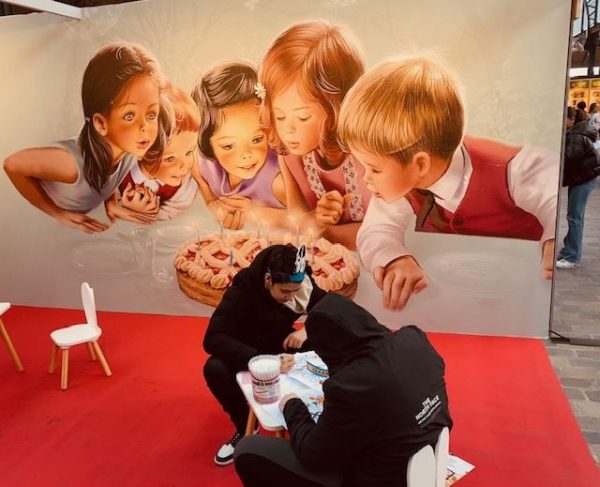
Wage Minimum
A wage at a minimum level is frequently lower than the minimum wage. Most EU countries have a legal minimum wage that should protect against poverty risks at low levels of wages. Over decades it has not yet been possible to raise all low wages to this level. Le Monde (Béatrice Madeline et Aline Leclerc) has published on April 3rd a comprehensive analysis of sectors and people concerned with this difficulty to make a decent living while earning the minimum wage. In France (La désmicardisation), as in many other countries, it is difficult to earn just a bit more as the minimum wage because both employers and employees may lose social benefits if they just earn some hundred € more than the legal minimum wage. For all those persons who do receive only a wage even below the minimum wage getting stuck in a poverty trap is very likely. The number of working hours is then often is the only option to make ends meet your needs. Put bluntly, you work additional hours and/or take a second job to complement the lack of earning a wage at the minimum level. Public procurement that makes the application of the minimum wage compulsory and controls this application effectively benefits society as a whole. Lots of infrastructure projects, urban and rural development receive public support. The conditionality to pay the minimum wage + X should be a „conditio sine qua non“. The millions of workers at the lower end of the wage distribution have a power at the ballot box, which continues to be underestimated in many European countries. The EP elections on June 9th will probably alert us about the lack of faith in a bettering of living and working conditions of those persons coping with wage minima.
Cancer Inequality
Inequality is a hugely important topic for societies. Inequality has many different dimensions and differential longitudinal patterns. New data in this field of social research are helpful to inform on possible ways to prevent increasing inequality. At the same time, it is important to reflect on factors that may reduce inequality in and between societies. Inequality in health is both an outcome of inequality experienced during previous stages of the life course as well as a factor in causing inequality in the evolution of the life course later on. Disentangling the factors is a difficult research issue.
A first descriptive pattern across Europe allows to get a snapshot impression of the status quo as a first indication of what health inequality looks like. Cancer is a major cause of mortality across Europe and by 2045 it is estimated to be the leading cause of mortality.
Without precisely analyzing the causal factors the overview across European countries allows to give a first impression on fields that need more policy attention and more in depth studies. The European Cancer Inequalities Registry and the ECIR Data Tool is based on data from 2019 (Link). The overview matrix by employment status reveals the highest prevalence of smoking among the unemployed (followed by the employed, not shown in figure) and the frequency of alcohol consumption is highest among the employed. Low physical activity is mostly prevalent among the retired. This has consequences for cancer and gives hints to how an intensified prevention may work.
The OECD report (Link) based on these data and additional country case studies and policy data base reiterates the known prevention recommendations: Reduce smoking, alcohol consumption, air pollution as well as more physical activity. The dimensions of inequality are gender, age, employment status and most of years spent in education. The curing of cancer also suffers from inequities as to the amount of and access to screening of cancer. Cost coverage and shortages in medical personnel add to multiple sources of inequality in treatment of cancer within countries by regions and between nation states. The Lancet Public Health editorial contributes to the spread of the awareness among scientists and the medical profession.
(Image: ECIR data tool download 2024-2-22) 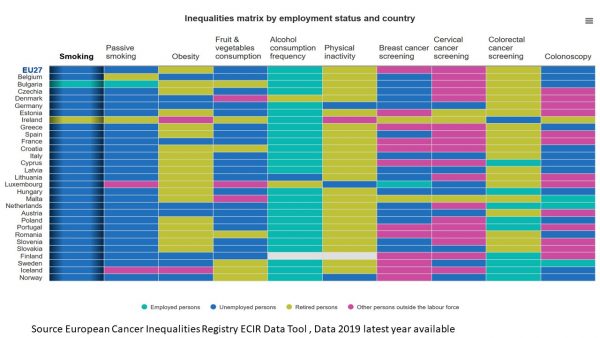
Greedflation
The teaching of economics and socioeconomic policies has to deal with the topics around inflation and economic inequality for centuries. Greedflation has become a newly coined term for the rise of inflation due to greedy firms who use a window of opportunity to achieve extra profit margins or windfall profits. At a time of perceived price rises in many sectors, sectors that have no cost increases might still try to push prices higher simply because almost everybody else does so. Higher profits then show up in the reporting season of enterprises quoted at the stock exchange and the increase in inequality between wage earners and shareholders will rise. Greedflation is a summary term for it. The ECB European Central Bank has mentioned this and Reuters has reported on it as well end of June 2023. Since then a wait and see strategy has been adopted. Now in February 2024 we witness the wider spread of extraordinary profits of big firms not only in the fossil energy sector but also bog banks. The economies and societies suffer huge losses and a massive redistribution of capital. Subsidies introduced to lower the shock of the coronavirus crisis and the Russian aggression are unpopular to be scaled back. Employees and their trade unions have a hard time negotiating adequate wage increases whereas most companies use the momentum of seemingly general price rises to push profit margins. The translation of this mechanism to the political economy risks to jeopardize the support for capitalism and market forces in general. Another wave of increasing inequality endangers the survival of democratic societies. Countries with only a short experience of the functioning of market economies are at a particular risk. Germany’s decline into dictatorship in the 1930s after the severe economic crisis should be remembered as a major threat. Greedflation is a very serious and very real threat which we have to address with economic and social policies rather than waiting until the European elections have passed. Time to act, the thinking has been done. Evidence accumulates to make the political case.
On Justice
Justice is a topic a bit like democracy. Most people deem it possible to simply state something is just or unjust, democratic or undemocratic, black or white. Rather than such a binary perspective it is often more helpful to take the pains to differentiate the many facets of each term and the complexity to categorize or to subsume a case under one or the other label.
Additionally, there is an evolutionary perspective on these topics. Individual cases evolve in form of trajectories. The binary view of justice or no justice might become more clear or more blurred. The exhibition of the “Topography of Terror” in Berlin offers a well established and documented view of the NS-terror during the years 1933-1945. The examples of horrific injustices throughout the exhibition are abundant. To perform justice is a much more difficult exercise and encounters lots of impediments.
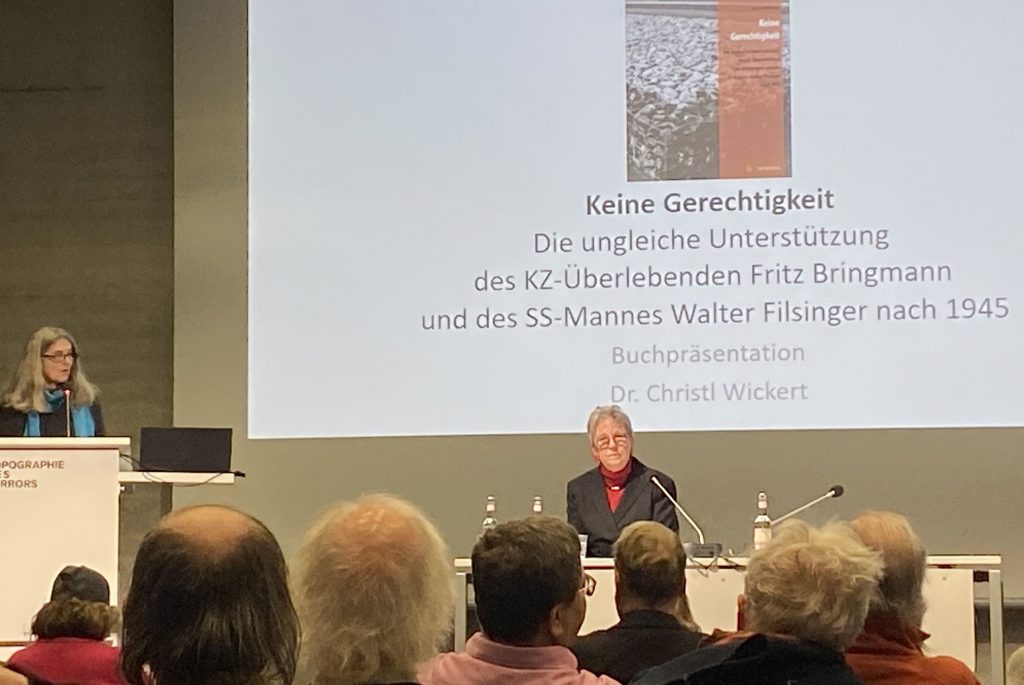
In January 2024 Christl Wickert presented her extensive research in archives which she published in the Metropol Verlag 2022 under the title “Keine Gerechtigkeit. Die ungleiche Unterstützung des KZ-Überlebenden Fritz Bringmann und des SS-Mannes Walter Filsinger nach 1945”. (engl. title and image below). Christl Wickert follows the life courses of the young Fritz Bringmann, prisoner in KZ Sachsenhausen and Neuengamme as of 17 years of age, and the life course of the SS member as of 17 years of age and SS soldier Walter Filsinger. Their life courses crossed at the concentration camp Neuengamme near Hamburg and perhaps later again in Hamburg Bergedorf. Whereas Fritz Bringmann had to struggle to get compensation for his injuries during imprisonment, Walter Filsinger managed through multiple manipulations of documents and dubious support from administrators as well as medical doctors to obtain war victim benefits.
From life course research we know that early disadvantages are hard to compensate throughout the following decades. This juxtaposition of 2 cases localised in the neighbourhood of Hamburg demonstrates this with full force. Injustice at the early stage of the life course is not compensated but rather magnified through the handling of each case through the proceedings of “administrative justice” in the institution building in the first few decades of the Federal Republic of Germany. The “thick description” as a scientific method is a lesson in unfolding as well as later on unravelling injustice.