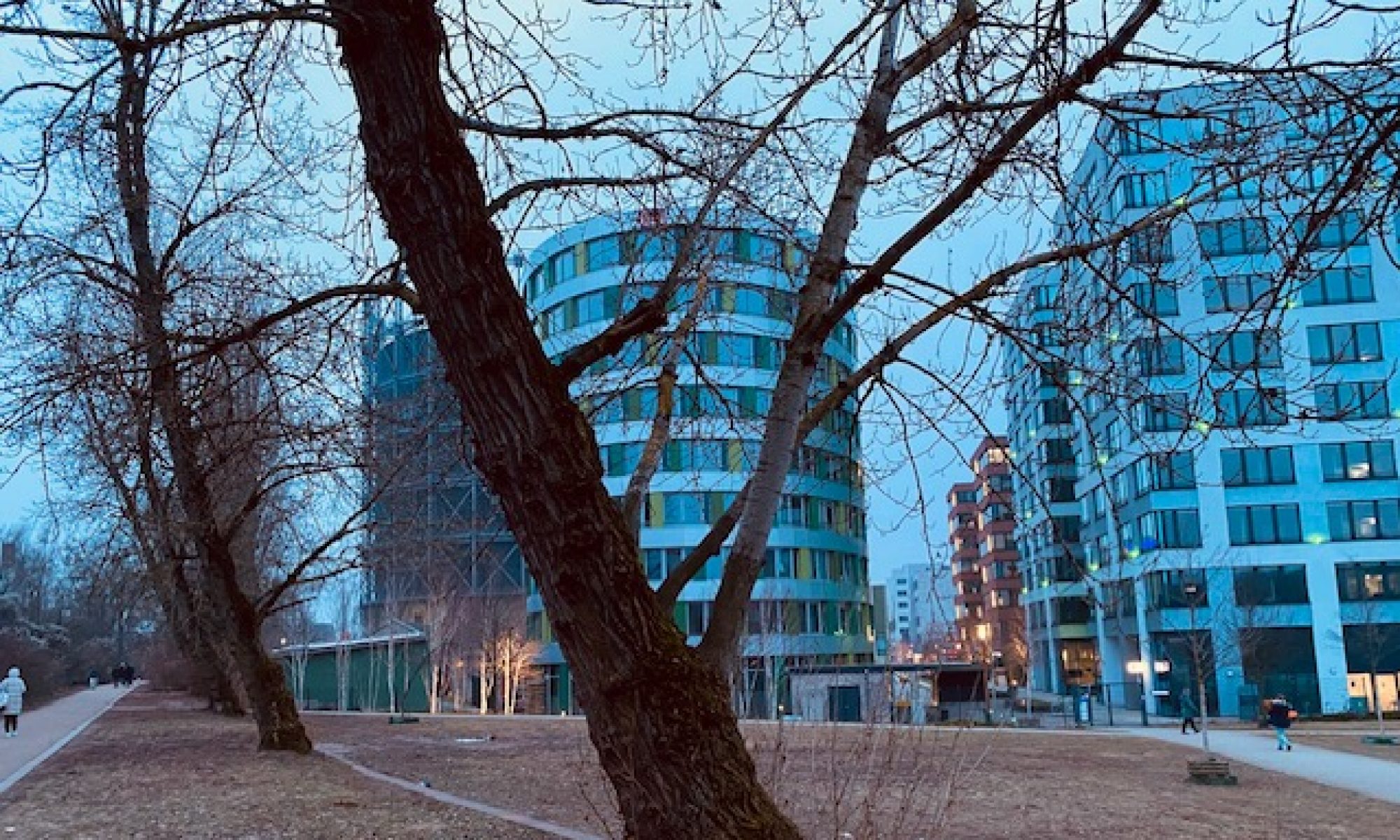

In most applications of AI there is one system of AI, for example a specialized service, that performs in isolation from other services. More powerful systems, however, allow for the combination of AI services. This may be useful in case of integrating services focusing on specialized sensors to gain a more complete impression of the performance of a system. As soon as two and more AI systems become integrated the risk of unwanted or illegal collusion may occur.
Collusion is defined in the realm of economic theory as the secret, undocumented, often illegal, restriction of competition originating from at least two otherwise rival competitors. In the realm of AI collusion has been defined by Motwani et al. (2024) as “teams of communicating generative AI agents solve joint tasks”. The cooperation of agents as well as the sharing of of previously exclusive information increase the risks of violation of rights of privacy or security. The AI related risks consist also in the dilution of responsibility. It becomes more difficult to identify the origin of fraudulent use of data like personal information or contacts. Just imagine using Alexa and Siri talking to each other to develop another integrated service as a simplified example.
The use of steganography techniques, i.e. the secret embedding of code into an AI system or image distribution, can protect authorship as well as open doors for fraudulent applications. The collusion of AI systems will blur legal borders and create multiple new issues to resolve in the construction and implementation of AI agents. New issues of trust in technologies will arise if no common standards and regulations will be defined. We seem to be just at the entry of the new brave world or 1984 in 2024.
(Image: KI MS-Copilot: Three smartphones in form of different robots stand upright on a desk in a circle. Each displays text on a computer image.)

Timeless Values
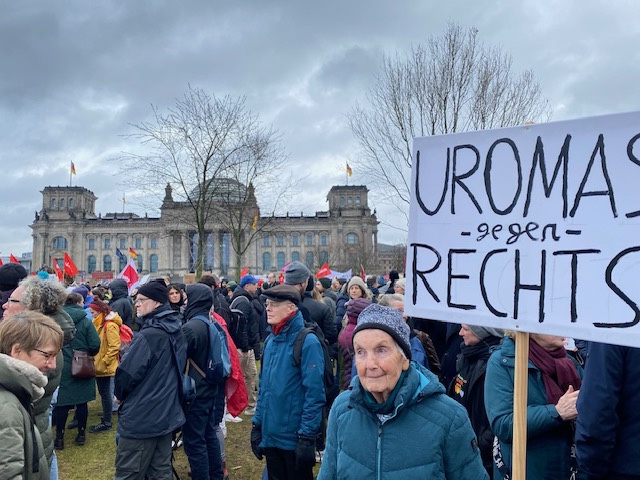
The declaration of human rights is more than 200 years old. However, the need to stand up for the defense of these rights needs many people to act accordingly. Political parties and courts are not strong enough to be the only defendants of democracy and human values. Solidarity across generations is another part of the struggle to defend democracy. In addition to the broad movement of “Omas gegen rechts”, the age distribution has been further enlarged with the “Uromas gegen rechts”. This most likely the generation with first hand life experiences from Nazi Germany and they should have reached an enlightened view of the horrors caused by the Nazi-regime. Unfortunately there are still some who continue to be prisoners in a fascist “brown” cage of mischievous memories. The great grandmother who was present at the demonstration was clear in her statement to stand up against right-wing extremism. (Image: With the permission of the lady I am happy to have evidence of the presence of super-agers at the demonstration in Berlin).
Zwang durch Terror
Durch den Terror der Willkürherrschaft mit rassistischer Doktrin wurde aus Zwangsarbeit eine lebensgefährliche Arbeit. Überzogene Sanktionen bei Diebstahl, Plünderung oder Sabotage wurden von den Nazis mit öffentlichen Hinrichtungen (Erhängen, Gruppenerschießung oder Guillotine) geahndet (siehe Katalog zur Ausstellung Alltag Zwangsarbeit S.44-45). Straflager und Verlegung in Konzentrationslager gehörten ebenfalls zur regelmäßigen Erfahrung.
Die Zwangslage der dort zur Arbeit gezwungenen Menschen ist kaum vorstellbar und fassbar in unserem System der Beschreibung von Arbeit. Totale Subordination kann vielleicht in Ansätzen verdeutlichen wie diese Situation auf die Personen gewirkt haben muss. Fluchtversuche waren fast ausgeschlossen. Selbst die Verbindung zu den meist deutschen Frauen in Fabriken war unter hohe Strafe gestellt und intime Verhältnisse (bezeichnet als Rassenschändung) wurden für beide Seiten lebensbedrohlich oder endeten für die Zwangsarbeiter oft tödlich. Der Terror in dieser Zeit bestand in der kontinuierlichen Gefahr und Angst tatsächlich oder vermeintlich eine Anklage zu erhalten, die unkontrollierbare, weil selbstherrliche, Strafen nach sich ziehen konnte.
Image: Ausstellung Alltag Zwangsarbeit 2024-1 in Dokumentationszentrum NS-Zwangsarbeit, Berlin Schöneweide. 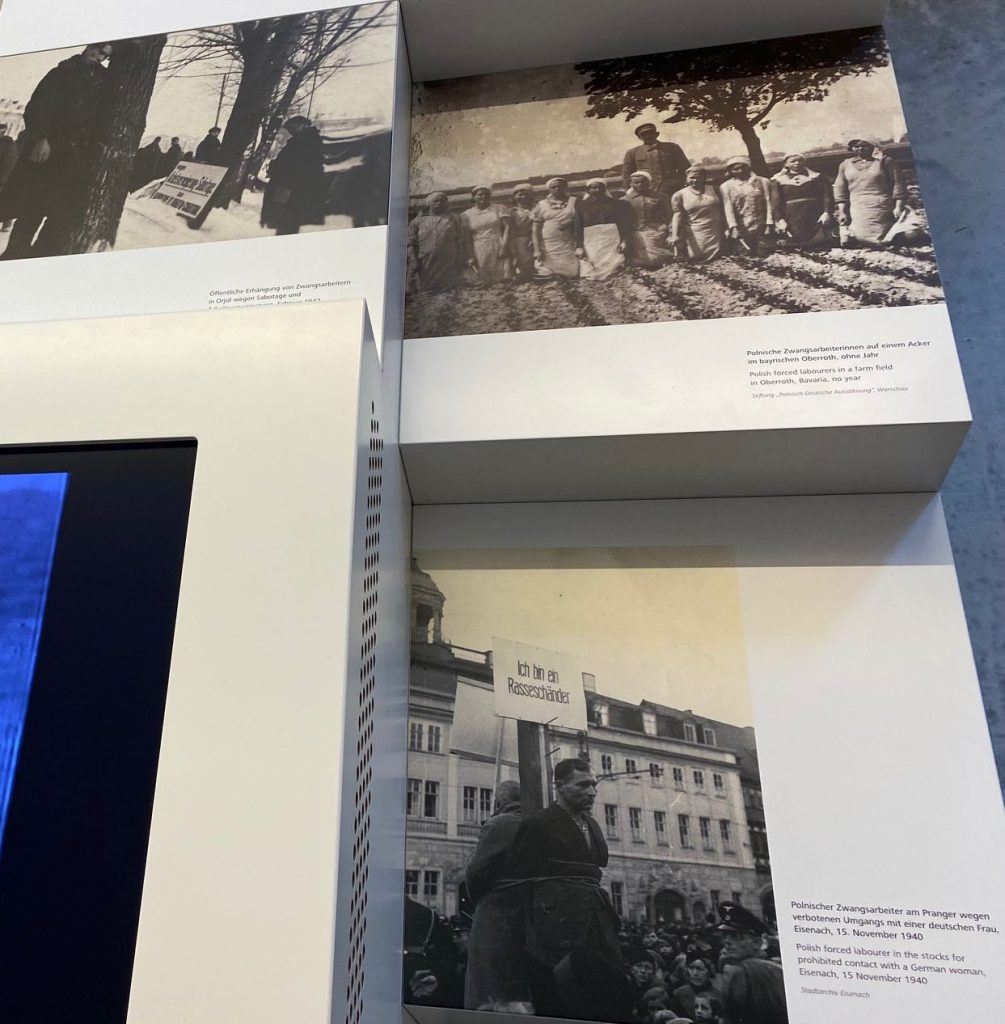
100 x 100
It is the horrible tragedy that Hamas terrorists after more than 100 days hold still more than 100 hostages. We shall never forget. Just like the terrorists taking hostages 51 years ago during the Munich Olympic games 1972. I believe it is about time to remember Winston Churchill’s famous words with a few changes, if I maybe allowed: “We shall never surrender. We shall fight terrorists on land and on sea. We shall fight them in the air and underground, in space if we need to.” This is part of not forgetting terror and staying alert to looming risks. For some the painful memories last their whole life long. Others, far too many, just forget, or worse, deny the facts. 
On Justice
Justice is a topic a bit like democracy. Most people deem it possible to simply state something is just or unjust, democratic or undemocratic, black or white. Rather than such a binary perspective it is often more helpful to take the pains to differentiate the many facets of each term and the complexity to categorize or to subsume a case under one or the other label.
Additionally, there is an evolutionary perspective on these topics. Individual cases evolve in form of trajectories. The binary view of justice or no justice might become more clear or more blurred. The exhibition of the “Topography of Terror” in Berlin offers a well established and documented view of the NS-terror during the years 1933-1945. The examples of horrific injustices throughout the exhibition are abundant. To perform justice is a much more difficult exercise and encounters lots of impediments.
In January 2024 Christl Wickert presented her extensive research in archives which she published in the Metropol Verlag 2022 under the title “Keine Gerechtigkeit. Die ungleiche Unterstützung des KZ-Überlebenden Fritz Bringmann und des SS-Mannes Walter Filsinger nach 1945”. (engl. title and image below). Christl Wickert follows the life courses of the young Fritz Bringmann, prisoner in KZ Sachsenhausen and Neuengamme as of 17 years of age, and the life course of the SS member as of 17 years of age and SS soldier Walter Filsinger. Their life courses crossed at the concentration camp Neuengamme near Hamburg and perhaps later again in Hamburg Bergedorf. Whereas Fritz Bringmann had to struggle to get compensation for his injuries during imprisonment, Walter Filsinger managed through multiple manipulations of documents and dubious support from administrators as well as medical doctors to obtain war victim benefits.
From life course research we know that early disadvantages are hard to compensate throughout the following decades. This juxtaposition of 2 cases localised in the neighbourhood of Hamburg demonstrates this with full force. Injustice at the early stage of the life course is not compensated but rather magnified through the handling of each case through the proceedings of “administrative justice” in the institution building in the first few decades of the Federal Republic of Germany. The “thick description” as a scientific method is a lesson in unfolding as well as later on unravelling injustice. 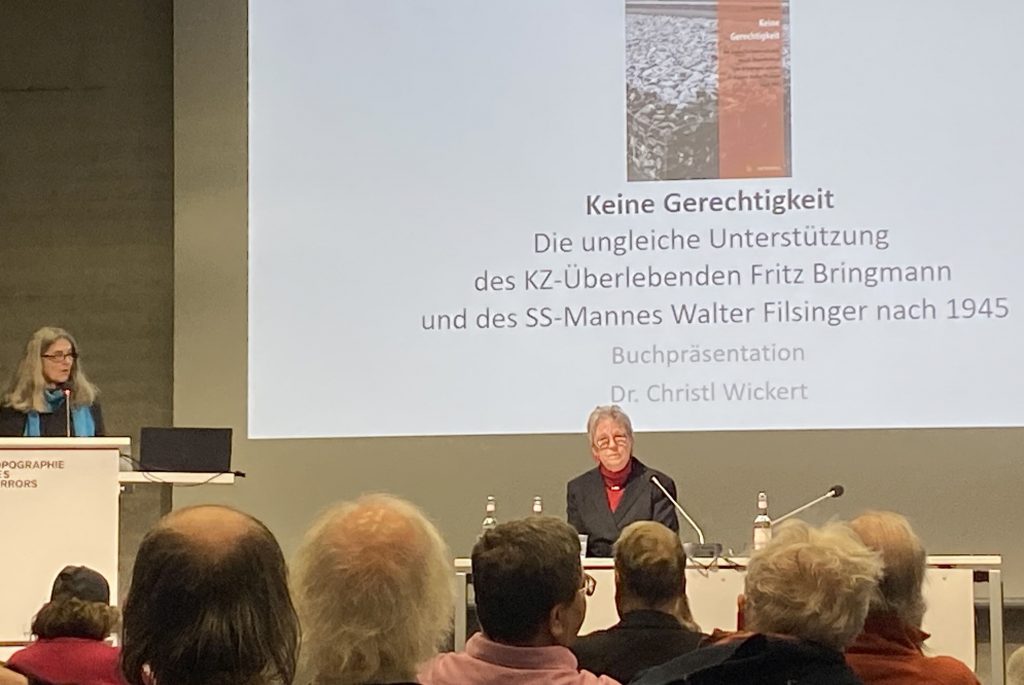
Winning Peace
Most analysts of international conflicts deal with winning or losing a war. At best they deal with short-term versus long-term versions of winning and losing. However, the question of how to win or achieve a lasting peace is rarely researched. Research on the 2nd World War reveal as soon as the turning point of the war was achieved the preparation of what will come after defeat. Organising humanitarian relief is part of warfare. The U.S. has set a good example of how to organise humanitarian aid as well as ensuring a lasting peace in Europe after the 2nd World War. Lots of books have been written on the Marshall Plan to get the economies in Europe (Western Europe) back to producing. Much less attention has been devoted to the important element of “de-nazification” of whole societies.
To win peace after the monstruous crimes of the Nazi-regime and the millions of followers and ruthless fighters was a challenge without precedents. The U.S. gave a good example of how to handle the process of winning peace in the regions under its military authority. In the following I shall refer to work published by Christa Horn (1992) “Die Internierungs- und Arbeitslager in Bayern 1945-1952”. The Allies had agreed upon to pursue war criminals. In April 1944 the Supreme Headquarters Allied Expeditionary Forces published the “Handbook for Military Government in Germany”. It was deemed important to detain “certain government and party officials and members of police and para-military formations” (p.17).
Common to demilitarisation efforts after a war, it is the primordial function to reduce the risks of a renewed uptake of guerilla-like attacks due to the amount of arms still widely available or hidden on the enemy’s territory. The document specified further that the continued presence of Nazis in government and other exposed positions “might be a threat to the security of the Allied Forces or an impediment to the attainment of the objectives of Military Government in Germany” (Arrest Categories Handbook, P.2). Denazification was a means to an end. The size of the task was, however, underestimated at several instances. For example, the organisation of the arrest and detention of more than 100.000 persons was a difficult task. After the end of fighting the transition to peace is not instantaneous. Hierarchical military and party structures had to be dismantled. The so-called “automatic arrest” issued on 13.4.1945 included all grades from the NSDAP down to the “Kreisleiter” or even “Ortgruppenleiter” as well as SS members and their “Helferinnen” (Horn, 1992 p.21). These arrests without judicial procedures came under critic as not-American in the U.S., but it took until 10.10.1948 to abandon this procedure. The literature on the issue refers more to the lack of adequate judicial procedures to handle such so many legal procedures with qualified persons as well as the difficulty to organise detention camps for more than a hundred thousand persons that should deserve to be prosecuted. Handing over to the national or regional judicial instances was, therefore, an important step. The risk to abandon the process of “denazification” was evident, but it was equally important to counter the expansion of the Russian-domination in Eastern Europe with the help of a strengthened Western Europe. Winning peace is a delicate balance of prosecution through the winners of the war and the subsequent prosecution of criminal actions through the indigenous population and its new institutional and judicial setup.
Social Sciences have a lot of solid insights to offer to win peace. With careful consideration they are helpful to learn from even for current international affairs and raging wars. Demilitarisation is only a small part of winning peace. Changing mind sets to internalise humanitarian values remains the biggest challenge and involves more than one generation. 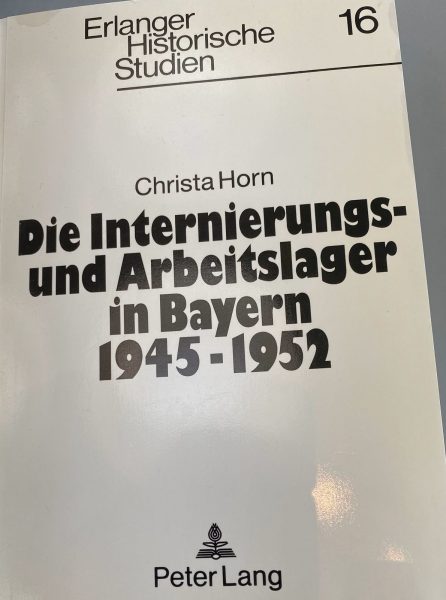
Arms trade
The sustainability of war depends a lot on the availability of arms. The Stockholm International Peace Research Institute (SIPRI) publishes regularly updated data on arms trade. The report ranks countries who are the most important exporters as well as importers of arms (from 2018-2022). The lists show for exporters that the U.S has been at the top of exporters with 40% of the global export share followed by Russia with 16%. France 11%, China 5.2, Germany 4.2 come next on the list. Taken together Italy, Spain and the U.K. reach another 10% jointly of global exports. South Korea and Israel come in with shares of 2.4 and 2.3 respectively. The top ten serve allies but also more broadly the world arms trade and race. New dynamics have started to come into force. The Russian aggression and war on Ukraine territory will have an impact to the extent that Russia is probably exporting less and shift to a more importing state.
Among the importing countries India is leading the ranking followed by Saudi Arabia and Qatar. More generally Asia and the Middle East were the most important buying countries. Importing arms might be interpreted as an indicator of perceived threat to a country. Long cycles of arms renewal may also drive statistics of arms trade, but new threats like cybersecurity and space technology have created new fields of potential attack and defence.
All in all, yet another rationale attributed to Clausewitz seems to play a role in driving the arms trade. “If you are perceived to be weak, an enemy will use this to attack”. Well, this also means that buying arms, producing or importing them, could deter a military aggression. That form of deterrence of aggression is known from the nuclear arms race as well. In the realm of conventional weapons, we have thought, it would no longer apply. We were mistaken in this respect. The dividend of peace has come to an end for many countries. The SIPRI report (2003, summary p.9) shows the continued rise on the global level of the arms trade. Why are we so scared of each other? Russia has reverted to imperial politics using conventional weapons. Containing such disrespect of internal law needs our full attention to avoid a spreading to other areas. The link of diplomacy and trade needs close scrutiny. 
Strafbar
Wir alle wissen, dass in Deutschland die Verwendung von Symbolen der Nationalsozialisten zum Beispiel in Fotos strafrechtlich verfolgt werden kann. Das trifft auch auf vermeintlich nur private Verwendung zu. Dazu hat das Bundesverfassungsgericht eine hilfreiche Erläuterung und Auflistung erstellt (Link dazu hier).
Das Oberverwaltungsgericht von Rheinland-Pfalz hat bereits klargestellt, dass eine Unterstützung der Reichsbürger für Beamte zum Verlust des Ruhegehalts führt. (Pressemitteilung OVG RF) Die Demokratie hat sich Mittel für ihre aktive Verteidigung geschaffen. Diese rechtsstaatlichen Mittel müssen wir noch entschiedener einsetzen.
Hilfreich kann das Weiterlesen auf der Konrad Adenauer Stiftung dazu sein. Dort wird in allgemeinverständlicher Art beschrieben, dass die zur Schau Stellung von Teilen der Uniform und Symbolen seit Gründung der Bundesrepublik verboten ist.
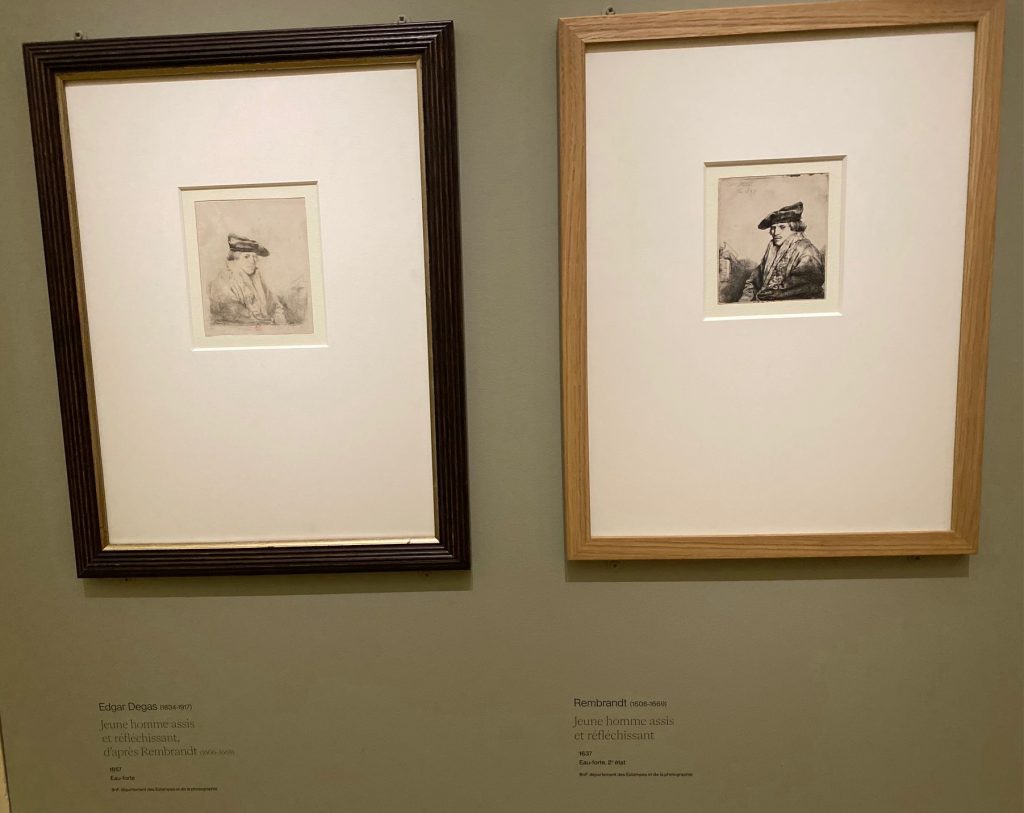
Meist steht hinter der Verwendung dieser Symbole keine Dummheit, sondern eine bewusste Aggression oder gar Boshaftigkeit gegenüber anderen Menschen. Menschenverachtung der Nationalsozialisten lässt sich nicht entschuldigen, damals nicht und heute nicht. Image: Edgar Degas d’après Rembrandt 2023 BnF.
Geo-politics
In the middle of October 2023 we witness the unexpected and unwanted rise of the geo-political importance of the European Union. First, after the aggression of Russia to realise a huge land grab on Ukrainian territory, the European Union managed to define its new geo-political role in supporting the Ukrainian struggle of independence and freedom versus Russian oppression. This means continuous support of several forms: humanitarian, supporting infrastructure like energy and food supplies as well as military equipment for defensive purposes. Achieving our own strategic autonomy means decoupling from energy supply from Russia despite huge investments to build interdependence particularly by Germany or Finland. Additionally, strategic autonomy means relying on international partners that share our values and quest for sovereignty. Supply chains for production systems have to be re-organised to ensure independence even in military conflicts.
A new role has become evident also in the attack from Hamas on the state of Israel. Historic links and responsibilities to the creation of the state of Israel have led the European Union to make its voice heard in the Middle East to limit escalating confrontations.
These changes in the geo-political role of the European Union have far-reaching implications internally as well as in its external relations. Some have been spelt out by Luuk van Middelaar (2022, adviser to Herman van Rompuy) in his lectures “Le réveil géopolitique de l’Europe”. In the introduction he makes clear what are the 3 major elements of the geo-political wake-up for Europe: (1) power, (2) territory and (3) narrative. Europe has shunned away from its geo-political role as a powerful player. (1) Believing more in a peaceful role, a moderator, deviating from its colonial past, upholding the primary role of international law and justice, the European Union has been forced by external powers disrespecting these premises to enter into various international border conflicts as a power in its own right. (2) Questions of territory matter most, if they are challenged by powerful neighbours who are not inclined to respect international law. Even uncontrolled migration is part of this disrespect of territorial integrity. (3) Speaking in the name of a whole community of countries who share the same values, gives a convincing force to be able to overcome national particularities and predilections.
However, the European Union’s new geo-political role has to be carefully communicated not only to the outside world (it is in no way thought to be offensive), but also internally. For example, the budgetary implications of the geo-political role need to be communicated to the electorate and public opinion(s) in Europe. Do not forget to carefully prepare the whole population on this new role.
Donald Tusk held steady to counter claims from the PIS-leaders in Poland to reduce the geo-political role of the European Union. Many countries and people sharing our values are eager to see the European Union to accept this new geo-political role to defend human rights, internal law and justice. (Background reading: Middelaar, L. v. 2022. Le réveil géopolitique de l’Europe. Paris : Collège de France. doi :10.4000/books.cdf.12770 ). Image: Extrait LeMonde diplomatique 2019-11) for discussion. 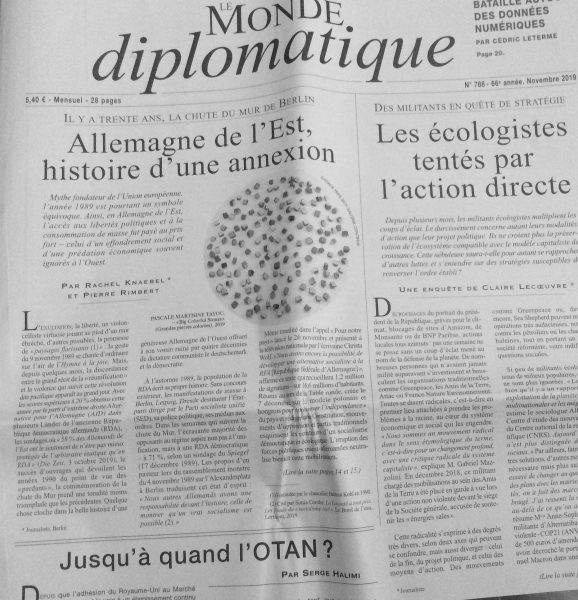
Human Rights
At times of war it is even more important to highlight the importance of respect of human rights. Russia continues to bombard civilians and destroys infrastructure that heats and feeds millions of people. Hamas in the Middle-East has killed more than a thousand civilians in Israel. Pushing violence beyond limits without respect of basic human rights is a very dangerous path for all human beings. Structures within each society need to take care of respect of these limits. The rule of law is fragile in authoritarian states or outright discarded. This makes human rights violations especially in wars or warlike conflict even more likely. The Human Rights Film Festival Berlin attempts to raise awareness to the facts of human rights violation wherever they occur across the globe. Following the link you have a chance to view some of the films online. The online flipbook allows to turn the pages of the magazine, which accompanies the film festival and provides a lot of additional information on the various categories. The section on the deep fakes is demonstrating how the use of fake news and fake images have an influence on us. The intensity of such fake news usually rises when elections approach in democracies. European elections will be seriously endangered through this kind of interference by Russian computerized disinformation networks and China is catching up on such misuse and systematic blocking of free information to its citizens. We shall have to be even more attentive to details in information and misinformation campaigns. Trusted websites and information channels of mass media have to step up their cybersecurity defences. Even small sites like this one have a responsibility to guard against abuses. In opening up the comments on the blog entries only for some time had the consequences of deleting “hundreds” of spam entries and undercover advertisements offering links to malicious sites. 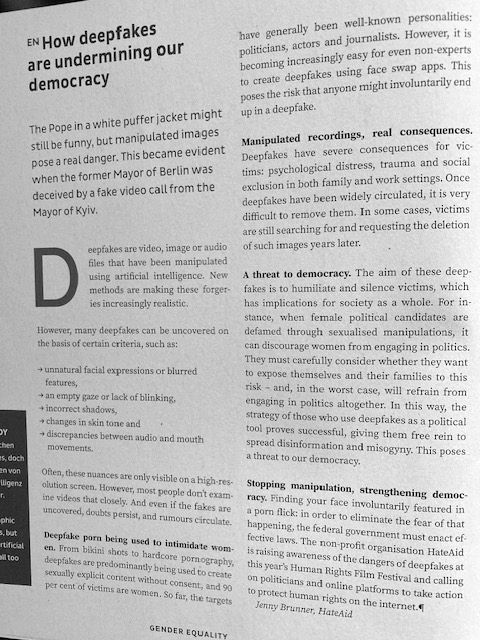 Filtering such spam is a professional task and has relatively high costs involved. A potential threat to the freedom of opinion and freedom of speech. Support for film makers and documentalists is important to strengthen the support of human rights.(Image: Human Rights Festival Magizine p.18 by Jenny Brunner, HateAid)