Pictures at an exhibition

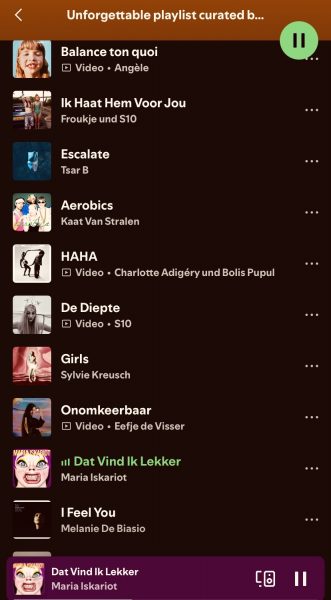
The playlist on Spotify, which accompanies the exhibition “Unforgettable” in Ghent, is an interesting extension of the unforgettable artists into today and tomorrow. You may be inclined to share your opinion in the way Maria Iskariot does it in “Dat find ik lekker” or more like Sophie Straat in “Dansen met de dood”. Anyway, women artists are coming front stage and this is great news despite all the backlashes we, unfortunately, witness in the 2020s. The curator of the playlist Murielle Scherre has managed to take us, a bit like the exuberant Modest Mussorgsky in his “Pictures at an exhibition”, beyond the marvelous exhibition rooms to a broad exploration of contemporary women artists’ world of imagination in music, visuals and songs. A great intergenerational accomplishment. 
Screenshot

Free Lunch

Who told you that there is no free lunch? On the premises of “The Berlin Philharmonic” a group of toddlers and babies had a free musical lunch. On the occasion of the lunch concert on 2026-1-28 in the spacious entry hall young musicians (piano, Ana Bakradze, and violoncello, Carlo Lay) gave a concert with Sonatas from Beethoven (op. 69) and Britten (op. 65) to an exceptionally broad range of ages in the audience. People fully enjoyed the concert, irrespective of uncomfortable seating also on stairs, if they managed to find a seat at all. The occasional breast feeding seemed to be the free lunch for some privileged babies. The adults were invited to contribute a donation to the UN refugee fund. Instead of the usual seasonal coughing, there were delighted outcries from the youngest, which enchanted the aging audiences additionally. The 2 musicians excelled in concentration on their performance in spite of the challenging setting.

Konzerthaus Organ

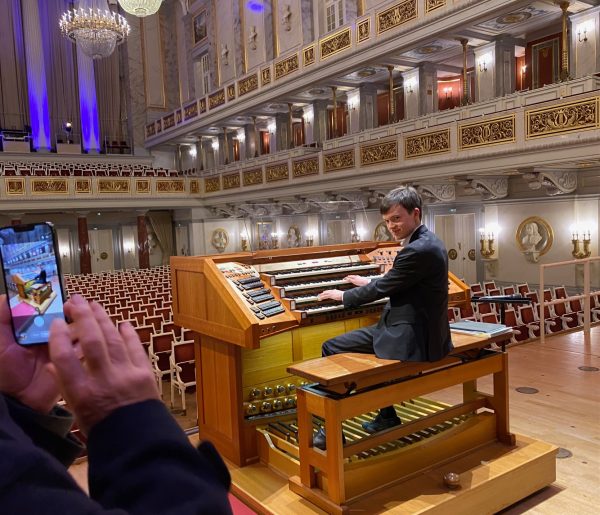
In the Espresso Concert series we have had the chance to listen to young talented musicians. On 2026-1-7 Julian Emanuel Becker charmed the audience with 5+1 pieces in the “Großer Saal“ on the Jehmlich Organ (4 manuals, 74 registers, 5811 pipes). The program ranged from Bruhns, Bach, Mendelssohn Bartholdy to 2 pieces by Jehan Alain, which made for an interesting surprise. Mastering this huge Konzerthaus organ with impressive skills at just 20 years of age caught the attention of the Berlin audience including the tourists on visits. The enthusiasm of Julian Emanuel Becker for his instrument and the brief introductions he gave himself to each piece created a unique learning as well as musical experience for the entire audience irrespective of age and prior expertise. The „Espresso addicts“ of the Konzerthaus even took the chance to chat with the young organist to learn more about the marvelous instrument and the next steps in his promising career. The studies in Paris at the Conservatoire have been important steps in the careers of formidable pianists and composers for more than 200 years. Becker will surely return to Berlin to give concerts again. Try to catch a seat, if you can. (Image: Julian Emanuel Becker 2026-1-7 at the Konzerthaus Jehmlich Organ)

Konzerthaus Espresso

Classical music in classicist architecture sounds like a perfect match. The audience is packed with people mostly 60+ years of age. One of the spectators happily admitted that without the espresso before the concert she would have a hard time to follow closely because after lunch at 2 p.m it is time for a rest rather than excitement.
The series of short concerts at lunchtime suits particular audiences. It is probably the only concert series where the queue in front of the toilet of men is equally long than the one for women. The short concert program allows for more experimental formats as well. Musicians who develop a solo program of shorter than standard concert hall duration can appear in high reputation locations and gain experience of performing in such prestigious settings.
With a “Zugabe” from the performer, but also in form of a small piece of chocolate for the audience at the exit, 21st century, classical Berlin knows how to charm its aging audience and population. Young performers learn that the mature audiences don’t bite any more. In case the sound and peaks become too modern they just adapt sound level of their hearing aids. It is perfect for all generations.

Liszt home

In Budapest we can visit one of the longer living places of Franz Liszt or Ferenc Liszt as some Hungarians would insist to call him. The Beethoven trained Carl Czerny offered piano and music classes free of charge to the young Franz Liszt in Vienna at the age of 11. In the biography by Klára Hamburger she describes the Paris years of Liszt from 1823 until 1839 as the most important ones for the pianist and particularly for his later compositions. Born in Hungary, the son of 2 Austrian parents he was trained in Paris by amongst others the Czech professor of the Conservatoire de Paris Antonin Reicha just like Chopin, Flotow or Offenbach. Writing an opera was the “must do” for a composer who aimed for the highest possible career at the time. In a letter to George Sand, Liszt (published 1937) complained already about the social status of musicians in society as servants to the higher ranks of society. Similar to Ravel many years later Liszt was rejected as official scholar by the Conservatoire de Musique and his wish to marry a daughter of noble decent was rejected early in his career. Such experiences probably contributed to his leaning towards the romantic form of expressions in music during most of his compositions. Literature, paintings of the French romantic period and the traveling artist “voyages et pèlerinages” became influential in his creative process. The competition between composers must have been fierce at the time and despite ample opportunities to perform in public and private venues making a living from music wasn’t always easy at the beginning. More than 100 years after his death his compositions are still a challenge for all pianists and the Hungarian Rhapsodies probably his greatest homage to his early childhood.

Tchaikovsky home

During the time before the “Zeitenwende” it was easy to visit the home of the composer Pyotr Ilyich Tchaikovsky in St. Petersburg. Therefore, we refer to our memory of the visit and the already 10 years ago restrained liking and appreciation of the Russian officials for the aristocratic composer, even accused to not be sufficiently Russian in his music compared other Russian composers. The composer had diverse love affairs, which were also not conform to official doctrines. The world wide success of his compositions, mostly known for his ballet music, remains popular in the 21st century. Similar to Beethoven, the biography by Malte Korff (Tschaikowsky, in German), highlights the final symphony as his masterpiece. The seems to be a reason to study “the last works” of composers specifically. The mature compositions appear to reflect on previous work and build or comment on previous work. The 6. symphony “Pathétique” was completed in his last year of his life, only at age 53. The final IV-th piece of it is entitled “Adagio lamentoso” and ends in very calm tempo and almost silence like a withering away heart beat. To my surprise I found a similarly very quiet ending in one of his early piano composition when he was only 28 years old “Romance Opus 5, Andante cantabile”. This early piece also ended “più lento” and from pp to ppp. (compare extract of image of notes below).

Beethoven Home

The home of Beethoven in Bonn is nicely preserved and full of objects related to his life and his creative work. For the musician and composer musical instruments have accompanied him throughout his life. The visit of his home of birth offers a chance to dive into the extraordinary accomplishments of this great figure of the late 18th and early 19th century. His 9th symphony is strong as ever and the European anthem has just more than 200 years since the first performance now. The visit of the museum is still the highlight of Bonn and the App of the Beethoven House offers unique insights into and listening of his manifold compositions. Handwritten notes and a pocketbook of preparations for the symphony demonstrate the all encompassing nature of music for Beethoven. From romantic letters to the romantic music pieces, the museum has it all. Even it is a rather tiny house from the outside the inner life is as huge as it can be. It is advisable to take at least half a day for the visit much more than you would usually take for visit of a museum. The link between the biographical information and listening to linked musical pieces with a chronological context are a unique experience. This spurs the interest to listen or listen again to some of the romantic masterpieces. The App is great also to listen directly to some of the music.

Ukraine Chanson

The Russian war in Ukraine is not limited to the military killings. From the earliest period in 2014 already Russia initiated a war on Ukraine culture and Ukrainian cultural heritage. Therefore, it is great to witness the efforts by Ukrainian musicians not only to retrieve their rich heritage for example in the field of chansons, but to develop traditional songs with new formats. Jazzy versions of children’s songs have been sung with an admirable soft voice by singer and composer Viktoria Leléka and her band.
Most people might think of children’s songs as an insignificant niche of music. The importance of singing songs for children and babies is a scientifically well documented finding. Early bonds are created and a sense of belonging and comfort, particularly during difficult times of life. Comforting music is also an intergenerational issue. Transmission of emotions and values across generations is the very fabric of societies. The recent album “Kolysanky” and the song “Ne Zhal” is a great reminder that it is the children that count not the, maybe, broken cradle.
During the war time with many absent fathers, chansons can bridge the emotional hardships. The movie “The Chorist” had demonstrated the power of children songs for children, their parents and all generations involved. Chansons have a much longer “half-time of life” than war.
From an unknown French composer the cradle song “Fais dodo Colin …” and Brahm’s Wiegenlied are classics many people in Europe will remember from their childhood and still transmit them today. Great news that Ukraine continues this tradition with new, innovative adaptations of their own lively cultural heritage.
(Image: extract of lyrics Ne Zhal’, from webpage)

Conducter Careers

The careers of conductors during the 1930s and 1940s have been propelled by joining the NSDAP on Germany. Even if not too outspoken as conductors on Nazi discriminatory policies many openings arose only due to banning Jewish conductors and musicians from performing in public. The acceptance of vacancies due to such restrictions advanced the careers of Karl Böhm as well as Herbert von Karajan. A theatre play Böhm at the Deutsches Theater in Berlin takes up this topic and puts the professional career in perspective of an anti-humanist leadership style. Karajan has also come into critic, because of his role in selecting musicians who were conform to the prevailing Nazi-antisemitism. It is important to work on these biographies and their implications for hundreds of lives of other musicians. Many careers have been destroyed due to these two prominent conductors ready to do almost anything to advance their careers. It puts their interpretation of music in a different light knowing about their instrumentalist approach to music, their own careers and the disrespectful Nazi doctrines. Image New Berlin Philharmonic, View from Kunstgewerbemuseum 2020.

Famous Neighbors

Sometimes people believe they can catch a bit of fame, if they live in a prominent neighborhood. Next to a famous person or the glamor surrounding such a place is inspiring. In Berlin the honor or fame is transmitted for example with the street names of composers. Everybody knows Johann Sebastian Bach and around Christmas time many of his compositions will be performed again. Directly next to Bach street we find Flotow street. It needs a bit of info about music and music history to identify the honor for Flotow to appear next to Bach. Well, Berlin you are „wunderbar“. You have made my day just on one of the first few days of the direct train connection between Paris and Berlin started. We grow together in small steps.