Berlin Futures

The city of Berlin is projecting itself into the future. Two long-term goals, Olympic Games 2036 or an Expo organization 2035, are potentially looming and all actors have to project themselves as to what role they want to play in such processes. Trades and industries have an essential role to play to realize any vision of the future, at the same time, local trades and industries ask for amenable conditions to do business in the necessarily restricted city space.
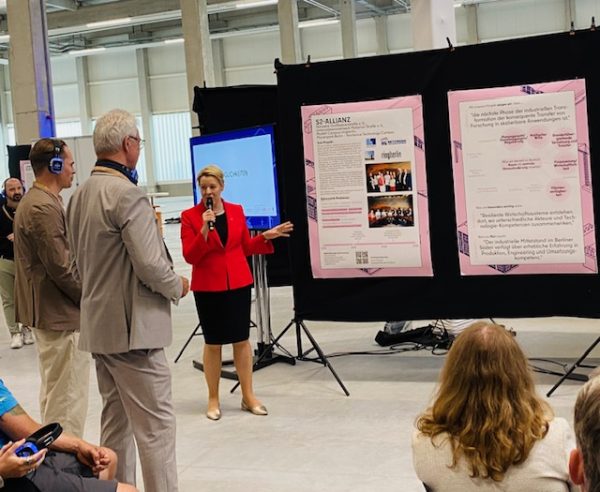
There is competition between housing projects and business parks across each metropolitan area as any form of growth needs space to grow in. The “1. Berlin Future Day of business parks” highlighted this potential source of conflict and business leaders exchanged their experiences and strategies how to arrive at manageable comprises.
There are several Win-Win constellations in which for example an additional stop on a metropolitan “S-Bahn” line benefits the business area and all those (future) employees going to and back from work. Infrastructure like transport, mobility, energy, internet speed and security, all play key roles in such visions of future. If networks of organizations address policy makers with well-defined requirements, politicians can act as facilitators to ease sometimes lengthy bureaucratic impediments. The call for public infrastructure investments by private business initiatives is a reminder of the need for public-private partnerships to create promising Berlin Futures. (Image: 1. Future Day of Business areas in Berlin, Senator Franziska Giffey 2026-7-15)

Job Quality Insights

In the U.S. the Upjohn Institute for Employment Research conducts a major empirical study on job quality (Houseman et al. 2025 1st wave 18.000 respondents). The documentation and the full set of questions (Link) cover 5 dimensions of job quality: compensation and job security; work structure and autonomy; work environment; worker agency and voice; growth and development. The special merit of the survey is that it makes great efforts to cover also new forms of (precarious) self-employment (Abraham et al. 2026). The degree to which can you make autonomous decisions is of relevance to the self-employed as well as it is a part of the job quality of dependent employees in small, large or big firms.
Related to the use of AI for work purposes question 31 asks for the influence on the decision to use new technologies in your job. This is the modern version of a question, whether you have influence on how you do your job. Bullying in a job may come from supervisors, colleagues or customers and respondents report on this. Beyond the answers given for “your main job”, it is noteworthy that the inclusion of questions on a secondary job allow to identify with more precision the precarious forms of how people try to manage to make a decent living in the U.S.A.
(Image: Exhibition Fashion Council Berlin at New National Gallery 2026)

AI data Input

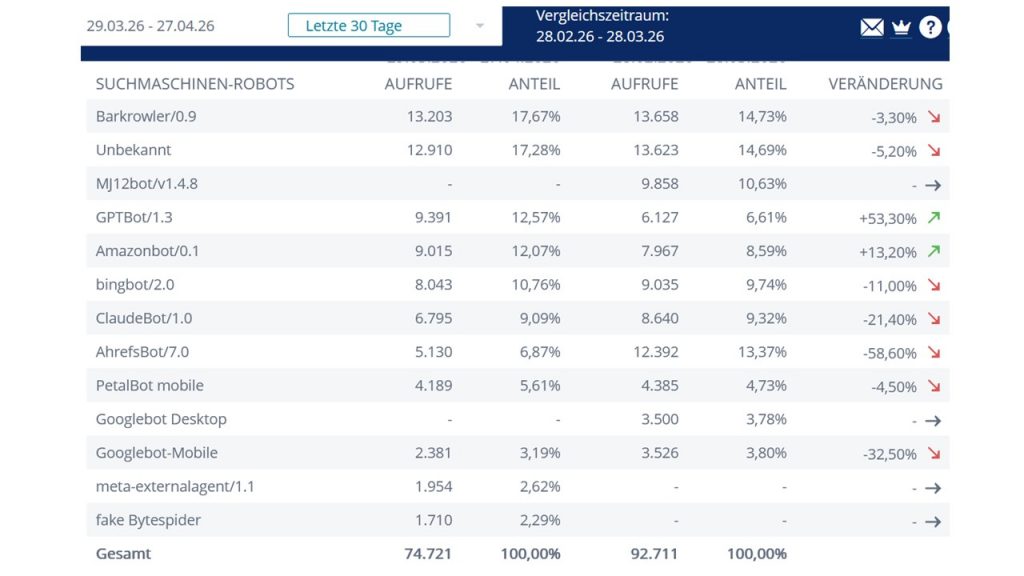
If you ever wondered where the information from AI and AI chatbots comes from, you will not be surprised that this webpage schoemann.org is regularly solicited for such purposes. The number of crawlers, that do so, is quite large. The ability to trace what exactly they are harvesting on your website, is quite a tricky issue. At least a basic awareness of how the internet has been transformed in the last few years becomes evident through the comparison of unique visits, many through search engines like Google search or others, with the amount of contacts by AI-associated crawlers (see slide from own webpage below).
During he last month up to 2026-4-27 there were about 75.000 contacts, compared to 93.000 during the previous month.
At first sight, AI chatbots have largely outnumbered the “personal visits” of my webpage (see evaluate web analytics). On the other hand, I have no information of how many visits are, (at least potentially) re-directed hints from AI chatbots to my content.
In terms of “traffic” for a webpage, the information of how the AI-driven or AI-assisted search operates with other persons’ contributions will be the challenge of the coming years. If AI chatbots had to pay 10 cents per visit, I would have a comfortable pay every month from this content use. The issue of AI paying for access to reliable and high quality content has to be dealt with sooner rather than later. You may prompt a chatbot on this issue.
Meanwhile: My New Book on AI is out Now 2026-4-28:
“AI and Social Science: Potentials versus Limitations” by Dr. Klaus Schoemann, online reading and free download (here) before implementation of Paywall later on.

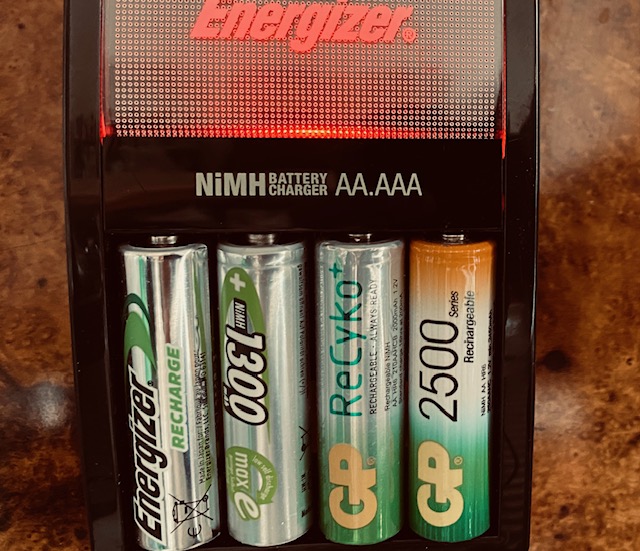
Quantum battery

The first prototype of a Quantum battery has been successfully tested. The Commonwealth Scientific and Industrial Research Organisation CSIRO with corresponding author James Q. Quach published the paper on the “quantum battery tuned for strong light–matter coupling” (Kieran Hymas et al. 2026) open access. Although there have been close to 20 papers on the theory behind quantum charging already, the demonstration as a proof of concept (in business terminology) has been missing so far. The superextensive charging with photons builds upon “a laser pump pulse with bandwidth ~31 nm and resonant with the LP branch induces excitations in the quantum battery” (Kieran Hymas et al. 2026 p.3). Since batteries need not only be charged, but also discharged in a safe and fast way, the prototype demonstrated also this additional functionality.
This is a huge step towards the feasibility of the “All electric society” as the efficient storage which includes fast charging and discharging beyond storage have been a bottleneck in the wider adoption of the “All electric society”.
(Image: old fashioned NiMH battery charging at home)

Work time reduction

One of the major elements of social progress in the 20th century consisted in the reduction of work time. Reductions from 48 hours per week in the first half of the century were largely reduced to 40 hours per week or less in some industries with strong trade union representation. State regulations also pushed in this direction with positive implications for physical and mental health as well as wellbeing. Advances in longevity of employees may be attributable to this social progress agenda of the 20th century. In the 21st century we witness a new thrust of enterprises and employees striving to implement a 4 day work schedule by at the same time organizing a further reduction of work hours. The scientific evidence which is based on pre- and post trial assessments of workers satisfaction shows rather positive results (Fan, Schor, Kelly, Gu 2025). More studies are due to accompany this potential of further health and wellbeing effects of reduced work time and the reorganization of work time in enterprises. 

Pepper and Nao

We have seen many persons that became somehow emotionally touched when addressed by Pepper or Nao. These 2 versions of a humanoid robot have served for thousands of persons as the first welcoming moving information desk. I have been guided through museums (DTM, Berlin) and exhibitions by this robot guide with a friendly outlook. Beyond those experiences there is a lesson in industrial policy to be learned from this innovative French humanoid robot. The start-up enterprise was founded as early as 2005. With a substantial funding of ½ billion € from Softbank the enterprise could develop robots for the fields of personal companionship, education, restaurant services or personal care for the elderly.
We have seen the robots at international fairs in several countries, but the prohibitive costs have limited the rapid spread of the robots to broader applications. Subsequently, the decline of the enterprise, or not reaching financial targets fast enough, caused the loss of financial support for the enterprise. In 2025, Aldebaran filed for bankruptcy and the patents will be sold to the best offers. The employees received generous packages of departure and will most likely find rapidly jobs in other robotics, IT or AI related fields.
The loss is probably greatest for the persons who were serviced by Pepper or Nao in elderly homes or the Swiss hospitals, as spare parts or updates will no longer be available. The humanoid robot story is yet another case where the social, economic and financial context of technology is overriding the technological innovation process.

Design skills

The is a huge B2C or C2B market in connection with home design and adaptations. Nowadays people are inspired by instagram, pinterest, YouTube and TikTok. Additionally, many play around with Apps to create their own images of how they would like to arrange or rearrange their home. Some have taken first steps to include measurements of their home in the design. The compatibility with professional software of the construction sector, however, is a drawback that delays or leads people to go to enterprises that take into account the prior efforts of young lay designers. It is a little bit like an own contribution in home building quite popular among new home builders to alleviate the upfront cash needed for first home acquisition. The younger generation could offer some of their “digital native” skills to bridge the gap in construction and home design. Of course, reworking and precise measurements on the location will still be required as construction has a lot of legal liability issues involved. Cooperation is a form of burden sharing to advance faster and/or with lower costs.

Wellness Sickness

There appears to be some kind of a relationship between the 2 conepts of wellness and sickness. Some would argue that the more sick you are, the more you seek wellness. Sickness seems to be the precursor of wellness for many people. Wellbeing or happiness are even higher order concepts which are only indirectly related to wellness. In an almost 600 pages science and fiction novel, Nathan Hill (Link) constructs his plot based on the psychological research on the placebo effect. With a sufficient aura around a pseudo-medication administered in a wellness clinic, the clients or some figure near the 50% random positive effects are treated with at least no negative side effects. On page 152 we find the more explicit description of how to induce a placebo effect in participants. Context, expectations, faith, symbols, metaphors and story are all ingredients for a placebo effect to work. Sometmes without knowing we receive a treatment in our childhood or throughout the life course that we work on using placebo effects to overcome them. The novel by Hill (2024) is a well researched psychological as well as sociological fiction including a bibliography, which reminds us „If you cling too hard to what you want to see, you miss what’s really there.“ (p. 496).

Build Tec

Home construction has turned into the art of isolation. Saving energy is easiest in a well isolated home. Besides the roof the walls, doors and windows are next issue. Isolation inside and/or isolation outside are good points of departure. Heat pumps are the next step that needs attention. This is already a sequence of works that have to be planned well in advance. Electric current or LAN wiring or even fibre are additional features a modern home should be equipped with. Lots of different skills involved that we are unlikely to find in traditional occupations. Networks of enterprises are involved in building technologies. Startups in this area could offer better integrated services to clients to advance energy savings rather than the traditional skill sets spread over multiple trades and occupations. Learning tasks and skill needs are abundant.

Start-up Winner

The SCCON 2024 has awarded one of its prizes for start-ups to „neuraflow“, which proposes the programming of chatbots for small communities or cities among other AI-applications. The test in multiple languages for the city of Bremerhaven is fun to test and shows that online public services can be witty and fun to use. The incorporation of local dialects gives the impression of a very personalized service. Moving the administration closer to the heart and the location of its citizens is achievable through shifting communication online. Prior information before a first contact speeds up information and administrative processes for everyone involved. Congratulations to the team involved and we look forward to many nice applications of the same technology in other cities. Admin can be fun, even in Germany 😉😂