In French cinema Jean Gabin is a much adored person. Equally, Marlene Dietrich had, probably an even more far reaching international career. Both were accomplished and successful actors long before the 2nd world war broke out. In the U.S both fell in love and had a long lasting romance together. Their war time activities and “engagement” in fighting Nazi-Germany were extraordinary. It meant that both took active roles to use their charisma to mobilize people and soldiers to fight for freedom.
Shortly after the war then, both made a last attempt to work together in a movie production, but it could not unite the couple again. The “Deutsche Kinemathek” displays currently a page from the Diary of the “Diva” to underscore to what extent “Dietrich” was depressed about the break-up of their longer lasting love affair. Some say Gabin was the only person who quit her, all (most?) other relationships were terminated by the Diva. The junctions of biographies are hard to predict. The circumstances of the 2nd world war and internalized civic obligations to fight for freedom and democracy were wholeheartedly shared by both, but eventually they grew apart nevertheless. Tough experiences even for the much adored persons on the forefront of the stages worldwide. There seem to be many instances of repetition of the same story not only in movies, but also in real life.
Image: Deutsche Kinemathek Museum 2024-5 
Comparative Advantage
In economics all students go through the calculus of comparative advantage. People, regions or whole countries tend to apply comparative advantage to their production systems and ensuing internal or external trade. The basic rationale developed by David Ricardo has not changed that much over 200 years. The fields of application, however, are continuously expanded. Lindsay and Gartzke (2020) have applied the comparative advantage rationale to military strategy. The paper quotes 26 times Clausewitz and demonstrates the links of strategy to the basic economic and social rationale of comparative advantage. It is the politics of production that even the presence of trade may override the rationale of comparative advantage to favour local production of “operational domains” or military equipment.
In Russia’s aggression and war against Ukraine own production and trading of weapons has returned to the forefront of the concerns. In addition to the production of ammunition, the provision of drones has dominated the international arms trade related to the Russian aggression. Resources and time for production are additional factors that have an impact on availability of weapons at the right time at the right place and with the sufficiently trained persons to operate them.
The strategies that cross domains or combine domains seem the most promising. The careful analysis of your own comparative advantages or disadvantages needs to be the basis of any strategic decisions. This has been known for 2 centuries at least and is still valid in many fields of application. Additional considerations for “home production” might add to the complexity of the issue. Sustainability has also found its way into the field of comparative advantage at last. This may alter the analysis of comparative advantage of operational domains as well. Lots of unresolved puzzles still around. It will need years to sort this out despite the urgency of the Russian aggression on Ukraine.(Image: AI Copilot.2024-4-30 2 political leaders deal weapons. One has a comparative advantage in ships. The other one has a comparative advantage in aircrafts. they deal together)

Russian Angst
The title of a book “Russian Angst” by Thomas Franke summarizes the state of Russian society under Putin. It dates back to 2017, but the underlying process of Angst in the Russian society is increasing rather than diminishing due to the already 2 years long intensive hot war of Russia against Ukraine. The Russian Angst is a fear of a continued roll back of its authoritarian rule in Eastern parts of the world and its internal threat that its own people will claim more rights like freedom of speech, freedom of the press and effective democratic voting rights. In a dictatorship the “Angst” is a pervasive phenomenon which creeps into all spheres of live. Franke and Dornblüth (2023) describe the toxic society in Russia. Intoxication and torture of opponents are used by the Putin regime as a threat to suppress critical voices in Russia. Through this a climate of “Angst” is spread so that any internal opposition has to face very high risks to utter any discontent. The experience of a barbarian, totalitarian regime is well known. The threat to life and the presence of intimidation to any disobedient behaviour are strictly persecuted. Nevertheless, the need to think beyond the Putin regime is well under way. The more external and internal, real or imagined threats are countered with brutal force, the more the regime reveals its true kind of governance by force. This invites and leads to the strengthening of counter forces both internally and externally. It seems like box fight in the before last round of a very vulnerable, weakened and isolated boxer. Not many will bet on the likely loser and more countries who previously supported Putin will stop their erroneous policy. Russian Angst and loneliness will further increase. 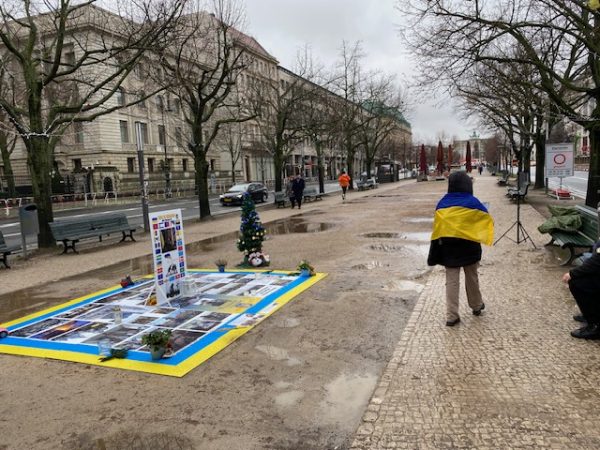
Need of War
It seems like a horrific idea to talk about the need of war. We might have deemed it outdated to read about the terrible love of war or about the strategy of war. However, the time of war is back in Europe and Eastern Europe feels the real threat and Ukraine the bombs hailing from Russia. Why does Putin love war? The love of war is largely driven by domestic issues. Staying in power for unliked authoritarian leaders is easiest if they indulge in external conflicts. Dictators love war because it makes it easier for them to sustain leadership through brutal force within the country due to a proclaimed external threat or even outright engagement in war. Democratically elected leaders know that they will leave office eventually in a peaceful way (exceptions like Trump are rare). Dictators use any force or terror necessary to stay in power. The love of war is part of this.
Hence, the need of war goes without questioning, if a country in decline or at risk of decline tries to uphold an inefficient, belligerent regime. Beyond rational reasons, such regimes will abuse ideation about national pride, the national interest and anything pertaining to some supposed myths of nationhood to justify its need of war. The dictators have all failed eventually as resistance against this need of useless war is found out by enemies either within or externally. But thousands or millions of victims will suffer. The pressure against the need of war has to rise internally from opposition as well as from alliances of democracies that do not need war to motivate their people to achieve the best they are able to deliver.
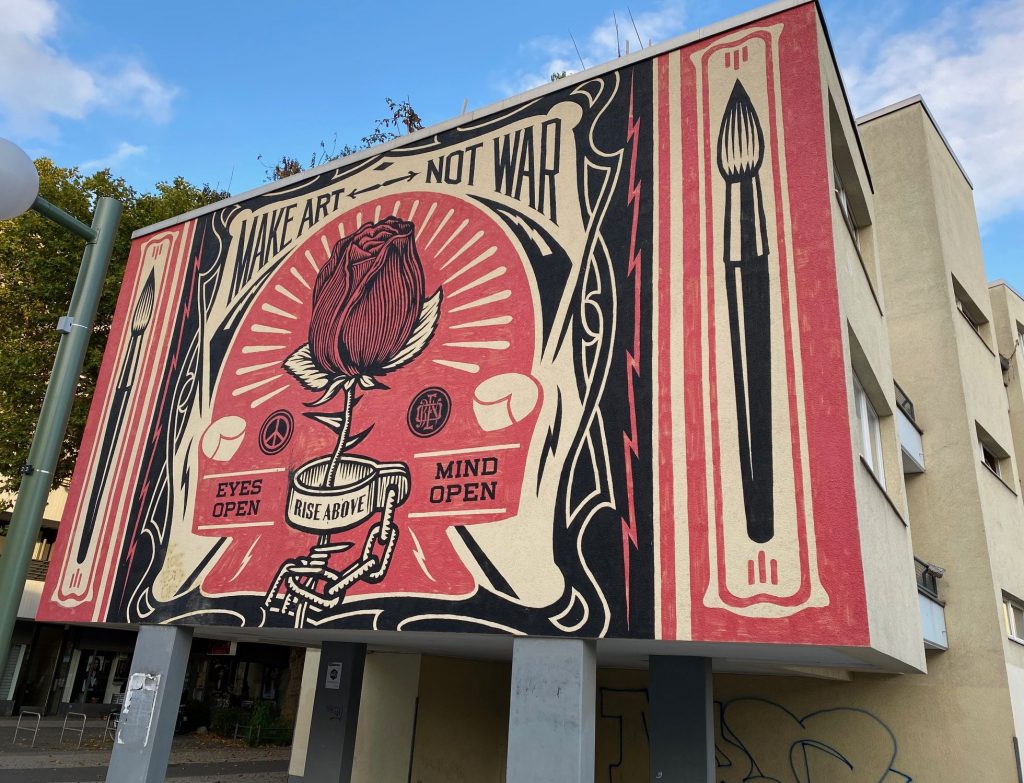
Therefore, the defence of democratic rule is, at the same time, a fight against the need of war by some doomed regimes. After winning the war comes the difficult task of winning peace. This means to create a state of affairs and a state of mind that can do without the need of war. If the external threat diminishes the internal threats might rise and have to be contained as well. Lots of challenges, even for mature democracies. (Image: Berlin 2022-10)
Satellites
Every now and again satellites make headlines. In international politics the “Sputnik moment” of 1957 was such a key defining moment. Russia sending a satellite into space set off a massive investment programme in the United States to counter a potential threat from Russia coming from space. In 2024 we discuss again the next ratcheting up of in a race of armament threatening the earth from space. Russia is believed to enable satellites to carry a nuclear bomb that would orbit around the earth and could lead to mass destruction of satellites that nowadays enable navigation, communication and monitoring what is happening on earth.
As beyond the state-owned satellite networks there has been a private satellite network that assisted Ukraine to defend itself against the Russian aggression, we probably are about to witness the extension of warfare on earth into space. In addition to the so-called cyberwar, which threatens computer-based systems with viruses, ransomware or break-downs, we may face new kinds of threats. We shall have to consider this as part of modern warfare.
Since the late 1960s there exists an international agreement not to use space for nuclear arms. However, Russia does no longer seem to respect its commitment to this. A further escalation of the war of Russia in Ukraine with “conventional” weapons carries the risk to set off another arms race including the earths orbit. This is no science-fiction or whistle blowing, but based on a high-level report and press coverage by the New York Times on 2024-2-17 (Link).
The outrageous implication of such a massive explosion in space is that its implications of the globe on parts of the world and people not being a party in the war will suffer most likely as much as the opposed nations. The food shortages due to Russia’s aggression caused people in Africa to suffer or even die of hunger. Satellite outages of a massive scale will have severe consequences as well.
Information and communication systems have proven to be determining the outcome of a war. This has been one lesson of more than two hundred years of studying military strategies since Clausewitz. Space and satellites have apparently not contributed to improve the understanding of each other, but only the communication within the respective communication bubbles. Maybe artists can help us to overcome the danger of escalation. (Image: “Afrogalactica” by Kapwani Kiwanga 2011: calogue of exhibition “The length of the horizon” Wolfsburg and Copenhagen 2023). 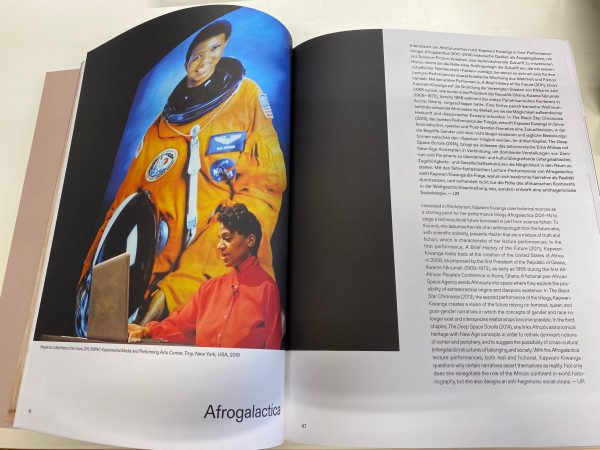
West Europe
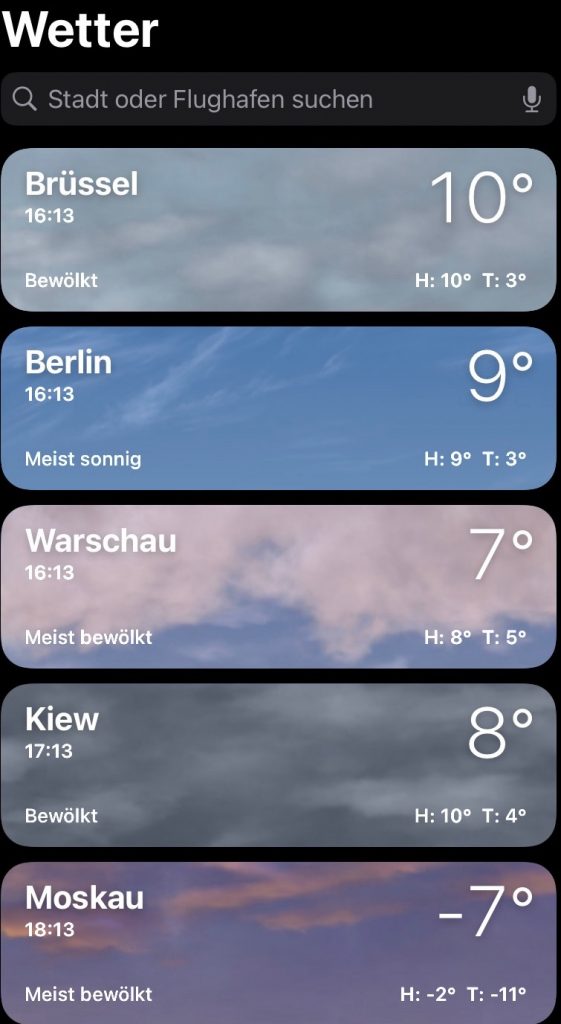
There has been a shift of political borders in Eastern Europe. Russia has been trying to shift its border further to the West by brutal force attacking Ukraine. Political defence and military action have managed to preserve western values in Ukraine. On the 13th of February 2024 the meteorological data confirm a clear belonging of Ukraine to the western climatic conditions. Temperatures in Kiev are very similar to the western hemisphere and very different from the cold in Moscow. This is just a little detail or coincidence but it bears a nice resemblance to the political weather currently in Europe. It is by all means much colder in Moscow than in western Europe. The time and the climate are a changing.
Clausewitz 3
As the Russian aggression in Ukraine continues it is interesting to re-read Clausewitz again. In his major work on strategy in warfare we rediscover lots of strategies that Putin’s army applies in the war against Ukraine. But equally, the successful defence strategy of Ukraine with a sizable difference in the size of the army, they both let us better understand the theoretical considerations and relevance of Clausewitz until today. For example,the overriding importance of the size of an army in comparison to the opponent was discarded by Clausewitz (p.111-112) already. He refers to the battles at Rossbach and Leuthen in the Seven Years’ War 1756-1763. Frederic the Great won 2 battles despite having armies of half the size or even less at his disposal (Tempelhoff). Training and morale of the armies is an important part of the explanation of a later outcome. In terms of strategy Clausewitz mentions surprise and wit in chapters as well. The next 3 chapters are devoted to (in modern words) distribution and mobility of forces in space and across time including additionally a strategic reserve. The “classical warfare” which Clausewitz transforms into a theory of warfare is followed with horrific resemblance by Putin’s Russia in the 21st century. “War is an instrument of politics” writes Clausewitz 200 years ago (p. 467-8).
The painters or theorists that attempted to go beyond this rationale have had a hard time to convince politicians otherwise. The idea that law and courts will replace the atrocious power play of nations is silenced again for some years, only to come back with more force eventually.
(Image Extract from Nationalgalerie and Digital Collection of Gemäldegalerie 2024-1 by Adolphe Menzel “Ansprache Friedrich des Großen an seine Generale vor der Schlacht bei Leuthen 1757) unvollendet. 
Survivors
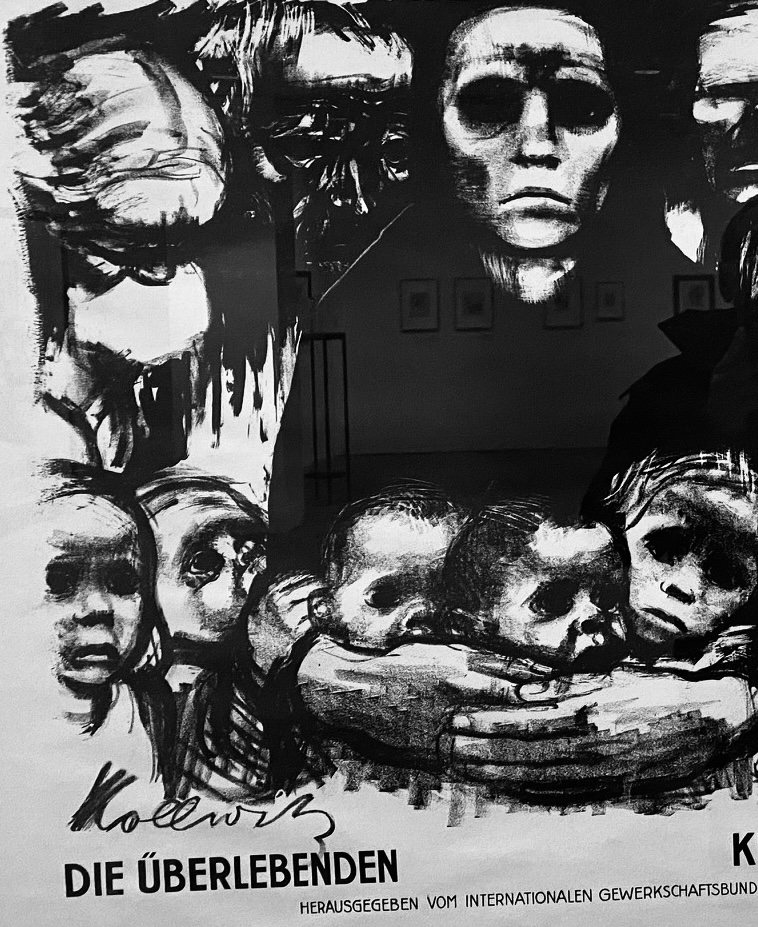
The survivors of war have experienced unimaginable violence and suffering. Once fighting ends the horrors of war live on in the memories of all survivors irrespective of which side they have been fighting. Almost all have lost someone or something they cherished before the outbreak of war. Käthe Kollwitz has depicted these horrific experiences in many examples of her art work. They speak to us today just as much as in the past. Berlin is a great place to learn more about her art. The image below is an extract from a drawing in poster form edited by the International Trade Union Federation from 1923 shown in the Brücke Museum in Berlin Dahlem in 2023.
Continuity in 2024
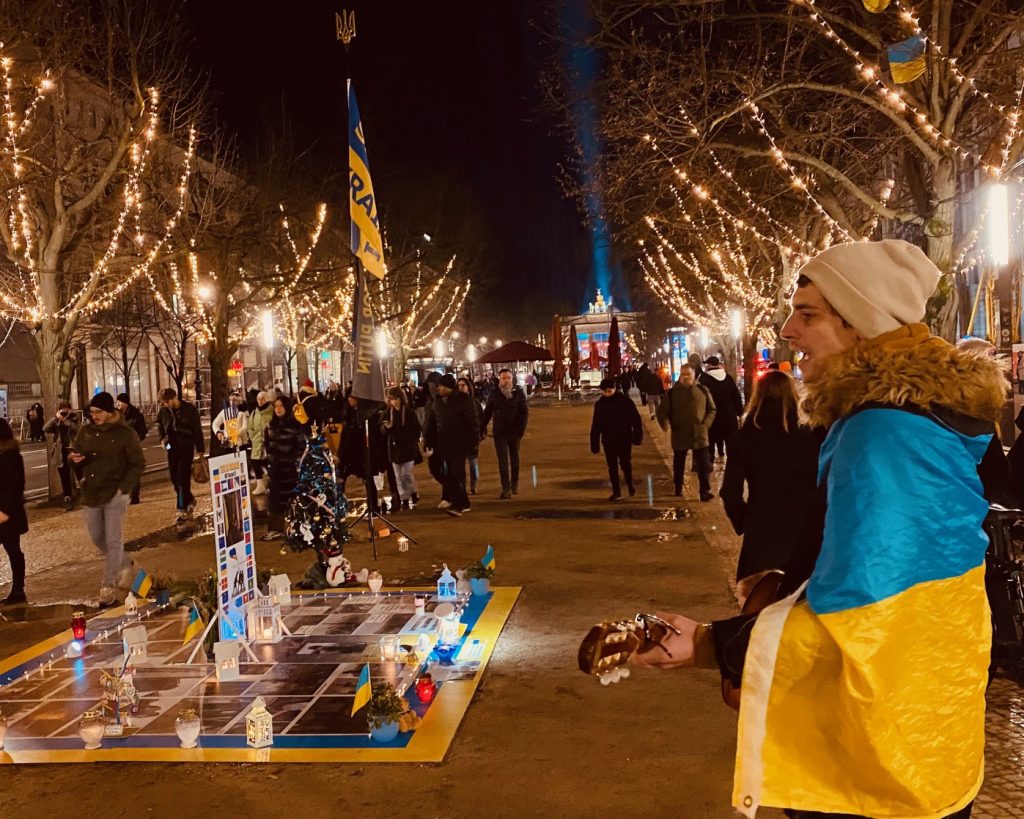
The Russian aggression continues on Ukrainian territory also in 2024. Based on false allegations and stories about a supposed Russian heritage based on Ukraine territory the ongoing war is once again fought more about the past than the present. The future is entirely disregarded by Russia as if it is clear to them that they do not have a future of the dictatorial regime. If a country does no longer care about future perspectives or future generations even, this country is likely to become very dangerous for neighboring countries and beyond because of the high discounting which implicitly applies to all its investments. Western companies who moved out of Russia had immediately high losses. At the same time Russia continues on a daily basis to destroy lives and property. We just shall not stop to support the fight for freedom and democracy in Ukraine as long as it takes. It fighting for our future rather than demons of the past.
Finding Peace
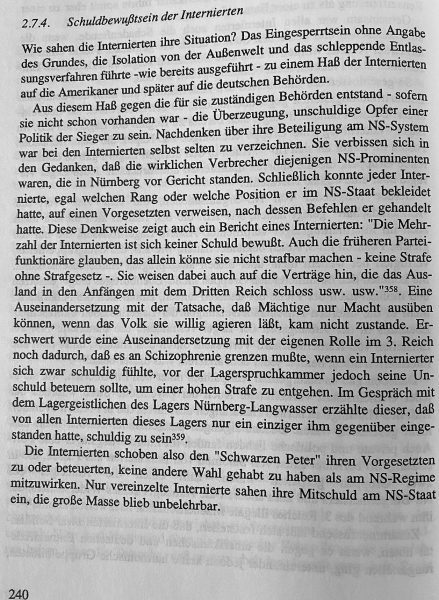
In international conflicts it the task of diplomacy to find or negotiate peace agreements. Monitoring of the evolution and progress is part of the deal. For societies internally it is equally important to find peace again. Totalitarian regimes are characterized by terror and intimidation of its own citizens. This holds true today as much as in the past. Finding peace, however, necessitates to prosecute criminals and this irrespective of their previous or current status in society. The American authorities after the 2nd world war have held more than ten thousand prisoners due to their commanding functions in the NS-time. After 3 years of imprisonment and attempts of so-called re-education the evaluation of the results were of very modest success. Most prisoners would find excuses rather than admit to their participation in the killing machine of the Nazi throughout Europe and over more than a decade.
The study by Christa Horn (1992) “Die Internierungs- und Arbeitslager in Bayern 1945-1952” comes to the same sobering conclusion (p. 127 extract below). This bears the danger that the totalitarian ideology continues to have supporters and even the transmission to other generations might be attempted. This highlights the importance of reconciliation in the lengthy process of finding peace. It far from easy to resolve who is guilty and of what. The Americans started the process before handing over responsibility to the regional judicial system. More than 75 years after 1945 we still have to name and insist on the criminal behavior of the totalitarian regime with millions of party officials and even more followers. Finding peace is a protracted process if not a struggle that involves 3 and maybe 4 generations by now.