Democracy in Nepal

Nepal has witnessed a peaceful revolution in which the young generation of Nepalis has “out-smarted” the previous rulers of Nepal. With close to a 2/3 majority of seats in parliament (Nepali Times), the RSP as the party of a somehow charismatic musician and performer has a 5 year mandate to tackle the many challenges to bring real change for Nepali people. The hopes are running high that corruption will be contained and enough jobs inside Nepal can be created for the young. The positive sign, that many Nepalis migrant workers who had left the country now return to Nepal, encourages further support by international donors and investors.
Running a democratic election in a country that comprises the Himalayan mountainous region is confronted with a particular challenge to make every vote count as communication with remote areas takes additional time and effort. Campaigning through social media can be more effective only if even remote areas have reliable access to the internet. Inter-generational assistance is often a precondition of timely access to information. The Himalayan region experiences already the effects of global warming as melting of glaciers. It is the youngest generation that will have to confront the consequences. Time to take government in their own hands, and beyond a one man show. (Image: ESA Himalayan Mountains, ESA Standard Licence) 

Retirement Recruitment

The debate that later retirement of seniors reduces the hiring of youth has received new attention. Paul Mohnen published a paper on the “retirement slowdown on the US youth labor market” , which demonstrates this “crowding out effect”. Moreover, the recruitment of middle aged workers is also affected, as job changes slowed down for these age groups. The surprising finding is that higher skilled youth suffers the largest reduction in employment opportunities and become “pulled” into lower skilled jobs as jo offers for lower skilled persons remained high during the observation periods (until 2017!). This evidence suggests that the well-documented firm-level effect of fewer retirement means less recruitment holds also for society as a whole. Knowing that recruitment during a recession affects young workers more than persons already in employment, the macro level effects in 2025 will be rather unfavorable for young labor market entrants. (Image Frans Hals 1625, Odessa Museum in Berlin exhibition 2025).

Robot repairs

Robots have been used mostly in industry for assembling, transport or sorting tasks. There is also a role in disassembling to enhance circularity. To repair electric or mechanic devices there is an enhanced version needed which starts with a diagnosis of the problem. Algorithms can sort out promising from dead end routes of repairs. However, the recognition of objects into things that can be repaired and those without repair potential is a worthwhile assistance. Beyond the economic and ecological rationale for repairs, there is an emotional or nostalgic sense to it as well. Maybe, from a life course perspective any object related to the teenager years of a person qualify for nostalgic value. Even simple robots or AI-assisted objects may qualify for this in future. Artificial friends will be like tamagotchis in need of repairs.

Robot assistant

Adjustment processes on the labour market take their time. This means that care workers are in short supply in most countries of the OECD. Engineers as well. There are so many robots, care robots I mean, still to develop that the shortage of engineers give little hope that we shall have affordable solutions in this area for the next few years. The issue is mainly about integrating and enhancing already existing solutions. If you are a mechanical engineer you can put together motorised mechanical pieces, small motorised electric devices and, for example, small infrared emitting and receiving devises.
All this is child’s play these days (see image below). The assembling of a small Robot assistant that follows movements or can escape from a small labyrinth makes such simple structures transparent for learners and users. There is nothing magical about it, just adding together small pieces and the electronic devices to steer the movements. The learning tool from KOSMOS has been on the market for 5 years. It is a helpful device to explain basics through hands-on experience. The limits of robotics equally become more evident. Our own health and safety is concerned with larger devices cohabiting with us. A robot assistant can take on easy tasks like to follow me through my living space in old age carrying a mobile phone, keys or an emergency device. More sophisticated tasks need more sensors and AI to train the most needed and best routines. For many years this needs our input and our control as well as supervision of such devices. Most robots will operate as assistants with us in the driving seat or the boss.
This is yet another element of the “all electric society“. We are moving towards the use of more electronics assisting us from year to year.

Kids Gaming

The pressure on children and their parents is high to succumb to the temptation of digital and online gaming. Albeit there are many funny and learning alternatives for them if they are accompanied by an instructor to build or invent their own game. With some adaptations it is possible to assemble for example a coordination game for children which directs a small ball through a labyrinth. Add speed and tricky holes to the “parcour” and the race is on. It is little bit like hands-on physics as the speed and acceleration patterns across the parcour varies a lot. Planning, building and playing are an ensemble in this simple game. Probably also more fun than the x-th repetition of a digital game.

(Inspiration from: Berliner Kultur gestalten, workshops for children).


Bilingual Plus not WEIRD

The scientific literature on bilingual learning and living experience is abundant. Positive cognitive and social inclusion effects dominate the results. The scientific research has moved on to more tricky questions of bilingualism which shifts gear to multilingual learning. Many people and children are bilingual plus additional contacts to another or several other languages. Multilinguism has been of interest for several scientific disciplines. The effects on cognitive development have received a lot of attention. In order to achieve further progress in the study of multilingual development, it is instructive to move beyond bilingualism and the WEIRD particiants in most psychological studies (WEIRD = Western, Educated, Industrialized, Rich and Democratic). The paper by Omane, Benders & Boll-Avetisyan (DOI) takes this as a starting point and investigates the experience of infants with 2-6 languages.
They establish a protocol how to record the surrounding languages in a structured way. A major distinction into direct and indirect exposure to languages is a major finding. The example from Ghana provides a useful basis for other studies of multilingual experiences. A correct recording of different language inputs in time and of the sources is at the basis for later measurements of effects of different kinds of exposure and intensity of exposure.
(Image: Children’s room in Berlin Museum Martin Gropius Bau 2025)

Suicide Prevention

The annual mortality statistics and special reports on suicidal tendencies are a tough reading. OECD Statistics give a at least an approximate, comparative perspective. Reporting routines and medical confirmation of a suicide or suicidal behavior still vary quite a bit between countries. Nevertheless, the usually reported incidents per 100.000 persons remain rather abstract.
Absolute numbers speak a clear language. For example in Germany there were about 10.300 recorded suicides in 2023, France had to mourn about 9200 in 2022. To put the size of the problem in perspective it is helpful to know that in Germany all other not aging related causes of death like traffic accidents, drugs or murder make up for around 7.000 deaths per year. The targeting of resources and prevention efforts on these vulnerable people seems inevitable. However, we see only limited additional efforts to curb the problem.
A more detailed analysis of the frequencies reveals the gender and age differences. More men commit suicides and older (very old) people have higher risks. The oldest age group of men is most at risk.
Since the Covid-19 pandemic young women show rising trends in many countries again of suicidal attempts and self-inflicted wounds. Despite a continuing effort of research (Links) there is no single cause to explain the occurrences.
As a working hypothesis, which awaits empirical tests, I would look into societal factors that stigmatize persons who are made to believe or feel like they are beyond the normal spectrum of society. The lack of acceptance of diversity concerning gender, age, ethnicity, body shapes or mental states like anxiety. Poverty might cause immense distress and suffering. Large shifts in wealth in both directions cause additional risks.
It seems as if our minds and society are constantly in a kind of „regression towards the mean“ posing challenges to those furthest away from the average or perceived norms. Percentile ranks or percentile scores are commonly used to express a person’s position in a frequency distribution. For example you are better/lower than 90% of persons of your age group. Such statements might cause further distress for persons. However, summarising across several (psychological) measurements, they may yield encouraging indications as well. Actual and perceived positions in such percentile ranks add another “social risk” as perceived positions may govern behavior.

Generational differences

The study of generational differences has a long tradition in sociology. A recent study by Wysmulek et al. (Acta Sociologica 2024, 131pp). highlights changes in how youth values education, abilities and hard work. The study carried out with Polish data shows that it is not the straightforward historical grouping of birth cohorts that matters most, but the experience of living through a period of crisis or stability during the formation of so-called meritocratic beliefs. Once formed, these beliefs tend to persist for prolonged periods of time well into middle and late adulthood.

Many judgements about young people might suffer a substantial generational bias when viewed from another generation’s vantage point. Cross-generational differences in beliefs and behavior are dependent on homogeneous or heterogeneous experiences of the respective generations. Disrespect of such generational differences is bound to yield severe misunderstandings. Who told you that social life was easy anyway? (Image decorated piano in shopping mall, Berlin 2024)

Sandbox Games

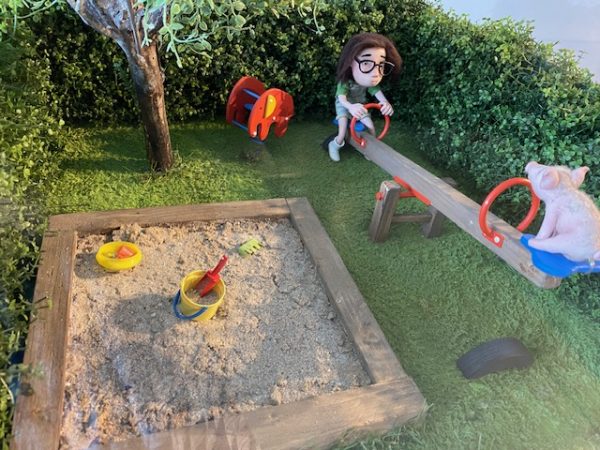
Children from a very early age onwards play strategic games. Even in the sandbox we can learn from surprising talents of how to get the shovel from the other player(s). Having grown up a bit the repertoire of strategies becomes a bit more sophisticated, but most children tend to apply the same ones now and then. For example, to obtain one of the always scarce places on the swing or the balance, you may reach your goal in attracting the occupant(s) to a supposed even more exciting object on the playground or outside of it. Once the occupants leave the swing to join you somewhere else, you rush back to the swing and hope that the other child(ren)/parents are not more powerful to take back the swing. Strategies on the playground are abundant. Most children run, or get run, through the full set of tricky strategies during their youth. If you still want to learn more, study economics (typical economist’s joke). Alternatively, if you like strategies claiming that other children are not following the rules or want to know how best to fix the rules so you’re going to win anyway, study law (lawyer’s jokes). If you believe fairness is your real best argument study sociology, philosophy or theology. Make sure most other people in the playground have a similar set of strategies otherwise fists and tears will be gaining the upper hand.

Family Music Days

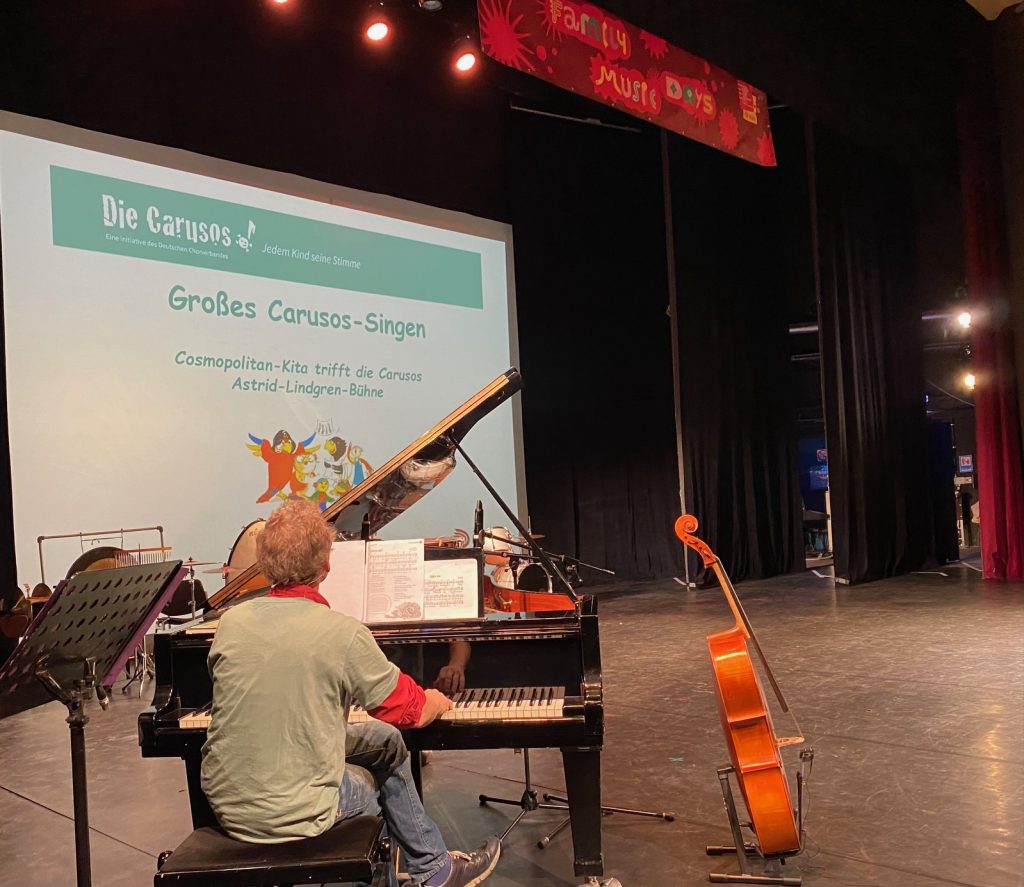
Kids are queens, kings and princesses as well as princes at the family music days in Berlin at the FEZ. Kids can enjoy the full spectrum of musical experiences from just listening to playing themselves, if they feel like it or dare to risk a sound. Just making noise is okay, too. Building your very own version of a musical instrument is a great learning experience for the young. To make music it doesn’t always have to be an expensive instrument. Your own imagination assisted by persons with patience and passion creates marvelous sound experiences. Initiating kids to the endless worlds of sound is having lasting effects on them. Great to see a concert hall full of young enthusiasts. Learning is so much fun, if taught in accessible and inclusive ways. Professional instructors joined by many volunteers make the world go round for kids. Wish you we here. Let’s spread the message.

Berlin FEZ 2024-3-16