AI Racing

AI has entered the racing of cars after we have been racing horses, dogs and camels for many decades. The fact behind all these races is the huge market for gambling. Anything you can bet on will do for juicy profits in that industry. The recent “Abu Dhabi Autonomous Racing League” is the latest addition to the racing craze. Moving online with 600000 spectators at its peak on video and gaming platforms the investment seems promising. The only problem, AI is not yet ready to really compete with the world of real drivers. The progress, however, is astonishing. Just one lap of 2 minutes on the circuit yields 15 Terrabyte of data from 50 sensors. These are closed circuits so no person can enter or animal can get in their way. The challenge to integrate more data and faster processing as well as algorithms for fast decision making is steep. Great learning opportunities for advances in robotics. The hype has not been able to live up to the expectations as no real racing took place yet. We have replaced the gladiators of the Roman empire with Formula 1 drivers. It is only fair to retire those drivers soon and let AI race cars against each other. It feels like a computer game on screen and it is as we shall most likely watch these races on a screen as well. Hence, what is the point. Watching youth on TWITCH play racing games will probably not change the viewing behavior of the masses. The programmers have nevertheless great learning opportunities and will find their way rapidly into the job market. The other challenges of ASPIRE seem more important for humanity like human rescue and food for the growing world population. In the meantime let the boys play around with cars and learn about potentials as well as failures of AI-programmers and dealing with both.

AI Disruption

Many scientists started to question the disruptive potential of AI in, for example, the military’s domain. The Journal of Strategic Studies featured 3 papers on AI and autonomous systems more generally. The major argument by Anthony King is the reliance of autonomous systems on other systems mainly human operators even in the background to get these systems off the ground and maybe back again. Not only logistic support but also satellite communication is needed to guide and protect the operations. In quoting Clausewitz, Anthony King stated that war is a “collision of two living forces”. Strategy and counter-strategy will co-evolve as will attack and defence.
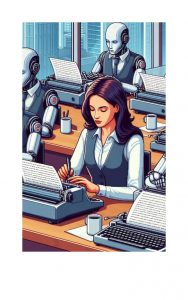
Jackie G. Schneider and Julia Macdonald (2024) advocate the use of autonomous and unmanned systems for their cost effectiveness. Economic costs as well as political costs are lower for these new strategic weapons. Mass fire power from swarms of drones is much cheaper than nuclear warheads and the home electorate is assumed to be more willing to accept and support limited and more precisely targeted unmanned missions. The disruption potential of AI is huge but it is most likely an addition to the arsenals than replacing them. (Image 2 swarms of drones fly in the air above tanks, created by AI – copilot-designer 2024-4-29).

Hannover Fair

The annual science fair at Hannover is a kind of a show of things to touch and of those things that come to the public market in the near future. Most of the annual hype is about potentials of production. Rationalization, using few resources or innovative solutions of digitization are high on the agenda. Create your digital twin, save energy, make production more safe or cyber secured.
Robotics is another reason to visit the fair. Some 7 years ago I had my Sputnik experience there. The robotics company KUKA had demonstrated live the that assembling a car from pre-manufactured components takes just 10 minutes for the robots. Shortly afterwards the whole company was bought by Chinese investors. Roughly 5 years later we are swamped by cars from China. It was not that difficult to predict this at that time. Okay, we need to focus on more value added production and take our workforces (not only) in Europe along on the way. Reclaiming well-paid, unionized jobs in manufacturing, as Joe Biden does, will not be an easy task. Robots and their programming is expensive, but skilled workers, too. Hence, the solution is likely to be robot-assisted manufacturing as a kind of hybrid solution for cost-effective production systems.
Following the proceedings of the 2024 fair we are astonished to realize that visiting the fair is still a rather “physical exercise” walking through the halls. After the Covid-19 shock we expected a lot more “online content”. Instead we keep referring to webpages and newletters rather than virtual visits and tours. The preparation of the visit in advance remains a laborious adventure. However, the in-person networking activities in the industry are largely advanced by ease of exchanging virtual business cards and the “FEMWORX” activities.
This year’s Sputnik moment at Hannover is probably most likely related to the pervasive applications of AI across all areas of the industry and along the whole supply chain. Repairing and recycling have become mainstream activities (www.festo.com). Robotics for learning purposes can also be found to get you started with automating boring household tasks (www.igus.eu).
Visiting Hannover in person still involves lengthy road travel or expensive public transport (DB with ICE). Autonomous driving and ride sharing solutions might be a worthwhile topic for next year’s fair. Last year I thought we would meet in the “metaverse fair” rather than in Hannover 2024. Be prepared for another Sputnik moment next year, maybe.
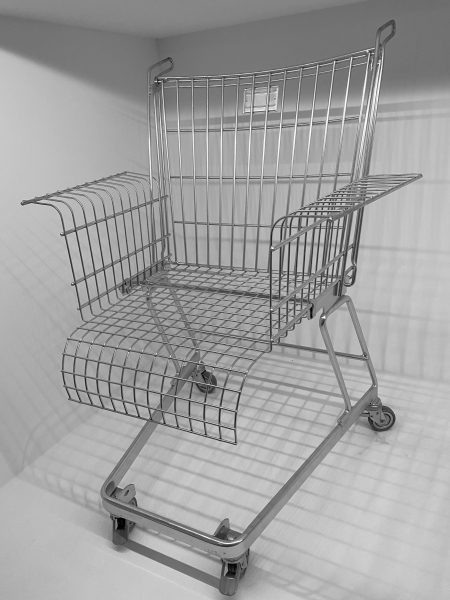
(Image: Consumer’s Rest by Stiletto, Frank Schreiner, 1983)

AI Defence

For those following the development in robotics we have been astonished by the progress of, for example, rescue robots. After an earthquake such robots could enter a building that is about to collapse and search the rooms for survivors. A recent article in “Foreign Affairs” by Michèle A. Flournoy has started its thinking about the use of AI in the military with a similar 20 year old example. A small drone flying through a building and inspecting the dangers of entering for persons or soldiers. Since then technology has advanced and the use of AI for automatic detection of dangers and “neutralising” it, is no longer science fiction. The wars of today are a testing ground for AI enhanced military strategies. It is about time that social scientists get involved as well.
Warfare left to robots and AI is unlikely to respect human values unless we implement such thoughts right from the be beginning into the new technology. An advanced comprehension of what algorithms do and what data they are trained on are crucial elements to watch out for. According to Flourney, AI will assist in planning as well as logistics of the military. Additionally, AI will allow a “better understanding of what its potential adversaries might be thinking”. Checking through hours of surveillance videos is also likely to be taken over by AI as the time consuming nature of the task binds a lot of staff, that may be put to work on other tasks. Training of people and the armed forces become a crucial part of any AI strategy. The chances to develop a “responsible AI” are high in the free world that cherishes human rights and democratic values. Raising curiosity about AI and an awareness of the dangers are two sides of the same coin or bullet. Both need to grow together.
(Image created by Dall-E Copilot Prompt: “5 Robots disguised as soldiers with dash cams on helmet encircle a small house where another robot is hiding” on 2024-4-23)

AI Reader

In the middle of the hype around AI it is useful to take stock of the reflection and evolution of AI. In my own analyses and writings on AI it evident that a narrowing of focus has taken place. Whereas before 2022 the writing dealt more with digital technologies in general. The links to the literature on the social construction of technologies was obvious. Algorithms and AI was a part of the broader topic of society and technology.
This has changed. The public debate is focused on “everything AI now”. We look at technological developments largely through the lens of AI now. Hence, my focus of assessments of technology from a societal perspective follows this trend. In a collection of blog entries on AI we try to demonstrate the far reaching changes that have started to have an impact on us. In the last few months the all encompassing concern about AI’s effect on us needs full attention of social scientists, policy makers, companies and the public at large. We can no longer leave this topic to the software engineers alone. By the way, they themselves ask us to get involved and take the latest advances in AI more seriously.
As a “flipbook” the online reading is rather comfortable (Link to flipbook publisher MPL). The pdf or epub files of the blog entries allow to directly follow the links to sources in webpages or other publications (AI and Society 2p 2024-4-18). The cycles of analyses and comments have become faster. Traditional book writing suffers from time lags that risk to make pubications outdated rather quickly. Dynamic ebook writing might bridge the gap between time to reflect and speed to publish or inform the wider public. The first update as .pdf-file is available here: AI and Society(2).

AI Travel

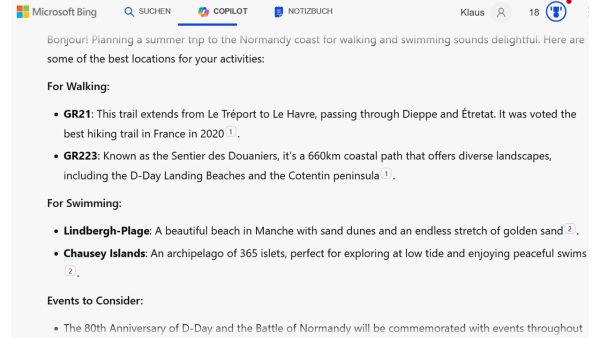
Playing around with AI it is nice to test take fun examples. Image you want to plan a vacation, then the use of AI is ready to suggest to you a couple of things to do. Of course, AI is eager to propose travelling services like transport or accommodation to you where it is likely to earn some commissions. So far, the use of the “Vacation Planer of Microsoft’s BING Copilot” is free of charge. In entering the time period and a region as well as some basic activities you’ll receive suggestions with quotes on the sources (webpages of public services from tourist offices mostly). It seems like trustworthy sources and the suggestions of D-Day activities in Normandy is a positive surprise to me. These are popular activities which attract huge international crowds every year.
Thinking further on the potentials it becomes evident that travel suggestions will be biased to those paying for ranking higher on the algorithms selection criteria, which are not disclosed. Entering into the chat with the AI you and AI can target more precisely locations and also hotels etc. You are disclosing more of your own preferences in the easy-going chat and probably next time you will be surprised to be recommended the same activities at another location again.
So far, I have bought travel guides or literature about locations to prepare vacations. This is likely to change. I complement my traditional search or planning with the “surprises” from AI for travelling. I rediscovered, for example, the public service of tourist offices and their publications ahead of the travel rather than the leaflets at the local tourist office. In order to plan ahead there is value in the augmented search and compilation capacities of AI. Drafting a letter in foreign languages is also no problem for AI. The evaluation of the usefulness of AI, however, can only be answered after the vacation. Outdated info or databases have a huge potential to spoil the fun parts as well.

AI and languages

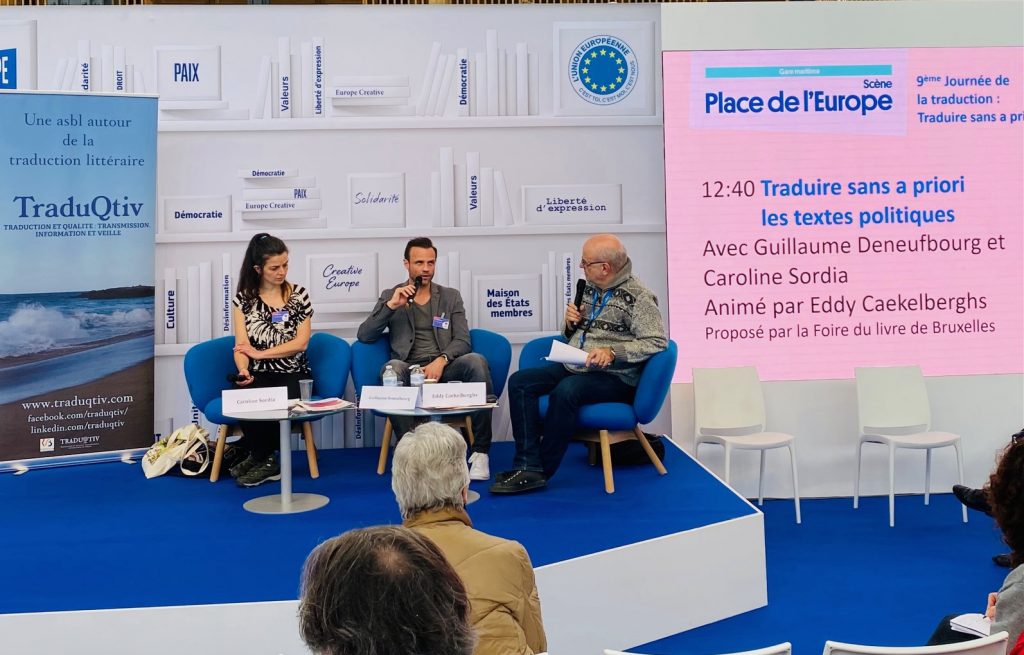
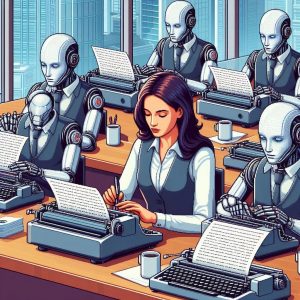
A big potential of AI is in the field of languages. Translations have been an expert domain and a pain for pupils at school. In professional settings translations are an expensive extra service for some or a good source of revenue. AI has shifted the translation game to a new level. In terms of speed of translating large amounts of written text AI is hard to beat. In terms of quality the battle of translaters against AI is still on. For chess players the battle against AI has been lost some years ago already. It remains an open question whether translators can still outperform AI or just adapt to using the technology themselves to improve both speed and quality of translations. The European Union with its many languages and commitment to cultural diversity can serve even more language communities with documents in their own language than before at marginally higher costs. A panel on the 9th day of translations at the „foire du livre de Bruxelles” 2024 expressed their reservations with regard to the use of AI in translation of political text or speech. Misunderstanding and misinterpretation will be the rule rather than the exception with potentially harmful consequences. Checking the correctness of translations is a permanent challenge for translators and can be very time consuming. There is room for an AI-assisted translation, but similar to other fields of application of AI, relying exclusively on AI bears high risks as well. We should not underestimate the creative part of translators to do full justice to a text or speech.

www.flb.be 2024 Translation

AI and PS

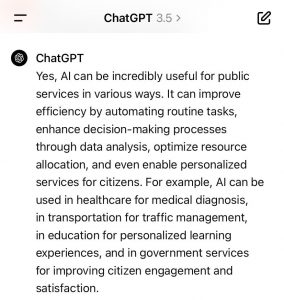
AI like in ChatGPT is guided by so-called prompts. After the entry of “what is AI” the machine returns a definition of itself. If you continue the chat with ChatGPT and enter: “Is it useful for public services” (PS), you receive an opinion of AI on its own usefulness (of course positive) and some examples in which AI in the public services have a good potential to improve the state of affairs. The AI ChatGPT is advocating AI for the PS for mainly 4 reasons: (1) efficiency purposes; (2) personalisation of services; (3) citizen engagement; (4) citizen satisfaction. (See image below). The perspective of employees of the public services is not really part of the answer by ChatGPT. This is a more ambiguous part of the answer and would probably need more space and additional explicit prompts to solicit an explicit answer on the issue. With all the know issues of concern of AI like gender bias or biased data as input, the introduction of AI in public services has to be accompanied by a thorough monitoring process. The legal limits to applications of AI are more severe in public services as the production of official documents is subject to additional security concerns.
This does certainly not preclude the use of AI in PS, but it requires more ample and rigorous testing of AI-applications in the PS. Such testing frameworks are still in development even in informatics as the sources of bias a manifold and sometimes tricky to detect even for experts in the field. Prior training with specific data sets (for example of thousands of possible prompts) has to be performed or sets of images for testing adapted to avoid bias. The task is big, but step by step building and testing promise useful results. It remains a challenge to find the right balance between the risks and the potentials of AI in PS.

AI and text

The performance of large language models (LLMs) with respect to text recognition and drafting texts is impressive. All those professions that draft a lot of texts have often decades of experience with using word-processing software. The assistance of software in the field of texts ranges from immediate typo corrections to suggestions of synonyms or grammatical corrections in previous word-processing software.
The improvement of AI stems for example from the potential to suggest alternative drafts of the text according to predefined styles. A very useful style is the “use of easy language”. This rewriting of texts simplifies texts in the sense that longer and more structured sentences are split into shorter ones, lesser-known words or acronyms are replaced by more common or simpler words. Some languages like German have a particular need to use easy language when it comes to administrative regulations and procedures. Public services that aim for inclusiveness of for example older persons or youth can become much more accessible if the use of easy language is spread more widely. Just keep in mind the large numbers of so-called “functional illiterates” (OECD study “PIAAC”) in all OCED countries.
AI can do a great job in assisting to reach a broader public with texts adapted to their level of literacy and numeracy competences. Webpage Designers have made use of Search Engine Optimization (SEO) for years now. The most common way is to use frequently searched keywords more often on your website in order to be found more often by search engines like GOOGLE et al. Additionally, AI allows to explain keywords, sentences or even jokes to you (Spriestersbach 2023 p.111). This may help in situations when cross-cultural understanding is important.
We have made use of optical character recognition (OCR) for a long time now in public services as well as firms and for private archives. AI is taking this “learning experience” to the next level by making use of the content of the recognized text. Predicting the following word or suggesting the next sentence was only the beginning of AI with respect to texts. AI can draft your speech to plead guilty or not guilty in a court. But we shall have to live with the consequences of making exclusive use of it rather than referring back to experts in the field. AI please shorten this entry, please!

AI by AI

It has become a common starting point to use electronic devices and online encyclopedias to search for definitions. Let us just do this for artificial intelligence. The open platform of Wikipedia returns on the query of “artificial intelligence” the following statement as a definition: “AI … is intelligence exhibited by machines, particularly computer systems …“. It is not like human intelligence, but tries to emulate it or even tries to improve on it. Part of any definition is also the range of applications of it in a broad range of scientific fields, economic sectors or public and private spheres of life. This shows the enormous scope of applications that keeps rapidly growing with the ease of access to software and applications of AI.
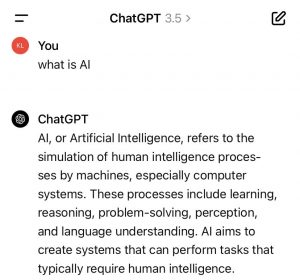
How does AI define itself? How is AI defined by AI? Putting the question to ChatGPT 3.5 in April 2024 I got the following fast return. (See image). ChatGPT provides a more careful definition as the “crowd” or networked intelligence of Wikipedia. AI only “refers to the simulation” of HI processes by machines”. Examples of such HI processes include the solving of problems and understanding of language. In doing this AI creates systems and performs tasks that usually or until now required HI. There seems to be a technological openness embedded in the definition of AI by AI that is not bound to legal restrictions of its use. The learning systems approach might or might not allow to respect the restrictions set to the systems by HI. Or, do such systems also learn how to circumvent the restrictions set by HI systems to limit AI systems? For the time being we test the boundaries of such systems in multiple fields of application from autonomous driving systems, video surveillance, marketing tools or public services. Potentials as well as risks will be defined in more detail in this process of technological development. Society has to accompany this process with high priority since fundamental human rights are at issue. Potentials for assistance of humans are equally large. The balance will be crucial.