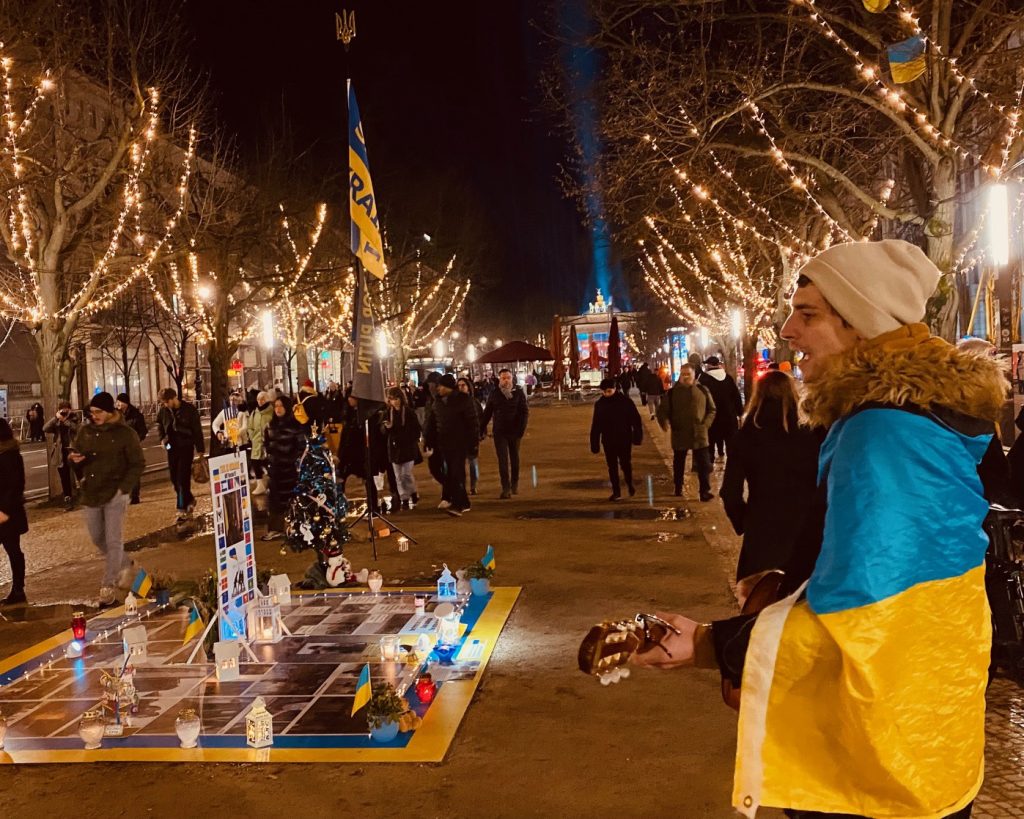
It is the horrible tragedy that Hamas terrorists after more than 100 days hold still more than 100 hostages. We shall never forget. Just like the terrorists taking hostages 51 years ago during the Munich Olympic games 1972. I believe it is about time to remember Winston Churchill’s famous words with a few changes, if I maybe allowed: “We shall never surrender. We shall fight terrorists on land and on sea. We shall fight them in the air and underground, in space if we need to.” This is part of not forgetting terror and staying alert to looming risks. For some the painful memories last their whole life long. Others, far too many, just forget, or worse, deny the facts. 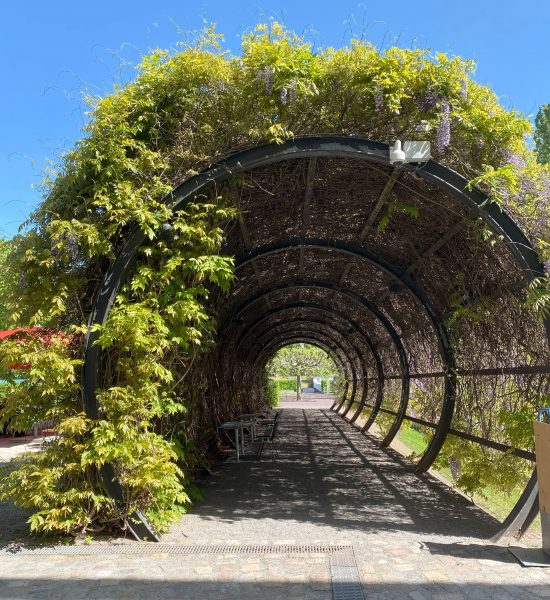
Poster Design
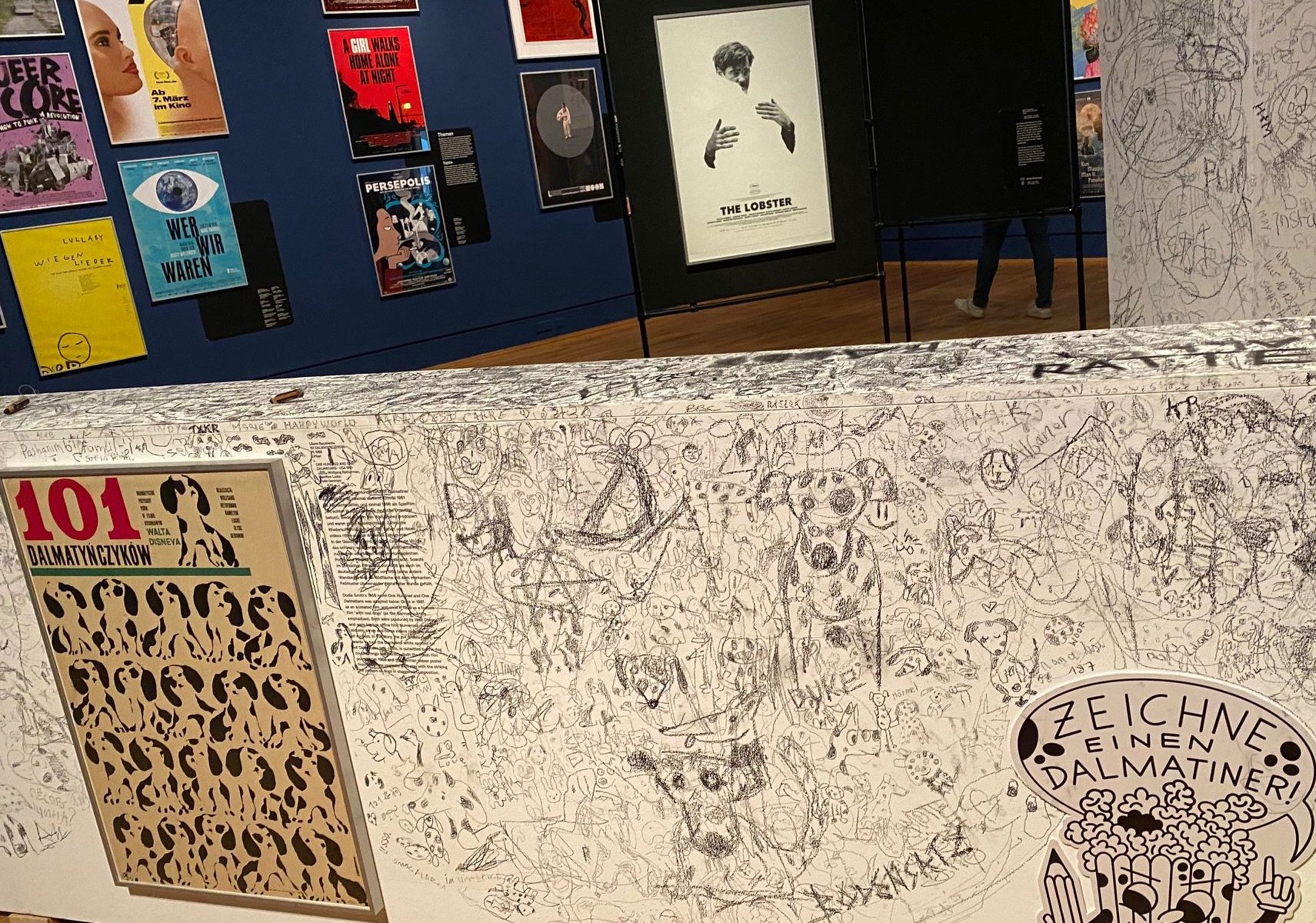
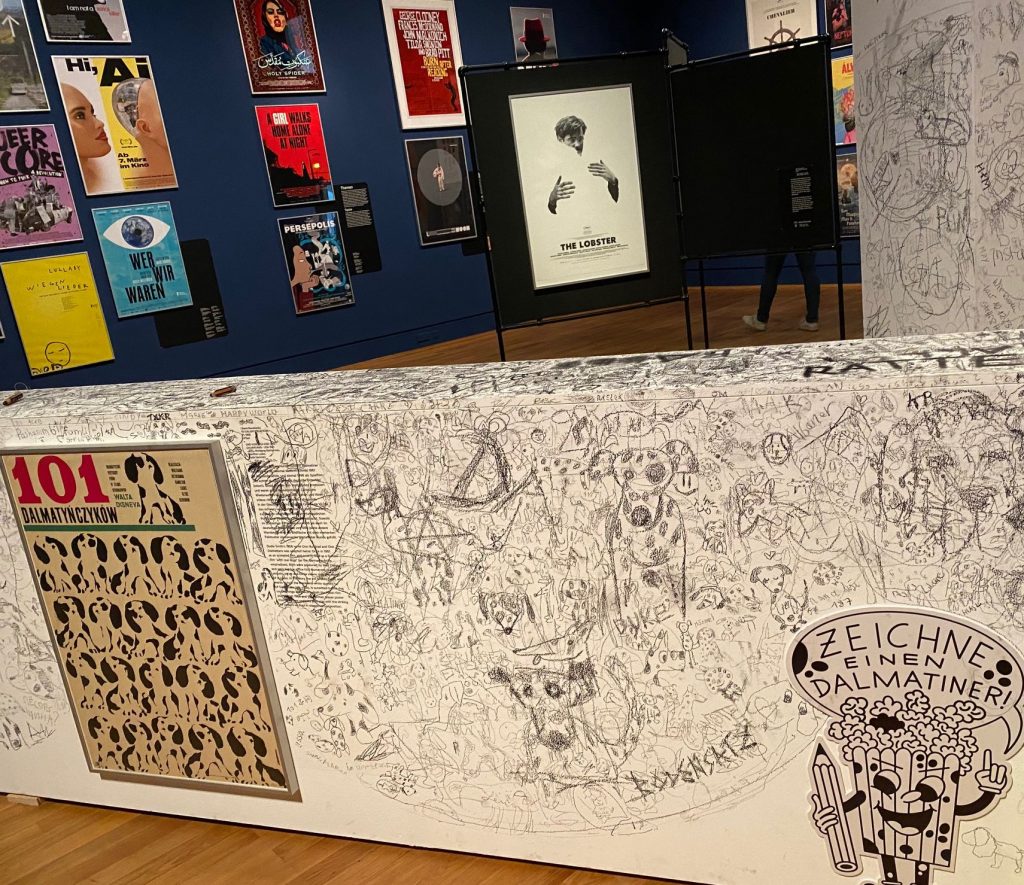
The effective use of posters in visual communication is a specific craft. Artists have been associated with poster design for more than a century. Cinemas continue this practice. For each movie produced there is an announcement posted in print or digital form. In combination with the Berlinale 2024 film festival the Kunstbibliothek in Berlin shows milestones of the history of movies and their representations in form of posters. Besides the historical approach there are many hints how to interpret the design language of posters throughout the 20th century. The encouragement to try to produce one yourself not only reserved to children is an additional activating feature of the exhibition (Link here). Cats and dogs will always catch attention and the playful approach chosen might be a start into a graphic design interest. Overall the exhibition offers a low threshold entry into the world of art and design. Instagramable image on posters evolved into short preview clips, just like instagram paved the way to tiktok video clips. In retrospect posters also provide shortcuts for our memories to recall whole movies that have accompanied us growing up and growing older.
Water fountain
We are lucky that in Berlin not all water fountains have disappeared from the public space. Some might remember that in schools it was usual to have a source of water free of charge for refreshments during breaks. Others cherish public places where there was a water fountain nearby.
Rather than looking where to buy refreshments, usually in plastic bottles nowadays, it was easy to hydrate yourself or the whole family from such a public source. Of course, these sources became the enemies of private companies cashing in extra profit margins the higher your urgency for water is. Hygiene is manageable, if a little bit of care is exercised. In periods of droughts such sources become an asset beyond the benefits for human beings (see image below, bees refreshing). In France, a law which prescribes that public institutions who receive visitors have to offer a point of access to fresh, drinkable water, is badly respected (Link to study). The result is more water in plastic bottles and the transport of those to inner cities. Plastic bottles contain thousands of micro- as well as nanoparticles of plastic which we are likely to digest (LINK to PNAS study). Having your own device ready to be refilled from a public source in inner cities is a healthy alternative.
Sustainability science has studied the issues and delivers solutions. It is societies and policies that have to (re-) implement these solutions. Here again we are back to political science and public health coordinators to raise awareness for these “blue solutions”. 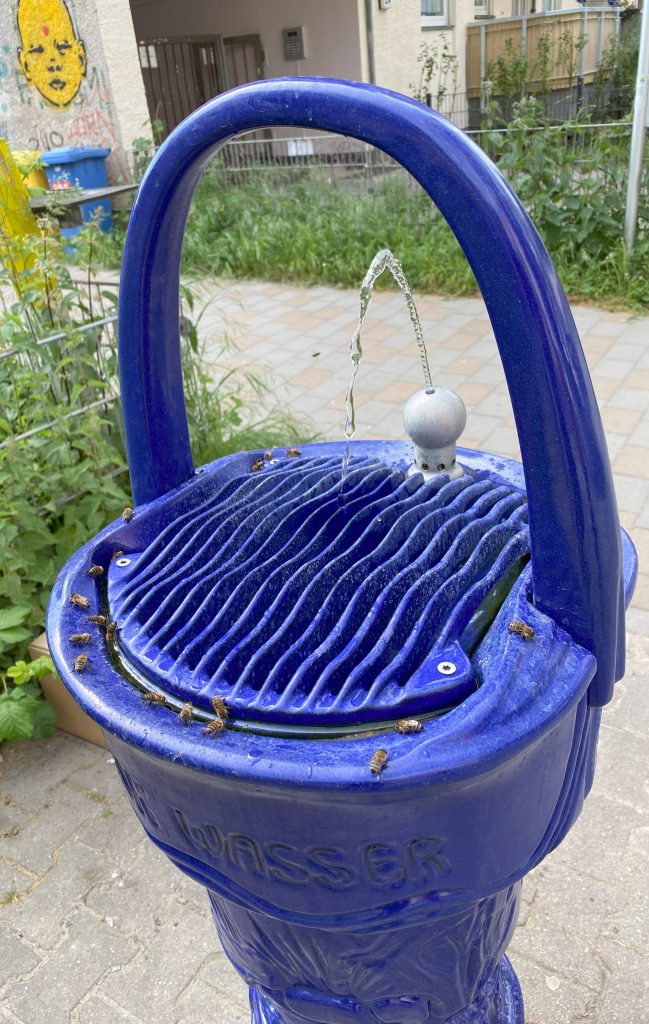
Ethics of posterity
We have not inherited the earth from our ancestors; we are borrowing it from our descendants. (native American saying). Adeline Johns-Putra (2019) states this early in her book on “Climate change and the novel.” Her concern is how to think and write about the ethics of posterity. Approaches of ethics in the sense of parental care (for the planet) or motherhood environmentalism do not suffice in view of overpopulation of our planet. Shifting our identity away from toxic production and consumption is advocated in many novels. Science and science fiction offer many dystopian examples.
De Shalit (1995) wrote early on why posterity matters. It is not the standard of living of contemporaries that matters but we should consider ourselves as a part of a transgenerational community. The time horizon of our decisions matters. In pursuing arguments by John Rawls who re-established a contractionalist perspective on justice, we have to include future generations into our contractual obligations. Following this approach we might arrive at Brundtland’s perspective on the ethics of posterity which is called sufficientarianism in opposition to simple utilitarianism. In sufficientarianism we owe future generations a just and decent living or at least the possibility to have similar starting conditions. Shifting beyond the apocalyptic view of environmental disasters Adeline Johns-Putra (2019) brings to the forefront that we have to substantially lengthen our time horizon both for consequences of climate change and for dealing with it, albeit the fact that most destructive practices operate much faster than the re-establishing of greater biodiversity.
P.S.:Thanks to the curators of the Lese Lounge Staatsbibliothek Berlin for ease of access to the literature.
(Image: Natur & Kultur in “Extreme tension: Art between Politics and Society” Collection of the Nationalgalerie 1945-2000“. 2024-1) 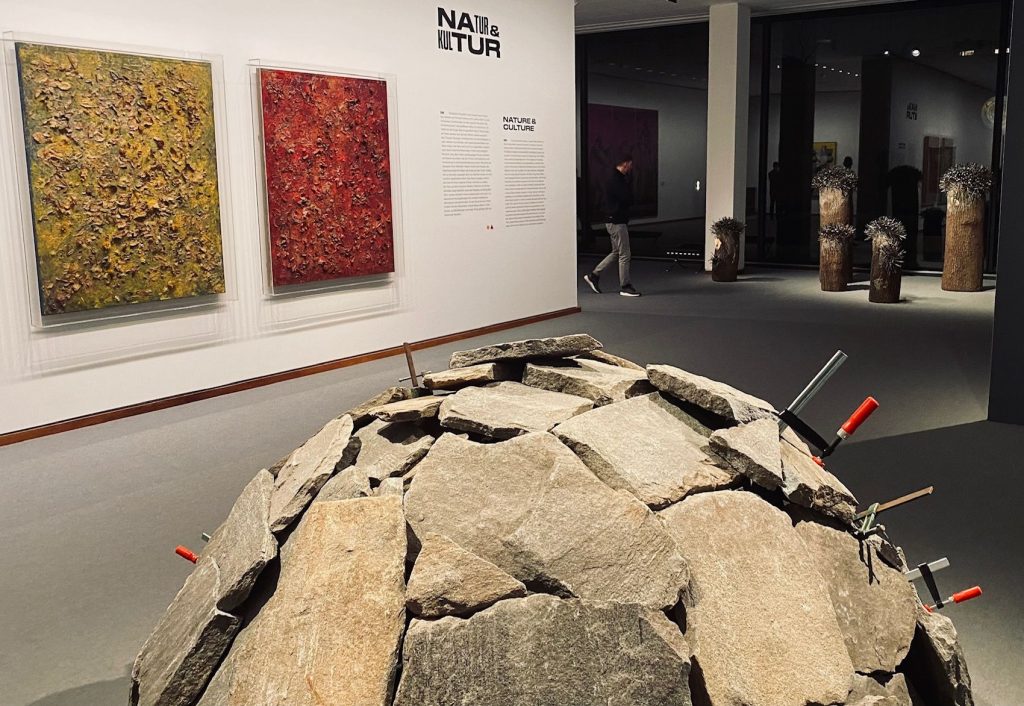
Air quality EU
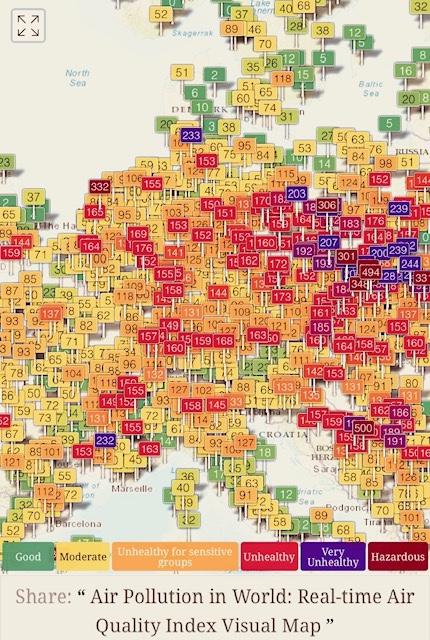
On some days of the year there is a cumulative effect of bad influences on air quality in Europe. Cold winter temperatures increase emissions from heating. Outdated heating with coal, still important in Eastern Europe, causes high amounts of extra particles in the atmosphere. In January 2024 a train conductor strike in Germany irrespective of the good reasons for it, makes people take their cars. Road blockades by opponents to reducing diesel subsidies to agri-business add to the pollution situation on a specific day. Overall the population suffers and breathes additional amounts of cancerous particles. Particles settle as dust on crop producing soil, of which we all feed ourselves. This is a vicious circle, which we need to break in the interest of all of us, particularly for the more fragile people and children. The latter start to crowd the medical doctors with sometimes lacking the delivery of crucial medicines for this target group. Where do we go from here? Compromises are key, security of supply chain and allowing, not too much, time for transition periods.
Renewables
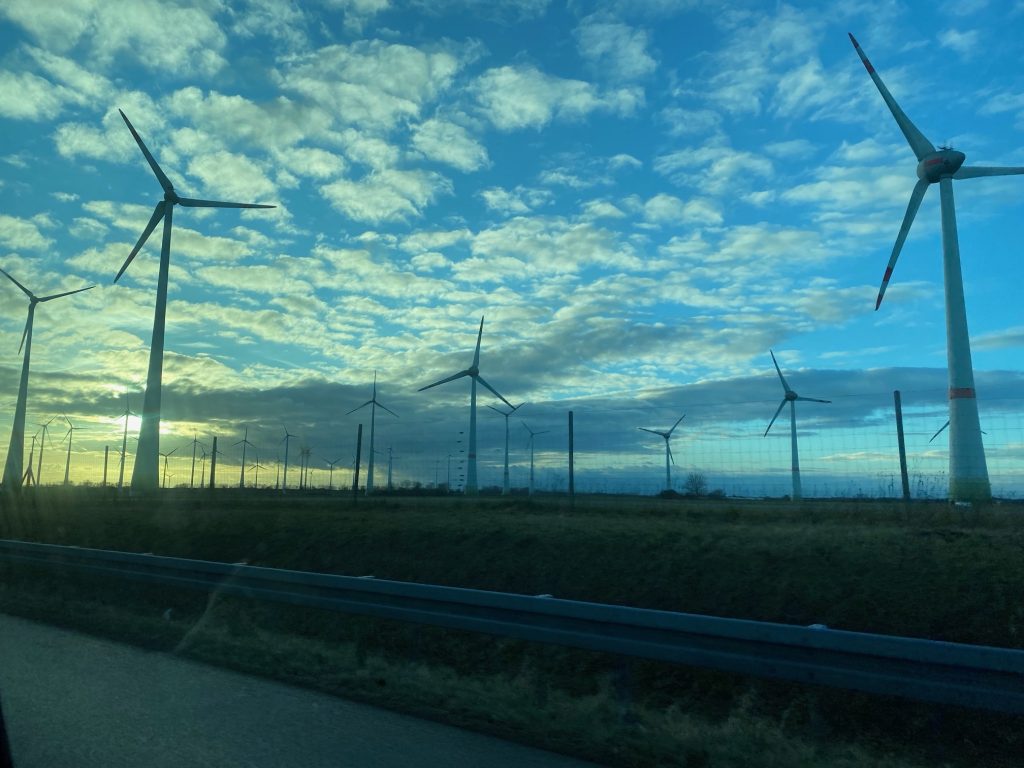
Renewable energy has reached for the 1sr time a share of more than 50% in Spain and Germany in 2023. This is an astonishing milestone in the energy transition of both countries. For Spain a report from Red Energy Espanola attributes the Spanish success story to the expansion of mainly wind energy (Link). The increase of renewable energy in Germany is due to a more rapid expansion of solar energy (Link). In any case a continued expansion of both forms of renewables allows to reduce the share of fossil fuel even more rapidly than previously estimated. Good news for the planet particularly to phase out energy from coal due to its highly polluting side effect. Countries with faster trajectories shall serve as examples that it is feasible to manage the energy transition also for large countries. Political instability might be a price worth paying considering the positive effects for future generations. Managing the transition in a just way which means to assist poorer households, ensures the respect of social policy targets at the same time. With this in mind the energy transition can be perceived by all as an opportunity rather than a threat to their welfare and wellbeing.
Museum Orga
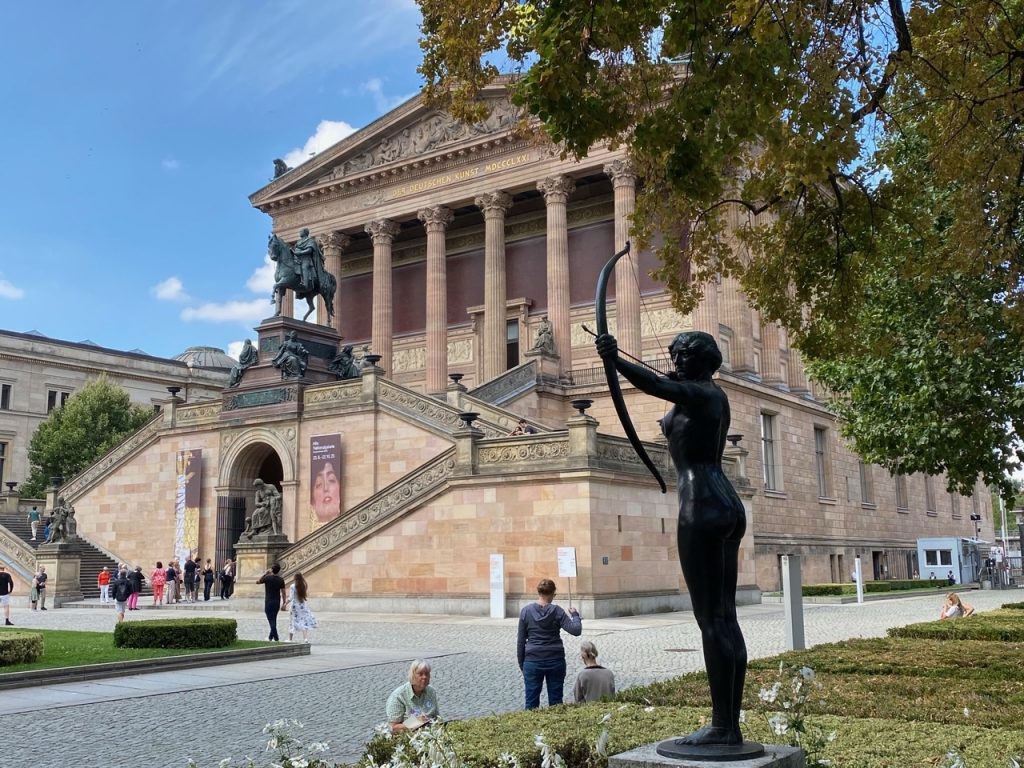
The cathedrals of modernity are under permanent scrutiny. The discussion in Germany was sparked by a recommendation of the scientific advisory council to the federal government (Wissenschaftsrat) to separate the Prussian heritage museums and institutions (SPK) in Berlin into separate entities that have higher autonomy to shape their individual profiles. Too much hierarchy blocks innovation and openness to new approaches that might not fit an overriding instance of decision making. The arts and sciences as well as their libraries need substantial degrees of freedom to flourish in their specific cultural and societal environment. The same discussion is currently occupying Paris and France, since overall the visitors after the Covid-19 crises have not yet come back to the same levels. Digitalization has opened up new opportunities and potentials to reach new audiences. This needed new resources even at a time of budget constraints. Museums have started to take their social functions more seriously besides their role to preserve the cultural heritage. Economic thinking in terms of scarcity of art works, competition between museums and cities or countries for tourism have entered the stages as well. Prices of entry and quantities of visitors have become additional concerns in the organization of the museum landscape. A lot to cope with and to balance multiple policy targets. Accessibility of those treasures is key. Opening up to broader audiences is costly but crucial to provide the justification of the public funds allocated. Great to see more complementary private investment in this exciting field. The prominent archers in front of the Berlin museums have moved ahead into a new round of competition in the organization of museums.
Memory Management
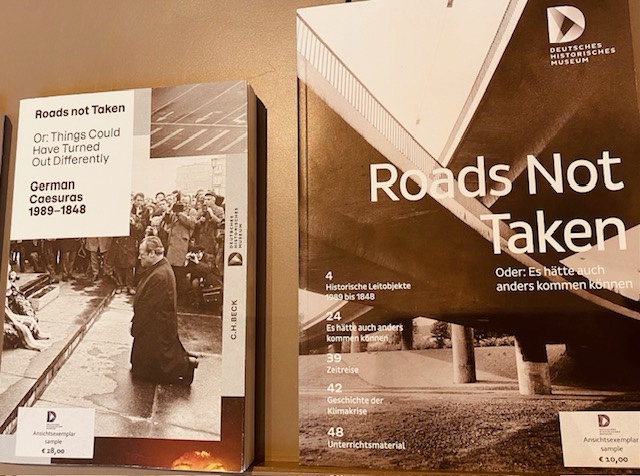
It seems a strange combination of words: memory management. In computing it has the function to allocate sufficient memory to specific tasks and has substantial implications for software performance (Yves Younan et al. 2010). It is also a security issue as what is stored somewhere might get accessed from other persons or programs with harmful intentions. Historians have a completely different approach to the issue. Individual as well as collective memories are frequently subject to memory management and manipulation. Therefore, it is necessary to critically deal with neglect and purposeful management of collective memories. In Germany we had numerous incidents of rectifying collective memories about the role of diplomats or the Wehrmacht during the Nazi period. Huge efforts were necessary to correct wrong representations of professions during and immediately after the 2WW. They are still necessary today. All children have to learn the concept of time, the past times and the concept of future. Periods after wars particularly generate a narrow focus on the present and the bare necessities of survival in societies. Dealing with and reworking the past and cherished memories is rarely attempted. It appears to be a paradox that without a coherent concept of the past the imagination about the potentials of the future are narrowed down. ‘Burned fingers’ cause additional restrictions. Literature for children and young adults has an important role to open up fictional spaces or laboratories for imagination. Freeing yourself from past restrictions while being aware of responsibilities due to the past allows a conscious way forward and human development. Sebastian Bernhardt (JuLit 3/2023) emphasised this and the Deutsches Historisches Museum had an exposition on this topic as well. Memory Management is a bit about the past but much more about the future. This is why we have to address it.
Survivors
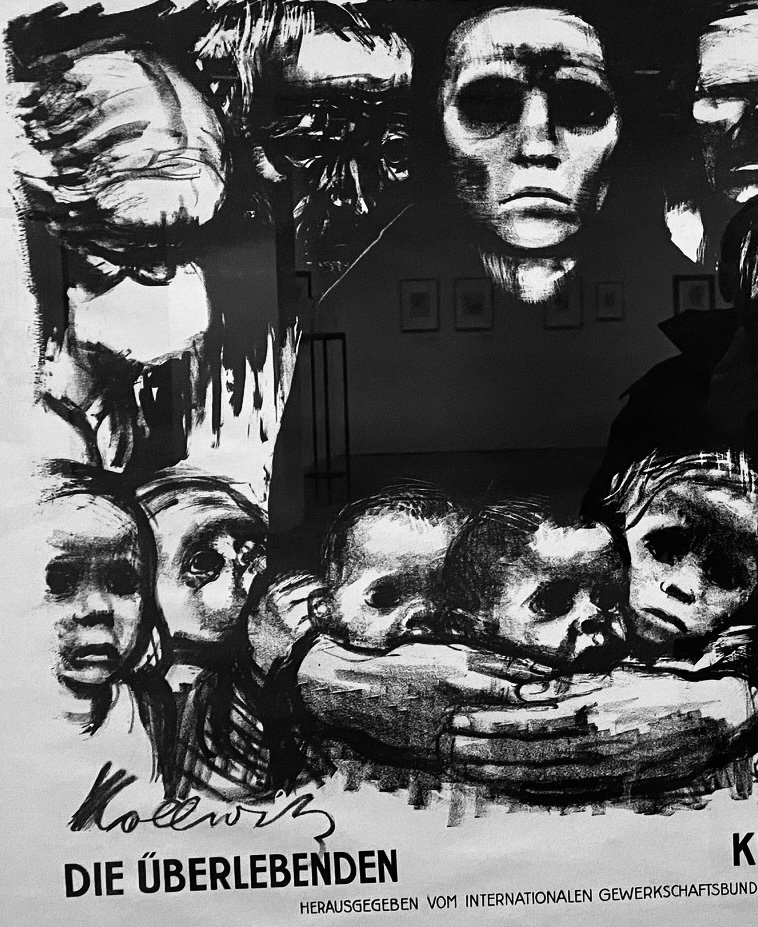
The survivors of war have experienced unimaginable violence and suffering. Once fighting ends the horrors of war live on in the memories of all survivors irrespective of which side they have been fighting. Almost all have lost someone or something they cherished before the outbreak of war. Käthe Kollwitz has depicted these horrific experiences in many examples of her art work. They speak to us today just as much as in the past. Berlin is a great place to learn more about her art. The image below is an extract from a drawing in poster form edited by the International Trade Union Federation from 1923 shown in the Brücke Museum in Berlin Dahlem in 2023.
Continuity in 2024
The Russian aggression continues on Ukrainian territory also in 2024. Based on false allegations and stories about a supposed Russian heritage based on Ukraine territory the ongoing war is once again fought more about the past than the present. The future is entirely disregarded by Russia as if it is clear to them that they do not have a future of the dictatorial regime. If a country does no longer care about future perspectives or future generations even, this country is likely to become very dangerous for neighboring countries and beyond because of the high discounting which implicitly applies to all its investments. Western companies who moved out of Russia had immediately high losses. At the same time Russia continues on a daily basis to destroy lives and property. We just shall not stop to support the fight for freedom and democracy in Ukraine as long as it takes. It fighting for our future rather than demons of the past.