Konzerthaus Espresso

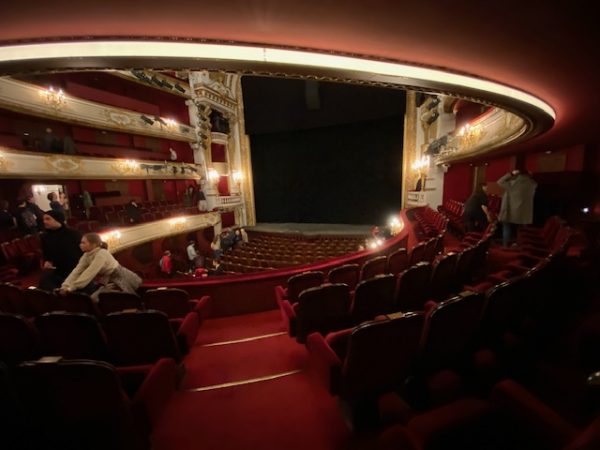
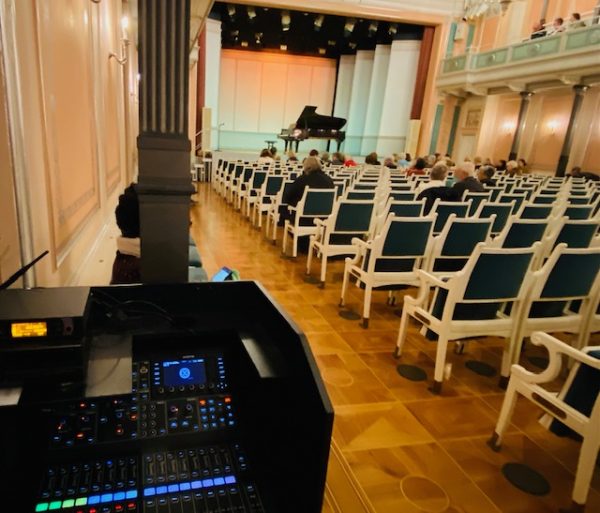
Classical music in classicist architecture sounds like a perfect match. The audience is packed with people mostly 60+ years of age. One of the spectators happily admitted that without the espresso before the concert she would have a hard time to follow closely because after lunch at 2 p.m it is time for a rest rather than excitement.
The series of short concerts at lunchtime suits particular audiences. It is probably the only concert series where the queue in front of the toilet of men is equally long than the one for women. The short concert program allows for more experimental formats as well. Musicians who develop a solo program of shorter than standard concert hall duration can appear in high reputation locations and gain experience of performing in such prestigious settings.
With a “Zugabe” from the performer, but also in form of a small piece of chocolate for the audience at the exit, 21st century, classical Berlin knows how to charm its aging audience and population. Young performers learn that the mature audiences don’t bite any more. In case the sound and peaks become too modern they just adapt sound level of their hearing aids. It is perfect for all generations.
Dancing School

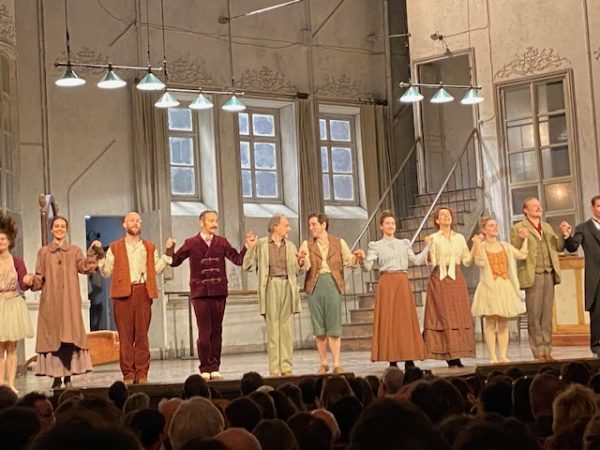
Most of us know very little about what happens in a dancing school. This has intrigued artists for centuries. The Paris-based “Comédie francaise” has chosen the “L’école de danse” de Carlo Goldini as one of the pieces to enter its repertoire in 2025. Whereas modern dance celebrates the freedom of motion of humans, the early 18th century theatre piece by Goldini is a comedy in which the tyrannic ballet teacher attempts relentlessly to maximize profits based on the talents of the dancers either by placing them at a high reputation theaters or marrying them. Of course, each time a sizable commission has to be paid to the dealer of talents. Sounds familiar to what happens in other professions today, doesn’t it?
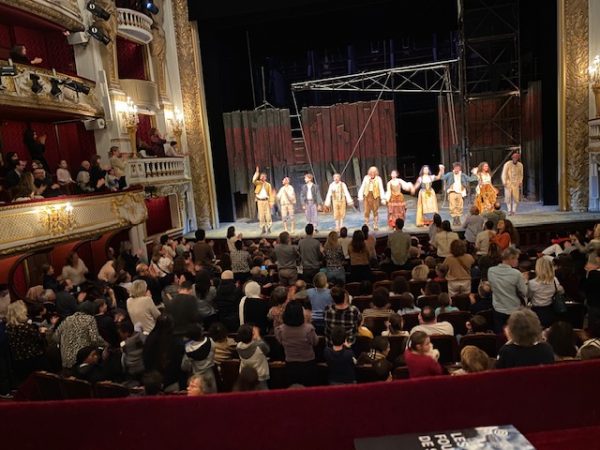
The borders between “dealing with love” and “dealing in love” become blurred in this comedy and Goldini shows his talent to play out intrigues on stage in an admirable way. It is a pleasure to experience the fun on stage with the manifold intrigues. (Image: actors of Comédie francaise in L’école de danse 2025-12).

Minds alike

Great minds, think alike. In the „propositions on happiness“, the author Alain mentions as inspiration for his thought process: Aristotle (XLVII) via Marc Aurel (LXIII) to George Sand (LXVI). This is an interesting perspective and abbreviation of the history of ideas. The impact of stoicism in his thinking of happiness becomes evident. Although originally he was described by another person as a relentless optimist, he was happy to accept this summarizing label of his personality. In his writings, that also may work as recommendations he stresses the importance to “know yourself”. That’s not an easy to achieve objective, as self-deceit is all to common.
However, in desperate moments or just on a rainy day (both are entries from Alain), you will need to know how to console yourself. Friendships and knowing how to please others become virtues, which contribute to your own happiness.
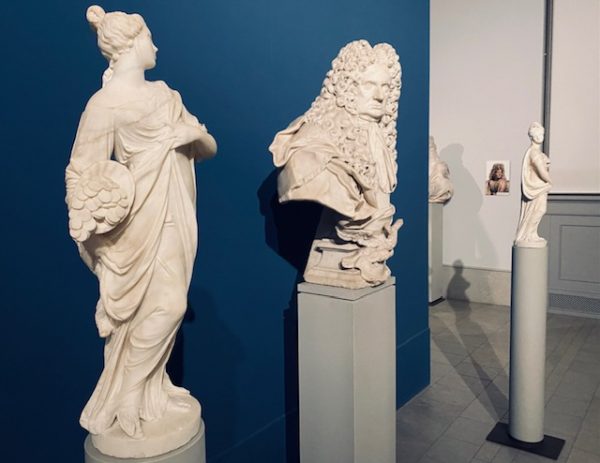
Perhaps the best summary of the history of ideas with respect to happiness is his last sentence in the paragraph “victories” (LXXXVII): “Le bonheur est une récompense qui vient à ceux qui ne l’ont pas cherchée.” In my own translation: Happiness is a reward for those who did not search for it. (Image: Bode Museum Berlin, Allegorie wealth in front, facing allegorie honour in background; middle duke Montecuccoli.) 

Memory design

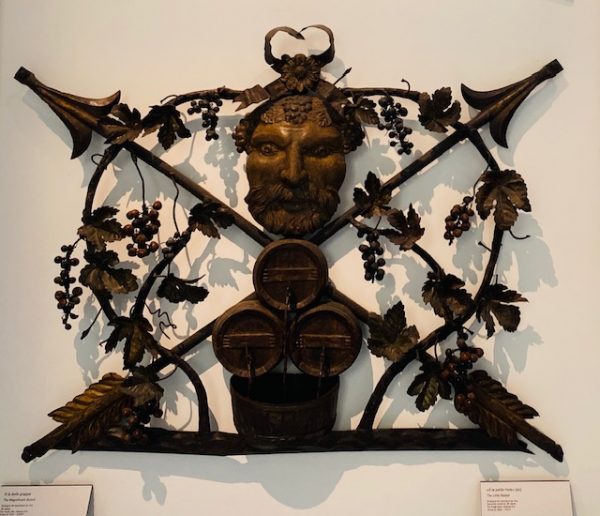
The progress in the field of genetic editing and design is astonishing. The research group of Johannes Graeff tested the “behavioral consequences of epigenetically editing the Arc promoter within engram cells”. Plasticity is a key feature of memory formation and the experimental evidence shows that this plasticity can also be interrupted. Moreover, the scientists were able to demonstrate a reversibility of retention or un unlearning of manifestations in memory of mice. The bidirectional reversibility of memory expression has potentially therapeutic value for traumatized humans eventually. However, if memory becomes part of a design feature of human species, the risks involved are just as important as the potentials. In totalitarian political systems techniques of “memory design” might be able to adapt such influences on memory, which used to be called brainwashing. Ethics commissions could get ready already to define safeguarding of human memory.  (Image: The fountain of Bacchus, Museum of Paris, 18th century wine merchant entry)


Multilingual aging

Some myths, for example about the effects of multilingual competencies on brain health, continue to hunt people. The proponents of a monolingual world are widespread and have in some countries fatal historical heritage. The study by researchers  (Amoruso et al. 2025) use data from 86.000 persons in Europe  (SHARE Database, waves 1-9) from several countries. They show the better aging of brains for bilingual persons and even more so for persons practicing multilingual 2+ languages. The “domain-independent protective effect of multilingualism” for healthy brain aging is very robust and works after statistical accounting for other potentially intervening factors like socioeconomic or institutional factors. Some known stressors like migration, however, which operate often as psychosocial stressor, can have similar negative effects just as alcohol consumption and sleep disruption. Multilingualism and the correlate of multiculturalism keep a brain “on its toes” and contribute significantly to our healthy brains.  

Telework Challenge

There is a seminal trend that many employees prefer to have a choice to work on the premises of the employer or remote from home. This flexibility has become a major element of collective bargaining on work and time in larger companies in order to clarify rights and obligations.
In France it is about 1 in 5 of employees who do telework one day per month (1 in 6 in Nouvelle Aquitaine). The higher up in the hierarchy a person is, the more likely s/he is to do telework. Higher levels of educational attainment and seniority in a company also improve the access to and use of telework. There are still many employees who would like to do telework in their jobs, which technically could be done remotely, but who cannot do it (1 in 3). Most of those are denied the possibility by their employers.
Data from a survey in Germany from 2014 showed that before Covid-19 men were worked more often remotely than did women (Lott & Abendroth, 2019). The latest figures from France 2024 show that women have overtaken men as remote workers (Askenazy et al. 2025). As working from home has become more a part of the “standard employment relationship” today, the fears of loosing out on career opportunities due working from home seems to play less of a role nowadays, probably for both gender. Compared to 2014 the costs of equipment and availability and ease of installation of fast internet have become more affordable and might push the spread of telework even further.
The data from France show a strong positive correlation of remote work and commuting distance to work. Hence, long commuting distances “drive” more people into telework, which makes a lot of ecological sense, too.

Classic Farces

Molière’s theatre pieces were popular pieces. Born with the name Jean-Baptiste Poquelin and son of a rich “tapissier” of the rue Saint-Honoré in Paris, he made a tough choice to devote his life to touring as a ”farceur” and comedian, having studied also law in Orléans before. Only after his first successful performances, farces and theatre plays, he could afford to buy the theâtre du Palais Royal, despite a bankruptcy about 20 years earlier with his own theatre. The much later title “Troupe du Roi” (of Louis XIV) and a pension by the King assured a financial and political independence rarely found in this period of classic theatre.
Molière’s “Les fourberies de Scapin” was written towards the end of his life and as a classic farce in the 17th century. The story is full of funny scenes and witty dialogues, which make it a great “intergenerational” theatre play even today. The plot about the institution of marriage addresses a cleaving social and legal construct “marriage”, which continues to excite all generations and across centuries.
(Source: Histoire de la littérature française XVII siècle. Robert Horville  in (Georges Décote series editor)

Sociology in Theatre

Thanks to the inspiring direction by Denis Podalydès of Molière’s “Les fourberies de Scapin” we can experience the fruitful application of sociology to classical theatre production. This combination of thoughts has been performed at the “Comédie Française” for more than 7 years in 2025-11. The accompanying booklet of the performance mentioned the ample inspiration of Denis Podalydès by the French sociologist Pierre Bourdieu. Personalities in Molière’s theatre are represented as incarnations of the “habitus” each character stands for. Such an interpretation of the roles in the theatre play, raises awareness about the subtle differences between personalities. Even two rich men may differ in their habitus, because their fortunes are of different size or kind, yet they may share even more personality traits. Molière was a particularly crafted author, director and actor to stage such subtle differences, which are embedded into societies often across generations.  

Colette The Cat

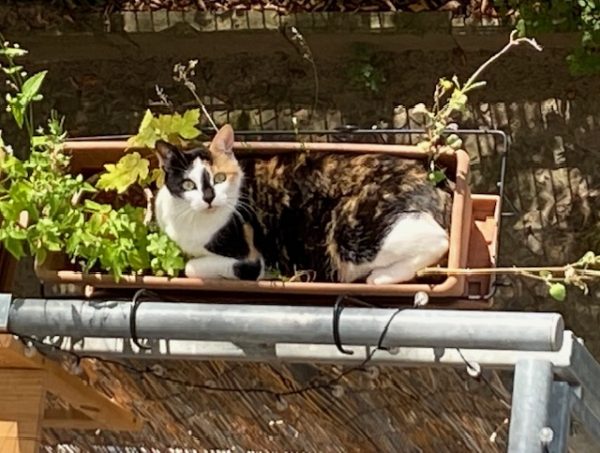
The novel “The Cat” (La chatte) was written by Colette with a view on the emancipation of women. The main character “Camille” freshly married to her husband is terribly jealous of the cat 🐈‍⬛ of her husband Alain. In order to deal with this situation she dropped the cat from a window in a moment of anger. As her husband seemed ready to divorce her due to this incident she claimed that her husband defended higher moral standards for the cat than for her psychological wellbeing. The novel certainly raises the issue of hierarchy of rights and duties. The moral dilemma highlights the schism of animal rights and/versus human rights. This specific issue seems to be resolved in the modern context, where both animal and human rights are protected in parallel. On a more abstract level, however, our relationship with animals and nature requires us to balance the rights and relationships again and again.

Polypharmacy issues

As we age, we become more likely to confront polypharmacy issues. Polypharmacy is defined as taking 5 or more medications per day. The study reported in The Lancet healthy longevity by Payne et al. 2025 had participants with a median of 4 health conditions and a median of 8 prescriptions. Even a comprehensive set up which involved several experts from medical doctors and pharmacists did not manage to achieve a significant improvement in polypharmacy outcomes in this experimental study with otherwise carefully matched intervention and control group. However, the mental health (measured in patients as “health-care-related quality of life”) slightly increased and the “treatment burden” experienced by patients was slightly reduced.
In combination with a previous study the probability of errors in nurses, who are the prime persons responsible for the administration of medications in institutionalized settings, the reduction of potentials for errors like they are to be found in polypharmacy should continue to be a prime target of this research in future. Together with the knowledge about the prevalence of functional illiteracy at older ages, polypharmacy remains a critical issue on the public health agenda beyond the experimental settings in this study.