Spring in Autumn

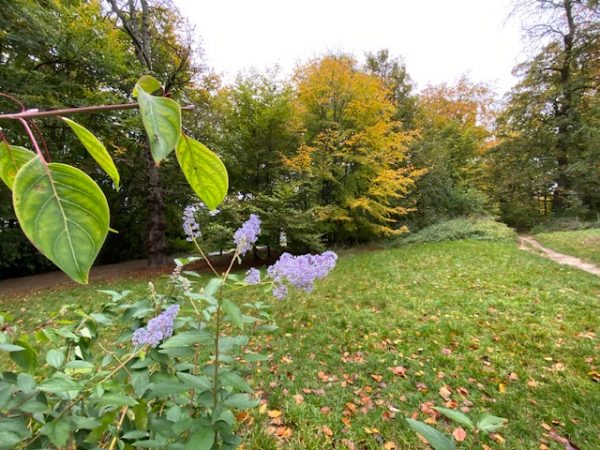
Can we have spring in autumn? Of course not, most people would answer. The definitions of spring and autumn are clearly defined as separate seasons. Depictions of the seasons in paintings in the Romantic or Impressionist periods are hard to imagine with somewhat blurred distinctions between seasons. And yet, climate change in the 21st century show surprising spring flowers in autumn across Europe. This leads to lots of confusion in nature’s time table.
From a life course perspective, we may ask, whether it is possible to experience a 2nd spring in the season’s view of the life course. More healthy years and spring feelings in the autumn of live have propelled a whole new industry around longevity and the mantra to “stay healthy for the wealthy”. The growing health inequality over the extended life course is a silent killer. The experience of spring in autumn remains a distant dream for most people with multi-morbidity.
Our experience of sequential or linear time, where one season follows the other, gets disturbed or at least blurred. The “Gleichzeitigkeit des Ungleichzeitigen” in English the “simultaneity of the non-simultaneous“ can be observed in the macro-world of everyday experience, albeit in a different way than Ernst Bloch defined the concept. On the other hand, it is no longer necessary to invoke Einstein’s theory of relativity or quantum physics to come up with apparently strange phenomena, but empirical facts allow us to question received wisdom, evidence based.

Tether thy liver

There are few of us who take our liver seriously. Yet, this big organ plays a central role in our body to regulate metabolism. The obesity pandemic in western countries increases health risks, just as excessive alcohol consumption increases risks of liver dysfunction. Additionally, viruses increase the risk of failure of this organ.
Each of these risks as well as any combination of one of the risks with another one have led to rising public health risks. Several studies since 2020 have highlighted these increased risks for populations in general. The risks, however, have an unequal spread across subgroups of society. A recent comment based on the research of the INSERM U955 team in “The Lancet Regional Health” by Brustia et al. “Liver-related mortality strikes hardest where deprivation is greatest.” Health inequities consist in the lack of income available to buy healthy food or in untreated alcohol addiction, both more common in poor people.
In order to tackle the inequity, the team of medical doctors call for a shift in awareness. Structural reasons like diagnostic delay, remoteness or health literacy are just as important as individual predilections like nutrition or lifestyles. Inequality in access to health and ability to afford a healthy lifestyle have become serious drivers of social inequality in the 21st century.

Popular Sociology

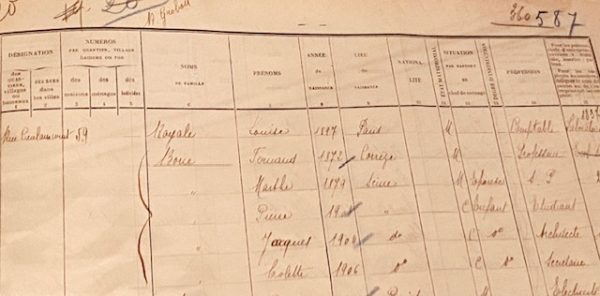
Sociology, like other social science disciplines, has often difficulties in reaching bigger audiences. However, in combination with a museum which specializes in the history of a big city like Paris, the insights can suddenly become very popular. The “Musée Carnavalet of the history of Paris” has mounted an exhibition, which builds on the population censuses of 1926,1931 and 1936. The access to the complete original records of 3x about 2 millions of people has become a national treasure for social scientists and the public at large.
People flock to the exhibition. Some do it to learn about the past of their districts or streets. Others to learn about historical facts, which are sometimes linked to the family anecdotes and broader historical narratives. Out of this interest grows an understanding of macro- and micro-level social processes, which makes use of basic statistics.
People ask themselves: Is your (family) story unique or is it part of a more general pattern or social process like urbanization or social mobility.
(Image: original census recording sheet – Paris)

Colette nature narratives

In the 21st century we know that posting images of cats and dogs yields thousands of likes on the digital social media. Long before today, writers have tried to make us understand our existence through the narratives among animals, also beyond cats and dogs.
Embedded in nature, stories unfolded through the interaction of these animals. Transfigurations and lessons were derived from such fables as well as the tales constructed around the interaction of nature, animals and humans. The commemoration of Colette in the park of the Palais Royal in Paris combines all those aspects.
She grew up in the countryside, wrote “La Chatte” and lived in an apartment at the Palais Royal with a splendid view of the park later in her life.
It is a tiny spot of cultivated nature in the heart of Paris, even a bit isolated from the busy surroundings. Certainly, these days in the centre of Paris you are more likely to meet “Aristocats”, maybe from the 5 star hotels around, rather than the ordinary cat passing by.
(Image, bench in park of Palais Royal, Paris: inscription is a citation from Colette 1925 letter)

Colette Home

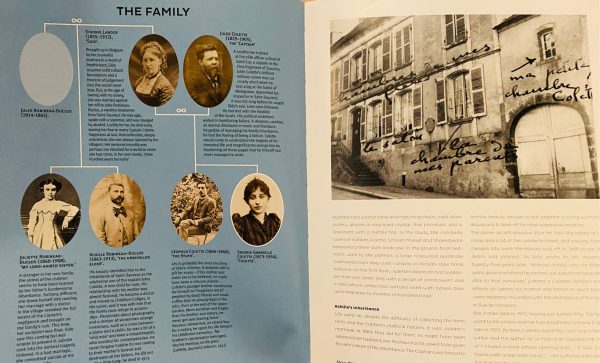
  1. The home of Colette, the French writer of the first half of the 20th century, is an interesting example of the high attributed value for her later creative career. The home and the gardens around, seemingly had a huge and lasting impact on her imagination.Her writings are firmly embedded into not just her home of childhood and adolescent years, but also the changoof homes and contexts literally made Colette. The documentation of this in the “Musée Colette”, which presents the different phases of her life course, allows to get a better understanding of the interconnected world of experiences and artistic work. It takes an especially broad set of influences to form such a polyartist. The libretto for an opera orchestrated by Maurice Ravel or a model for Matisse, stand for the openness to new experiences and take risks when she embarked on new creative endeavors. (Image Musée Collette catalog p. 6)  

Polyartist Colette

It is a complex task to do justice to a polyartist like Colette. The curators of the exhibition “Les mondes de Colette” (BNF 2025) Bouvard, Dimerman, Le Bras do a great job to present the biography of Colette, the writer, journalist, dancer in music halls, model (for Matisse) and entrepreneur in all facets of her activities. The role model of an emancipated women as early as the 1910s, 1920s and 1930s. The struggle of women artists in the early years of the 20th century to make a living from art is well documented already. To make a living of writing has always been a challenge if you do cherish your independence and liberty of expression. Versatility in artistic production is one escape route. Colette made a strength of this in diving into different forms of art and professional activities close to the artistic and creative world. In a quite unique way, she became her own muse for her own artistic work; and a character and inspiration exploring many facets of live. The economic misfortune experienced her parents became a source and force of inspiration.
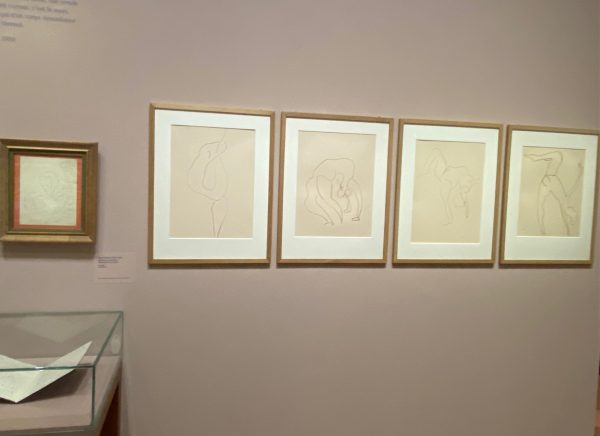
Contrary to the expectations of the market of arts and literature, she did not feel like sticking to just one activity. Her most lasting achievements, probably, were her literary accomplishments for most people, although Matisse immortalized her in his specific style of abstraction.
Polyartists just like Polymaths, make more comprehensive contributions to our experiences.
(Image:Lithographie by Henri Matisse of Colette, exhibition Colette at BNF 2025).

Digital Social Networks

Social networks have become the place to be. The need to distinguish the digital social networks from the social networks of people in the analog or “real” world is important, as we realize that many young persons seem to suffer from loneliness despite a hundred personal links in the digital social networks. This paradox of digital and non-digital social networks needs careful attention of researchers because of the opportunities and risks involved in the transferability of contacts from one network to another.
There is s a kind of “conversion rate” of digital contacts into face-to-face contacts and even purchases for marketing purposes in the world of business. The sociology of the virtual has to deal with these paradoxical social relationships and study the increasing phenomenon of being «alone together». Increasingly we are alone, but together. Over the life course this phenomenon and the digital social network paradox change as well.
To research such a topic we need rather intrusive, personal data and access to the digital traces of people as they construct and deconstruct either form of social networks. 

Unexpected effects

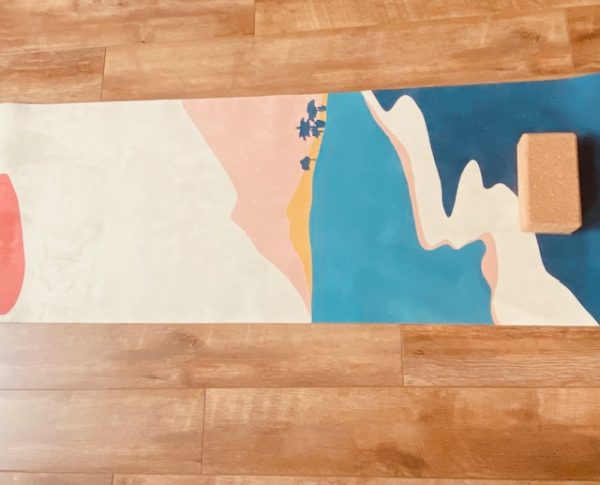
It is, unfortunately, a rare event in science to publish unexpected effects of an experiment. Sometimes, results even turn out to be the opposite of what to tried to show with the use of an experimental setting. The learning for the science community, however, is bigger in such cases. Why? A carefully designed experiment (Oliveira et al. 2025) to measure the effects of 2 different 12 month long yoga trainings to prevent falls in 60+ persons (mean age 67) revealed that the less challenging “seated yoga” was better in preventing seniors from falls.
Participants in the more challenging Iyengar yoga-based sessions reported more falls in the 12 months follow-up period. Due to Covid-19 the trainings took place as an online course, which might have reduced the influence of a coach in correcting positions and observe other physiological or psychological issues with participants.
However, the insights are a great lesson for experiments to produce opposite results of expectations with the lesson that human beings can be rather complex. From a health psychology perspective, it might be the case that participants in the more challenging yoga classed became also more daring in balance as well as other exercises.
Just being overly confident compared to their positive improvements, which might turn around an initially positive effect on balance and falls. From a socio-economic perspective, we would question the implicit assumption of the study that participants have a random distribution or underlying tendency towards risky behaviour. The longer the observation window (post-intervention) is, the more intervening socio-economic factors enter into the physiological-behavioural equation. Hence, expect unexpected effects.

Inclusive images

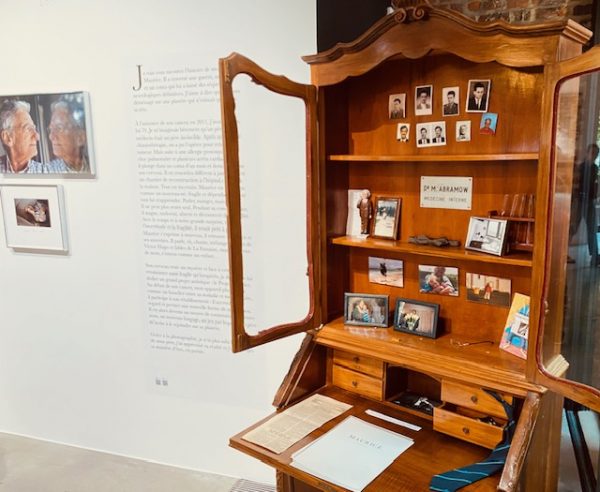
In the last 2 decades we can observe a strong concern among photographers to broaden the spectrum covered by images beyond well established imagery of non-binary gender. Diversity in imagery has taken a broader scope to extend, for example, the age range of people who are portrayed as central topic of exhibitions. The topic of mental diversity is more recent and needs a similar or even increased sensitivity to do justice to the whole spectrum of people. The photography of people with mental challenges necessitates a much more careful approach to the persons and complex personalities the photographer intends to portray. Trust and the development of trust of more vulnerable persons is a time sensitive process. The work by Charlotte Abramow “Maurice, Tristesse et rigolade” is a fine example of a photographer who portrayed over a long time of taking care of her father, previously a medical doctor, The years of the final stages of the life course of her father have been the subject over many years as the survivor of an extended medical coma had to struggle with the tough challenge of re-learning basic life skills again.
Abramow portrays her father as an actor of his “second life”, where the borders between reality, reconfigurations of his memories,   and “mise en scene” to co-produce the images. The images go far beyond the portrayal of aging and mental challenges as a deficit of persons. Yes, it is an integral part of these persons, but there is so much fun and positive emotions that derive from the intensive collaboration of actor, father and photographer that the images stick with us for a longer time. The presentation of props along with the photos creates an immersive installation, which strengthens the emotional bonding with the inclusive images of the later phase of the life course of Maurice.

Marc Aurel Book 12

The closing book of Marc Aurel’s Meditations is taking issue with his own posterity. As a guideline for others, he formulated the claim not to care so much more about the opinions of others, but to stand by own reasoning and trust in one’s own opinion. “I have ofetn wondered how it is that everyone loves himself more than anyone else, but rates his own judgement of himself below that of others. … So it is that we have more respect for what our neighbours will think of us than we have for ourselves.” (Paragraph 4, Penguin Classics).
Of course, in the age of “philosophy as discourse” (Habermas), we are used to criticism of books and their authors. For the emperor philosopher this was less obvious, albeit the Socratic tradition of exchanges between teachers and their scholars was a kind of precursor of 20th century philosophy.
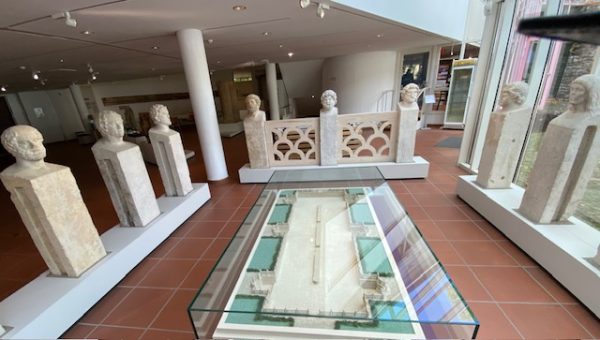
His writings in ancient Greek, however, remained little known and debated until its first Latin publication. Ever since, it has been a prominent work on ethics and leadership. The exhibition in Trier featured the copy of Helmut Schmidt, as the long reach of stoic writings on virtues and leadership.
(Image: Stadtmuseum Trier, Model of Villa in Welschbillig)