Embedded Artists

The Brussels districts have their specific identities. 

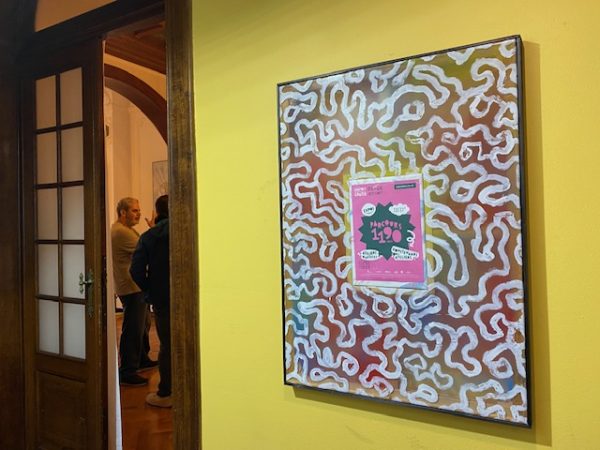
The Forêt district is reconfiguring itself rapidly. In addition to the Modern Art Gallery Wiels, It hosts a multitude of diverse artists. Many of them opened their doors to the public as part of the 4 days of Parcours 1190. It turned out to be a truly Inclusive experience in the broadest sense possible. The immersive experience of seeing the work and the artists, some of them in their private homes, created a sense of an embedded connection to their work and personalities. The artists are embedded in the district around them nd the people of the district might feel a bit more connected to the artists surrounding them. The artist has integrated the pink poster of parcour1190 into one of his works under the overarching theme of inclusion. Social inclusion can take many forms, The Brussels district Forêt has added new dimensions to it. (Image entry to Hassan Bouzougarh‘s exhibition on 2025-10-5, Brussels Forêt). 
Deus ex machina

The term “deus ex machina” used to be applied more in its figurative meaning. With the rise of digital tools like chatbots, facilitated and enhanced through AI, God is speaking to us not only in multiple languages, but also from our pockets through our smartphones and headsets. This is a rather recent form of “deus ex machina”, which we did not expect some years ago. The bible as e-book or pdf-file has been around for some decades, but only more recently we can enter conversations with God through chatbots as another version of “deus ex machina “ about almost everything (and pay for it via digital credit card). Programming of such an AI-tool is easily achieved. AI will prepare a weekly or daily sermon or prayer for you, following your predilections of your favourite quotes of the bible. An interesting twist to the programming is to use authorized as well as unauthorized translations of the bible across several centuries.
Another interesting enlargement of the input data base is the inclusion of interpretations and discussions not only within your own religious community, but beyond. Maybe the discussion of several different religious chatbots with each other could prevent aggressions due to differences in basic beliefs. These “dei ex machina” might further our understanding of what makes us humans different from machines and machine-based solutions of human conflicts.
As genetic clones of ourselves have become already technically more feasible, our digital alter-egos (the comprehensive collection of traces in the internet and digital images, plus social scoring) help to empower those “dei ex machina”.
This kind of “Brave New World” asks us to be rather brave ourselves.
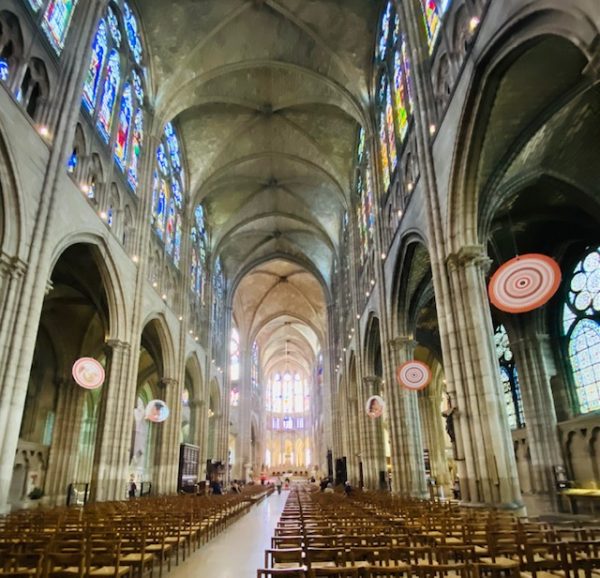
(Image: interior St Denis Basilique Cathedral Paris 2024)

Inclusive images

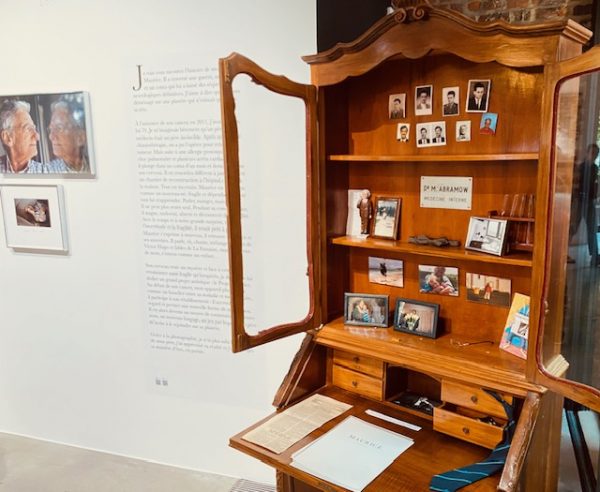
In the last 2 decades we can observe a strong concern among photographers to broaden the spectrum covered by images beyond well established imagery of non-binary gender. Diversity in imagery has taken a broader scope to extend, for example, the age range of people who are portrayed as central topic of exhibitions. The topic of mental diversity is more recent and needs a similar or even increased sensitivity to do justice to the whole spectrum of people. The photography of people with mental challenges necessitates a much more careful approach to the persons and complex personalities the photographer intends to portray. Trust and the development of trust of more vulnerable persons is a time sensitive process. The work by Charlotte Abramow “Maurice, Tristesse et rigolade” is a fine example of a photographer who portrayed over a long time of taking care of her father, previously a medical doctor, The years of the final stages of the life course of her father have been the subject over many years as the survivor of an extended medical coma had to struggle with the tough challenge of re-learning basic life skills again.
Abramow portrays her father as an actor of his “second life”, where the borders between reality, reconfigurations of his memories,   and “mise en scene” to co-produce the images. The images go far beyond the portrayal of aging and mental challenges as a deficit of persons. Yes, it is an integral part of these persons, but there is so much fun and positive emotions that derive from the intensive collaboration of actor, father and photographer that the images stick with us for a longer time. The presentation of props along with the photos creates an immersive installation, which strengthens the emotional bonding with the inclusive images of the later phase of the life course of Maurice.

Marc Aurel critics

In the literature on and about Marc Aurel (Brenan 1882, pp. 484) the end of the ancient world is mentioned frequently. This refers to the beginning of the end of the Roman empire and the rise of Christianity to be become more influential. What caused the decline? The nepotism in the governance structure through the placement of family members to influential positions and as successor alienated many followers who previously believed in the high moral standards advocated by Marc Aurel.
Justifications of superiority by social origin are standard at the time of writing, but Marc Aurel did not see the potential of a more equitable distribution of offices. Women were relegated to subordinate or no public positions and are not mentioned with respect to  the importance of reasoning or social competence either, none but one in his acknowledgements (Book 1). The discrepancy between the formulation of virtues as well as ideal standards versus own practices of hierarchical leadership, recourse to slavery and brutal upholding of the empire should not go unmentioned.

Marc Aurel Book 11

Throughout the Meditations, Marc Aurel concerns himself with the idea and importance of the common good. Based on his experience as Consul and Roman Emperor, the common good is of primary concern. At least in his thinking and writing these concerns play a very prominent role just like the “social“. In order to ensure his own successor, as described by Katherine Kennedy (2020 through www.classicalwisdom.com) he was only the 2nd Roman Emperor  to appoint a biological heir as his successor, which met a lot of criticism already at that time. Nevertheless, in his philosophical thinking and leadership guidelines he cherished the common good above all. “Have I done something for the common good? Then I too have benefited. Have this thought always ready to hand: and no stopping.” (Book 11 paragraph 4, Penguin Classics edition). This is in contrast to the predominant utilitarian thoughts many centuries later where the pursuit of your own benefit will further the benefit for society. The reversal of the logical sequence in later thoughts is particularly remarkable as well. The process of individualisation seems to be another additional factor in the lack of concern for the common good in the 21st century. Raising the awareness to further the common good is a continued challenged in most societies.

Marc Aurel Book 8-9

In book 7 paragraph 38 the stoic wisdom is exemplified in the the the short phrase „If you have sharp sight, use it: but, as the poet says, add wise judgment“. Being sharp in your reasoning or data collection is only part of the human endeavor. A wise judgement is, however, an ambitious aim as judgments have different short term and long term consequences. Intergenerational considerations as for climate change ask for respect of other species, biodiversity and to take into account very long time horizons.  The quote from book 8 paragraph 5 appears very modern or post-modern in this context. „There can often be wrongs of omission as well as commission.“ (both citations from Penguin Classics edition) Not acting on behalf of future generations and disappearing species is the most crying omission of our time.

Marc Aurel Book 7

In paragraph 63 Marc Aurel refers to Plato as one of his sources: “No soul”, says Plato, “likes to be robbed of truth” ( and continues himself) “– and the same holds of justice, moderation, kindness, and all such virtues. Essential that you should keep this constantly in your mind: this will make you more gentle to all.” The remarkable reasoning is to transform the own generalized experience into a behavioural recommendation. It may be argued that Marc Aurel starts from a kind of Aristotelian empirical study of persons in different life domains to derive an empirical fact. Based on this he develops a more Plato inspired “idealistic picture of mankind”. He is very much preoccupied with the philosophical question, how is a good life for all possible. In a previous paragraph (55) he outlined his 3 guiding fundamentals: (1) “The main principles in a man’s constitution is the social; (2)… resistance to the promptings of the flesh, like impulses; (3) judgement unhurried and undeceived”.
With such a claim for a “rational constitution” of man, he puts himself into the footsteps of previous philosophers of the ancient Greek tradition and, therefore, his writing in Greek rather than Latin is also a homage to this philosophical heritage.
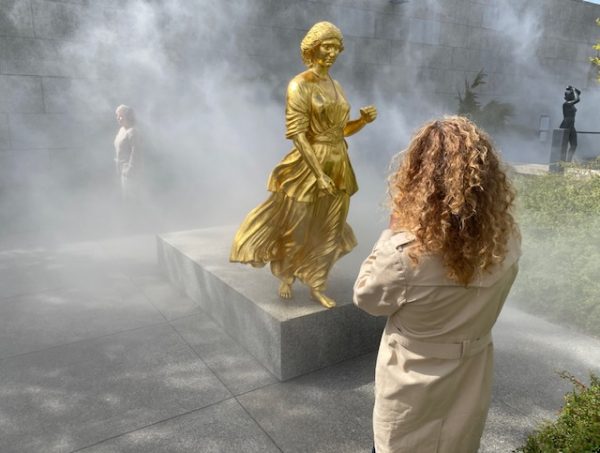
(Image: parts of Installation by Fujiko Nakaya in Neue Nationalgalerie Berlin 2025)

Marc Aurel Book 2-5

There are several translations of Marc Aurel. In the Shakespeare English translation from the Greek original of the Meditations a passage (Book 5 paragraph XXIII) describes or idealises humans as a “reasonable and sociable creature, regulated and directed.” The same short quote of this paragraph in the English translation by Martin Hammond (Penguin Classics p.43) reads: “…my wish is to follow the nature of a rational and social being.” Of course, both translations are pretty similar at first glance, but the difference of “reasonable” versus “rational” and “sociable” versus social” mark very important differences that had and have different impacts throughout the following centuries up to today. As in many other instances going back to the original version in Greek (book link) might clarify the issue, however, the entry barrier is access to the bilingual version and use of an ancient Greek dictionary.
With almost 2000 years of advances in rational approaches and its tools like mathematics, the scope of the rational is huge and the behavioural turn in the social sciences demonstrates the limitations of human’s use of rationality (λογικός) in decision-making. Reasonable seems to come closer in today’s “post-enlightenment” world.
There is also quite a divergent connotation in the simply “sociable” (κοινωνικός) being or the “social” being, which has a wider scope attached to it. Hence, lets be aware of the implicit interpretations of translations. For a start the parallel reading of translation and original (Link) might enhance our understanding and spur even new translations and interpretations, which speak with the classic originals to today’s audiences (with or without AI).
A witty joinder of both previous translations is “And my will is the will of a reasonable and social being”. (Link Book V, paragraph 29 bottom).
From the Greek to French in book V (Link)  with an even broader understanding of the social as “la société universelle”.

(Image: Camille Claudel 1905: “Persée et la Gorgone, Lucile Audouy collection Paris, exhibited in Berlin 2025, Alte Nationalgalerie)

Marc Aurel Book 1

The reading of Marc Aurel’s Meditations in its Book 1 offers first of all his acknowledgments of people who had a lasting impact on him or offered learnings to him. He presented these learnings or take-home lessons as we call this nowadays in a style of “positive psychology”. This means writes about the positive influences and which kinds of positive behaviors he saw in living examples of others and which he felt were particularly worthy of general consideration. In philosophical retrospect we might read the book 1 as a list of “categorical imperatives” which would make a decent life feasible for all. His acknowledgments start with 1 line on his grandfather (decency and mild temper), 2 lines on his biological father (integrity and manliness), 3 lines on his mother (piety, generosity, avoidance of wrongdoing and simplicity of living), but 4 lines on his tutor, even more on other advisers, 20+ on his adoptive father, which is more than on “the gods”.  All these experiences impregnated him with a sense for a “ruler’s responsibility for the common good”. (p.8). The stoic virtue lies in the extensive list of positive contributions from others to make him the rather unique philosopher and emperor.

Chatbot Me

Chatbots are helpful to allow queries to larger data sets like the blog entries here. So here is a try of a Chatbot to query all entries on AI using ChatGPT to create a Chatbot that uses and references it source from www.schoemann.org/tag/ai and the AI reader in pdf-format.
Please send me an email if the hallucinations of this Chatbot 1.0 on AI from a social science perspective are giving strange results. I’ll get back to you. Please use at your own risk as I cannot guarantee for all answers. The usual disclaimer applies here.

ChatGPT proposed the following set of Questions and Answers on the blog for an entry into the chat: Example Q&A with the chatbot

Q: What are the social science concerns with AI?
A: Bias in results, job shifts, democracy risks, privacy, and new inequalities.

Q: What does the text say about reinforcement learning?
A: It’s seen as the next step for AI: focusing on learning and reasoning, not just predicting text. It also uses fewer resources.

Q: How are robots described in the document?
A: Robots are mostly assistants. They can follow people or carry small items, but more complex tasks need sensors and AI training.

Q: What about biased results?
A: Studies can be misleading if control groups are flawed. AI faces the same challenge — social scientists warn: “handle with care”.

Q: What is Schoemann’s blog view on AI?
A: He links AI to energy use, fairness, and its role in the “all-electric society” — stressing efficiency and responsibility.

More on the chatbot (in testing phase) and the Link to the coding help received from ChatGPT on this mini-test-project :
https://chatgpt.com/share/68c1d160-0cc0-8003-bf04-991b9e7c3b24