Aging Challenge

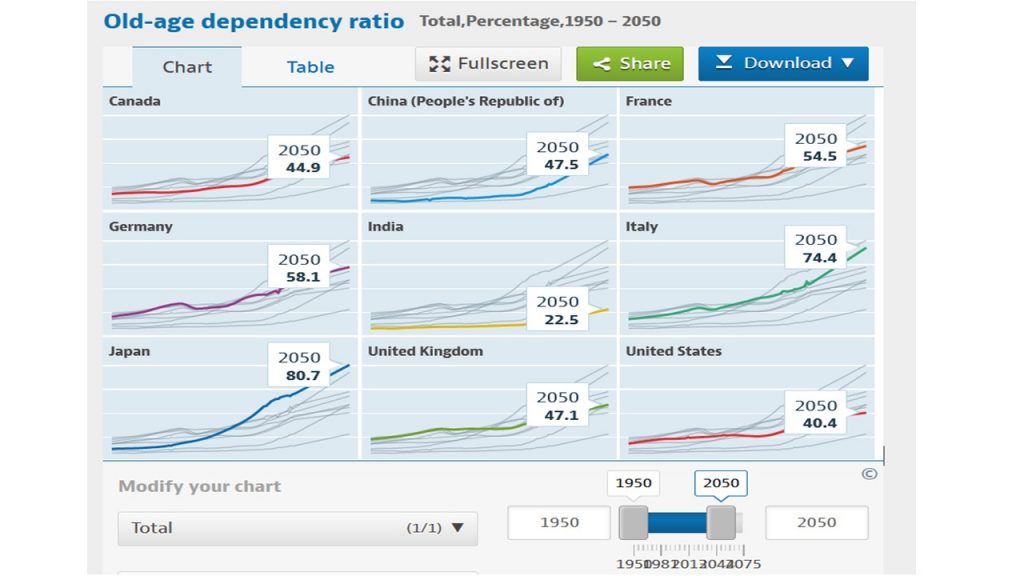
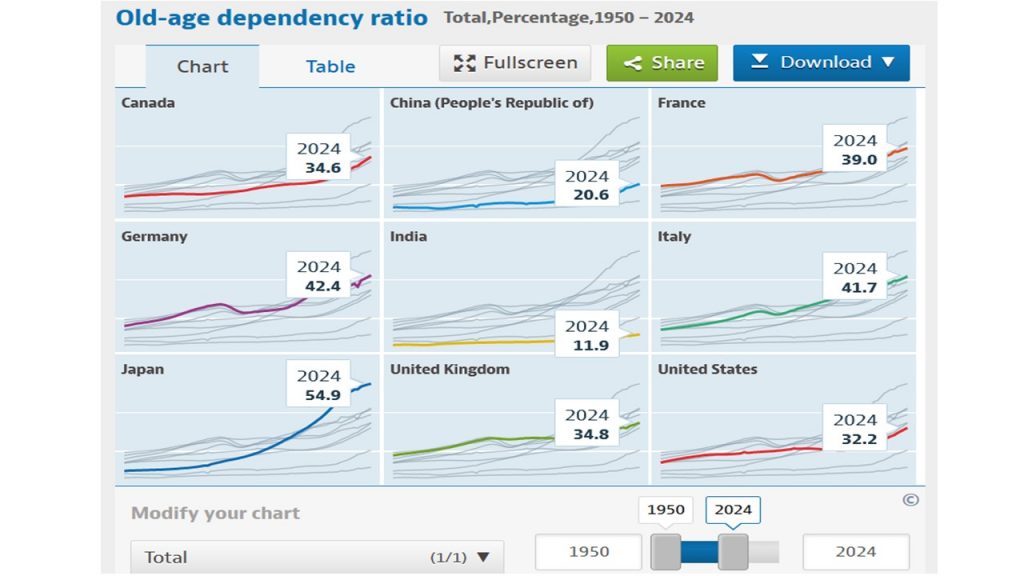
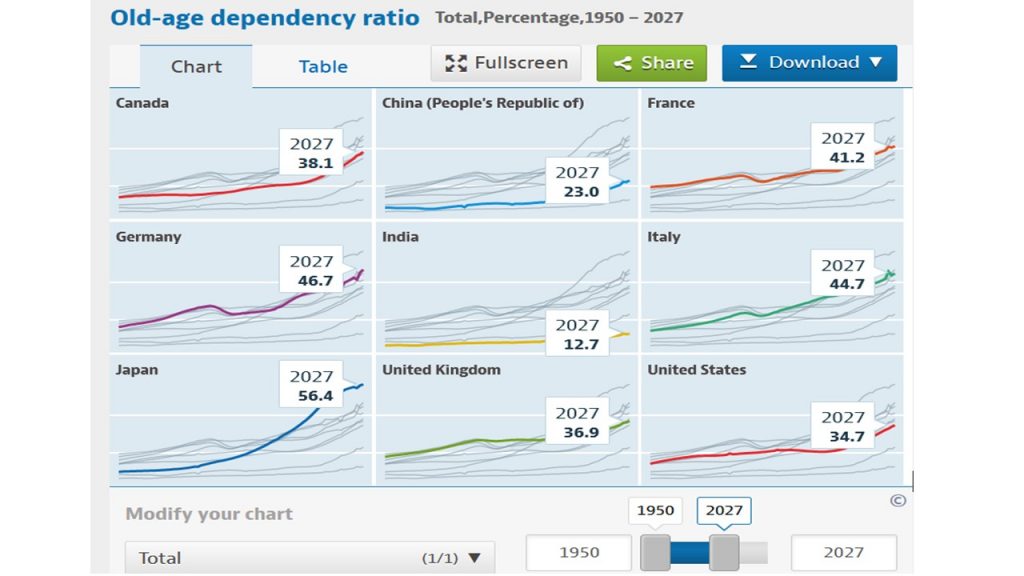
Several countries face an aging challenge now and in the near future. The OECD provides some basic data, figures and projections. All data to calculate the aging challenge are more subject to change than they used to. The Covid-19 rise in mortality rates has implications as the number of premature deaths of the elderly (65+) has risen even in the economically advanced countries. The so-called old-age dependency ratio is a widely used indicator to assess the charge or pressure on the working-age population (20 to 64) to finance those in retirement (65+). demographic ratio is defined as the number of individuals aged 65 and over per 100 people of working age defined as those at ages.
Major factors that have an impact on the ratio are mortality and fertility rates as well as migration, but also participation rates in employment for those younger than 20 or older than 65 years of age. Seminal shifts in participation of women in the labour force contribute also to reduce the old-age dependency ratio. An influx of about 1 million of refugees who have immediately a work permit like Ukrainians in Germany have a substantial impact as well. Life expectancy is expected to rise again after the years of reduction due to Covid-19. In 2024 and 2027 these ratios do not move too much. Extending the time horizon to 2050, when people born in 1985 would start to retire shows more reason for concern. Whereas in 2024 France, Germany and Italy are still fairly close to each other (2.4 percentage points), the gap starts to widen as of 2027 (5.5 percentage points). In 2050 Italy is projected to have an old-age dependency ratio of 74.4%, about 20 percentage points higher than France.
Okay, in the long-run we are all dead, says an economist joke, but changes to increase fertility or allowing more migrants in are not in sight for Italy. Therefore, the urge to react is increasing there. Younger generations might not be able or willing to foot the bill of high pension expenditure in Italy. Compared to Italy or even Japan the pressure on France is much less pressing, contrary to the national government’s opinion and policy initiatives to increase retirement age without parliamentary majority.
Source for projections and figures: OECD (2023), Old-age dependency ratio (indicator). doi: 10.1787/e0255c98-en (Accessed on 04 October 2023).
Avoidable Mortality

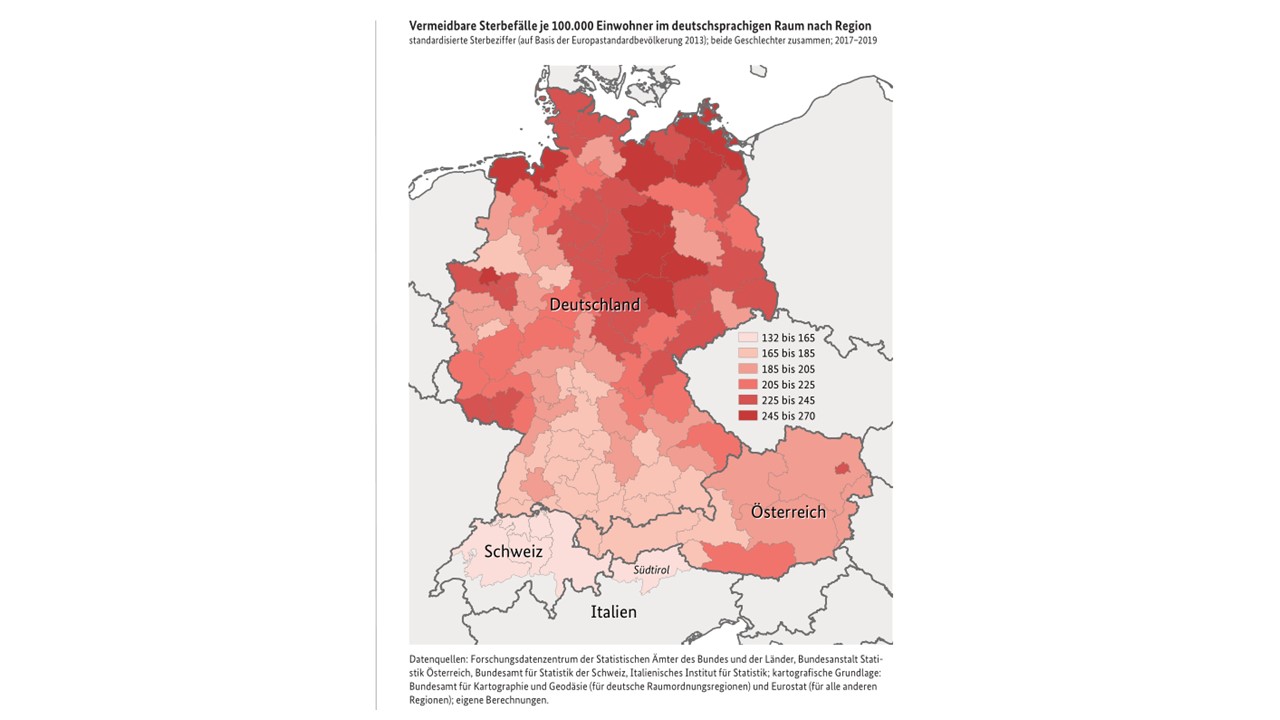
Mortality in many instances is avoidable. Estimates Mühlichen et al. (2023) for Germany are as high as 19% of all deaths in the years 2017 to 2019. For men the figure is as high as 24%, for women “only” 13%. The scientific interest in the concept of avoidable death originates in the interest to indirectly gauge the efficiency of health systems. In order to do this the authors estimated cause-deleted life tables in a fine graded regional fashion. Avoidable deaths are defined as deaths that occur before the age of 75 and are either classified as medically preventable or preventable through a different life style. The study applies a quasi-experimental design in comparing German speaking regions within Europe. This allows to measure the influence of health care systems on a general level within Germany, Austria, Switzerland and South Tirol in Italy. The study corrects for different age structures in these regions. For Germany avoidable deaths are substantially higher in the North than in the South. Additionally Eastern parts of Germany have higher avoidable deaths. Even the best performing regions in Germany have higher rates of avoidable mortality than Switzerland.
The differential to other countries health systems is worth a concern, because the expenditure in the German health system per 1000 population are among the highest in Europe (OECD 2021). Despite the high expenditure per head, avoidable mortality remains particularly high for German men and in the North and East of Germany. Lack of prevention of unhealthy life styles is most likely the decisive factor to explain the disappointing results. There might be another “unaccounted” risk factor that originates in the lack of sufficient preventative health care and environmental risks during the young age of the regional populations. 33 years of unification and a cut-off age of 75 mean that in East Germany the oldest people lived through 40 years of high pollution coal as primary heating system.  Similar to Northern and Western Germany little concern and careless use of risky fertilizers might drive higher mortality decades after exposure. Life style patterns might additionally contribute, but are harder to assess in comparison. Research to clarify these differentials are just at the beginning. A valid conclusion remains: prevention is key, but it has many facets.

Nations Fail

Ever since Adam Smith wrote on the “Wealth of Nations” the topic concerns social scientists. The discourse around the wealth of nations has become even more fundamental these days. Beyond wealth calculated in economic terms we are convinced to add well-being of the population as well as the state of the environment into the accounting procedures like national accounts. But wait a second. Similar to the term wealth we have to widen our perspective in what is considered to be a nation. Shifting borders through wars (Russia aggression on Ukraine) or separatist tendencies of regions, (re-)unification of Germany or Korea (eventually) show that the nation is a concept in flux. Considering migrants from former colonies still as having residential rights in the colonising country shows, there is more to nations than a one size fits all nation concept.
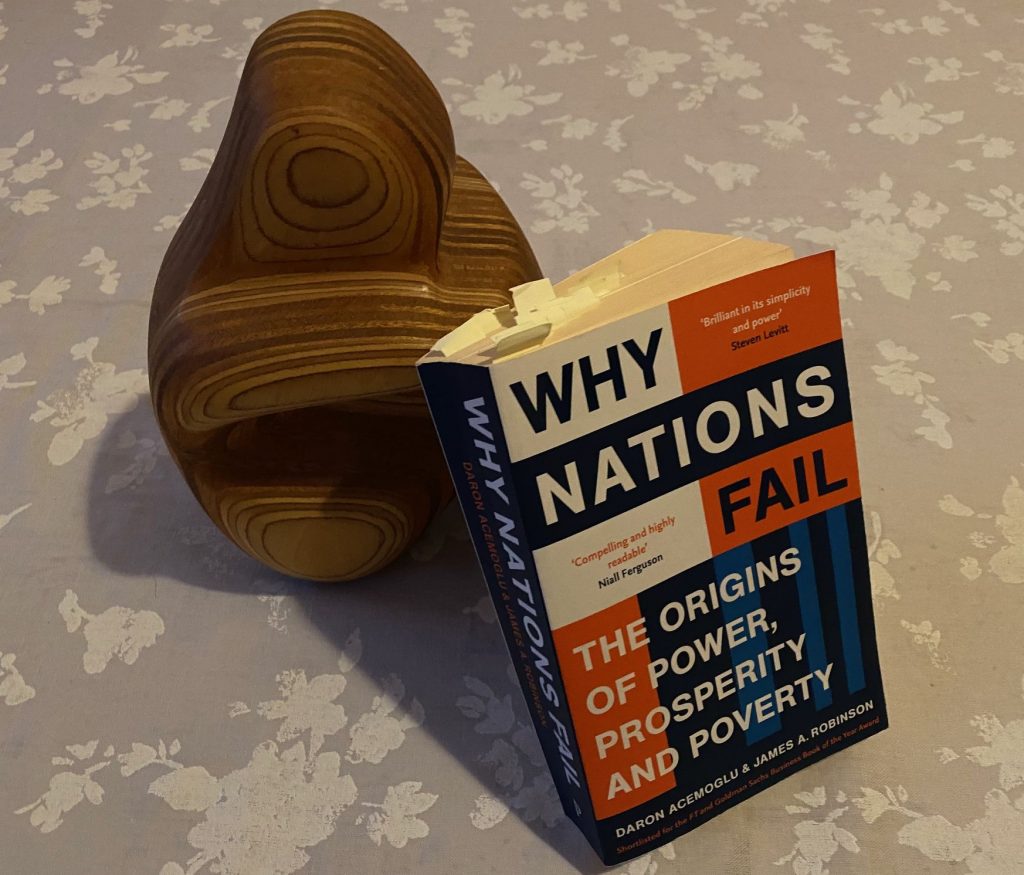
Daron Acemoglu and James A. Robinson had published the book on “Why nations fail. The origins of power, prosperity and poverty” already in 2012. On the 3rd of October Germany celebrates its re-unification only because the Russian dominated German Democratic Republic (and the other Eastern European satellite states under Russian control) can be considered as a failed state. These Russian dominated states crushed private initiatives and build corrupt systems where party allegiance and hierarchical structures were overemphasised. Following Acemoglu and Robinson (chapter 10) the lack of diffusion of prosperity is likely to be the root cause. Even similar to the French revolution, which brought about tough measures of redistribution, the external threats to the post-revolution France demanded subscription of masses into armies to defend the young republic against aristocratic rulers in the surroundings. If monarchy in France is a failed state, the post-revolution France survives due to high identification with the republican idea. The Soviet dominated Ukraine is a failed state, but the Ukraine of today resists due to its willingness to defend its own republican ideals. To get virtuous circles of development started, inclusiveness across the board is necessary. Leave nobody behind, seems to be a shortcut summary. It is much easier said than done. Loosing younger generations in the sense that they no longer subscribe or feel part of an inclusive wealth of the nation is a highly dangerous path. Failed states have a history in failed inclusive social and economic practices. Democracies are at risks just as much as authoritarian nations. However, democracies have better institutional settings to address the lack of inclusion and in multiple ways.
When I celebrate the 3rd of October in the Federal Republic of Germany I celebrate (1) the accomplished failure of the GDR, its undemocratically elected elites, corrupt institutions and the failure of the thousands of willing collaborators of the Russia-backed regime; (2) the peaceful resistance movement, (3) the relatively short-lived humanitarian focus of the Russian leadership at the time to not send in the tanks and (4) the willingness of the FRG to support 20 million new citizens for many years to come (5) the allies of the FRG to accept the potential security threat of a strengthened Federal Republic of Germany, which might entail a shift in the balance of power in Europe.
And yet, even in 2023 we pose questions on what is the concept of failure, when authoritarian regime can still survive for sooo long and some still accomplish extensions. We keep questioning the sense of the term “nation” in modern times and across the globe. Too many wars are still fought in the name of a “nation” even if only a handful of military-supported leaders and single autocrats try to impose wars in the name of some rather vague or plainly mistaken claim of nationhood.
On the 3rd of October we celebrate that “nations can fail” opening a path into a more prosperous and inclusive society. Some nations fail, just because they were no nation in the first place. The GDR was such an artefact of international compromise as part of the overall “balance of power” and the Cold War. The result of this process gives so much hope to other divided nations (Korea) or nations under authoritarian oppressive rule.

Marathon Prep

Most people, including many sociologists, believe preparation for a marathon is a rather lonely exercise. During hot summers you get up early and run alone across the streets in your neighbourhood or in a green area. Even on weekends you tend to put on your running gear at least once to chip in a few extra miles or once or twice before the marathon a longer distance test run of 20, 25 or 30 kilometers. Just for the sake of testing to withstand more pain, like in the real event. Running guides in form of books, apps reach “cult status”. In sociology we teach students about the social trends of individualisation ever since the book by Putnam “Bowling alone”, which depicted the new kind of lonesome person going alone to the bowling hall for exercise, as social life seems to evolve towards “individualised” leisure time and social life. Social capital seems to get lost on the way.
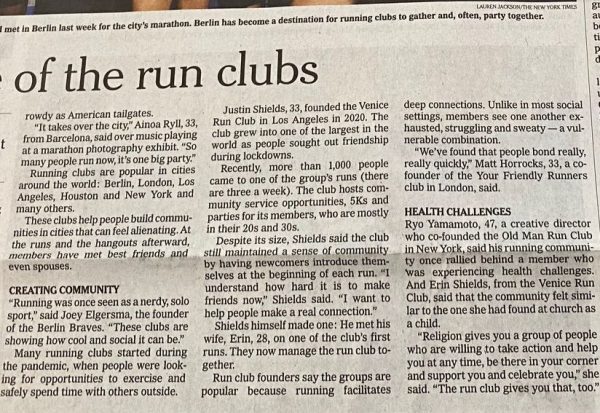
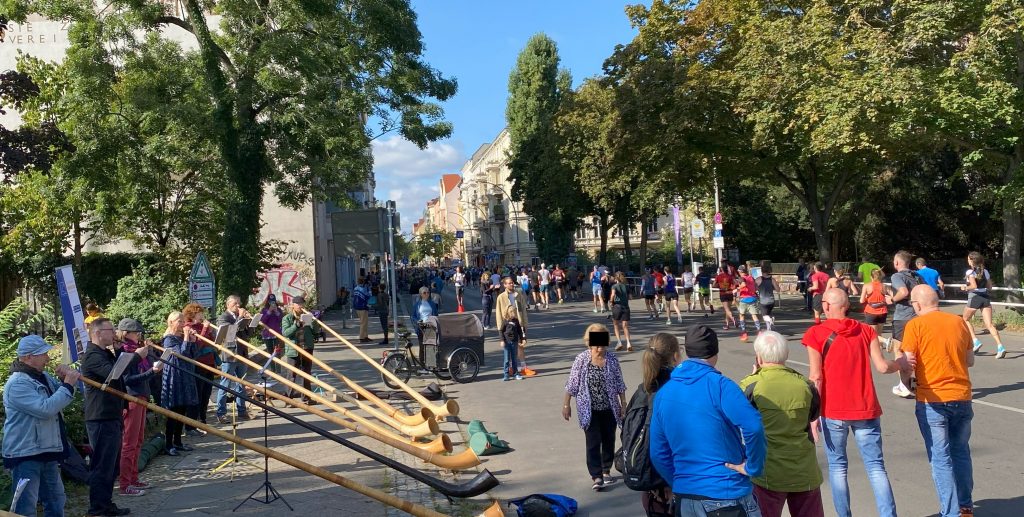
“The New York Times International” published an article and photo by Lauren Jackson on September, 27 (2023) page 17 in the sports section, which states the not so new phenomenon of “run clubs” (see extract on image below). These clubs bring runners from all walks of life together on a regular basis to train jointly and add a social function to the club as well. Just like previous sport clubs or socialising bowling groups did before, they meet and greet as well as party and celebrate together. Even travelling thousands of miles to distant events occurs in groups. Berlin seems to be a very attractive location for such clubs to go to. For some the sport stays in front of the activities, but for quite a few the social and party-like atmosphere is just as important. Even a local Berlin newspaper portrayed an older runner who stops in-between to have a small glass of alcohol-free beer on a terrace 2 steps from the official track with friends and family. Most people take their time record rather seriously, but the event is to enjoy community and celebration. Lauren Jackson even equates this to some forms of religious practice. I’s rather call this the other side of the same coin. Lone practice and meditation like running prepares a person to enjoy community (again). Extremes in both directions are part of the bell-shaped probability distribution of runners across the lonely-crowded spectrum of running experiences. The Marathon 42km 195m certainly has some historical even mystical connotation. While watching the finishing line at 42 km, just after the hypothetical run from Marathon to Athens in ancient Greece, you see many worn out persons, but also the many happy faces. After the run you meet your peers to exchange on stories and anecdotes around the track. Success and failure, just as in other team sports become a topic of conversation and shared experiences. These are community building events as wheel chairs and hand-driven bikes are part of the Berlin event as well as the in-line skaters the day before. In Berlin you get a feeling that running world records (women 2023, men 2022) can go hand in hand with the running fun for many. From “bowling alone” to “running together”. Sounds good to me.

Marathon Berlin2023

Berlin celebrates its 49th Marathon in September 2023. The first Berlin Marathon in 1974 had less than 300 participants. To separate this from Olympic games, these runs were coined “Volks-marathon” at the time. 5 events had already taken place in New York when these annual events started to catch on in Berlin. In 2023 there are close to 50.000 participants mostly drawn from a lottery of about 500.000 entries. So, you can call yourself one of the lucky few, if you manage to get a place. The event is a drain, but it creates a fantastic hype not only for the runners. The many cheers and bands along the running track transform the inner city into a huge party zone. The Berlin marathon is known around the world for its fast track. In 2023 Berlin is proud to be the city where both the women and men’s world record are held currently at the same time. This is quite an achievement.
Personally, I enjoy more the courage, stamina and will power all the participants gear up to. Months, if not years of preparation find their climax in getting to the starting line in the “Tiergarten”, just where you had (have) the “Love Parades” some weeks before. The finishing line is 300 meters away, once you have passed the “Bandenburger Tor”. From a public health perspective, we applaud the encouragement such events give to all those that have an active life style and to some to get started on such a trajectory. The media coverage is enormous and with all sponsorships, equipment, hotels, meals and travelling involved such events have become big business, too. No such event and going to health limits is without risk. This is, of course, also the case in Berlin. The emotions run high for almost all, except for a few, who go too far beyond their limits.
The medical assessments of exhaustive endurance sports are an ongoing research issue. A recent literature review reveals that there are quite substantial numbers of previous smokers or persons with previously unhealthy life styles participating in popular marathons. Running, probably, has been part of overcoming bad habits of the past. It is therefore, not surprising to find that some of the participants are at a risk of wanting to run too much or too fast for their current state of health. The hypnotising effect of music and stimulation from being part of a huge crowd, contribute to the effect to go beyond limits. Cardiovascular events or brain lesions are, therefore, part of the ex-post risks of participants who have had specific medical check-ups. Know your limits, train them wisely, but respect that limits exist. This seems to be a reasonable summary based on sports medical research. Berlin 42km finishing line2023

Luftschloss

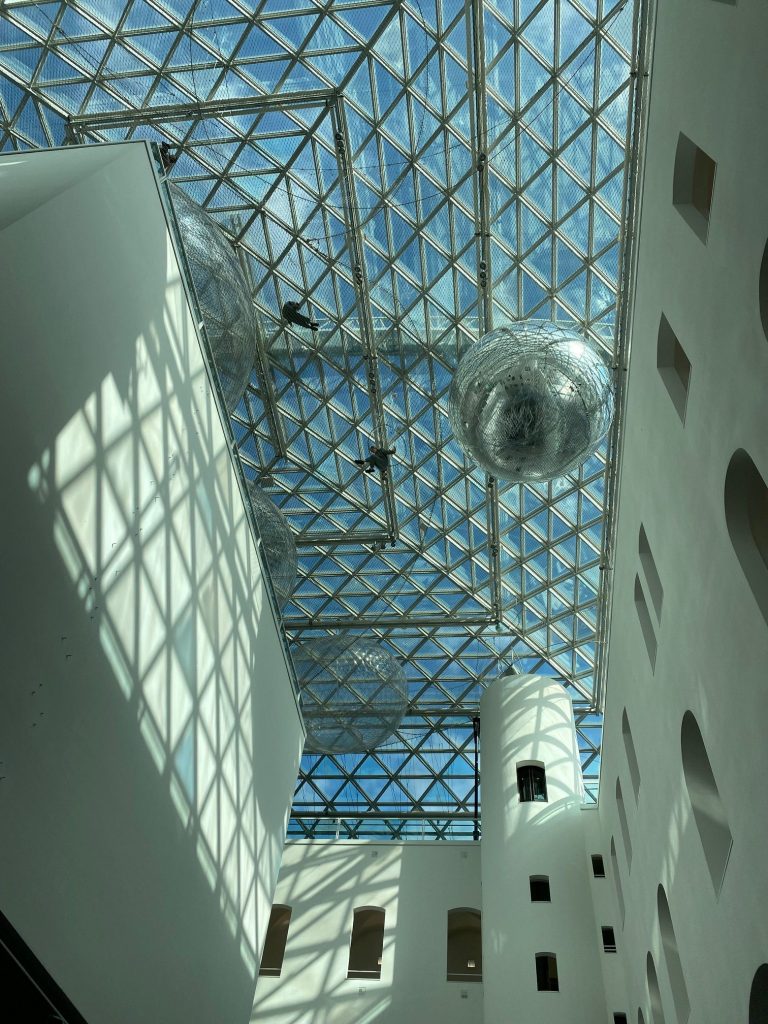
Im K21 der Kunstsammlung Nordrhein-Westfalen ist ein Luftschloss eingebaut worden. Es ist das einzige mir bekannte Luftschloss, das für alle Besuchenden begehbar und fühlbar ist. In wahrhaft luftiger Höhe von 25+ Metern über der Eingangshalle der Kunsthalle K21 und zentral unter der gläsernen Dachkuppel platziert, lässt sich mal so richtig abhängen. Nahezu schwebend kann die weiträumige Installation von Tomás Saraceno erklommen werden. Die Schritte und wippenden Bewegungen der anderen BesucherInnen lassen sich unvermittelt ebenfalls erspüren. Du bist nicht allein, im originären Sinne des Wortes. Die buchstäbliche Vernetzung mit allen anderen Personen werden durch Schwingungen des Netzes zu anderen Kletternden oder Chillenden übertragen. Eine unmittelbar erlebbare Erfahrung der Verbundenheit mit unbekannten, anderen Menschen stellt sich ein. Die Verbundenheit innerhalb einer Gesellschaft wird eindringlich verdeutlicht. Die Angst, durch die Höhe verursacht, weicht rasch der freudigen Erfahrung der Schwebung und der kindlichen Erfahrung der Suspension. Nahezu freischwebend in der Luft, im Orbit erlebt jede/r sein eigenes Luftschloss inmitten von transparenten Kugeln, die wie Planeten wirken. Gleichsam real, aber dennoch imaginär durchwandern wir die Installation immer im Bewusstsein, dass andere um uns sind, die unsere Schritte, Möglichkeiten und Haltungen mit beeinflussen. Vom Luftschloss träumen oder im Luftschloss träumen, beides ist dort machbar.
CO2 freundlich lässt sich die Erfahrung in der APP Aerocene fortsetzen. Der für unser Wetter so bedeutsame Jetstream wird zur imaginären Flugerfahrung genutzt und mit recht aktuellen Daten gespeist. Die Verbindung zu „Earth and Space Sciences“ ermöglicht die Einbettung der sozialen Erfahrung in einen noch weiteren Kontext.
Die eigenen 4 Wände sind die Grenze. Das galt schon früher nicht. Weit darüber hinaus lassen sich neue Möglichkeiten erschließen, die nicht umweltbelastend sind. Selbst die Reichstagskuppel in Berlin sehe ich plötzlich mit ganz anderen Augen. Mehr als Möglichkeitsraum, statt der traurigen Vergangenheit und der zerstrittenen Gegenwart. Was wäre die Kunst, wenn sie nicht zum Träumen anregen würde.

Generationswechsel

In den öffentlichen Bibliotheken ist ein Generationswechsel der Besuchenden überfällig. Traditionell finden sich 4 unterschiedliche Gruppen von Personen in den öffentlichen Bibliotheken wieder. Da sind (1) die bildungsaffinen Rentenempfangenden, (2) die Eltern mit Kleinkind(ern), (3) Wärme- oder Kühle suchende Menschen der Umgebung und (4) die Schul-, Hochschul- oder Examensvorbereitenden. Soziologisch betrachtet ist das ein interessantes Aufeinandertreffen von gesellschaftlichen Randgruppen.
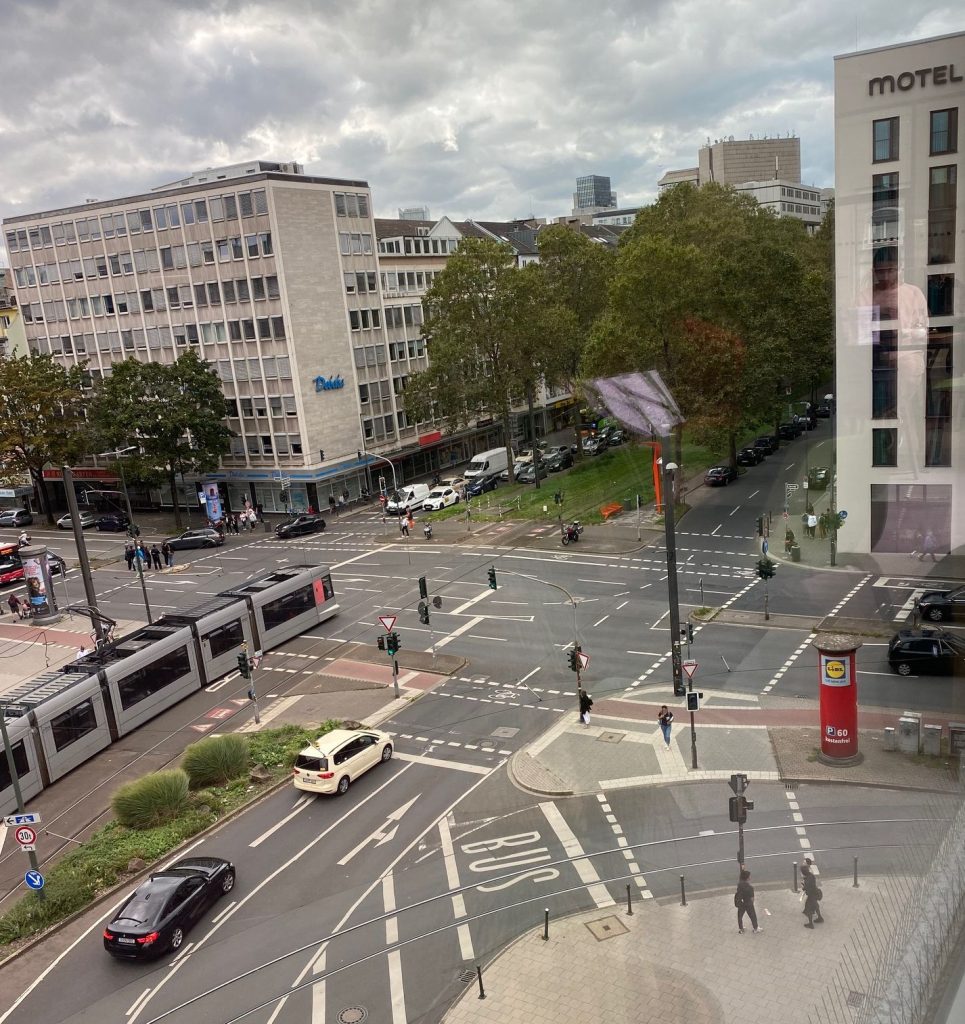
Die „Neue Zentralbibliothek im KAP1“ (Düsseldorf) hat aus diesen meist unverbunden nebeneinander operierenden Gruppen eine kommunikative Gemeinschaft produziert. Aktion und Interaktion ist nun angesagt. Der Flyer betont richtungsweisend: „Menschen, Bücher, Räume“. Fortan soll der Mensch und seine Lernfähigkeit im Vordergrund stehen, nicht mehr nur die Bücher. Dazu braucht es meistens anders oder umgestaltete Räume. Lernen war immer schon interaktiv und nur in Teilen allein im stillen Kämmerlein. Dazu braucht es Labs als Lernräume und nicht nur die Stille der „Page-turner“. Lernboxen, Lernstudio, Musikstudio sowie eine „Kreativschmiede“. Dort wird heute gepodcasted, 3D gedruckt und es werden social-media Kanäle entworfen und betrieben, immer schön generationsübergreifend. Voneinander Lernen ist das Motto nicht mehr nur nebeneinander und im Wettbewerb um die beste Bewertung. Kollaboration und gesellschaftlicher Zusammenhalt brauchen neue Räume, dem KAP1 in der Düsseldorfer Zentralbibliothek ist dabei schon viel gelungen. Die zentrale innenstädtische Lage ganz nah am Hauptbahnhof ist ein zusätzliches Asset. Ansonsten hätte ich mich wohl nicht auf der Durchreise dorthin verlaufen. Ein Random-Walk in Bahnhofsnähe, verursacht durch verpasste Verbindungen der Bahn, hat zu einer unerwarteten, bereichernden Zwischenpause geführt. Der Ausblick aus dem Café auf das übliche innerstädtische Verkehrschaos konnte umgeben von Alt und Jung richtig genossen werden.

Li-Be

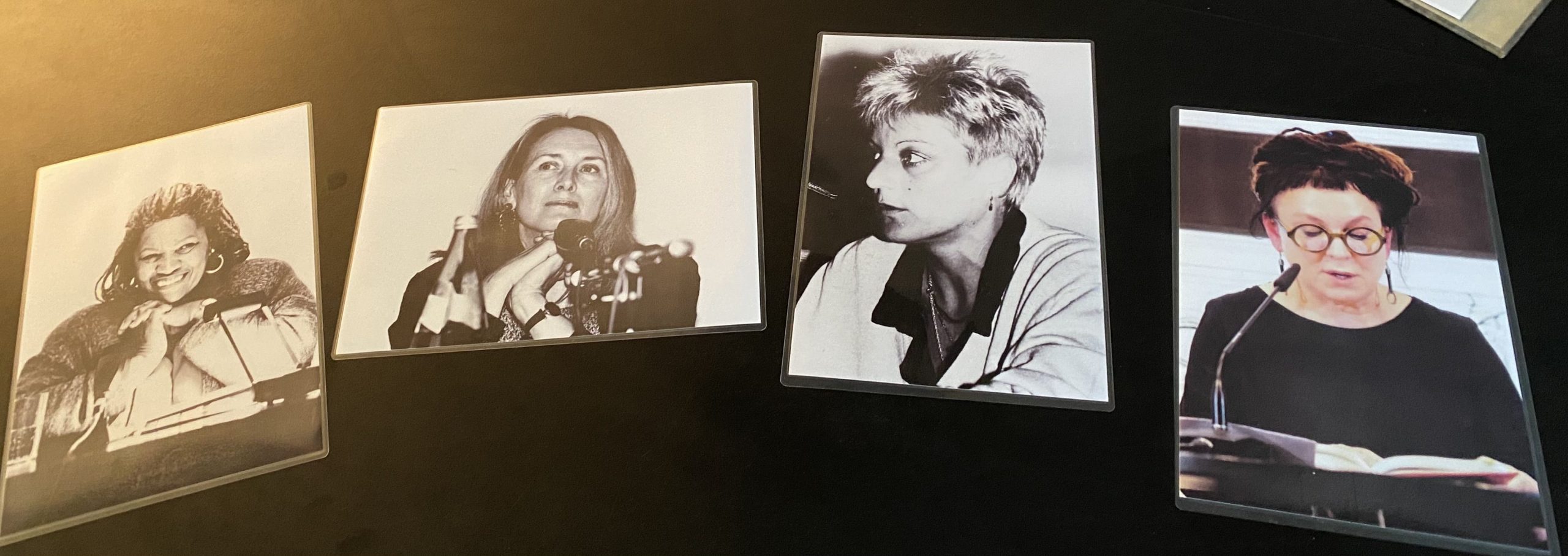
Jede/r hat so seine Assoziationen mit Li_be. Für eine kleine Gruppe von Literaturbegeisterten steht Li-Be seit langem für das Literaturhaus Berlin. Das war nun ebenfalls, anlässlich des Tag des Offenen Denkmals, im September 2023, als solches zu besichtigen. Zentral am Ku’damm plaziert, in der benachbarten Fasanenstraße, liegt diese geschichtsträchtige Villa in mitten eines kleinen Gartens. Trotz wechselvoller Geschichte konnte die Villa als Ganzes erhalten werden, nachdem der Denkmalschutz Veränderungen untersagt hatte. Das Haus der Li-Be hat wirklich alles gesehen, was Leute sich unter Liebe so vorstellen und wahrscheinlich noch einiges mehr. Nach den familiären Nutzungen der Gründerzeit, wurde in den wilden 20er Jahren dort ein russischer und ein arabischer Studentenclub eingerichtet in Verbindung mit der Humboldt-Stiftung, die sich auch heute noch um den wissenschaftlichen Austausch bemüht. Das Rote Kreuz hatte eine erfolgreiche Suppenküche dort in der unmittelbaren Nachkriegszeit betrieben. In den 60er Jahren war es ein Nachtlokal, aber auch einige Jahre ein Studio für modernen Tanz von Manja Chmiél, einer Schülerin von Mary Wigman. Die heutige Nutzung hat weiterhin viel mit Liebe zu tun. Lesungen und Workshops laden laufend ein, sich mit Literatur zu befassen. Der Zeit angemessen finden sich in den Archiven des Literaturhauses zahlreiche Prominente AutorInnen, die Lesungen dort abgehalten haben. Starke Frauen bildeten dabei seit den Anfängen als Literaturhaus einen Schwerpunkt. Nobelpreisträgerinnen gehören zu den Vorleserinnen seit geraumer Zeit. Annie Ernaud und Herta Müller traten schon lange vor den Nobelpreisen dort auf. Toni Morrison und Olga Tokarczuk im  Jahr der Preisverleihung oder kurz danach. Ein wahrlich toller Ort und dennoch keineswegs mit BesucherInnen überlaufen. Es bleibt eben so eine Sache mit der Liebe, auch im Li-Be.

Write, write, write

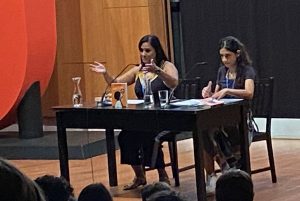
A poster announcing the “internationales literaturfestival berlin 2023” prints in big letters: “Read, read, read, … 14 times”. This is a quote from Werner Herzog when he was asked what makes a good filmmaker. The message from Manjeet Mann to the young audience at Berlin added to this: “write, write, write”. At least this was my impression as a summary of the talk and her short readings from her novel in verse “The crossing”.
The lecture hall of the “Stabi” was packed with students from high-school who felt at ease with the English language presentation and talk. The host Shiva Mesgarian managed to get the crowd of students to ask questions in the huge lecture theatre. Manjeet was giving a lot of insights into writing, editing, motivation and the difficulty to give a voice to persons from marginalized backgrounds. In her case as a person of colour herself, born and raised in England with additional links to India, she took issue with the topic of refugees. Living in Folkestone (Kent), she is confronted with people crossing the Channel on a daily basis.
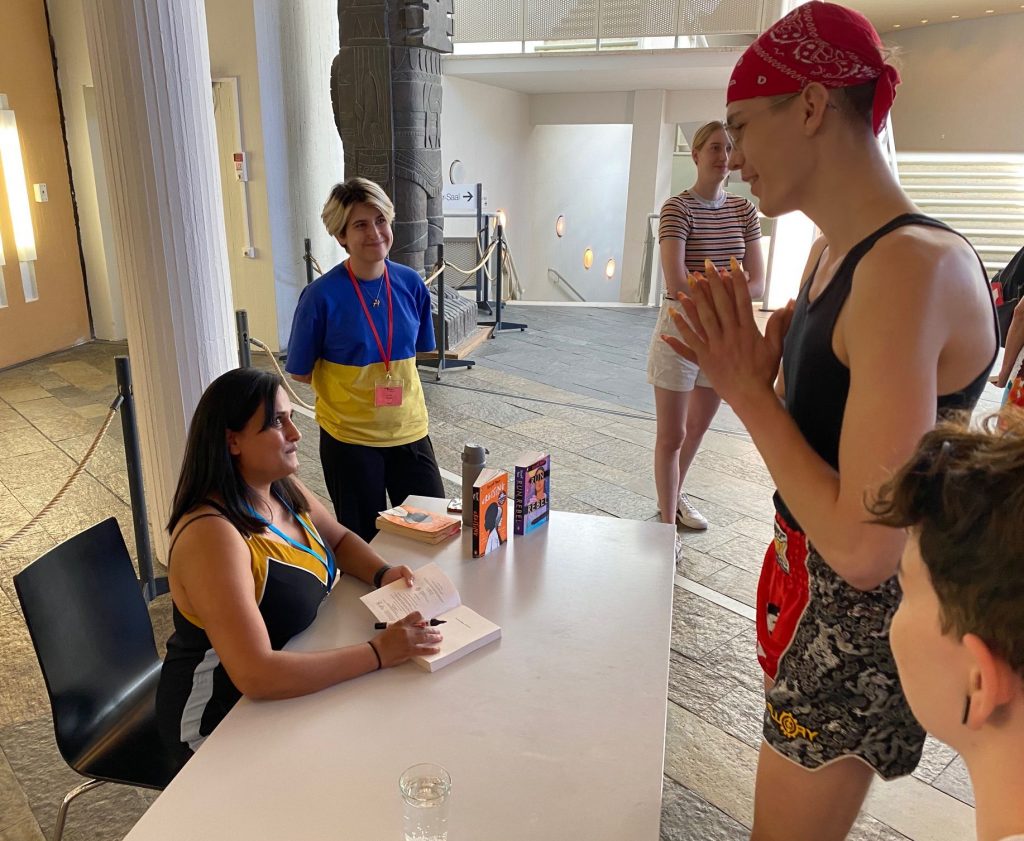
Her book “The crossing” is actually building bridges between countries and continents. Her entertaining way to talk about her hard work as writer motivates, inspires and encourages young persons to pick up their pencil and/or notebook to start writing. Just don’t stop. Journaling helps. Take your emotions of an issue seriously, then work on it. Give characters a voice who have not received much attention. Go out and interview persons to get authentic input.
It is not about appropriation of a story. It is about meeting and exchanging with marginalised persons. Return your written pieces to those “sensitive readers”, whose story you attempt to develop. All this takes time. Re-writing is an important element as well. “Having written the story for yourself, you then re-write it for the readers”. Edit, clarify, sharpen, blur, attend to detail – all this helps the reader to follow and enjoy. These were the messages to all the students who were grateful for advice as the new season of essay writing in school, university and beyond is about to start.

Energy Food

For more than a decade now researchers have shown the link between energy prices and food prices. At first sight this might seem surprising. In traditional or romantic associations with growing food, there is no link between the cost of energy and food production. Growing crops in your garden does not need more than sunlight, soil and water. Yes, that was long ago. Industrial production of food is heavily relying on energy to heat, feed and water plants or animals. Additionally, the supply chains have become far more distant, which increases the CO2 footprint even further. Therefore, it is no longer surprising that a great number of econometric studies confirm the close link of energy prices and subsequent pressure on food prices. This is not restricted to Europe, but has reached global contamination.
Enjoying seasonal local food is a double catch solution. You grow according to local weather conditions and use traditional conservation methods, if the crop is exceeding your demand at that time. Providing heating for animals to increase productivity or quality of products appears to be one of the most wasteful ways to further increase the spiralling up of energy and food prices.
In agricultural science there is a lot of research into the “energy intake” of animals to better grow or produce more milk etc. This is the expensive intermediary step using energy to produce energy intake for animals rather than humans. It is surprising that we take so many years to address these well-known linkages that have turned to serious problems after Russia’s war on Ukraine. Agriculture and farmers can be part of the solution rather than a problem themselves, if the link of energy consumption and food prices is taken seriously.