
Celebrating democracy in Germany is rare. We take it for granted that democracy persists, as most of us have not experienced it otherwise in Germany. This is grossly mistaken as the opinion polls show repeatedly in recent years. Therefore, it is welcome to find the “Portable Grundgesetz” at the “Demokratiefest” in Berlin and Bonn at the event to celebrate 75 years of democracy in West Germany and 35 years in East Germany.
 The century-old tradition to produce miniature books has been revived and the miniature books have been widely distributed at the event. A side effect consists in the eco-friendliness of this version, which saves a lot of paper. It is fun also fun to turn pages rapidly and discover some paragraphs which we would not have read otherwise. “Daumenkino” is the German word for versions that contain many images. Maybe next time, an illustrated and/or animated version of the Grundgesetz could encourage youth to celebrate using the texts, §s and images to discover the fundamentals of our constitution.
 325 years ago, Weigel the Elder has illustrated, edited and published such a tiny edition of the Bible. It is currently exposed in the treasure museum at the “Kulturwerk” in the “Stabi Ost” in Berlin. “Back to the Future”, lots of ideas we get by taking archives seriously. By chance inspiration is undervalued. Search algorithms have a hard time to replace this in an effective way so far.
Democracy celebrates
With all the bad experiences of Nazi-Germany and the failure to defend democracy in Germany against its fascist enemies in the 1930s, it was a pleasure to celebrate democracy in Germany together with a huge crowd. 3 days of information and party around the major institutions of democracy Parliament, government, federal governments, constitutional court and all ministries joining in with pavilions in the parks nearby allowed a bottom up feeling of democracy. Visiting the chancellery as well as the parliament in a single day shows the openness of these institutions and the ease of access to our political system. People of all ages and all walks of life strolled around and enjoyed the day. Freedom to voice your opinion was easy and many took their time to do it. Civil society organizations were a natural part of the show. We seem prepared to stand up for our democratic values and principles. This will be tested in all the forthcoming elections.

Image History
The archives of the history of movies and/or television show to us the multiple ways how images capture our attention and memories. Visual narratives are an own category of our personal and collective memory. The wide range of visual experiences are a powerful way to influence. Not only the movies and stories matter, but the whole range of images associated with the cinema world. Poster collections, newspapers and today the so-called social media multiply the original images. The Deutsche Kinemathek allows a special, critical understanding of image history as Germany has been using and abusing images and movies in a very manipulating manner historically. The message is: do not take images for face value. The ways and techniques to manipulate images have been widely used and are all around us today. Whereas the mass media in previous decades have dominated the collective memories we have entered into an era with many more subcultures that evolve within their own bubble of images. An original attempt to cut 65 movies of German film history into less than 4 minutes is presented in the exhibition (Milkowski and Simbeni). It focuses on gestures and “les regards”, “Blicke”, how the actresses and actors seem to look at us. Eyes capture attention, and this as soon as we open our eyes as children. Our brain works as image recorder and our memory algorithms tend to favor image recognition while processing images continuously. We do not know much about our own image sorting algorithm or algorithms yet. Research on aging of the brain gives some hints. With declining short term memory the images stored in long term memory take the upper hand. This makes an understanding of the history of images even more important.


Deutsche Kinemathek
Just in the vicinity of the Potsdamer Platz in Berlin you’ll find the Deutsche Kinemathek, the museum movies, actors, actresses, directors and the history of cinema in Germany. There is a small specialized library in the Kinemathek that allows to dive not only into journals and books, but also video material, scenarios and accessories. Of course, you will find a lot of material on all sorts of movie stars (heroines) over more than a hundred years. The “Divas” of the industry take up a large part of the exhibition. “Marlene Dietrich” much more than “Hildegard Knef“, the former born and the latter lived for a long time in Berlin-Schöneberg (Berlin-Pretty-Hill as some locals call it nowadays). The 2 Divas probably caused the funny translation. Anyway, the hall in the Kinemathek which is exclusively devoted to Marlene Dietrich impresses with a lot of glamour and mirrors around.
For those with not only a biographical, but also life course interest in cinema cherish the public access to the library. The most impressive table there is the desk with access to the Ukrainian movies and about cinema in Ukraine. A list with QR-codes allows you to readily approach the recent developments before and during the Russian aggression on Ukraine (See image below). After all Potsdamer Platz in Berlin was a hot-spot of the cold war period in the divided Berlin. A little bit of a “Metropolis-atmosphere” can still be felt. The Kinemathek explains well what this is all about. 
Camparing Covid-19
In the middle of May 2024 we tend to believe the Covid-19 pandemic is over. However, towards the beginning of the year 2024 in the U.S. we observed at the peak about 2500 deaths per week.  In Germany deaths/week amounted to 250. Compared to the overall population size killing is more pervasive in the U.S. than in Germany. The map of the specialized agency “Centers for Disease Control and Prevention” (CDC) in the U.S. shows the coastal regions to be more affected than the center. Population density seems to be still a driver of the spread of infections, illness and deaths. The timeline of deaths due to Covid-19 infections for Germany follows a broadly similar pattern, albeit on a lower level even if roughly accounting for population size (RKI-data). As we tend to forget what the pandemic caused as social and economic disaster in societies, we have to stay alert as the major prevention of Covid-19. Learn to live with the virus around us. This means to keep up our preventive levels of hygiene as well as monitoring of trends.
Many thanks to all those who do the sometimes boring number crunching for us. This includes the medical doctors who bother to do the timely reporting of new infectious diseases on a regular basis.

Barbie Chemical
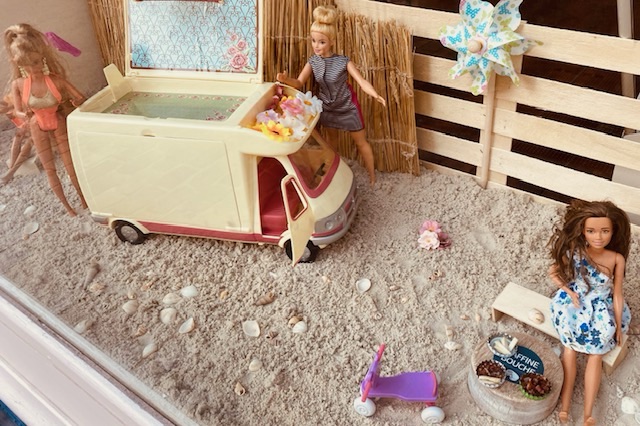
Chemistry is sometimes perceived to be uninteresting, but only until you realize it might be beneficial to know more about some underlying chemical processes. The Royal Society of Chemistry has finally found a topic in chemistry to give chemistry a popular push. The Barbie hype is far from over as we all learned in the recent past. Now conservationists have found a topic with chemical processes involved to demonstrate the usefulness of chemistry knowledge for the conservation of your treasures or collections of plastic dolls or puppets in general. Most plastics PVC was not intended to last, but the deteriorated forms have a long lasting effect in form of PVAS or microplastics. So aging research has reached popular concerns like the aging of Barbie, who is believed to be “forever young”.
Photos Exhibit
Our usual expectation of an exhibition of photography is to look at photos at a wall. Sometimes there is more it. The Exhibition Space at the “Haus am Kleistpark” features Michael Schäfer who attempts to go a bit beyond these traditional forms. In the works of photo cubes on water surfaces “2021_57”, or a dice floating on the waves of oceans, the video representation of his photographs takes the assembled images beyond their flat 2D surface. However, the 2D representation is at the origin, then transformed into a 3D dice, which then is animated as a 4D format. Moving beyond the flat screen image takes photography into the 21st century.
His work “Les acteurs 1-26” from 2007 is shown at the entry hall of the exhibition. It shows pupils of a class at an elite school who deem themselves in leadership roles in the near future. Is it acting? Is it projection into a future role they are likely to take on. They represent stereotypes, of course, but some are pretty convincing in these roles already. Some others still seem to reflect on what they are doing there. Even acting these roles, they are aware of the meaning of social rank and class in society. Without having read the sociologist Bourdieu, all are aware of the fine, little elements of distinction as they have evolved over time. We could teach an interesting sociology class in this exhibition. 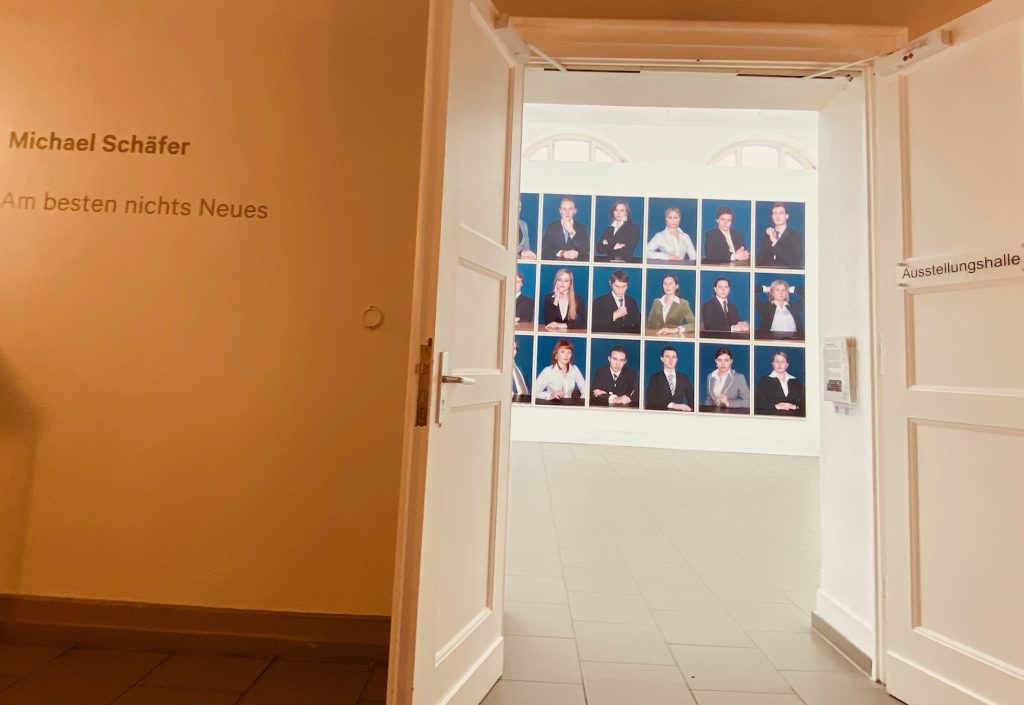
Science Politics
We tend to believe that science is independent of politics. Even if the individual scientist does research and studies free of immediate political influences, there are many ways in which politics has an impact on science. Sociologists refer to Max Weber as a prominent figure in the “Werturteilsstreit” that claimed the need for science to be conducted beyond political interference. Karl Popper is another reference in this respect who proposed the positive science approach which starts from theory, hypotheses and testing in the sense of identifying false statements, hypotheses and underlying theories. Modern science is also linked to publications of results. This has become an industry of its own and it is sometimes quite surprising to see the lengthy delays that scientific results get published. One example, Jackie G. Schneider and Julia Macdonald (2024) had to wait 3 years until their paper finally appeared in print in a scientific journal. This paper was received by the Journal in February 2021 and published only in 2024 in the 2nd issue of the journal but online in January 2023! Reports in Nature on difficulties of Indian, African and Chinese scientists to get their work done and published are alarming as well. Further regionalization and departmentalization work against the fundamental principles of independent science and scientists. It is a big issue of international cooperation as well.
Find Trust
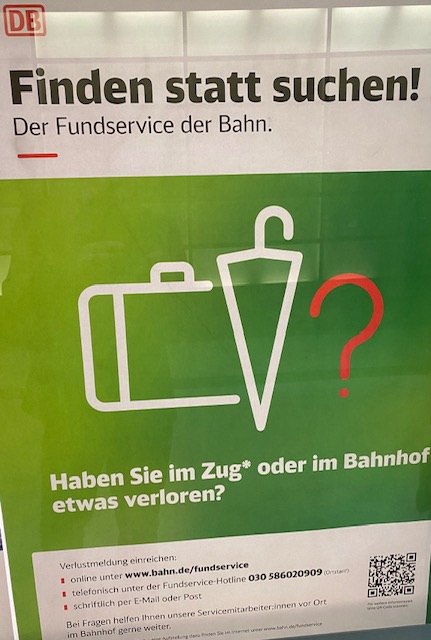
Societies have different levels of trust. Trust in politicians or political institutions has been researched a lot. Another example of trust is related to things lost and found. Losing an item on a train or a mobile phone somewhere are severe tests of the level of trust in a society. How likely is it that the item is going to be found and returned to you. We usually estimate the probability of the return of items as being rather low. The more we are surprised to find out that there are thousands of items found and returned. The Deutsche Bahn has a special service in operation to take care of lost items. Additionally, there are auctions of items found but nobody claimed the ownership of it in the following months. Not giving up on a lost item is the first step to find it again. It would be a nice test whether in high trust societies it is more likely to find something lost. If you have a higher trust that items will be returned you are also more likely to make the effort to claim the item back.
Family Kafka
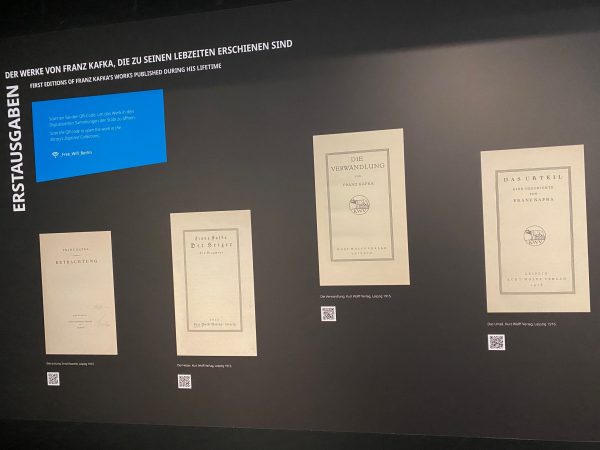
100 years after Franz Kafka’s death nearly all facets of his life and writings have been analyzed. The archives of the editor Wagenbach and the publishing house have now opened an exhibition at the “Stabi Ost” in Berlin adding a family picture book description of Kafka’s life (Curator Hans-Gerd Koch). This is of interest because Kafka himself had written an extensive letter to his father (Brief an den Vater) in which he tries to understand his intricate relationship with his father and other family members.
Nowadays, some people would try to analyze Kafka’s life through the parapsychological technique of family constellations. The far-reaching and pan-European family networks of the Kafka (father) and Löwy (mother) families were more than just an excellent source of inspiration. 2 younger brothers died in their first year. 3 younger sisters followed more traditional evolutionary patterns within families. The television series on Kafka’s life add to the understanding of his sources of inspiration and “parallel worlds” he created and lived in. The exceptional “fictionalization” of his own life and existence in the spirit of André Breton’s surrealism remains a milestone in the history of literature.
Kafka himself thought he was not really “instagrammable”at the time, but his image has reached and still reaches millions of people (Link to Picture archive). He himself would probably have defended the thesis that the most powerful images are within us. … and they are hard to escape from.
(Image from Exposition in Staatsbibliothek Berlin 2024-4, QR-code links to reading in originals!)