Master AI

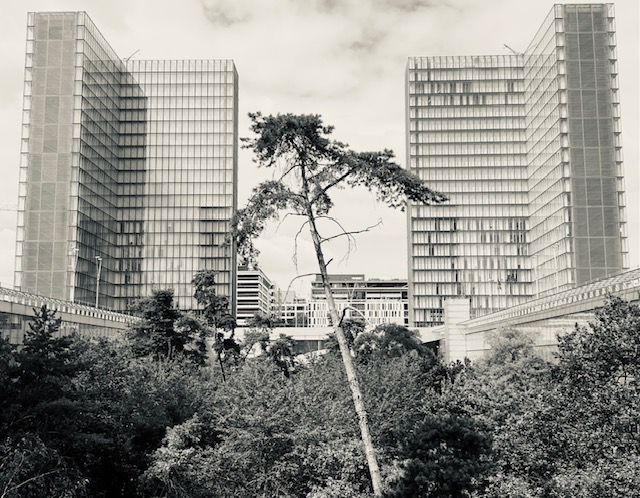
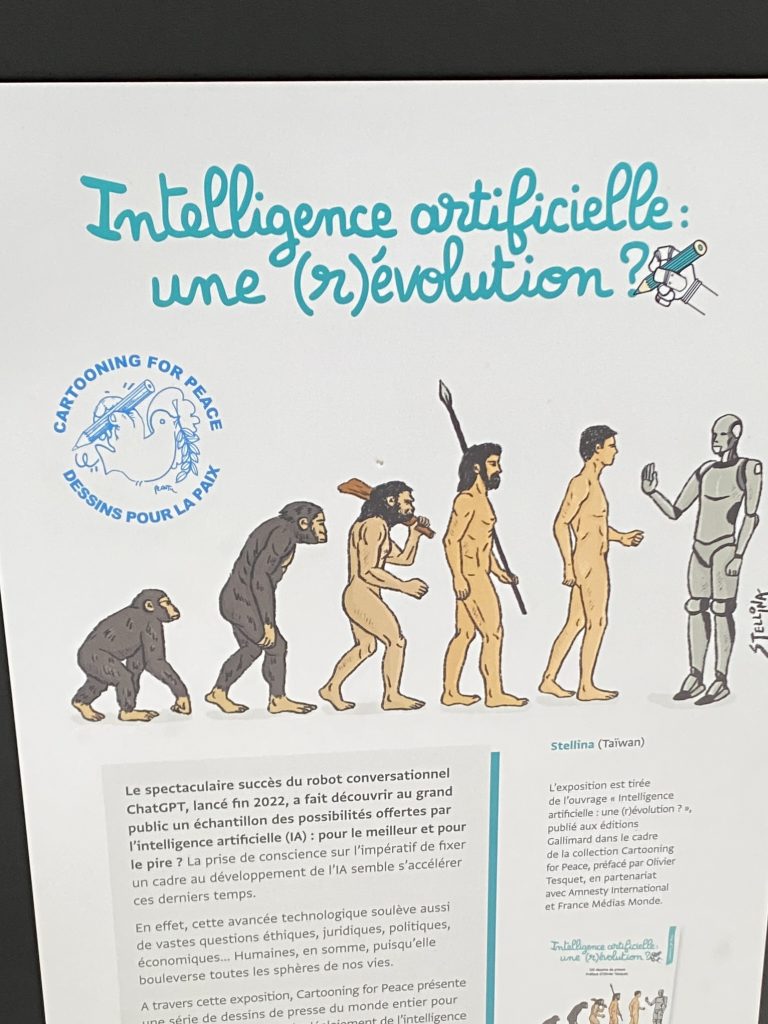
In 2025 the exhibition “Cartooning for Peace” at the BNF in Paris had already an exhibit authored by Stellina Chen from Taiwan, which summarized the evolution and projected the consequences of an all encompassing AI revolution (Image below taken at exhibition 2025 BNF). Currently we exercise ourselves in using various forms of AI or learn how to program them ourselves. It is our aim to master the new technology so it becomes a helpful tool. However, there are already many instances where it is no longer us mastering AI, but the AI has turned around the table and has started to master us. The applications of AI have entered our work tasks, tries and frequently succeeds in improvements of our routines and processes.
In private life a similar revolution is happening, when AI offers advice, which is hard not to follow and very convincing most of the time. Since getting involved in a conversion with AI tests your logic and debating competences, we find ourselves more and more in situations where AI is telling us what to do in the best of a convincing manner. After centuries of humanity to find freedom from oppression and the freedom to what we want ourselves, we seem to be ready to hand over control to AI. We are just like toddlers in this respect, willing or obliged to follow our master.
Disaster tourism

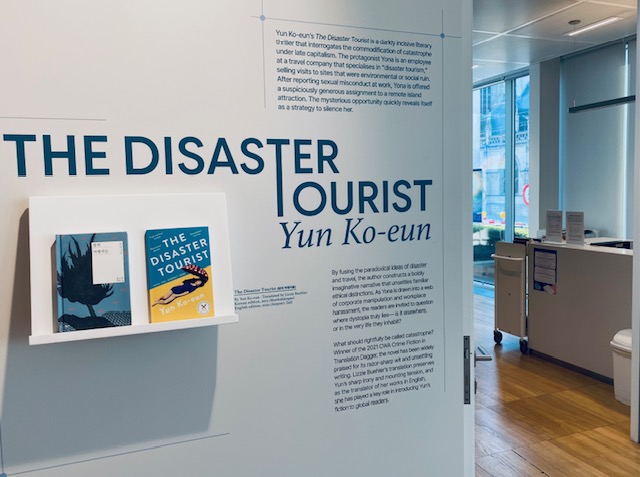
My personal background gave me lots of personal experience with almost annual next to a small river bed. Since I left the region for studies, the flooding has increased and several times have reached the scale of disasters. Therefore, I am very sensitive and have mixed feeling to the issue of disaster tourism. Such tourism is a nuisance at the time of the disaster, but cash through tourism helps the hard hit region and residents to overcome the losses faster. Would I travel to Tschernobyl or Fukushima for that reason? Probably not, but the intentional war disasters and crimes caused by Nazi-terror.  The Korean novelist Yun Ko-eun did not shun away from writing about a guide who takes tourists to places of environmental disasters until being sent involuntarily to such a site herself. This is not about the “K-Chicken belt”, a series of places with famous chicken dishes, nor about the potential consequences of repeated K-pop events of the famous BTS-boy group in Seoul in 2026. So glad to see that Korean youth has a chance to thrive under democratic rule. (Image: Exhibition in Korean cultural center Brussels 2026-3) 

Quantum battery

The first prototype of a Quantum battery has been successfully tested. The Commonwealth Scientific and Industrial Research Organisation CSIRO with corresponding author James Q. Quach published the paper on the “quantum battery tuned for strong light–matter coupling” (Kieran Hymas et al. 2026) open access. Although there have been close to 20 papers on the theory behind quantum charging already, the demonstration as a proof of concept (in business terminology) has been missing so far. The superextensive charging with photons builds upon “a laser pump pulse with bandwidth ~31 nm and resonant with the LP branch induces excitations in the quantum battery” (Kieran Hymas et al. 2026 p.3). Since batteries need not only be charged, but also discharged in a safe and fast way, the prototype demonstrated also this additional functionality.
This is a huge step towards the feasibility of the “All electric society” as the efficient storage which includes fast charging and discharging beyond storage have been a bottleneck in the wider adoption of the “All electric society”.
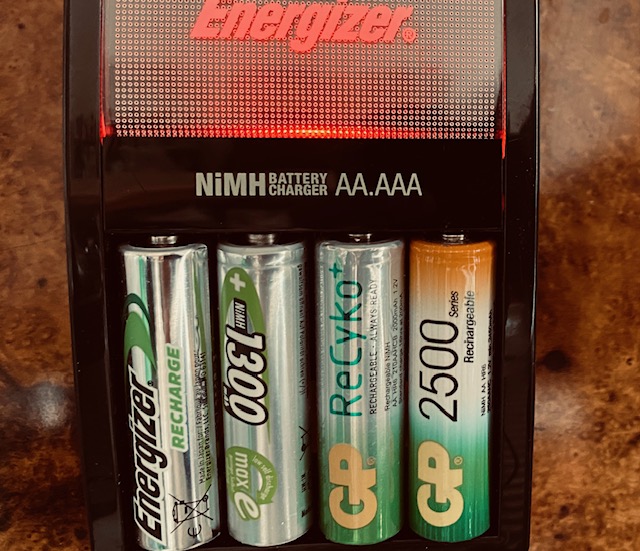
(Image: old fashioned NiMH battery charging at home)

Super fast spin

For all players of table tennis, tennis, pocket billards or football, the secrets of achieving a fast spin on the ball is interesting. The bouncing of a ball changes inherent with the speed of the spin.
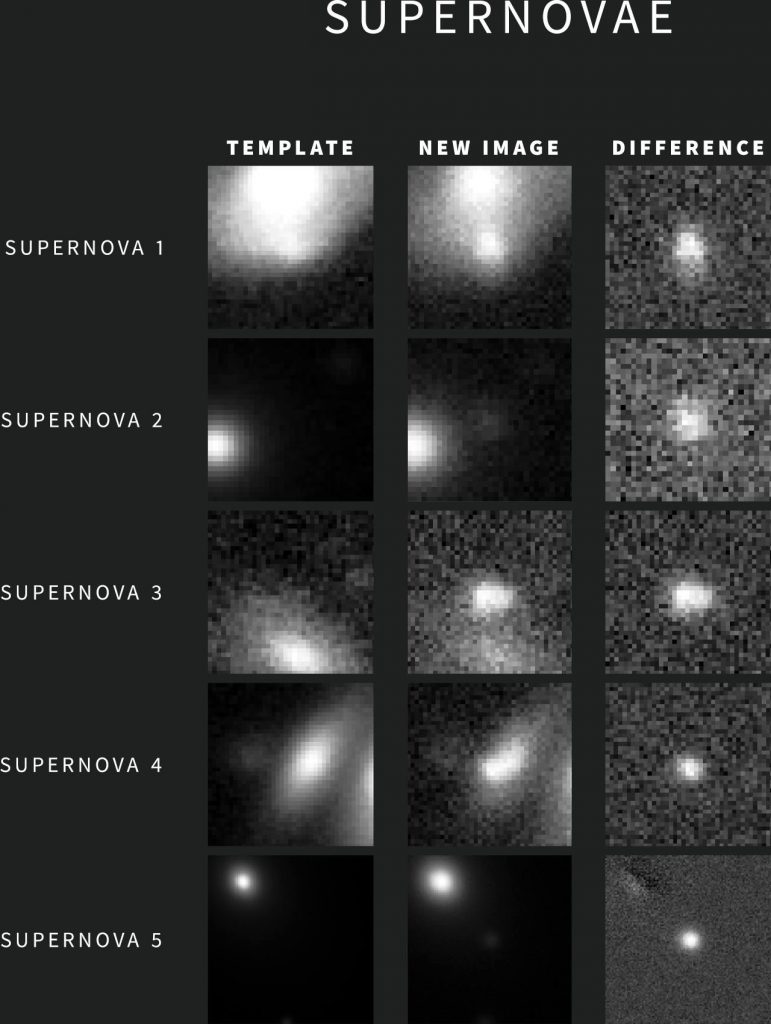
The maths and physics of such movements are well understood, the empirical phenomenon of super fast spin still draws large audiences. The earth is typically spinning about once every 24 hours, hardly noticeable for us living on it. Seen from space this changes already and it makes for marvellous views on the blue planet. The NSF Vera C. Rubin project has made available the first few images of super fast spinning asteroids. The 2025 MN 45 asteroid is such a fast spinning one. The asteroid has a rotation period of about 2 minutes only, with a size of about 700 meters as diameter.
Collisions with such a super fast spinning asteroid, made out of very hard material as otherwise it would have disintegrated already, is likely to cause substantial damage in space. It is not threatening us, but satellites or rockets on their way to planet Mars in space would certainly be knocked out due to any collision. For the time being, we may just admire the splendid images of space, spins and the occasional collisions. (Image: Link to source NSF Vera Rubin 2026, NSF-DOE Vera C. Rubin Observatory/NOIRLab/SLAC/AURA)

Rockets concept

Goddard’s rocket science concept had a hard time to get finally accepted. As early as 1926-3-16 he achieved a 2 seconds lasting propulsion of a rocket with an innovative liquid fuel concept. The combination of liquid fuels like gasoline (later hydrogen) with liquid oxygen allowed rockets to achieve longer distances with equal weight. Eventually, such rocket fuel would allow more control than relying on any other form of a combustion chamber. Rocket science celebrates 100 years of existence with spectacular successes as well as failures. The collection of scientific papers on the subject by the AIAA is a passionate reminder of how tough and lengthy scientific progress in fact is. Beyond rocket science we might ask the question what are we actually looking for up there or wherever the rocket might end up eventually. It is probably fair enough to say that we don’t always know in advance. This is keeping an open mind to technological innovation, but only if such technology is developed for the benefit of humanity rather than with an obsession to dominate others. The end phase of the 2nd world war told us such a lesson. It should be remembered at the same time as remembering 100 years of rocket science. 

Bob the AI-enhanced builder

Most kids today and GenZ youth have come across the TV-series “Bob the builder”. Baby boomer parents have been worried about the work ethos which might be the hidden agenda of the videos. In 2026 we can now draft a new episode called “Bob the AI-builder”. Many episodes could be re-written when Bob and his team have access and get training with AI toolboxes. The study published by ActivTrak (2026-3-11) reports that companies make on average use of 7+ different AI-tools, up from 2 in 2023. This constitutes a hint that complexity at work is increasing as each tool has to be managed and the boundaries of its use need to be respected. As most search engines offer an AI-short cut to search it is not surprising that now 80% of the workforce use some form of AI in 2026. The productivity increases in quantitative terms as more output can be achieved in the same time or slightly shorter work days. However, workload is moved even more to weekends now.
The upcoming challenge through AI-tools is the reduced “the AI users’ focus time”, which suffered 9% compared to non-users. For Bob the AI-enhanced builder this means “AI is being used as an additional productivity layer, not a substitute for existing work”. The overall workload is not reduced by AI. The intensity of work increased between 2023-2025.
There is still a puzzle in the data. Multitasking (+12%) and collaboration (+34%) both increased, but the duration of an average focused session and focus efficiency dropped. The challenges for employees increase. Handling simultaneous processes and keeping an open mind to collaboration are key competences for Bob the AI-enhanced builder.
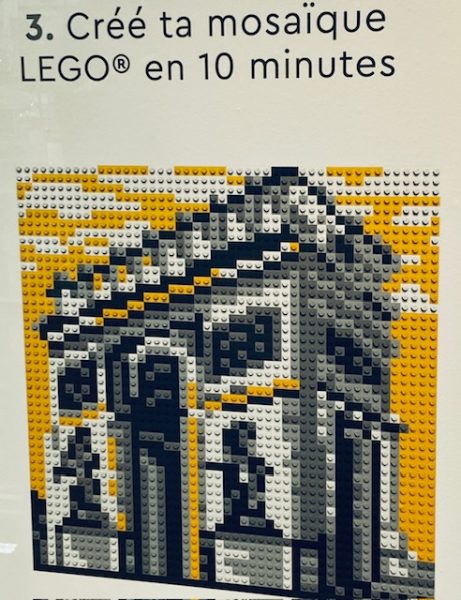
(Image: LEGO-shop in Paris 2026-2)

Trust or not to trust

… that is the question. The social science research on trust, distrust or corruption is expanding rapidly. As in some other fields of research the increase in research itself becomes an issue of trust in science as the uncontrolled use of AI has produced an inflation of pseudo-scientific papers as well (Link). However, the finding by Spadaro et al. (2020) that interpersonal trust (trusting beliefs and behavior) is influenced by a general feeling of security as well as trust in institutions is supported by experimental and interview-based research.
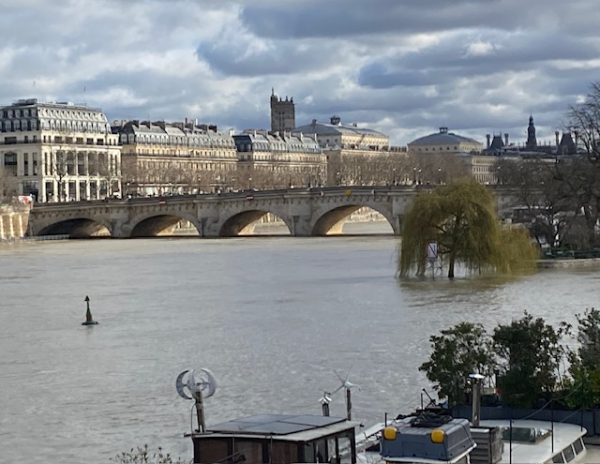
There are still many challenges to the research in this field. The “feeling of security” has an overall component, but also several subcategories like the objective or subjective feeling of job security, which is dependent on national and collective systems of employment protection legislation. Economic security or security of a sufficient retirement income might be at times considered more important than (in-)security in cities or the countryside. Differences of the mechanisms by gender and age have to be studied in detail as well, which necessitates large data collections on the issues. Churches that used to be considered as trustworthy institutions or the police forces have been accused of abuses of the high trust placed in them in the last few years. These 2 examples demonstrate that trust itself is a dynamic issue with ups and downs over time, rarely constant over time. Game theoretical considerations add further to the view that trust might be used as a strategy just like economic power. (Image: Cathedrale de Meaux) 

Defense strategies

Technological developments of drones, aircrafts, rockets and satellites take a lot of time. In order to produce not only prototypes, but ready-to-use weapons, it needs advanced engineering competencies and capacities as well. The arrival of hypersonic rockets, that fly at the speed of 5 Mach necessitate a rethinking of defense strategies to be able to react in ever shorter time spells to external threats. The European Defence Fund intends to spend almost 3 billion € over 7 years to prepare our defense strategies in the EU for the next generation of lethal weapons.
On 2026-3-4 the Iran-regime made use of such a fast rocket, but it was possible to intercept its flight just in time by NATO-allies. Yes, unfortunately “rocket science” is back on the research agenda. In fact, this research has been ongoing across the world, just a bit more below the public radar.
Missions to the moon or mars have been intensified in recent years. This is not surprising or spectacular fact. For some it is surprising, that the number of countries (for example India) which are active in rocket science is increasing and spreading further across the globe. The multipolarity of the international political arena seems more evident in 2026-3.

Interconnected multipolarity

In a very long-term anthropological perspective on the balance of power on the globe, the period that mankind lived on this globe has been characterised by an unconnected multipolarity. People lived in their more or less isolated communities before the Egyptian, Roman, Chinese, Australian, African or Japanese empires and people of the world became connected through new means of transport and communication networks.
In the 21st century the world wide web has broad us closer together and suddenly we realize that unipolarity or bipolarity might be options again through the unipolar dominance in airspace and radio frequencies. Even if unconnected multipolarity has been by far the longest period of mankind, the new developments in international politics resemble more a world of interconnected multipolarity than an American dominated unipolar or bipolar world of the Cold War period until the collapse of the Soviet Union. Stephen Walt (2026) and Raja Mohan (2026) discuss the concept of multipolarity in the same issue of Foreign Affairs (Vol. 105 Nr.2). Whereas Walt emphasises the USA as a “predatory hegemon”, Mohan describes the USA as being tempted and actually currently going it alone in international politics.
The current military image of world politics seems to be dominated by unipolarity again, maybe just before the longer run realities of economic, demographic, financial, trade and productivity developments, already reflected already in such data, take the upper hand again. The spectrum of the unipolar, bipolar, multipolar world privots around multipolarity in the long run, even if bipolar or unipolar intermezzi are part of the historical evolution.
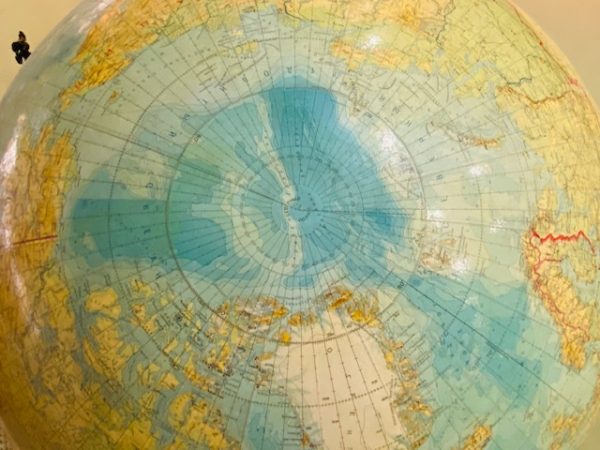
(Image: view of Obzorno-geografceskij globus, Moskau 1994, Stabi Berlin 2026-1)

Holistic public health

Based on case study in Queensland Australia, Boocock et al. (2026) propose the wider application of holistic public health laws. Due to effects of global warming the local burden of disease may rise due to larger scale floods and subsequent growth of for example mosquito populations that transmit infectious diseases. It will be necessary for societies to understand the processes behind the growth of mosquito populations and what can be done to prevent and protect oneself from the consequences. This is not only an environmental issue, but also an issue of continuous learning across all strata of society. Neighborhoods tend to suffer the same impact of chemicals used or the spreading of diseases like Dengue or malaria. The case study makes a convincing argument about the intrinsic relationship between the social and environmental processes at work.