
Memory Struggle

The struggle of memory is also the memory of a struggle. The exhibition in the Palais Populaire in Berlin doesn’t leave spectators untouched. It is a struggle to recover memories which were attempted to be eradicated. This is the univeral message of this exhibition. The colonial past and crimes are part of the struggles of artists from these cultures to re-establish their rights to their own views, traditions and memories. Grass and plants may cover the shelled soil and people, but traces or mortars are often left behind. Light from different angles needs to be shed on these places to reveal the shadows of the wounds. The atrocities and exploitation linked to colonialism and imperialism keeps us struggling with those memories. Just before we jump to the conclusion that it is a memory of a past struggle, we are reminded that consequences are still haunting the present and with the Russian aggression in Ukraine we have to realize the fight against imperialism continues in the 21st century. Thanks for memorable moments and impressions in view of a global arts and history experience. (Image of art work installation by Sammy Boloji, untitled 2018, exhibition Palais Populaire, Deutsche Bank foundation)
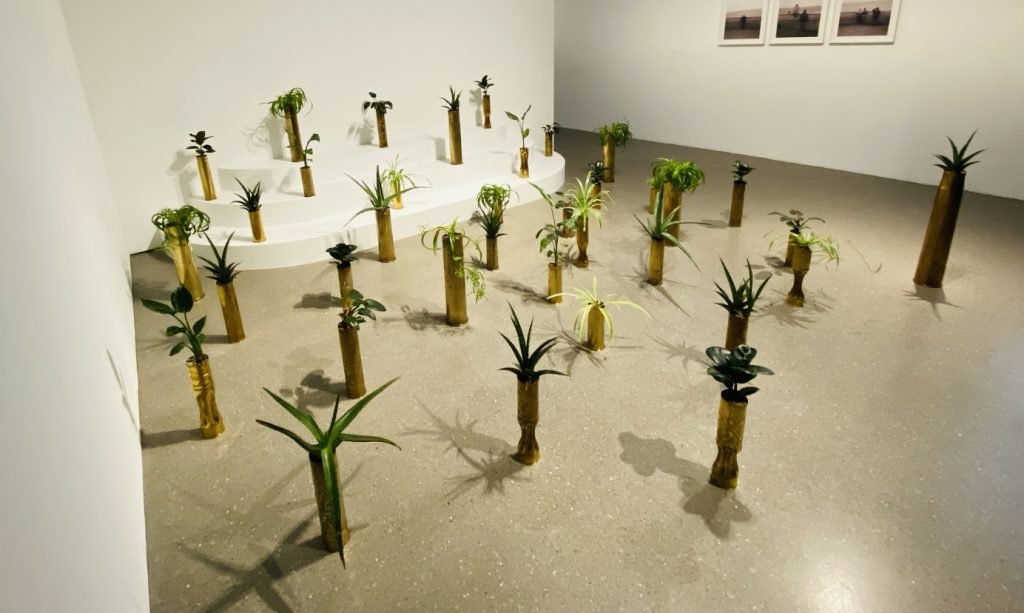

Sammy Boloji, untitled 2018 exhibition Berlin 2024

AI or I

Generative AI receives a lot of attention. One of the main issues is, to study how AI interacts with humans. The hiring decision by managers or an AI algorithm is an interesting application. According to Marie-Pierre Dargnies et al. (2022) the preference for human decisions remains strong despite reasonably unbiased performance of an algorithm. The main issue is with the transparency of the algorithmic decision-making. As a worker or as a hiring manager the preferences continue to sit with the person rather than the AI. It is a worrying outcome, however, that if the rule of gender equality is removed from the algorithm both workers and managers tend to prefer the algorithmic outcome. I interpret this as a latent preference of study participants for gender bias, which could lead them to expect a more favoured outcome in case the AI makes the decision. Knowing what decision-making rules have gone into the hiring algorithm has an impact on all persons involved.
A new managerial competence is to be able to assess tasks carefully, whether you should perform the task yourself or delegate to AI. In this sense the old question: to do the task yourself or to delegate has simply been enlarged by an additional delegation option. The decision-tree goes from (1) To delegate or not to delegate, and (2) if I want/need to delegate, should I delegate to AI or somebody in person (not allowed to use AI).
I opted to use AI for image creation rather than to take a photo myself or by one from a professional photographer. (Image creation: NEUROFLASH AI – Image-Flash 2024-1-26)

AI and We

Research is beginning to provide empirical evidence and experimental modelling results on the widespread use of generative AI. First results by Doshi and Hauser point at the individual benefits of using artificial intelligence but the widespread use of it is likely to narrow the scope of novel content. This research is particularly interesting because it deals with the micro level to macro level aggregation effects. It is fine for me to use AI. If it becomes a mass phenomenon, we expect in sum a negative outcome for society as a whole.
The example at hand deals with the capability to innovate or to come up with novel content. As more and more texts or newspapers are published with extensive use of genAI, the real element of creation will remain the domain of humans for quite some time.
In my opinion this is due to the difficulties for algorithms to differentiate between the positive and too risky negative aspects of innovative solutions. A query for AI might ask to come up with an innovative solution for auto-mobility of short distances. A human being might propose walking due to the additional health effects the AI might propose helicopter lifts. The not so stupid machine would need a lot of additional information about circumstances to generate useful solutions. Therefore it is not surprising that sometimes public transport apps propose to walk short distances rather than waiting for “delayed or unreliable services“ they provide themselves. Personal circumstances like mobility with children, other dependents or luggage are usually beyond the scope of the information base of the algorithms.
On the other hand, if the AI knows that 50.000 persons after an event want to take public transport at the same time the indication to walk or wait solves an aggregation problem of individual preferences to adapt to available capacities. Lots of issues to solve for AI and us or better yet, us and AI.
(Image creation: AI using Microsoft Dall-E Image creator: Prompt: a person with notebook in profile and in front of 5 other persons in Office with windows 26.1.2024, 8:24 PM)

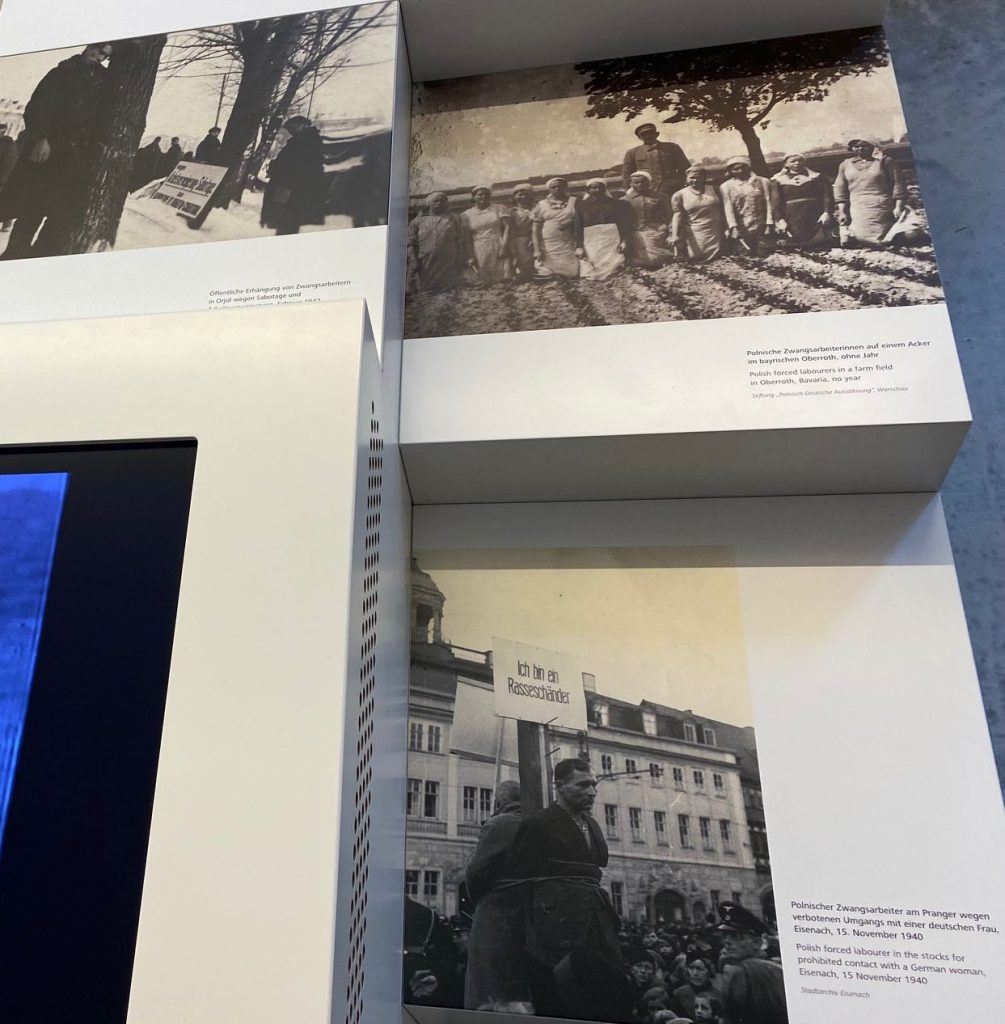
Zwang durch Terror

Durch den Terror der Willkürherrschaft mit rassistischer Doktrin wurde aus Zwangsarbeit eine lebensgefährliche Arbeit. Überzogene Sanktionen bei Diebstahl, Plünderung oder Sabotage wurden von den Nazis mit öffentlichen Hinrichtungen (Erhängen, Gruppenerschießung oder Guillotine) geahndet (siehe Katalog zur Ausstellung Alltag Zwangsarbeit S.44-45). Straflager und Verlegung in Konzentrationslager gehörten ebenfalls zur regelmäßigen Erfahrung.
Die Zwangslage der dort zur Arbeit gezwungenen Menschen ist kaum vorstellbar und fassbar in unserem System der Beschreibung von Arbeit. Totale Subordination kann vielleicht in Ansätzen verdeutlichen wie diese Situation auf die Personen gewirkt haben muss. Fluchtversuche waren fast ausgeschlossen. Selbst die Verbindung zu den meist deutschen Frauen in Fabriken war unter hohe Strafe gestellt und intime Verhältnisse (bezeichnet als Rassenschändung) wurden für beide Seiten lebensbedrohlich oder endeten für die Zwangsarbeiter oft tödlich. Der Terror in dieser Zeit bestand in der kontinuierlichen Gefahr und Angst tatsächlich oder vermeintlich eine Anklage zu erhalten, die unkontrollierbare, weil selbstherrliche, Strafen nach sich ziehen konnte.
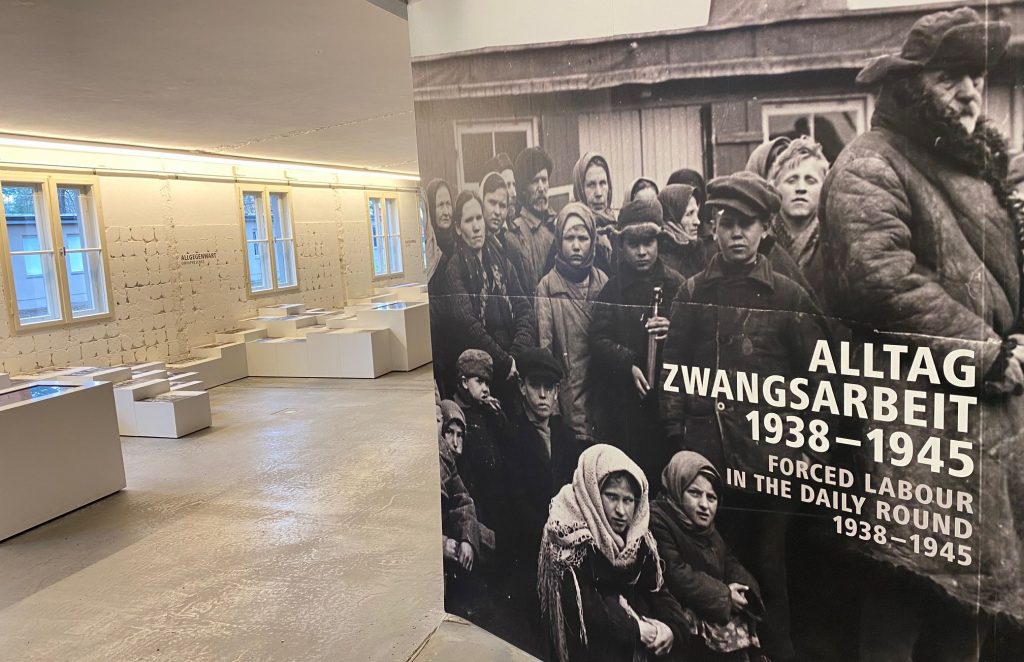
Image: Ausstellung Alltag Zwangsarbeit 2024-1 in Dokumentationszentrum NS-Zwangsarbeit, Berlin Schöneweide. 

Zwangsarbeit

Die Annäherung an das Thema Zwangsarbeit ist nicht einfach. Auch heute prangern wir zu Recht Zwangsarbeit egal wo auf der Welt an. Die mit weitem Abstand grausamste und umfangreichste Durchführung von Zwangsarbeit haben die Nazis in Deutschland und von ihnen besetzten Gebieten vollzogen. Neben den Schrecken der Konzentrationslager mit dem millionenfachen Mord an Menschen jüdischer Abstammung ist die Aufarbeitung der Verbrechen in Zusammenhang mit der Zwangsarbeit lange in den Hintergrund getreten. Selbst die Zeitzeugen wie Francois Cavanna (2020, S. 10-11) vertraten die Ansicht, dass im Vergleich zu den Ermordungen und Kriegsopfern ihre Erfahrungen und Leiden im Zusammenhang mit der Zwangsarbeit in den Hintergrund traten. („… cela me rendit plus modéré dans l’expression de mes souffrances. … nous ne pouvons que fermer notre gueule. Ce que je fais. »).
Neben der systematischen Ermordungsmaschine der Konzentrationslager in der NS-Zeit verdient das millionenfache Leid und die Terrordrohungen und Anwendungen der Nazi gegenüber den ZwangsarbeiterInnen eine angemessene Bedeutung. Das Dokumentationszentrum NS Zwangsarbeit in Berlin Schöneweide bietet dafür eine hervorragende Ausgangsbasis. Die Ausstellung ist für alle Altersgruppen geeignet. Behutsamer Einstieg für Schulklassen ab der 5. Klasse und zum Nachdenken anregend für Erwachsene mit Informations- und Lerninteresse. Das Ausstellungskonzept mit seinen vielfältigen biografischen Materialien von Zeitzeugen erleichtert, neben der Faktenfülle, einen emotionalen Zugang zum Thema. Online lässt sich beispielsweise die Verteilung der Zwangsrekrutierten die Arbeitsdienst leisten mussten je nach Stadtviertel oder sogar Straße verfolgen (Link Datenbank und Map).
Die Löhne für deutsche ArbeiterInnen und Ost-ArbeiterInnen aus den osteuropäischen besetzten Gebieten waren fast zehnmal höher. Die in westlichen Besatzungsgebieten zwangsverpflichteten Personen oder selbst anfänglich mit scheinbar höheren Löhnen als vor Ort (Organisation Todt) üblich angeworbene Personen erfuhren die spätere Abwertung ihrer Entlohnung. Es bleibt die Betonung auf Zwang, Terror und Einschüchterung bei der Zwangsarbeit meistens in menschenunwürdigen Massenbaracken aus industrieller Massenproduktion. Einstieg in die Erfahrung: NS Zwangsarbeit Dokumenteationszentrum.

Shrinkflation

Shrinkflation is a hybrid term that combines “to shrink” with “inflation”. The trick is to keep prices at the same level for a product, but to reduce the weight or amount sold at a constant price. The intention of producers is to indirectly increase prices without touching at price tickets on products. As consumer you are likely to remember the price tag of a product, but much less the unit costs. However, the unit price is the basis for fair comparisons. In supermarkets there is an obligation to print also unit prices (€/kg or €/L) next to price labels. Comparisons allow information irrespective of package size. In shrinkflation the higher unit costs of a product will drive the official measure of inflation (Destatis, 2024). In Germany inflation for food had the top inflation rate in 2023, surpassing even price rises for energy.
On the one hand, shrinkflation is cheating on consumers to sell them less for the same price. On the other hand, oversized products that solicit higher consumption are part of the health and environmental problems we face. The obesity pandemic is part of the XXL consumption hype the food industry and supermarkets have created. In this respect, more expensive food (Eurostat info) potentially may trigger the rethinking of consumption and nutrition. “Eating better instead of less” has always been more expensive.
Besides the profit-maximising logic of shrinkflation, there is at least a small hope that behavioural changes might be triggered to consume less, to use less detergent in washing, less sugar drinks, smaller size pizza and so on. Shrinking our food intake is part of the solution for many problems. In the end cutting out most convenience food will save you a lot of money. As a side effect of such behavioural changes, eventually prices are likely to come down some time later again.

Clausewitz 3

As the Russian aggression in Ukraine continues it is interesting to re-read Clausewitz again. In his major work on strategy in warfare we rediscover lots of strategies that Putin’s army applies in the war against Ukraine. But equally, the successful defence strategy of Ukraine with a sizable difference in the size of the army, they both let us better understand the theoretical considerations and relevance of Clausewitz until today. For example,the overriding importance of the size of an army in comparison to the opponent was discarded by Clausewitz (p.111-112) already. He refers to the battles at Rossbach and Leuthen in the Seven Years’ War 1756-1763. Frederic the Great won 2 battles despite having armies of half the size or even less at his disposal (Tempelhoff). Training and morale of the armies is an important part of the explanation of a later outcome. In terms of strategy Clausewitz mentions surprise and wit in chapters as well. The next 3 chapters are devoted to (in modern words) distribution and mobility of forces in space and across time including additionally a strategic reserve. The “classical warfare” which Clausewitz transforms into a theory of warfare is followed with horrific resemblance by Putin’s Russia in the 21st century. “War is an instrument of politics” writes Clausewitz 200 years ago (p. 467-8).
The painters or theorists that attempted to go beyond this rationale have had a hard time to convince politicians otherwise. The idea that law and courts will replace the atrocious power play of nations is silenced again for some years, only to come back with more force eventually.
(Image Extract from Nationalgalerie and Digital Collection of Gemäldegalerie 2024-1 by Adolphe Menzel “Ansprache Friedrich des Großen an seine Generale vor der Schlacht bei Leuthen 1757) unvollendet.

Ideal City

Ideal City

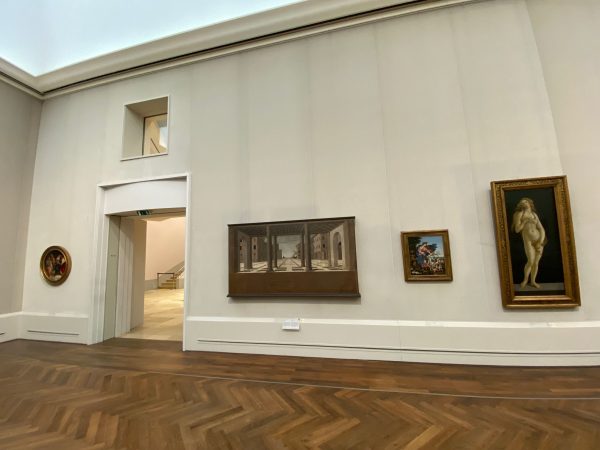
Even beyond humans the issue of what constitutes the ideal city is a matter of historical as well as experimental significance. Science has recently uncovered a city like organization of habitats in the Amazon region (Link Science.org). The organization of the Greek city states has been the model for the development of democratic ideation. The Roman imperialism has thrived through the splendor of its cities and city lifestyle. No surprise that this continues to be a constant concern for humanity.
Rapid urbanization continues in Africa and Asia. Europe also struggles to keep pace with infrastructure development in every growing cities. Whereas the ideal city in the early Italian Renaissance was imagined without trees, we witness a renewed interest to bring back nature-like environments and architecture back into cities. Combining the best of 2 worlds seems possible. Redesigning inner cities remains a continuous challenge. It is much more than thinking about bricks and mortar. It is mostly about how we want to live, work and communicate together. Therefore, it concerns all of us. Paintings help us along in our ideation about where and how we want to live together. The linear views of the Renaissance appear hardly convenient after the experience of the 20th century.
(Image Gemäldegalerie Berlin, 2024-1, Raum XVIII, Ident Nr. 1615 “Ideal city” from ca 1490 attributed to Francesco di Giogio Martini and next to well-known ideal “Venus” painting by Sandro Botticelli 1490).

Benchmarks

The physiological benchmarkS of VOPs (Very Old Person) has been lifted by an Irish athlete recently. The 92 year old person has been examined with state of the art physiological measurements to better demonstrate the training efforts and health outcomes of the VOP. In fact the cardiovascular fitness is comparable to a much younger person without much exercise. In differentiation to a sedentary lifestyle the VOP has a daily 40 minutes rowing routine plus 2-3 times resistance training, meaning weights. 20 years without injury made him indoor rowing champion repeatedly. Physiological benchmarks have been extended due to the surprising late onset of the training only at 73 years of age. Starting late with physical exercise allows to reap enormous benefits as well. For physiological fitness it is not only “use it or lose it” but “use it and extend it”. Almost irrespective of age the novel findings suggest a cardiovascular plasticity that was believed to be impossible. The descriptive account in “The Journal of Applied Physiology” allows no causal inference. Many cardiologists would probably even advise against such high intensity training without careful medical examination before, during and after some months. From a statistical or epidemiological point of view this statistical outlier will likely lead to adjustments of algorithmic potentials of human performance in older age. Handle with care, I would suggest. Working against resistance regularly remains an interesting perspective for an aging person and aging societies.

Flotow CH

Noch 20 Jahre nach seinem Tod wurde Friedrich von Flotow recht prominent aufgeführt. Im Stadt- und Aktien- Theater der Stadt St. Gallen stand seine Oper “Martha” an einem Mittwoch 26.4.1905 auf dem Programm (Anfang 8 Uhr präzis), gefolgt von Mozarts Zauberflöte 2 Tage später.  Was für eine Konkurrenz. Das Plakat zur Aufführung ist in der Digitalen Bibliothek der Kunstbibliothek in Berlin anzusehen (Link).
Die Geschichte des Theaters in St. Gallen ist aus ökonomischen,  gesellschaftlichen und architektonischen Gründen interessant. Das Tagblatt berichtete in 2007 über den Abriss der historischen Städte und den sehr verspäteten Neubau einer moderneren, größeren und wirtschaftlicheren Spielstätte. Damals zu Beginn des 20. Jahrhunderts schon standen populäre Werke wie die Martha und die Zauberflöte auf dem Spielplan. Die Aktionäre des Stadt- und Aktien- Theaters der Stadt St. Gallen haben wohl schon immer etwas mehr auf das Geld geschaut, auch wenn es um Kunst geht. Mehr Zuschauende und Zuhörende ist demokratisch und nebenbei gut für’s Geschäft. Der Abriss war beklagenswerter Weise im Jahr 1971. Ein Neubau an anderem Ort startete bereits 1968. Dieser Bau musste ebenfalls nach 40 Jahren Spielzeit grundsaniert oder abgerissen werden.  Heute findet sich darin ein lebhaftes Programm mit Musicals als ausgezeichnetem Schwerpunkt und beispielsweise des Theaterstücks „Gott“ von Ferdinand von Schirach . Die Stadt und die Aktionäre sind wohl aus der finanziellen Verantwortung, aber das Kanton St.Gallen und der Lotteriefond sind eingesprungen. Bildquelle und Großansicht Kunstbibliothek SPK Berlin.