
Skill loss

There is a sense of skill loss in watching the trends to increase comfort. We all use washing machines and maybe dishwashers. Households can save a lot of time by using those machines. Some porcelain and clothes should not be left to the machines. The need to organize traditional washing routines is almost forgotten after 1-2 generations. The same holds for many technical skills. Bicycle and car repairs or small repairs of electrical appliances are delegated to specialized repair shops. Not using or having learned these skills puts you in a form of dependency and at the risk to pay a price for specializing on other skills. Find out and focus on what you are best at. This has been the mantra of economic theory since Adam Smith. The potential value of satisfaction with an own production rather than a bought product is frequently acknowledged for baking cakes yourself rather than simply buying one in a shop. The same rationale holds for many other skills. Autonomy of own production with possibility to improve or repair are forgotten values. The have become a luxury item or a necessity for persons lacking financial spending power to buy products from others. Many skills will be lost rapidly because products have become so cheap to replace or order for home delivery. Industrial production is desperately searching for skilled persons but losing skills is pervasive at the same time. Public schools and academic curricula will not be able to stand the tide of pervasive skill loss.
NS München

The documentation centre in Munich of the National Socialist time and crimes has an encompassing collection of documents on display. As the prime centre of the Fascist movement in Germany in the 1920s and early 1930s Munich was the home to party elites from the first months of the movement that became the epicentre of the dehumanizing policies we can follow throughout Europe (Topography of Terror, Berlin). The historical research in both documentation centres complement each other in many respects. Understanding the beginnings of the Fascist movement remains important to today. Fascist movements need to be stopped before terror even against neighbours takes hold. Records of the evolution of membership, men’s and women’s movements later on, attacks of the parliamentary system all have to be taken into account to be able to stem the Fascist tide at that time and today again.
“Materializing” is the current exhibition, which can be visited in part online. How can we deal with the “Shoah“? Polish artist have a long experience to cope and deal with the unimaginable horrors, the Nazis and the “Wehrmacht” committed in Poland.
Memories have to find a place, a piece, a word, a sound or an emotion to materialize. In that sense yesterday joins today and is preserved as learning and warning for tomorrow.
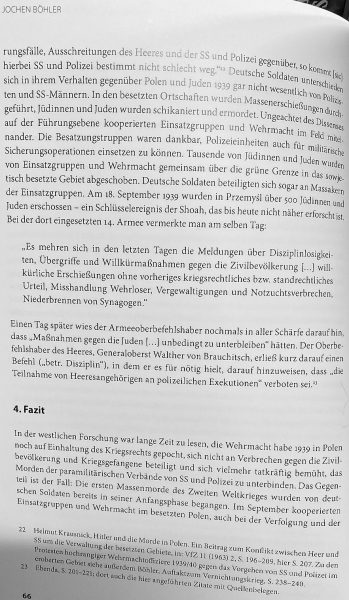
In addition to the much discussed “Wehrmachtsausstellung“, the work by Jochen Böhler provides ample evidence to debunk the myths of war without crime. This holds for the past and for the present. (Source: Böhler, 2019, S. 59-68, Die Wehrmacht und die Verbrechen an der Zivilbevölkerung während des deutschen Überfalls auf Polen 1939, Image below).

Topography of Terror

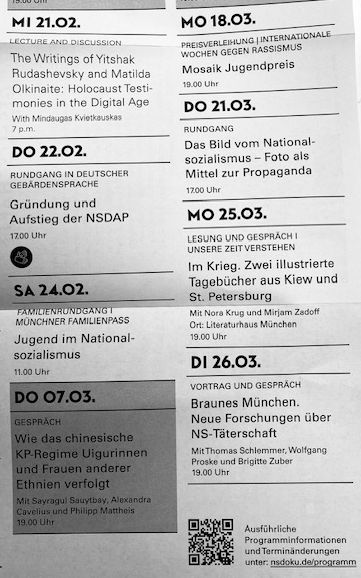
The documentation centre “Topography of Terror” in the middle of Berlin is easy to reach. The “Potsdamer Platz” is nearby and so is the “Kulturforum” with its galeries, museums and the “Berliner Philharmonie”.  The documentation centre gives easy access to the historical evolution of Nazi-dictatorship from the earl beginnings, the horrific terror spread across Europe and first insights into the prosecution of criminal acts in the immediate post-war period. The Beyond the  exhibition with audio-guide there is an easily accessible specialized library for personal or scientific research. The accompanying program of book presentations and discussions (image below) complements the busy show rooms. The external “walk through history” allows to grasp the main proceedings of the terror regime.
For special interest or research questions it is a very useful starting point. Hours in the library have to complement the research. Good to see that so many students walk through the documentation centre not only in groups from the neighbouring schools. The interest to understand when and how the terror started will allow us to better guard against those right-wing extremists who use a lot of techniques of propaganda well known and exposed in this documentation centre of the terror of the Nazi-regime.

Timeless Values

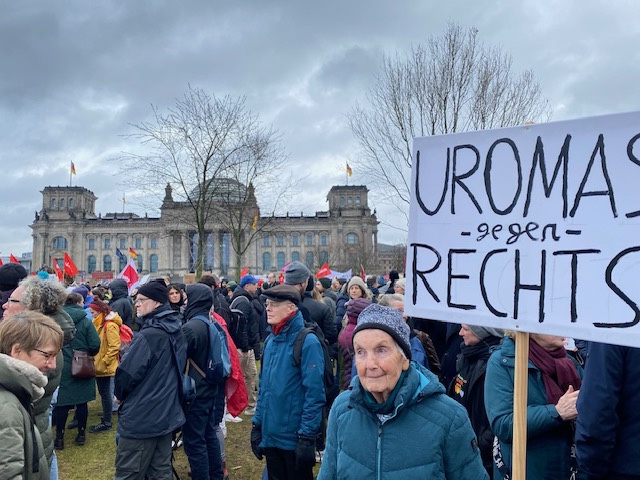
The declaration of human rights is more than 200 years old. However, the need to stand up for the defense of these rights needs many people to act accordingly. Political parties and courts are not strong enough to be the only defendants of democracy and human values. Solidarity across generations is another part of the struggle to defend democracy. In addition to the broad movement of “Omas gegen rechts”, the age distribution has been further enlarged with the “Uromas gegen rechts”. This most likely the generation with first hand life experiences from Nazi Germany and they should have reached an enlightened view of the horrors caused by the Nazi-regime. Unfortunately there are still some who continue to be prisoners in a fascist “brown” cage of mischievous memories. The great grandmother who was present at the demonstration was clear in her statement to stand up against right-wing extremism. (Image: With the permission of the lady I am happy to have evidence of the presence of super-agers at the demonstration in Berlin).

Berlin 2024-2-3. Demonstration

Fighting Fascists

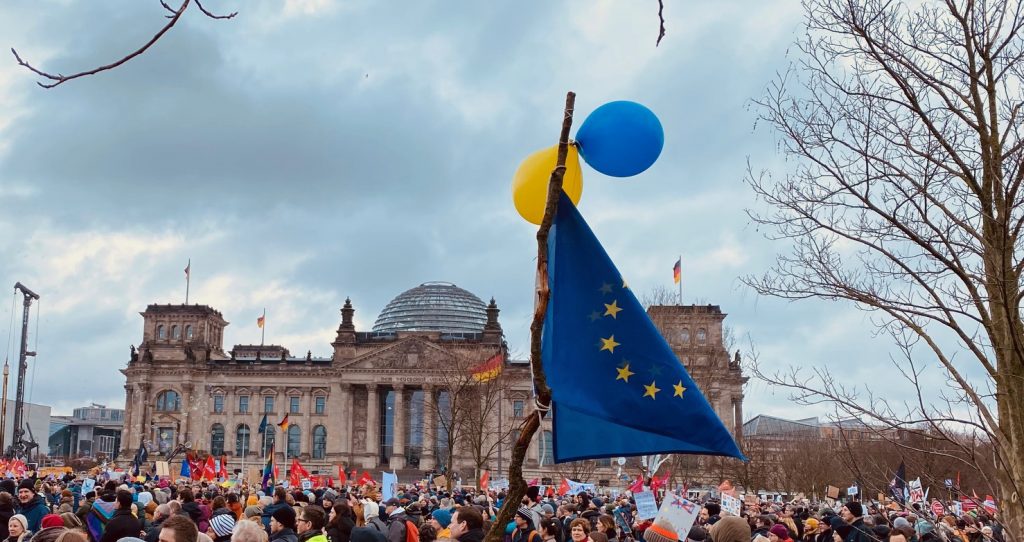
On february 3rd 2024 Berlin has seen the Parliament (Bundestag in the old Reichstag building) surrounded by young and old to raise their voice against the rise of right wing extremism in Germany. The broad alliance against extremism finds grassroots support from a very broad and diverse community. 1700 organizations have joined forces to send a strong signal that they are ready to act against the inhuman propaganda and persistent hate speech. The creativity to express the discontent in clear messages is impressive. Civil society is showing that diversity offers multiple benefits to find new ways to unite people. Great that European flags and balloons in Ukrainian colors where present as well. A movement of solidarity was felt with these people and that provides a strong message for the months ahead with so many elections taking place at the local, regional, national and European levels.

Berlin 2024-2-3

Flotow Paris1

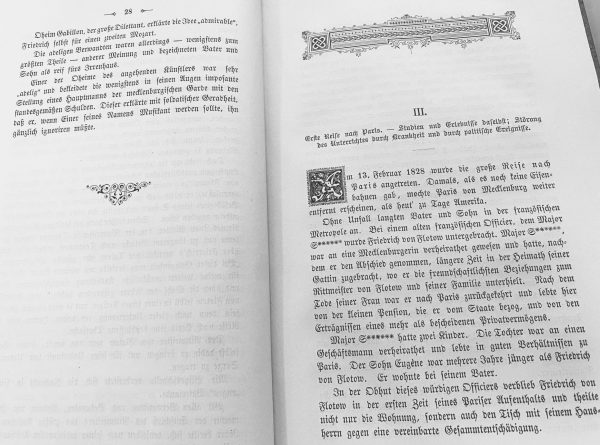
Die Biografie von Friedrich von Flotow, verfasst von seiner letzten Ehefrau, beschreibt die erste Parisreise und den prägenden Aufenthalt für die Ausbildung des noch sehr jungen Komponisten (S.29 ff). Bereits im Februar 1828, mit erst 15 Jahren, begann der erste Studienaufenthalt in Paris. In einer den Eltern bekannten Familie wurde der junge Friedrich aufgenommen und begann sein Musikstudium am Konservatorium. Prof. Friedrich Reicha war dort sein Lehrer, der 1825 seinen “Traité de la haute composition” veröffentlicht hatte. Schon Adam und Berlioz hatten bei Reicha Kompositionsunterricht einige Jahre vorher. Die Juli-Revolution 1830 in Paris führte jedoch zu solchen Unruhen, dass die Familie den Sohn rasch nach Mecklenburg zurückrief.
Die frühe Erfahrung in Paris, und wie wir heute sagen “total immersion” in die französische Sprachwelt und Musik, eröffnete dem jungen Komponisten einen Berufsweg, der sicherlich ohne den Aufenthalt völlig anders verlaufen wäre.
Seine letzte Komposition “Der blinde Musikant” ist als reale Erfahrung des jungen Flotow in der Biografie erwähnt. Zusammen mit seinem Freund Aubry hätte er für den stadtbekannten blinden Musikanten als Straßenmusikant Geld gesammelt. Mit seiner letzten Komposition hat er im Vorgriff auf seinen eigenen Tod, dem blinden Musikanten noch ein Denkmal gesetzt. Dieser war bald nach dieser Aktion dennoch verstorben.
Schüleraustausch und Studienaufenthalte zwischen D und F kann eine äußerst prägende Wirkung entfalten. Das trifft auch noch 200 Jahre später zu. (Image: Flotow Biografie 1892. A.28-29.

AI and Jobs

Forecasting the evolution of jobs in an economy is difficult. There is a lot of speculation currently about the impact of AI on the job market. According to an announcement of PWC based on a survey of global CEOs: a quarter of those interviewed estimated job cuts in the range of 5% in the next year. Google and Amazon have announced such cuts already in the fields of advertising and streaming, respectively. Both companies quote AI as reason for redundancies.
The IMF Staff Discussion Notes No. 2024/001 also stresses the higher impact on white collar employees rather than the bottom of the skill level and faster in more advanced economies.
Like it or not we shall have to deal with the pitfalls and opportunities of AI. The labour market is the prime target of my AI’s impact despite its use for multiple other purposes. AI enhanced robots might find their way even into personal care (fiction only until recently, Link) thereby coming close to very personal services. The future of work (another IMF paper) is happening now, and it is happening in combination or collaboration with AI. It will also be a distributional question of sharing the benefits of it rather than only the risks of job loss and enhanced performance and profits.
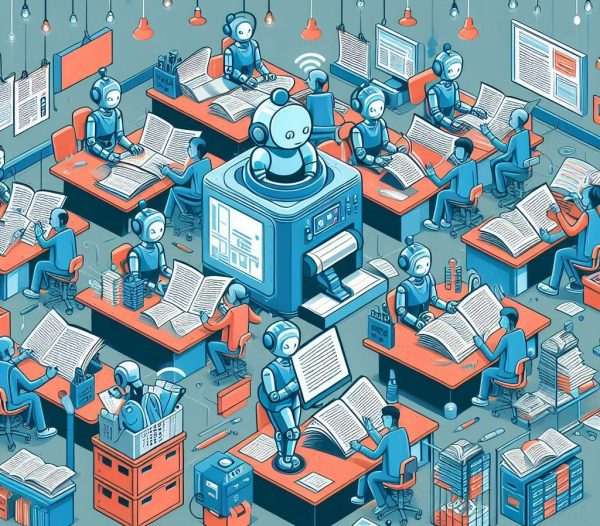
AI as image creator of BING interpreted my prompt in a way where robots outnumber humans in production, despite a different prompt specifying another share for robots. Job shifts will come, many might come sooner rather than later.
(Image prompt BING Mit KI erstellt ∙ 29. Januar 2024 um 8:34 PM
“20 persons work jointly with 5 robots on a newspaper editing texts”.)

Memory Flashes

The title of the exhibition in the Museum of Photography in Berlin was “Flashes of Memory”. The collaboration of the Kunstbibliothek with the “Yad Vashem – The World Holocaust Remembrance Center” prepared a photographic memorial of the murder of 6 million of human beings with Jewish origin or family ties. The images represented in the exhibition constitute a carefully curated selection of the photos taken as part of Nazi propaganda, the secretly produced photos by inmates and the Sowjet and American soldiers who prepared documentation of the horrors. It becomes clear throughout the different sections of the exhibition that the motivation of the photographer introduces more than just an individual perspective on the scene.
In the age of fake news and fake images it becomes more and more important to be able to read and interpret photos, taking into account the motivation of the photographer and its influence on the photo taken. In order to limit the spread of mischievous representation of the past, it is good to know that the use of AI as image creation does not allow with simple prompts to produce false documentation. It needs more sophistication and more human intervention to trick the algorithms. Additional use of photoshop will, however, increase the risks of abuses. Hence, it will be more important as of now to be able to differentiate images according to sources and authors. Our trust in photos has been shattered, and this is an important lesson in itself. It is a huge task for schools and adult learning to re-build the competence to distrust photos and images at first, then deconstruct the messages and motivations.
“Flashes of memory” is in some way linked to the “struggle of memory” exhibition. Both, obviously deal with the way historical events are and have to be present in our “collective” memory. Memories come back in flashes, sometimes, certainly for victims. Conscious and unconscious selections of images might come back at times and haunt victims for years. The correction of biased messages, is an important task for historians, social scientists and artists alike. It is all too easy and common to forget (Luhmann, 1996 Reality of mass media) and the difference between “Documentation” and “Decoration” (Lewis, 2001) or simply illustration needs to be scrutinised always anew. “Bildung” has some common roots (only four letters really) with “Bilder” in German language. It may be “une liaison dangereuse”, but the spurious link can also be turned into an educational or learning approach.
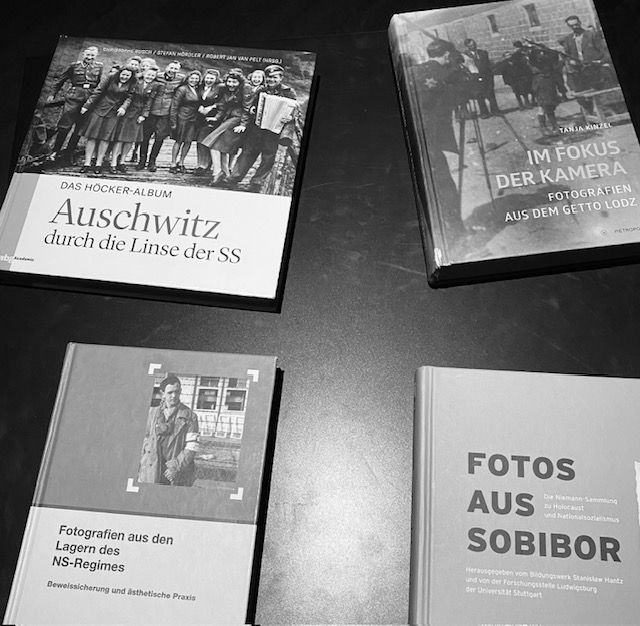
A permanent exhibition based on the material used in the exhibition would be a real asset to accompany and learn about the flashes of memory. A reading list of literature was also available at the exhibition (see image below) encouraging to dig deeper into this immensely important topic.

Postmodernism

The grand narratives of the modern world, like modernism itself, are under serious criticism. Deconstruction of the modern way of thinking has become philosophical mainstream. Economics as a science is in the middle of the behavioural shift and changing or at least complementing its narratives. Sociology has embraced postmodern thinking in theoretical as well as empirical forms (Mirchandani, 2005). The empirical measurement focuses a lot on the groups and people who hold postmodern beliefs and values. The discussion in the social and literary sciences continue. In the arts reading on modernism and postmodernism is a must in order to understand much of contemporary art or art from the 19th and 20th century.
Bookstores in art galleries that cover long spells of history can make surprising links between historical periods of art. Books of postmodernism appear next to books on romanticism. A lot of the ideation of postmodernism rejoins romantic depiction about nature, re-naturalizing or the emotional connotations of wildlife, isolated places and stillness.
On the other hand, we are confronted with the brutal world of war, drugs and crime. Classical warfare and strategies are back in Europe with tanks and rockets killing like in previous wars. The Russian empire of a specific version of modernism strikes back as if it were to stop the postmodern turn of the 21st century. Neo-fascism tries to build on the losers of the transitions to the socio-ecological economy and society. There are manifold backlashes of modernism, but the postmodern world is under continuous construction, most of in our mindsets.

Modernism

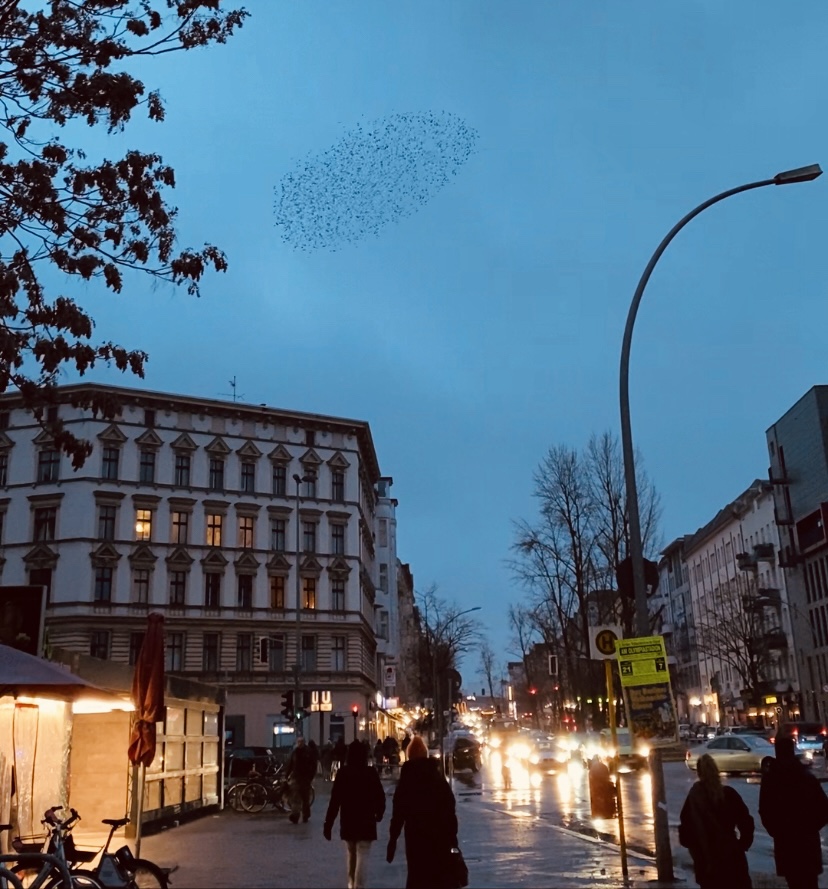
More and more people move into cities. A modern way of living is more accessible there. Besides abundant car traffic public services of transportation like buses and underground are within easy walking distance. Culture, science and education offer attractive opportunities for learning, working and leisure. Diversity is an additional asset most people appreciate of cities. The chances to live your very own way of life are much easier to achieve and thrive in as in remote or rural communities. “Birds of the same feather flock together “. It is easy to find likeminded people among a million people than among a hundred particularly if you’re a bit off the mainstream or avantgarde. The excitement of birds passing the city can reach the emotional force of Hitchcock’s famous movie “The birds”. Even in the modern world we not quite sure what these creatures are up to. Is it a swarm of drones? Are they out of control? Modernism has brought us many amenities, we have to make sure that we really are still in control.

Berlin Kleistpark 2024-1