Time that has passed, is subject to evalution and re-evaluation. Our memories work continuously on various representations of time in our mind. Memory management is one such example. Artist have also coined a phrase for a particular form of time management. “The assault of the present on the rest of time” Alexander Kluge had chosen this as the title of a movie on film-making and Katya Inozemtseva had chosen this as the title for the exhibition in Berlin 2023-24. Pieces of art may serve as evidence in court as testimony for war crimes. This is one of the challenging issues of this exhibition. The present uses evidence from the past to illustrate what happened. Re-interpretations are part of this process as well. It is not too rare, that in the present a reframing of the past may occur. Some try to alter the representation of the past (crimes committed long ago) as of minor importance. Such intentional misrepresentations represent the assault of the present on the past. It may eqaually be attempted to limit the scope of future options. The diesel engine is not the best technical solution for mobility of 8 billion people living on this planet in 2024. The reflection on time needs to take care of the “back shadow” and “forward shadow” of the present. On the individual level, today’s action might be largely determined by past events, experiences and transitions, but they pre-determine to some extent also future events.
Conditionalities shall occur and accumulate, for some more than for others. Some call this scar-effects, others the narrowing down of options. Life reviews may apply a reframing exercise, sometimes even to liberate yourself from the boundaries of the past to open up new or more future options. The time-space subject which ranges from experience to fiction is the matter of literature and cinema. Some people seem to choose to live in a fictional world for whatever reasons. Rather than a linear concept of time, the artists appear to imagine time in some form of a spiral: from the present you turn backwards in time to project yourself into the future. Maybe, we are caught up in some unresolved narration of the past, to try another projection into a different future. We see one or many movies grow out of this fictionalisation of the present.
The study of the life course remains a formidable challenge. Testing the reliability of sources to separate fact from fiction has overriding importance. Biographies derived from facebook or instagram entries over decades have to deal with this fictionalisation of the self even more than we were used to from other data sources. The basic challenge of the representation of time throughout the life course, however, remains the same.
Source: Kluge, A., Evans, T., & Liebman, S. (1990). The Assault of the Present on the Rest of Time. New German Critique, 49, 11–22. https://doi.org/10.2307/488371 (Image: Exhibition Brücke Museum, Lea Grundig, Unterm Hakenkreuz: die Hexe 1935, Zentrum für verfolgte Künste, Solingen). 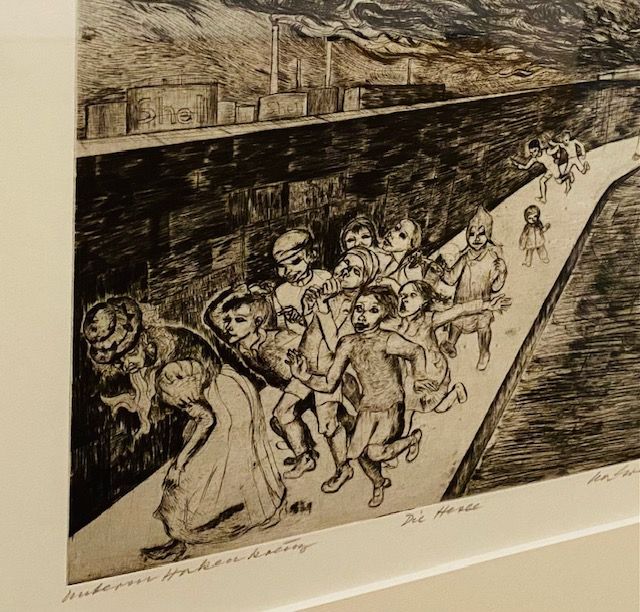
Richter
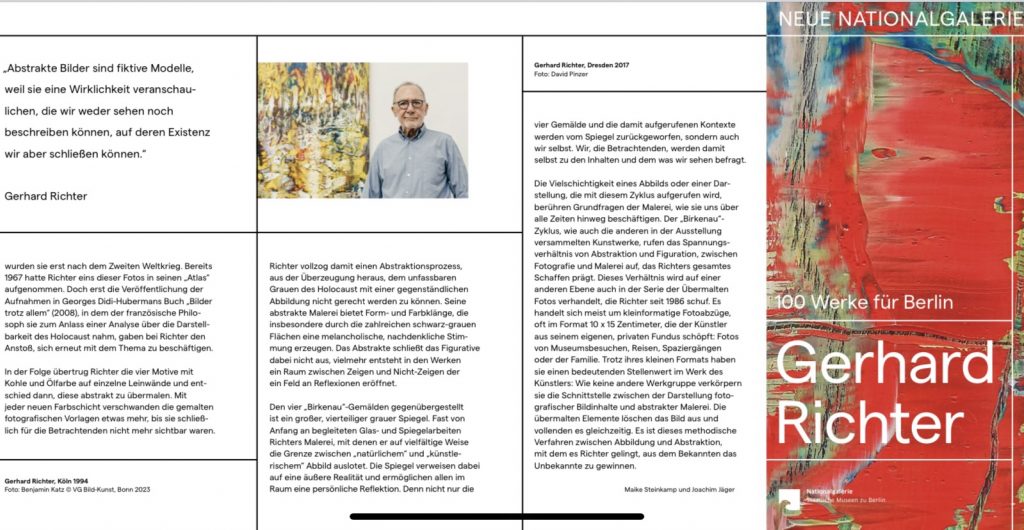
Gerhard Richter ist kein Richter. The painter Gerhard Richter is of cause not a judge. But somehow he is. In the representation of his 100 works for Berlin in the Neue Nationalgalerie he judges the horror beyond imagination of the Nazi concentration camps, reflects on the role of his own family in this and finds his own way to deal with it. Colors cover the black and white documentary fotos as if a new imaginary has to grow again to overcome the painful memories. He deals with the most difficult kind of confrontation with evil in an astonishing way. The horror as underlying fact remains present in our mind and at the same time we open up to light at the end of the tunnel and abundance of colors. Color is the way forward. Underneath, we tend to or like to forget about the many killing fields. Scratch a bit on the surface and you’ll find lots of unresolved issues again. All those fancy colors might just cover up the demons of the past and present. Maybe this is a grossly biased interpretation of his Auschwitz Buchenwald series of paintings, but only time will tell if we are successful in 2024+ to stem the tide of right wing extremism (again).
Museum Orga
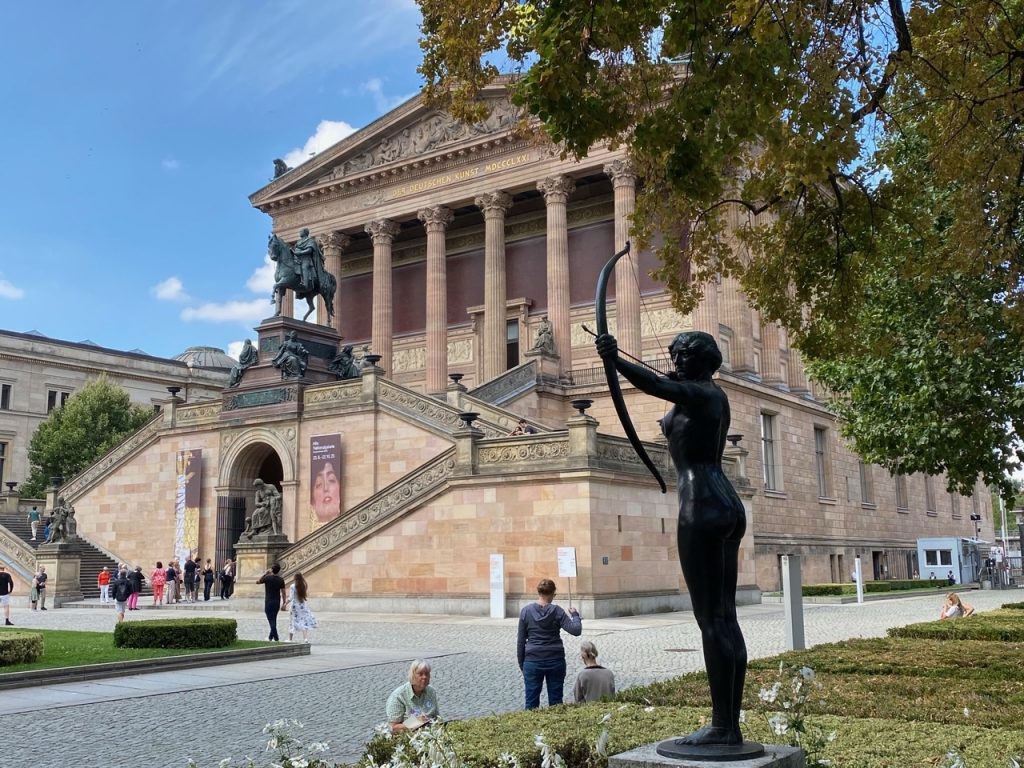
The cathedrals of modernity are under permanent scrutiny. The discussion in Germany was sparked by a recommendation of the scientific advisory council to the federal government (Wissenschaftsrat) to separate the Prussian heritage museums and institutions (SPK) in Berlin into separate entities that have higher autonomy to shape their individual profiles. Too much hierarchy blocks innovation and openness to new approaches that might not fit an overriding instance of decision making. The arts and sciences as well as their libraries need substantial degrees of freedom to flourish in their specific cultural and societal environment. The same discussion is currently occupying Paris and France, since overall the visitors after the Covid-19 crises have not yet come back to the same levels. Digitalization has opened up new opportunities and potentials to reach new audiences. This needed new resources even at a time of budget constraints. Museums have started to take their social functions more seriously besides their role to preserve the cultural heritage. Economic thinking in terms of scarcity of art works, competition between museums and cities or countries for tourism have entered the stages as well. Prices of entry and quantities of visitors have become additional concerns in the organization of the museum landscape. A lot to cope with and to balance multiple policy targets. Accessibility of those treasures is key. Opening up to broader audiences is costly but crucial to provide the justification of the public funds allocated. Great to see more complementary private investment in this exciting field. The prominent archers in front of the Berlin museums have moved ahead into a new round of competition in the organization of museums.
Only for Kids
We all have, hopefully, fond memories of children books. Sometimes authors are not so keen to tell that they are just writing books for children. This is often present in many biographies of authors of books for children. This is grossly unfair. Not only is the book market for children’s books one of the best- selling part of literature, but there are lots of interesting collaborations between authors and illustrators. Most books are expensive to produce, particularly if, additionally, translations are needed to reach more children and their parents. For small countries this might be a barrier. The Scandinavian countries have a tradition to translate and publish some selected children’s books in multiple Scandinavian languages and beyond. Therefore, it is no surprise to find a children’s book entitled “Kant” by Norwegian author Jon Fosse, illustrator Roj Friberg with the text translated into Swedish and published by the Danish Editor Carlsen, all in 1990.
The illustrations allow to understand the “bilderbok med text av Jon Fosse” using an enlightening imaginative visual language. From the cover already It is clear we deal with the universe and endless open space. There are black holes in it as well. Jon Fosse deals with “möjliga och omöjliga”, possibilities and impossibilities. Tackling such philosophical questions with children needs the best authors to address these issues. How to speak of the unspeakable, things we have hardly any words for remains a challenge. Relating to the world of dreams, appealing to children and their parents, does the trick. After all, you just need to close your eyes and you start to travel the universe and make lots of exciting encounters. The book has no page numbers, interesting. The image below is from page 25, just as an appetizer.
For more insights of how to deal with “nothingness” I refer to Friedrich C. Heller (2020) “Towards nothingness. Ideen der Reduktion in zeitgenössischen Bilderbüchern” (in Benner et al. editors 2020). Susan Sontag (2005) „die Ästhetik der Stille” (in Eugen Blume 2005, editor) will also help us along on the subject of stillness and minimalism. Maybe it is these essentials we should talk more about especially with our kids.
To continue the exploration of space and stillness just go to the webpage of the hubble telescope or the James Webb Space Telescope. The journey of your dreams will be hard to stop. 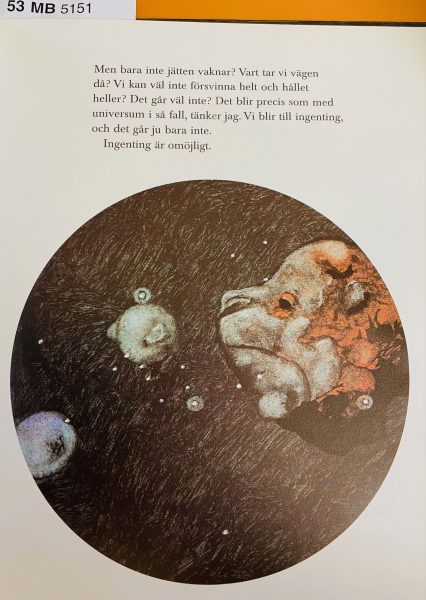
Tears mastered
Not many authors find decent ways to write about sad moments and the mastering of tears. Can we master tears? Should we even try to? For authors the question poses itself of a different kind. How do I write about emotions in which a person bursts in tears or sheds a single tear. 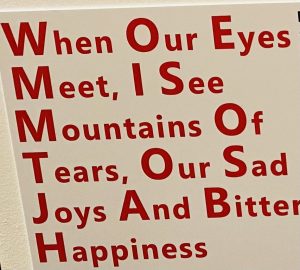 Even mastering tears or the delayed unmastered tears give rise to ample drama. Have you found a poet or author to whom you relate through the sorrows s/he expresses? Reading itself is a process of mastering tears due to the possibility to go through a wide spread of negative and positive emotions.
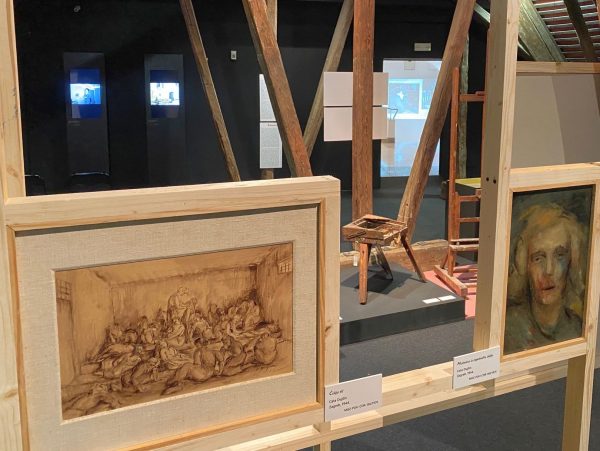
Towards the end of her life Cata Dujšin – Ribar wrote a poem that links to the imagery of the Norwegian poet Jon Fosse. Thanks to the exposition of her paintings and writing in the Zagreb City Museum Cata can become known to a wider audience. 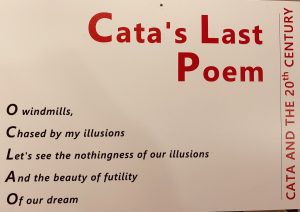 Hardly any traces in the internet of her writings in English make her even more of a local hero and an early female role model. The windmills are powered by the nothingness of our illusions. The beauty of futility is revealed in our dream. She puts it so much better. The biography and work of Cata Dujšin – Ribar summarises to some extent the whole history and misery of the 20th century beyond the Balkan region in a few words.
City Museums
Some city museums have a difficult time to present the richness of their historical heritage. Additionally, the question of city heritage maybe entangled with a process of nation building and citizenship altogether. The focus I advocate is on the evolution of democracy and the process of civilisation. The Zagreb City Museum on the top of the hill comes pretty close to such a perspective on history or historical perspective. Due to the recent efforts to excavate remains of the iron age underneath the more recent City Museum the historical line of Zagreb civilisation can be traced back even longer. The tumuli are worth a whole new section in the Museum. The process of civilisation with “burying cultures” are more than 2600-3000 years old in Zagreb. Democratisation as a process can also be studied with all its ups and downs over the history of the city and the Croation nation building. Capitals and city live play an important driving force in this process. Zagreb has experienced a bombing of the city centre as recently as 1991 (Banski Dvora) and again in 1995 (city of Zagreb) in the Croatian war of independence.
It is a real pleasure to walk through centuries of historical evolution beginning with the recent excavation of the iron age as well as the arts and crafts since the medieval times. Even passing the horrors of the 2nd world war through the eyes of the author and painter Cata Dujsin (image below from 1944) speak to us even today.
There is no linear process of civilisation which is improving over time. There have always been backlashes and there will be. It is even more important to be aware of the continuous risks to independence and democracy. The current setup of the Zagreb City Museum seems to focus on the Croatian population to remind them of their great heritage. With more English and foreign language subtitles and inscriptions the example of civilisation and democracy will be more accessible for even larger crowds of visitors. The online visit accessible in English is already an excellent appetiser.
The City Museum is moving from the internal Croatian function more and more to additional external function to offer learning experiences beyond the Croatian visitors in this tourist attraction that is internationalising in its work force at a rapid rate. 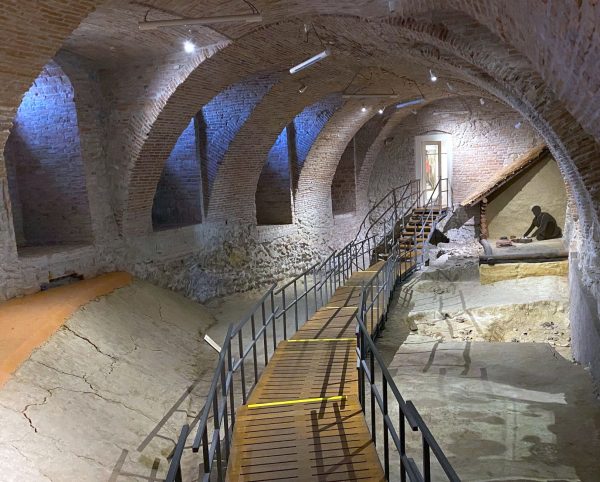
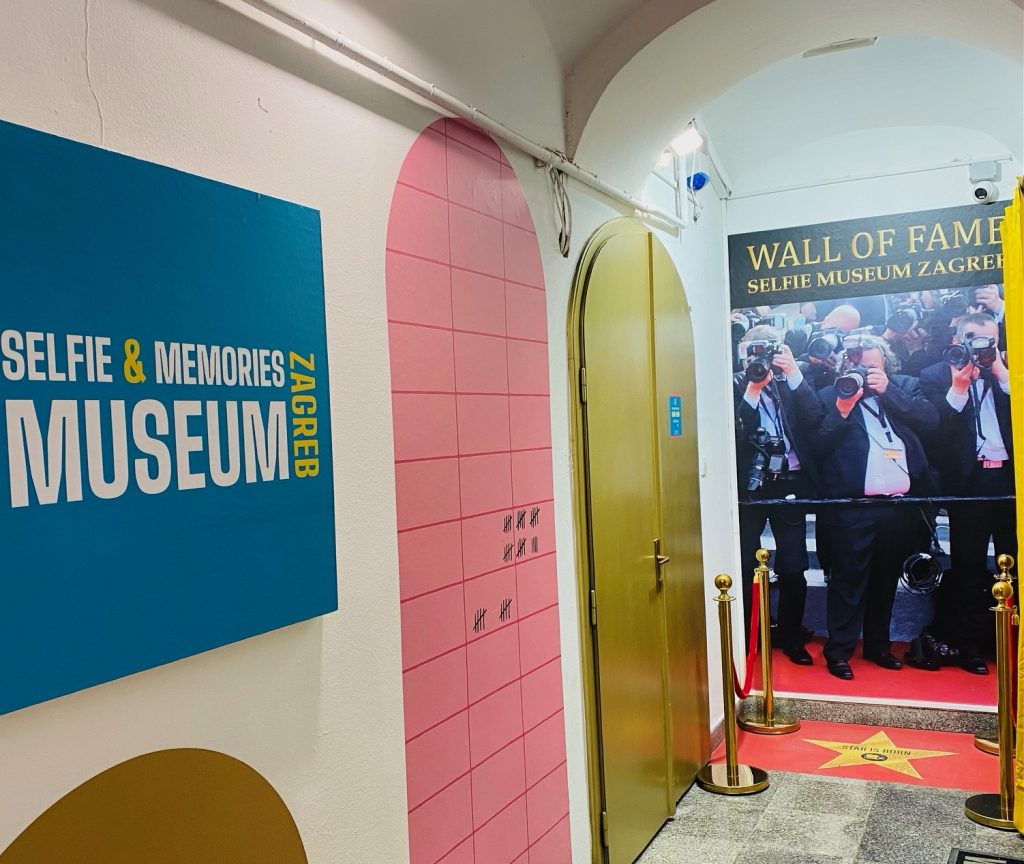
Selfie Museum
We have learned that games are not only played for fun. So-called serious games have found their way into health applications where we might learn while playing a game of how to integrate more walking into our life in the city. While walking after work I happened to pass the Selfie Museum in Zagreb. In fact despite carrying the name of museum it is more an assembly of scenarios in which you can realize many selfies in different settings that have been prepared for that purpose. Hence your production of photo shooting with yourself as the major character is facilitated and you no longer have to spend a lot of time on the setups. Call it a museum and you’ll have more visibility and visitors.
Styles of selfies have changed and shooting very short videos to post on tiktok is of course easy there. A real threat to huge and expensive cinema studios considering the enormous reach some of these selfies can reach. It is a bit like a theatre with multiple stages for everybody to use at moderate costs. Before long we shall come to realize the potential for many more interested in theatre to become actors and directors themselves. Democratize the world of theatre is the new social dimension here. Test yourself in another profession through playful interaction. Test and learn about other competencies. We are in the middle of the next wave of “gameification” previously reserved to people ready to accept higher risks of likely failure. The young can now take their parents to the museum and show off their culture and skills. Intergenerational learning has a new aspect as well. The sociology of the virtual has another phenomenon to evaluate.
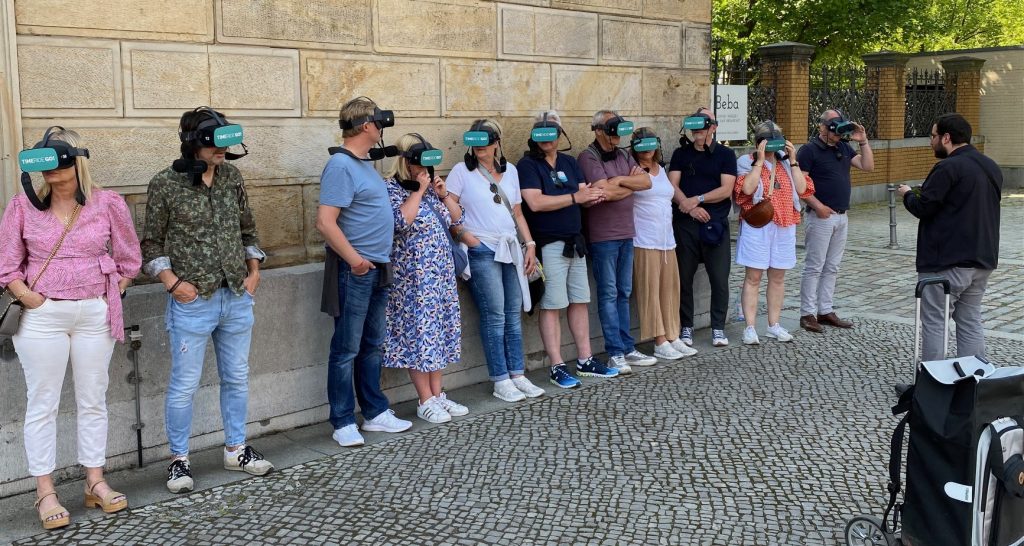
Mating Birds
Mating birds have astonishing capabilities. Some songbirds can expand areas of their brains during the mating season. Apparently this helps to outperform other birds in singing contests. The expansion of the brain in the preparation for mating is not so much of an interesting phenomenon in view of the fact of subsequent decline of the capacity. Of course in human engineering the expansion might be useful and the hope to repair a damaged brain is worthwhile as well. In a few years we might know how to expand brain irrespective of brain functions. The naive hope that we might just sing more beautifully in preparation for mating is probably misplaced. While everyone is talking about AI new horizons for HI as human intelligence or hybrid forms become more feasible. Meanwhile we continue to focus on our preparation for mating songs. It seems to exercise parts of the brain with the best intentions in mind. Composers have created fantastic arias and singers impressed audiences across the globe with melodies in preparation of mating like the birds. Art is full of such extraordinary examples. Let’s keep up the preparation as long as the season lasts and before climate change kicks in more forcefully. The mating season might be prolonged a bit, it might be too hot or too wet to prepare for mating as well.
Meta-language
Some writers accomplish the formidable task to draft a text that encompasses more than one language. Samuel Beckett surely is one of them. Arnaud Beaujeu (2011) exposes the meta-language that Beckett creates through his reductionism and minimalist style. It is first a deconstruction of language or languages expressed in French and/or English at times. There is an underlying discourse dealing with the link and sometimes opposition, but always a relationship between at least these 2 languages. Beaujeu reveals 2 other languages: « the trivial and the spiritual ». The reductionism of Beckett leads to a conscious expression of the obvious, the trivial in conversations. This, however, he turns in the theatre piece “cette fois” (original “That Time”) into a ritual, spiritual version of 3 persons A, B, C in a prayer like liturgy. In taking out the sentence structure and obligations of grammar more generally the text becomes a rhythmic reading of words. Today we might say a Rap-version of a text.
The meta-language is the spiritual experience and another kind of access and questioning of memory, eventually even reconstructing a collective memory. Maybe the meta-language is the attempt to collectivise and internalize the dialogue that has turned into a trilogue.
It is out of the memory of persons or historical evolutions that Beckett builds his meta-language. Adorno (1974) put this in a relationship to Shakespeare’s dramatic work and the experience of the horrors of Nazi-Germany. Sarcastically put, the question to Adorno was not ” to be or not to be”, but “to die or to die”. Beckett travelled in Germany extensively in the year 1936 and faught in the 2nd World War with the French resistance.
„Paroles, musique, mémoire“ (Beaujeu, 2011) span a triangle which allows for a profound, albeit mostly empty space. Beckett offers a safety net to bridge the gap by way of reconstructing a language reduced to basics as well as meditative silence. The script lies in the meta-language and poetry is the more common access to this meta or essential level of our existence. Listening to the meta-language is like listening to polyphonic music. Some find it very disruptive, others a spiritual experience. Meta-language is all around us, like it or not. (Image: Französische Friedrichstadtkirche Berlin, Exhibition Princesses, 2023)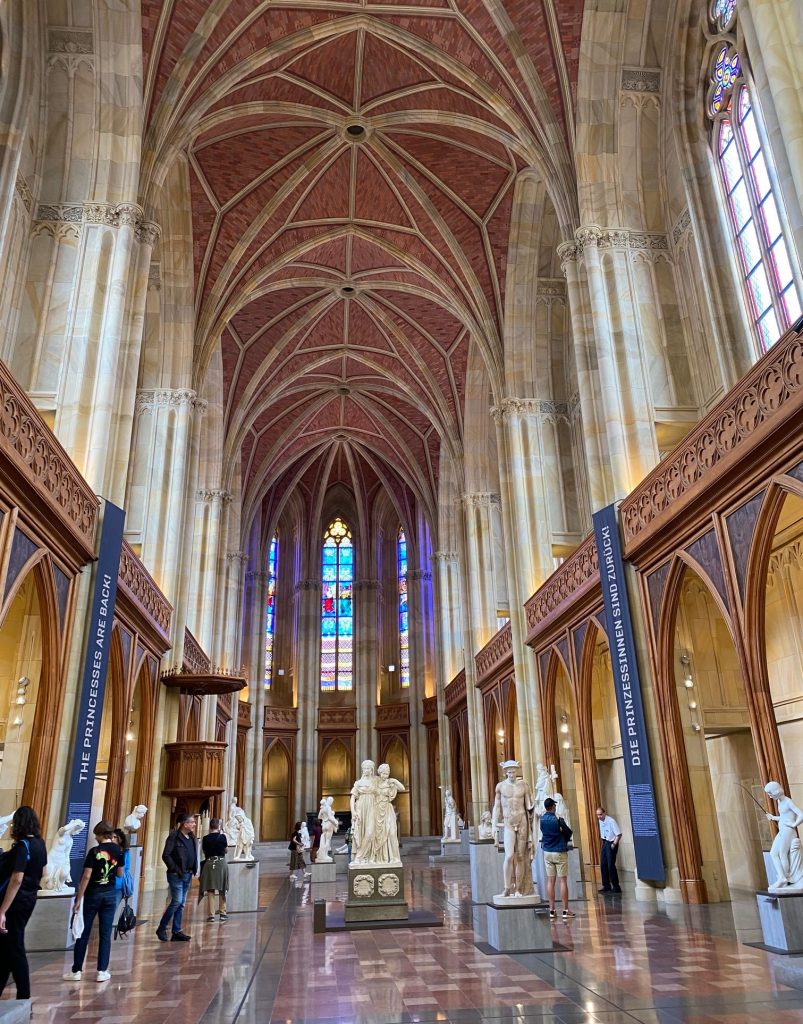
Ukraine Art
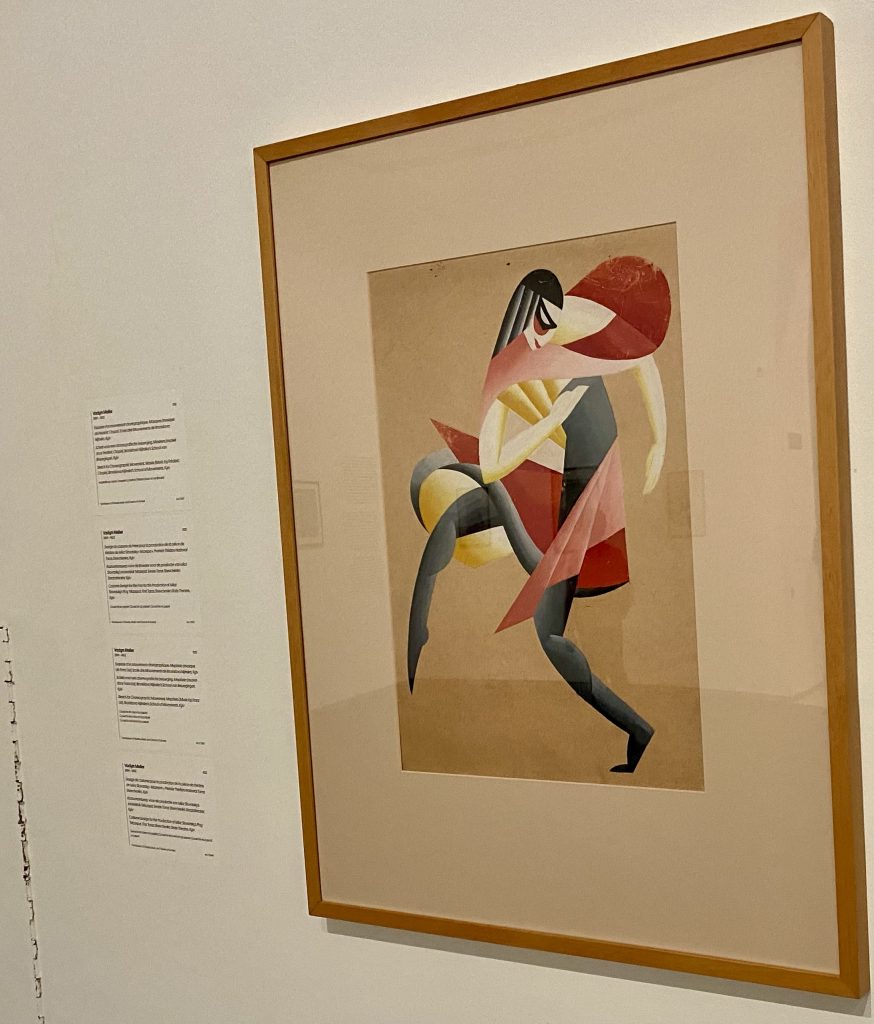
The touring exhibition of art works from Ukraine 1900-1930s is on show in Brussels at the Royal Museums of fine art Brussels in November December 2023. Before Ukraine became swallowed up in the Sowjetunion there was a very active independent artist world that had close links to all capitals in Western Europe. All art disciplines were covered. The paintings of Vadym Meller from 1919 (Aquarell on carton) show designs for a dance performance to the music of Chopin. The modern designs and vivid colors reflect the conscious reference to art movements across Europe. The inspiration from dance to painting is a recurrent theme in impressionistic paintings, abstract paintings and into our own time period. Ukrainian art from early on in the 20th century had a broad scope beyond the narrow focus on art controlled by the soviets. Well worth enlarging our vision to take into account these creative masterpieces from Eastern Europe as independent voices.