The rather stiff and rigid structure of the “Staatsbibliothek” in Berlin does not yet have a reputation to be a place of poetry, translation of poetry and recitals. This is about to change. As a student, researcher or lecturer I would have adored to see my library proposing a poetic coffee break. I would have gone for the necessary break in the afternoon, the coffee and, okay why not, a poetic experience. This time it was different. The organisers, “ilb and Stabi” got together and Ursula Jäcker together with Michael Bucher presented poetry from Shakespeare (Sonnet) in English followed by the German translation by Wolf Biermann.
Translating poetry is a very tricky thing. Just try it yourself and you will be full of admiration for the admirable work of translators of words, sentiments, rhyme and rhythms. The presentation of Biermann’s comments on his own work on translating Shakespeare’s sonnets gave interesting additional information on the short and precise English original and the longer, somehow fat translations into German (Biermann’s words). Thanks for the indication that Biermann deviated from the Shakespearean “iambic pentameter” to add a sixth foot most of the time (to be checked OMG). The choice of numbers 6, 18, 27, 66, 73, 76, 121, 147, 154 from the Shakespeare Sonnets were witty and entertaining for a coffee break. For example, from 27:
“And keep my drooping eyelids open wide,
Looking on darkness which the blind do see:…”
Also, from 76:
“Why write I still all one, ever the same,
And keep invention in a noted weed,
That every word doth almost tell my name,
Showing their birth, and where they did proceed?”
More than 400 years ago, these rhymes were drafted and still today writers and learners, at the Stabi and beyond, can somehow identify with the intricacies of the process of creative writing.
More of this, we need, today and for tomorrow. THX. 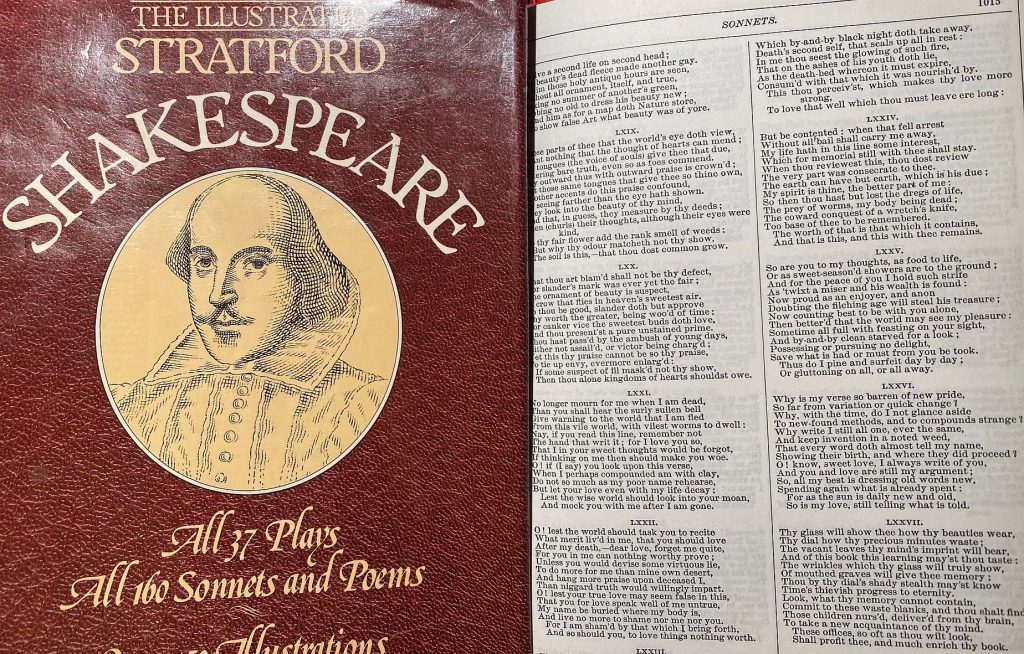
Princess
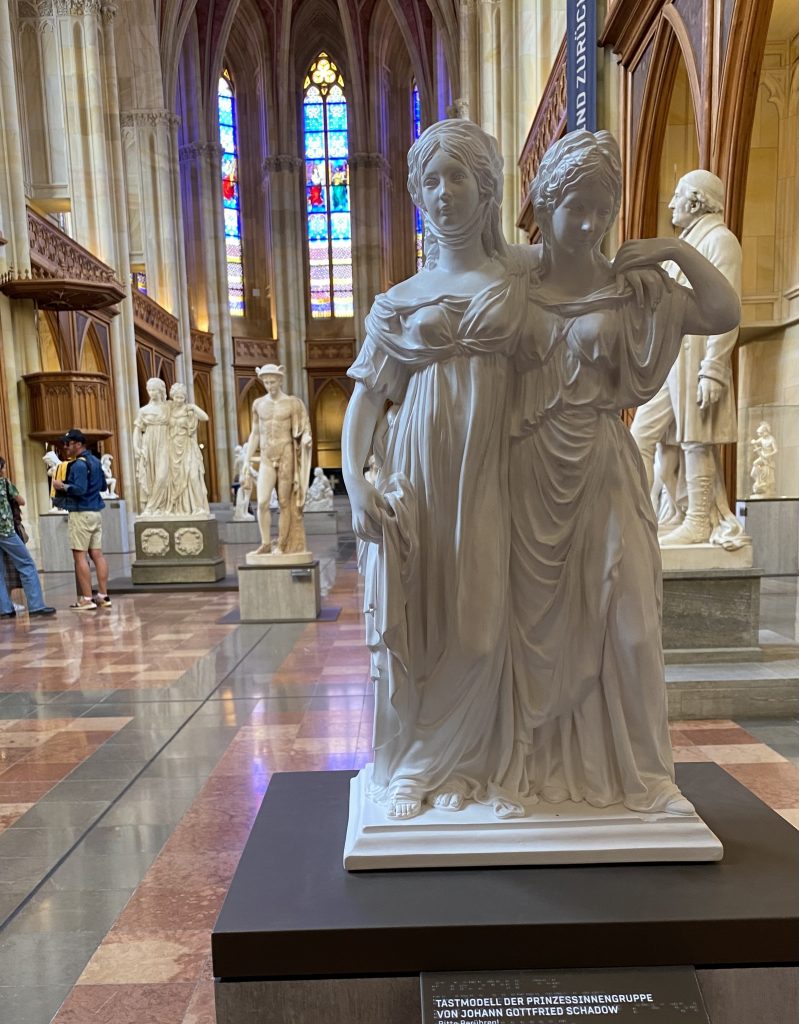
Berlin is proud to present its princesses after a marvelous lifting. Yes, in the middle of the barbie hype, Berlin exposes two of its princesses of the late 18th century. And you can touch them, if you like or dare to. They don’t bite. I have not seen anybody kissing them either, except for a Spanish football president. All this is happening in the Museum Church Friedrichswerder designed by architect Schinkel an built until 1830s. The grouping of the two sisters was unusual for the time and only the inscription at the bottom introduces the distinction that Louisa on the left is the princess heriting the throne. Frederica on the right is wearing a different foot wear, considered less noble. The privilige to touch the princesses applies only to the smaller copy in front of the image below with “Braille inscription”. The original is further behind. Of course, this one is protected against unwanted contact with the masses or “followers”. At the time “follower” still had a different meaning from today.
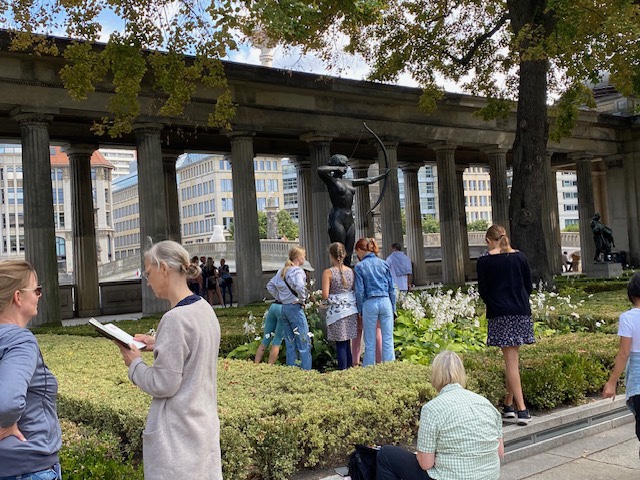
Bogenspannerin
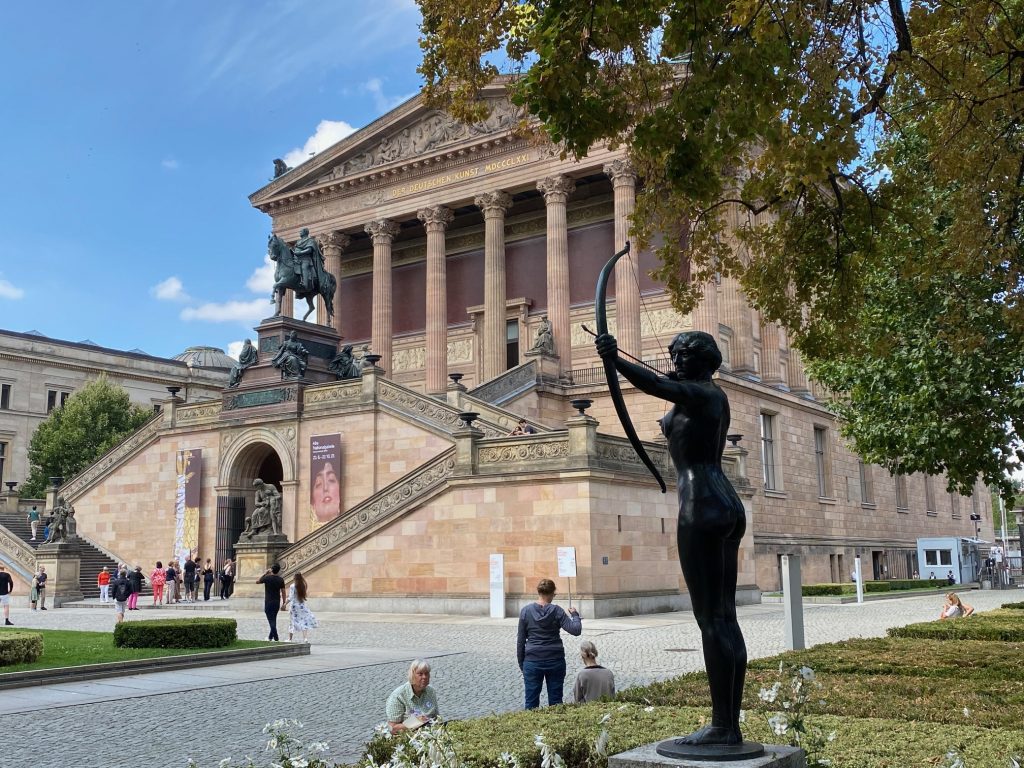
Seit der Antike sind Bogenschützen und Archer ein Thema der Künste. Meistens ist die männliche Repräsentation die dominierende Variante. In Berlin lässt aber auch seit langem eine starke weibliche Realisierung bewundern. Nahe dem Pergamon Museum und der Alten Nationalgalerie steht die Statue der Bogenspannerin. Die Zielrichtung geht Richtung Hedwigsdom, als ob der Kampf zwischen Kunst und Religion ein andauernder wäre. Erfahrene Stadtzeichnerinnen, aber auch Jugendliche fühlen sich dadurch angeregt. Kunstschaffende können einen nachhaltigen Einfluss haben. Innerhalb Berlins ist nicht nur die Vielfalt der Kulturen zu bestaunen, sondern auch der Wettbewerb der Künste um Aufmerksamkeit. Da werden nach Regierungswechseln oft viele Bögen gespannt. Bleibt abzuwarten, wen es alles dieses Mal treffen wird.
Everyday objects
If you were wondering whether everyday objects can be a piece of art, then the exhibition at the “Neue Nationalgalerie Berlin” is for you. Isa Genzken challenges our traditional view of everyday objects through small transformations of these objects. At first sight you “only” see something utterly familiar to you. A window, a radio, a rose or a wheelchair are immediately recognisable. However, all objects have a little twist to them causing some alienation, questioning or finding new connections. This is the stimulating experience of a visit of the exhibition. The booklet gives an informative overview of choice of sculptures chosen for the exhibition. Walking around in the spacious entry forum allows to appreciate the objects from many angles and in different lighting including twilight. Allow yourself to be challenged. Distancing your perspective beyond the obvious object you recognise broadens our vision of what we see and how we perceive it. The huge pink rose in front of the gallery overshadows even the monumental appearance of the Neue Nationalgalerie. In memoriam “Rosa Luxemburg” and Karl Liebknecht who were murdered not far away, near the “Landwehrkanal” in 1919.
Some visitors might like the skyscraper models she created to remind us that “design catastrophe” with the usual high rising buildings are pervasive around the world. Sculpture as architecture or architecture as sculpture has been her forward looking work from 2008 “Ground Zero – Hospital”.
With the construction work in full swing in the neighbourhood of the gallery with the design of a barn (Scheune) we understand the choice of the artist as a timely reminder that Berlin could be more daring in the architectural design. 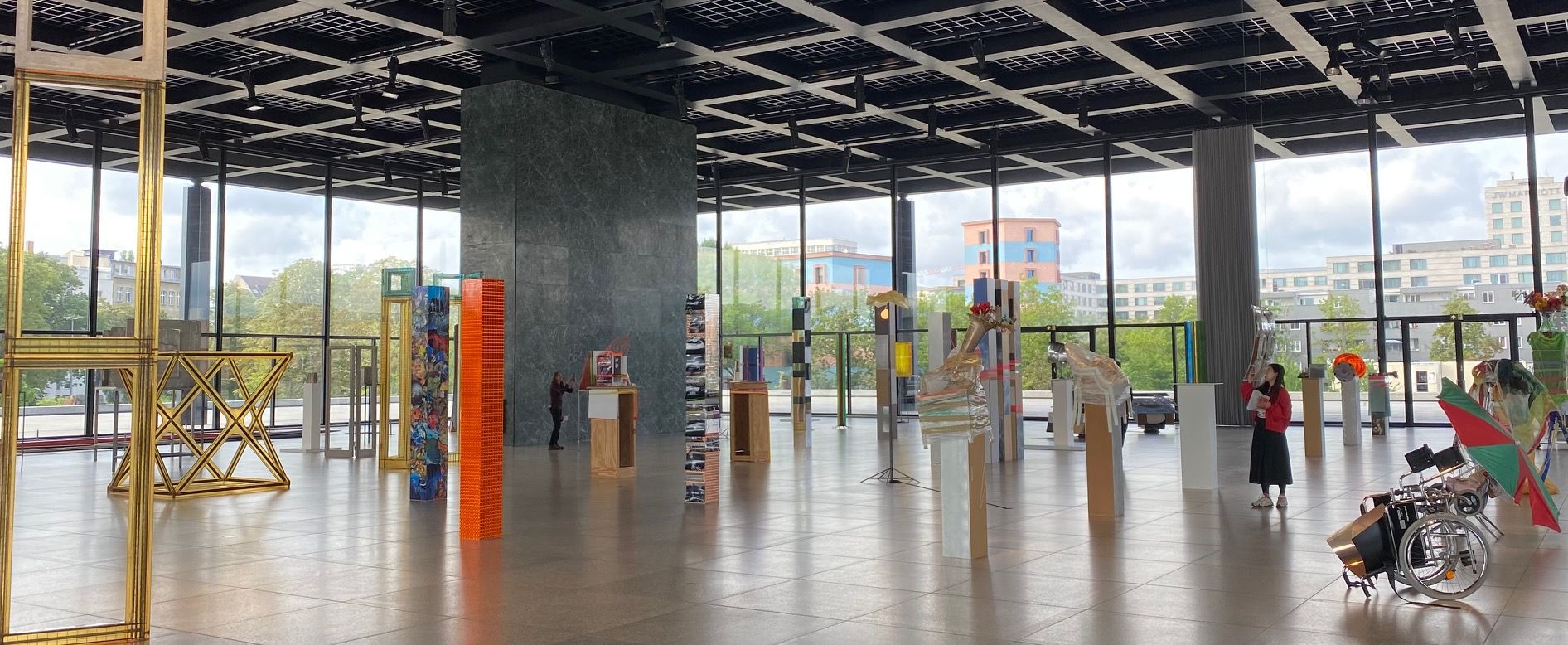
Politicians and Literature
Biographies as well as autobiographies of politicians receive a lot of attention. Even spouses of politicians or artists benefit from this sensational effect (Obama). But beyond these ex-post or after-office effects, it is more interesting to look at what literature or authors have had an impact on the life and, maybe, office of presidents. So-called literary couples or specific relationships between artists or authors can reveal interesting additional information to understand “what made these personalities”.
In “Le Monde” there is a series of articles devoted to such relationships. It is a kind of romantic summer reading satisfying nosy looks into the private lives of politicians and other celebrities of a more intellectual kind. On the 25th of August 2023 it was the turn of the relationship between Francois Mitterrand and Marguerite Duras entitled … “menteurs sublimes, forcément”.
Their long-standing relationship had in common to cover-up some of their failures in the Nazi-occupied France.
Post-war each person had more than just sympathy for the other person’s accomplishments. The interesting feature to accept advice and criticism from the other person is rare for highly exposed persons. Relationships between artists and presidents are somehow tricky for both. As artist you can get instrumentalised by power rather quickly. As politician you run the risk to open-up too much, as they are rarely unobserved. Paparazzi or other agents go a long way to get or make up a good story. “Tell me what you read, and I tell you who you are”. The relationship between literature, politics and politicians will never be easy. It remains good stuff for literature and cinema. 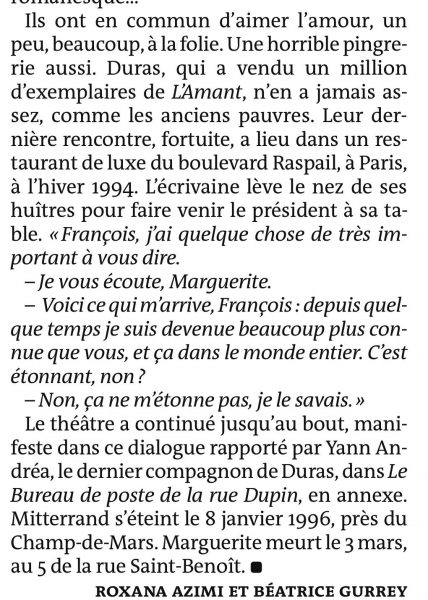
Corbusier ZH
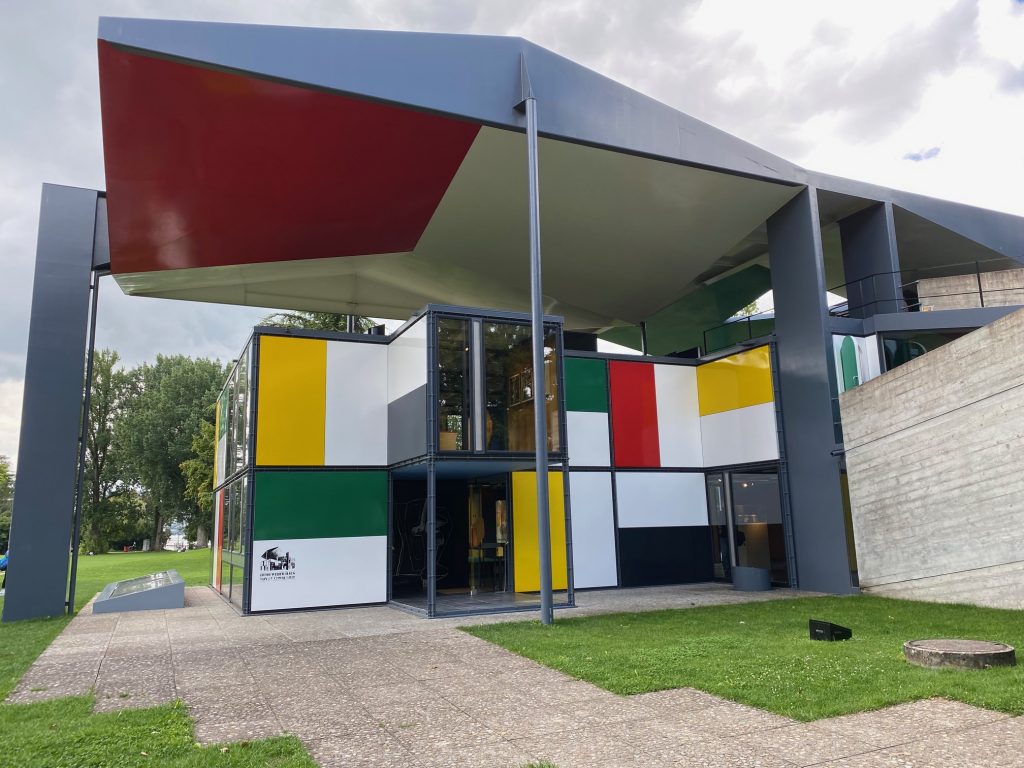
Realizations based on the theory of architecture by Le Corbusier are always worthy of visit. Passing through Zurich (CH) allows to discover another fine example of a villa he designed in the neighborhood of the old town. Within walking distance from the lake Zurich the spacious building allows just like the Paris example for an exhibition of art work within the villa. Horizontally stretched windows and a terrace on the roof make these villas look very modern. Rooftop bars and restaurants just stage a revival in inner cities as cool locations. Le Corbusier anticipated this long ago. Theories can have a long half value time of lasting.
The materials applied in the realizations were obviously less durable. This is the reason why the villa had been closed for renovations for many years. The reopening now shows the splendid views from inside out as well as from the outside. Colors are especially interesting in this example. Nothing is left to or build by chance. The Design language is spelled out in each detail down to door handles. An ongoing exhibition about the deterioration of materials and in some cases even toxic materials helps to understand the necessity to be aware of material science in construction. This makes visits even more informative. The confrontation of vision and sustainability becomes an additional topic also for the theory of architecture.
Stilfindung
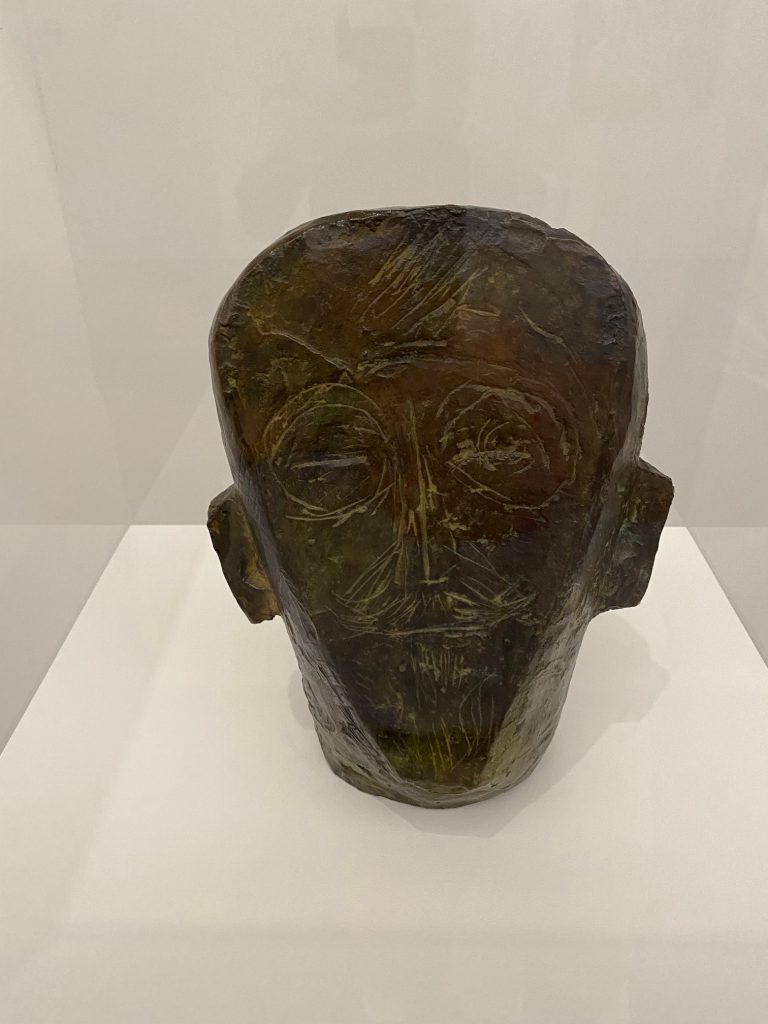
Kunstschaffende brauchen Jahre, oft auch Jahrzehnte, um ihren eigenen Stil zu finden. Das ist durchaus ein schwieriges Unterfangen. Frühes Ausprobieren verschiedener Kunstrichtungen ist dabei so etwas wie ein Experimentieren mit unterschiedlichen Werkzeugen. Da hilft es enorm, wenn schon einmal ein reichlich bestückter Werkzeugkasten im Elternhaus vorhanden ist. Das war in der Künstlerfamilie der Giacomettis der Fall. Der kleine Alberto hat mit Vater Giovannis Tinten, Federn, Ölfarben und Pinseln früh angefangen, sich auszuprobieren. Eltern, der kleine Bruder, Landschaften, Posen vieler Verwandten und Bekannten sowie jegliche Gegenstände wurden zu Objekten des Skizzierens für den Jugendlichen. Schule war nicht wirklich interessant, selbst die École des beaux arts in Paris erweiterte zwar sein Repertoire an Techniken und Sichtweisen, aber auf dem Weg der Selbstfindung scheint es nur eine Passage gewesen zu sein. Auf dem Weg der Abstraktion hat Paris allerdings die Kreativität stimuliert. Seine Skulpturen von Köpfen der Familie haben sich verallgemeinert, hin zum Universellen. Weit über seine Heimat hinaus sagen die Skulpturen des späteren Albertos uns etwas über Menschheit und Menschheitsgeschichte. Den Weg zu verstehen, den der „L‘homme qui marche“ bis zu seiner Verwirklichung beschritten hat, ist in der Ausstellung im Bündner Kunsthaus nachvollziehbar. Vielleicht mehr ein Lehrstück in Pädagogik und Kunstpädagogik, als in grandiosen Werken der Giacomettis. Welch ein Glück, dass sich Alberto von den Stilrichtungen anderer abgesetzt hat und einfach sein eigenes Ding gemacht hat. Beruf und Berufung können nahe beieinander liegen. Das ist die gute pädagogische Message.
Lotte
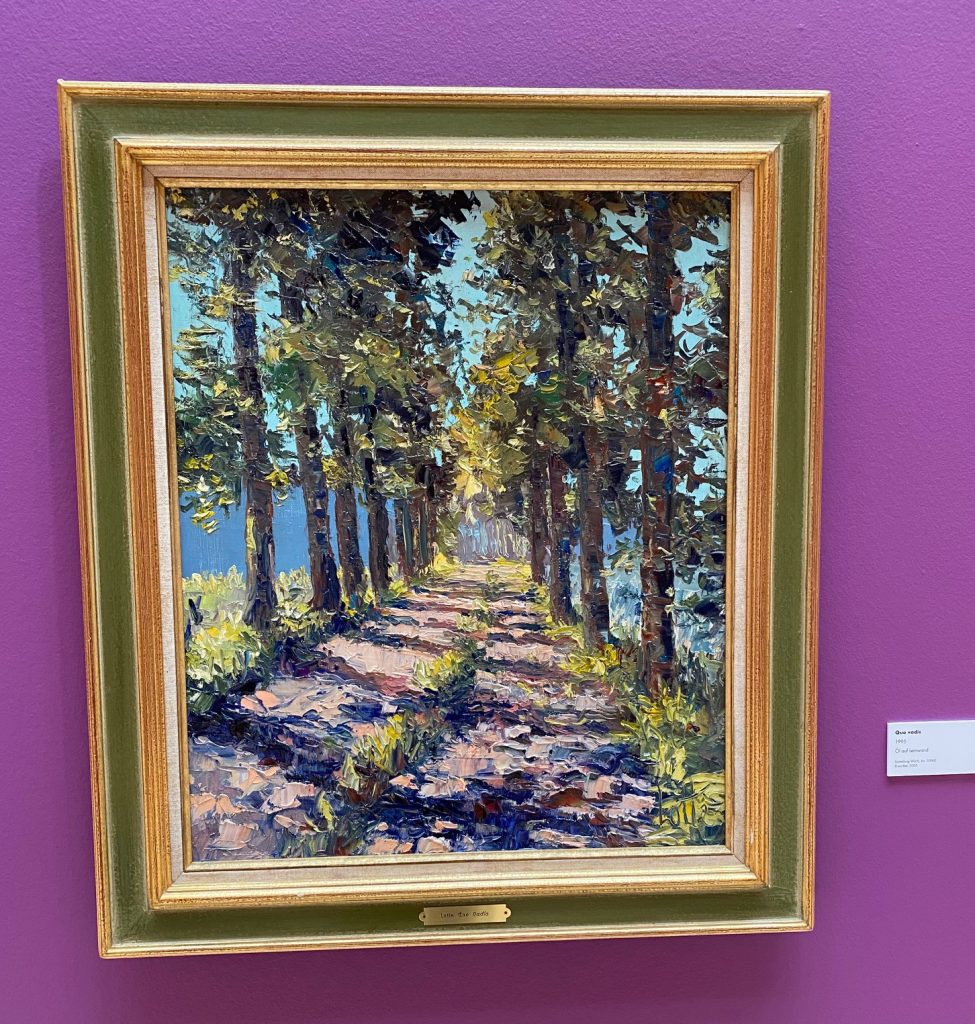
Im Forum Würth in Chur lässt sich in 2023 eine erfrischende Ergänzung zu der ebenfalls in Chur zu besuchenden Ausstellung der männlich dominierten Giacometti Familiensammlung erleben. Lotte, die Malerin, hat ein umfangreiches Werk von erlebten Landschaften hinterlassen. Dem Mäzen Würth ist es gelungen, einen bedeutenden Kontrapunkt zu setzen mit seiner Wertschätzung durch den Ankauf einer großen Sammlung. Weg von der bloßen Darstellung von Frauen durch Männer, hin zu Sichtweisen von Frauen. Im Begleittext zur Ausstellung wird treffend von einer Art bildlichem Reisetagebuch gesprochen. Ein Thema das den Kunst und kulturellen Diskurs in Chur seit Jahrzehnten beschäftigt. Aus der Gegenüberstellung zu den Giacometti Werken ergibt sich die Jahrtausende alte Frage des „l’homme qui marche“ und diese war und ist: „quo vadis“. Das ist denn auch der Titel eines im impressionistischen Stil ausgearbeitetes Gemälde von Lotte. Es ist gut in Szene gesetzt, auf violettem Hintergrund. Mäzene können Impulse geben, die dem oft beliebig erscheinenden Kunstmarkt emanzipatorische Anstöße geben. Kostenloser Besuch im Forum für reisende Familien besser als jeder Stopp an der Tankstelle, obwohl wir vor Ort richtig vollgetankt haben, im übertragenen Sinne.
Giacometti
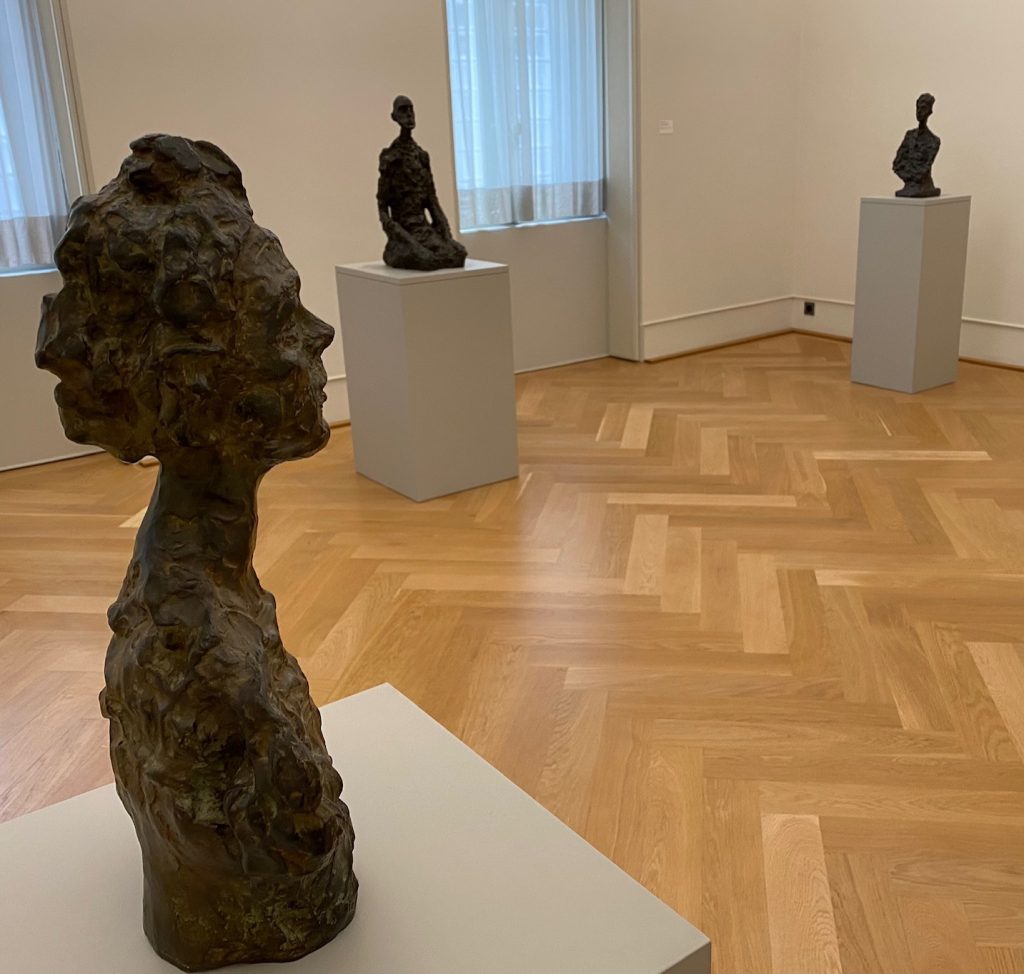
For everyone who enjoys a good walk, with or without dog, Alberto Giacometti is an artist of interest. The world-famous statue “L’homme qui marche” can be admired in several places. Chur (CH) is the artist’s place of death. The most prestigious galleries in Switzerland all have one or several of his art works. In the Bündner Museum in Chur three sculptures of women are perfectly put into correspondence in one exposition room. Eli and Anette from the years 1961 and 1965 talk to Francine with her arms closed in front (title: buste d’une femme). The latter one is from 1962, but was only finished and released as sculpture in 1966, the year of his death or departure. This seems to close a wide circle of creation in the life course of this itinerating artist. Walking the exhibition from sculpture to sculpture is a first step towards meditation walks. Awareness of the stories of the personalities involved widens our horizons. Alberto Giacometti is one of the many artists from the family of the Giacomettis. In the museum in Chur the other family members are well represented, too. Women artists seem to be missing there, probably this needs additional generations.
Errance
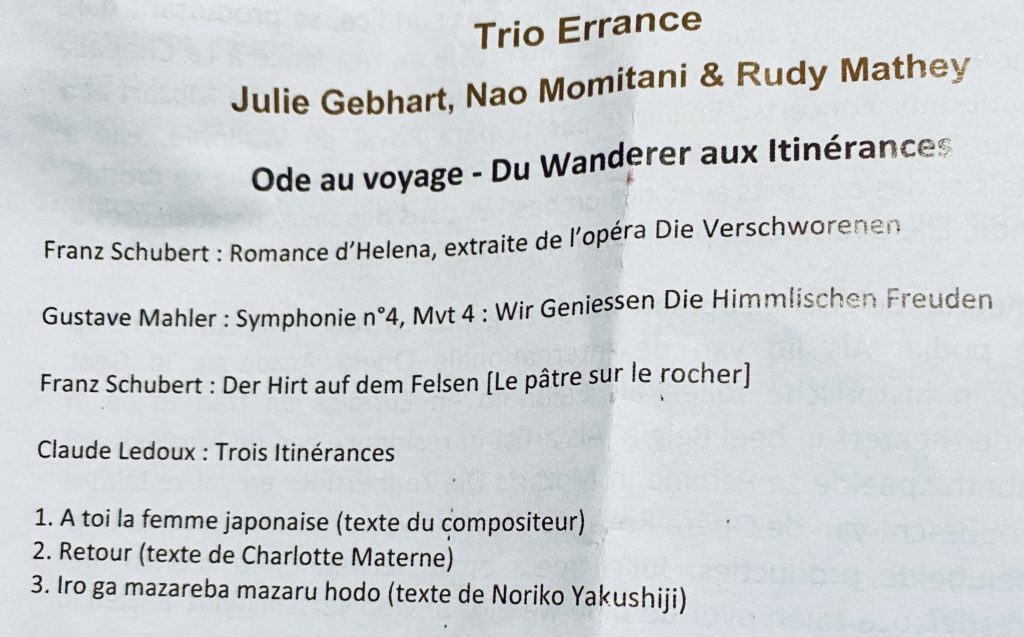
Das musicorum Festival in Brüssel ist gut für außergewöhnliche Überraschungen. Am 20-7-2023 gab es dort ein Konzert des Trio Errance. Sopranistin Julie Gebhart, Pianistin Nao Momitani und Klarinettist Rudy Mathey hatten ein kurzweiliges Konzert mit dem Titel Ode au voyage zusammengestellt Von Mahlers Auszug aus der 4. Symphonie 4. Satz „wir genießen die himmlischen Freuden“ wanderten wir Schuberts Hirten auf dem Felsen folgend zu den modernen „trois itinérances“ von Claude Ledoux. Von Romantik bis zur Trauerarbeit nach dem Attentat in Brüssel 2016 waren wir auf traumhaften sowie traumatischen Reisen. Dank dem hervorragenden Trio und dem Komponisten in Anwesenheit mit kurzer Einführung haben wir uns nicht auf diesem Weg verloren gefühlt. Emotional gestärkt sind wir auf dem Weg vorangeschritten. Eine wirkliche Feier- und Gedenkstunde.