Death and rebirth of author

Over the long run there have always been times when the death of the author had been announced. With the arrival of the printing press and the ease to mass produce prints and books, previous authors’ books could flood the market. Obviously this could put new authors at the risk of finding no audience anymore as printers asked cash upfront before printing. The economic risks were solely on the author’s side. Ebooks became a risk to publishers as authors had an additional alternative way of publishing. Then the advent of the internet changed again the world of books and publishing. Global distribution became an option. Thousands of authors could have died because authors from around the globe became more accessible. None of these threats have materialized. Publishing on a global scale is fine, only European publishers are concerned about a shrinking market. AI facilitates entry in new markets and AI could kill already struggling authors. Instead, AI opens up lots of opportunities for authors as well. Editing and translation services become more accessible to low budget production. The next wave, some claim a tsunami, shall submerge the publishing industry. Quality, selection of innovative content and events associated with the content shall still make the difference. There is neither the death of the author nor of the publishing world due to AI. On a global scale many new voices can be discovered, probably assisted a great deal by AI who would never have dared to become an author and to enter into the world of publishing or self-publishing. (Image: Korea at Frankfurt book fair 2026-10)


Korea at Frankfurt book fair 2026-10

Gaps in Mirror

The legendary figure of “Till Eulenspiegel” (name is a composition of “owl” and “mirror”) is still attracting attention, largely because of his way to reach and sometimes expose ordinary anomalies. We have mirrors all around us, as well as explicit historical details, but we tend to overlook or create voluntarily gaps into mirrored images of the past and their reflections into the present. The novel “The Gaps” (Die Lücken) by Shida Bazyar exemplifies, why dealing with history on a local level is of utmost importance for societies to be aware, deal and transmit fundamental human values. Till Eulenspiegel of the 21st century has a migration background and experience of care work, 2 fields at the cutting edge of humanity. Dealing with the gaps in narratives of locals enters visually into the novel as well. We ar caught t “automatic lly” read ov r the g__s before we realize how huge the gaps in narratives and our mirrors of the past can be. The novel is a great reminder to actively deal with our own gaps. Check the mirrors as well, there might be gaps that blur images of the past.

Latent social structure

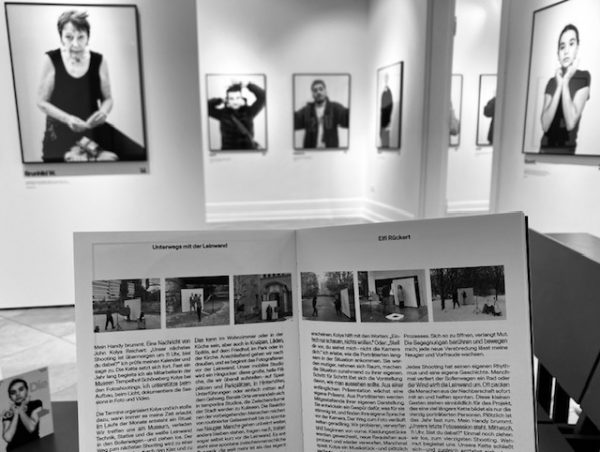
In empirical approaches to sociology we occasionally apply “latent variables analyses”. The aim is to uncover links between data that are not obvious in standard analyses of data. We are pretty convinced by evidence that age correlates with the probability of death. However, most tragedies are created around exceptional counter examples to this “rational expectation”. We also somehow have an intuition about the positive effect of social networks or the social fabric in a more general sense on living and survival. In some of those latent variable models we find evidence for an underlying factor without being able to properly name or frame it. Hence, as social scientists we continue to be interested in ways to make latent social structures more visible. With such an approach in mind I visited the exhibition by author and photographer “John Kolya Reichart” in the “Schöneberg Museum” entitled “Die Kette” (The Chain, 2026-5). The start of the chain is a familiar person in your neighborhood who leads you to the next person and so on. It is explicitly a non-random procedure, which complements proceedings of strictly random sample selection of survey methodologies. The sources for bias outcomes are multiple, however, an underlying or latent social fabric of a friendship and support mechanisms can be shown. Besides the b/w portraits and audios, giving a justification for the choice, the documentation of the process of production gives more insights into the risks and potentials of this form of insights into latent social structures.
(Image: Schoeneberg Museum, “Die Kette” by John Kolya Reichart)

Vaim and the sea

Vaim is not a person, it is an imaginary place, somewhere next to the sea, rather small in size, and in conventional terms nothing much is happening there, aging persons go about their daily routines in their more or less splendid isolation, speaking to someone is a rare act of achievement, most of the talk is speaking to yourself not even really thinking aloud, just ruminating on and on for days, sometimes weeks or maybe years in a person’s life 

Okay, my exercise in “slow writing”, a wee bit attempting to copy Jon Fosse, kept me going for 10 lines before the end of my paragraph. Jon Fosse keeps going without the end of a sentence  punctuation for 66 pages in the German translation by Hinrich Schmidt-Henkel. Reading the three phrases of Vaim, each as an extended poem and an “homage” to life from three intertwined perspectives, resembles a cubist painting and, maybe, at least for me, each one like the novella “The old man and the sea” by Ernest Hemingway. It is also a triptych in the religious tradition of paintings, just as much as “Vaim” follows in the footsteps of “Waiting for Godot” by Samuel Beckett. For all those who don’t care about any previous literature just read Jon Fosse as an endless love story of platonic relationships, silence and romance,  next to the sea. Please, don’t pass on your copy of Vaim to school-aged children as they might become very creative about punctuation. The only allowed end of a sentence are occasional question marks, which is a nice philosophical twist in Jon Fosse‘s literal exploration of time and love. 


Sociology in Theatre

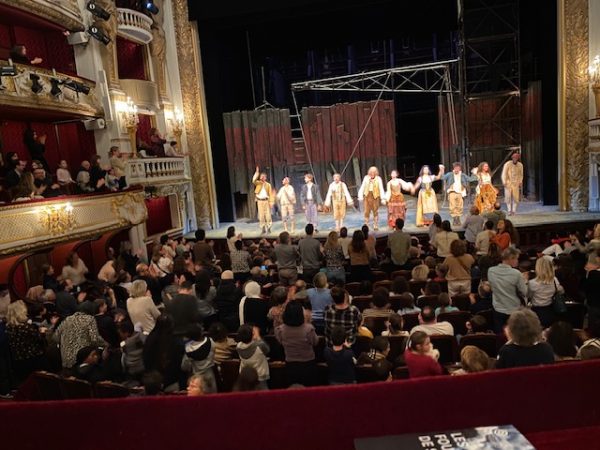
Thanks to the inspiring direction by Denis Podalydès of Molière’s “Les fourberies de Scapin” we can experience the fruitful application of sociology to classical theatre production. This combination of thoughts has been performed at the “Comédie Française” for more than 7 years in 2025-11. The accompanying booklet of the performance mentioned the ample inspiration of Denis Podalydès by the French sociologist Pierre Bourdieu. Personalities in Molière’s theatre are represented as incarnations of the “habitus” each character stands for. Such an interpretation of the roles in the theatre play, raises awareness about the subtle differences between personalities. Even two rich men may differ in their habitus, because their fortunes are of different size or kind, yet they may share even more personality traits. Molière was a particularly crafted author, director and actor to stage such subtle differences, which are embedded into societies often across generations.  

Racine Andromaque

The representation of Jean Racine’s “Andromaque” in Brussels at the Theâtre des Martyrs in 2025 has been an interesting choice, because the revival of a 17th century tragedy dealing with the intricacies of the Greek and Trojan war (mostly remembered for the Trojan horse). Jean Racine turned French theatre back to tragedies with his Andromaque (Résumé and analysis in French!), rather than the comedies or tragi-comedies of previous great authors like Molière.
The literary analysis of Andromaque by Roland Barthes (“Sur Racine”, 1963) identified 3 separate locations: chamber, anti-chamber and exteriors. The real power seems to live in the chamber as the place of respect, but also terror. (Compare also Mithridate). The anti-chamber is the place of diplomacy and the place of exchange of ideas, information and strategies. The exterior world is mostly closed off through walls or balconies as views from above. For Barthes this “symbolizes” even the prison inside or the pure heroic life inside the walls.
Besides this 21th century interpretation of 17th century theatre, Racine is remembered for his tragic love stories where A loves B, but B loves C and, maybe C falls in love with A. (Compare Robert Horville, 1991) The Condorcet paradox (Science of it) described only formally in the 18th century enlightenment, many decades later, had proven mathematically that such combinations of personal preferences are impossible to resolve. Hence, these confusions are great stuff for tragedies to evolve live on stage.  


Marx Home

The home of an influential philosopher, economist and political scientist is not easily presented like a home of a musician, a composer or an author. However, the home of Karl Marx in Trier on the Moselle river succeeds to present the biographical links of growing up in a historic city, the bourgeois upbringing of the young Marx and his formation as an independent and even revolutionary thinker of the economy and society. In 2025 the home is a museum supported by the Friedrich Ebert Foudation with a great online guide and access to additional scientific material. For authors like Karl Marx it is always of interest to follow not only the origin and evolution of the thought process, but also the shifts in the reception of his writings by subsequent generations. This part of the exhibition and an audio guide (downloadable as App).

In 2025 with an apparently ruthless capitalism at work in the biggest economy of the globe, the reminder that the economy is best to be understood as a political economy, which focuses on self-interest and profitable business deals, we find in Karl Marx still a worthwhile reminder of economic development even in the 21st century. The note-taking and studies in Exile in London are well documented in the tiny home and museum. Studying the misery of exploitation in supply chains and international commerce remains a topic of continuing interest as well. 

Intimate housing

The housing of famous persons has always attracted a lasting fascination. The “esprit des lieux” or the experience of the surroundings of an artist, composer, author or otherwise famous person, where most of the work had taken place is of general interest. In today’s language we would describe this as the context of creation. Biographical information and references to specific objects central to the process of creation play a crucial role in understanding what is behind human creation as it is district from AI. There are objects ( compare MAD Paris) and there are the social networks of creators. Modern biographies include both, some even in graphic forms similar to ancestry diagrams. 

The design of intimate living spaces for private life or the adequate environment for creativity are becoming more clear with the consciousness of the importance of dedicated designs of furniture, accessories and even scent. Our brains are multimodal and working as well as processing lots of information even beyond our conscious realizations. This black box of creativity is rather unique to the human brain and AI will probably take decades to emulate such complex processing. The MAD exhibition reveals that intimacy is also related to housing design and interior design. It doesn’t seem to be a random process, but habituation is part of the continued creative process. 

Theatre Archives

The process of creation in the realm of theatre performances has manifold facets. The French National Library (BNF) in Paris has received the archives of the „Théâtre du Rond-Point” in 2023 and honors the donation with a fascinating exhibition on the immense creativity of the author, scenarist and director Jean-Michel Ribes. (Image below) The professional diaries of Jean-Michel Ribes and the documentation through photographs from the performances and video extracts allow an intimate view into the hard work of producing theatrical performances, popular television shows and comedies. Jean-Michel Ribes took notes of all sorts and kept extensive lists of potential collaborators, actors, daily occurrences and just nice sounding phrases. From just a simple phrase heard on the streets he developed a small piece to be performed in shows. Listening to the people and enriching this with great actors in superb scenery made his popular success. The creativity seems to derive from ample note taking and coming back to them eventually.

Mangel Armut

Herta Müller hat bereits 2012 in „Das Chinesische Glasauge“ sehr treffend die Funktion von Mangel und Armut in Diktaturen beschrieben. Sowohl der ständige Mangel als auch die Armut dienen als Instrumente der Macht. Sie sind quasi die Fortsetzung von Ideologie zur Beherrschung der Massen. Zusammen bilden sie die Umgebung, den Kontext in dem dort gelebt wird. Die Herrschenden jedoch haben Privilegien, die sie von der Allgemeinheit absetzen. Diese knappe Beschreibung und Einleitung zur Kurzgeschichte haben eine große Portion Allgemeingültigkeit. In Mangel und Armut können kleine Vergünstigungen eine viel größere Wirkung entfachen. Sehnsüchte nach mehr werden nahezu zwingend hervorgebracht. Allein die Aussicht auf ein teilweises Stillen der Erwartungen oder nach mehr entfachen weiteres „höriges“ Verlangen. In Diktaturen werden die Personen, die unaufhörlich auf die Armut und den Mangel hinweisen meist geächtet oder sogar ins Exil gezwungen. Solche Störenfriede sind nicht gern gesehen. Das Russland unter Putin braucht Leute der herrschenden politischen Klasse zujubeln und bereitwillig in den Krieg ziehen oder an der Kriegsmaschinerie mitwirken. Wir sind mehr als eine Dekade weiter, aber diese Zusammenhänge bestehen ebenfalls weiter. Schmuck in der Mangelwirtschaft ist bereits eine Provokation. Das offene Tragen der Provokation kann im schlimmsten Fall das Leben kosten.
(Image: Herta Müller, 2023, Eine Fliege kommt durch einen halbern Wald, Carl Hanser Verlag, “Das Chinesische Glasauge”, S.50-61)