Emotional paradox

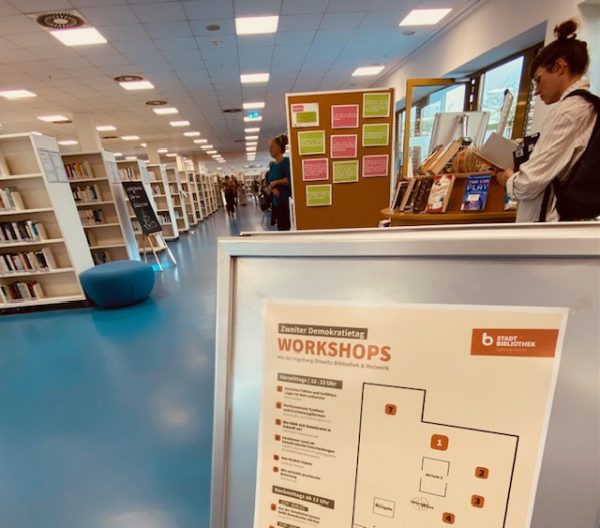
Democracies face an intrinsic paradox. High aspirations before inauguration, rising negative emotions during polarizing democratic periods and high positive emotions towards democracy after the loss of major components of it. However, This constitutes a working hypothesis in need of further research of its historical validity. Some active defendants of democracy have organized already sessions to speak about emotions in democracy. On the occasion of the International Day of Democracy a local initiative in Berlin (Mutwerk) took up this topic and brought together representatives of many local initiatives to foster the wealth of positive emotions due to democratic rule in southern Berlin. (Image: Public library Berlin Steglitz democracy day 2026-9-14)

Public library Berlin Steglitz democracy day 2026

VCs shun SA

Venture Capitalists have an eye on long-term safety of investments. Political upheavals, unrest or instability can deter investments as much as risks to the safety of the workforce. The abbreviation “SA” in Germany has at least 2 meanings. (1) Historically, it refers to the “Sturmabteilung”, which was important in the rise of the Fascist movement and Nazi-terror in the 1920s, 1930s. Foreign investors were right to shun away from investments during the rise of the Fascists in Germany as a total loss of the investment was to be expected. (2) In 2026-8 the abbreviation “SA” in Germany stands also for “Saxony-Anhalt”, one of the Federal States of Eastern Germany, formerly the GDR between 1949-1990.
The “Wallstreet Journal”, which is read by many international investors showed on its title page of WSJ 2026-9-7 a report by Bertrand Benoit on the disastrous election in Saxony-Anhalt giving the extreme right-wing party AfD close to an absolute majority of votes. The abandoned investment by Intel into a chip-production near the capital of SA, Magdeburg, has been in retrospect a rather wise investment decision. The internationality of the employees, who build and operate such plants, might have contributed to them feeling rather unsafe in a hostile environment towards foreign workers.

intel processor logo

Democracy or Democrisis

Measured on a global scale, democracy is in retreat. The report by the “Varieties of Democracy Institute” indicates that there are fewer people on the globe who enjoy the freedom and benefits of democracy overall. This is measured in domains like freedom of expression and the democratic quality of elections. The prevalence of democratic decision-making in opposition to autocratic ruling is closely related to the possibility to freely elect a new government in regular time intervals. The V-Dem Report 2026 indicates that 18 countries are on a favourable democratic development trajectory, whereas democracy is on the retreat in 44 countries. The freedom of expression suffered most (44 countries) and the quality of elections suffered in 22 countries. The positive developments (11 for freedom of expression, 7 for quality of elections) were outnumbered by negative ones. The cases of big countries with negative trends towards or tightening of autocratic ruling deteriorates the overall number of countries and specifically the number of people living in democracies in 2025 on the globe.
For all those living in lively democracies this should be a warning message (South Korea), that democracy is not a given. The enemies of democracy are working continuously from external territories to undermine a country’s democratic structures and decision-making. It is urgent to raise the quotas and limits by which fundamental democratic rules can be abandoned before it is too late. Let’s prepare a “defensive democracy doctrine” in Europe and the EU to signal more forcefully our willingness to stand up for freedom and democracy as fundamental values of humanity rather than an “Animal Farm“.

Democracy in Nepal

Nepal has witnessed a peaceful revolution in which the young generation of Nepalis has “out-smarted” the previous rulers of Nepal. With close to a 2/3 majority of seats in parliament (Nepali Times), the RSP as the party of a somehow charismatic musician and performer has a 5 year mandate to tackle the many challenges to bring real change for Nepali people. The hopes are running high that corruption will be contained and enough jobs inside Nepal can be created for the young. The positive sign, that many Nepalis migrant workers who had left the country now return to Nepal, encourages further support by international donors and investors.
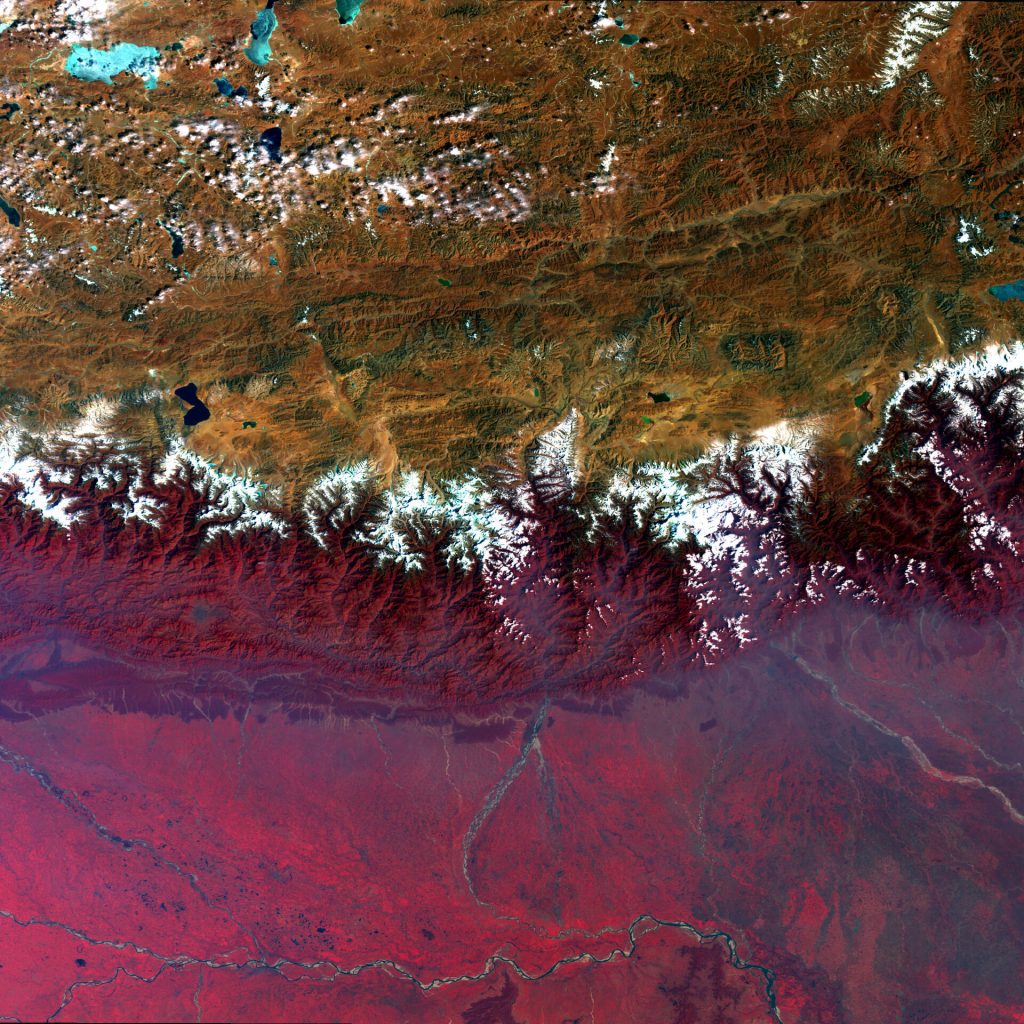
Running a democratic election in a country that comprises the Himalayan mountainous region is confronted with a particular challenge to make every vote count as communication with remote areas takes additional time and effort. Campaigning through social media can be more effective only if even remote areas have reliable access to the internet. Inter-generational assistance is often a precondition of timely access to information. The Himalayan region experiences already the effects of global warming as melting of glaciers. It is the youngest generation that will have to confront the consequences. Time to take government in their own hands, and beyond a one man show. (Image: ESA Himalayan Mountains, ESA Standard Licence) 

Time in Leadership

We identified already the importance of monitoring in democracies. The same theoretical considerations hold for an analysis of leadership irrespective of the organizational context, be it a government, governmental organization, non-governmental organization, association or private enterprise. In democracies, it is in most cases a constitutional rule that leadership positions are limited in time and it is “best practice” to have clear rules about renewable terms of office as well.
In private enterprises this seems to be of lesser importance, but the issue deserves more close scrutiny, not only by shareholders in case of a shared ownership or stocks. A particular person in the leadership position might be a good match for a company at times of growth or scaling of a start-up, but the same leadership is less likely to be an equally good match for the period of eventual stagnation or shrinkage.
Therefore, as an alternative hypothesis it might be wise to adopt leadership rules similar to filling leadership positions with politicians. Fixed-term and 1 renewal could be worth testing at the leadership level (like in presidential republics, USA or France), even if this does not preclude close monitoring of leadership processes. As a starting point for empirical research, Vogel, Raes, Bruch (2022) offer a toolkit to assess organizational energy and leadership trajectories. Learning from democracies as well as democratic procedures might be a worthwhile leadership model to follow. (Image: ceiling painting in chateau  Vaux le Vicomte)

Democracy in Energy

Can there be democracy in energy? Power supply and power distribution are core topics in the theory of democracy as well. One of the foundations of democracy is the separation of power into a legislative, executive and a judicial power. A resilient democracy can assure a sufficient functioning of this fragile “balance of power”. In an energy market or a nation’s energy distribution a comparable balance of (electric or gas) power provision might be envisaged. The costs of parallel infrastructures of power distribution are high, but the resilience of overall power distribution will benefit. Also from a redundancy perspective, more than one distribution system may step in if there are failures or delivery problems with one of the distribution networks. The democracy in energy perspective goes beyond this simple analogy. Power supply as well as power distribution have been concentrated in large public or private enterprises, which might care little in terms of security or reliability of the overall system, not only during armed conflicts. Independent energy production and use, for example through wind and solar energy including batteries have pushed the feasibility of more democracy in energy to new boundaries. These technologies have enabled a new bifurcation and make room for more democracy in energy. It is a rather realistic version of a previously rather utopian vision.

State capitalism

It is the 2025-12-17 edition of the Wall Street Journal (WSJ) that touts President Trump’s governance as “state capitalism”. Through a listing of recent state interference into the functioning of the economy, the branding of this as state capitalism by the capitalist-owned press is without precedent. The President’s office has obliged NVIDIA to pay 25% of revenue from its China business on advanced semi-conductors to the Trump-run government. We might call this a kind of kick-back or blackmailing, if you want to expand or keep your business with a specific client. Major institutions like the Central Bank (Federal Reserve in the USA) are tackled to follow state orders rather than keep an eye on their independent assessment of facts about the economy. Nomination of governor positions have been subject to persistent interference from the president’s office rather than the government taking a moderating role of divergent interests, competences and lobbying.
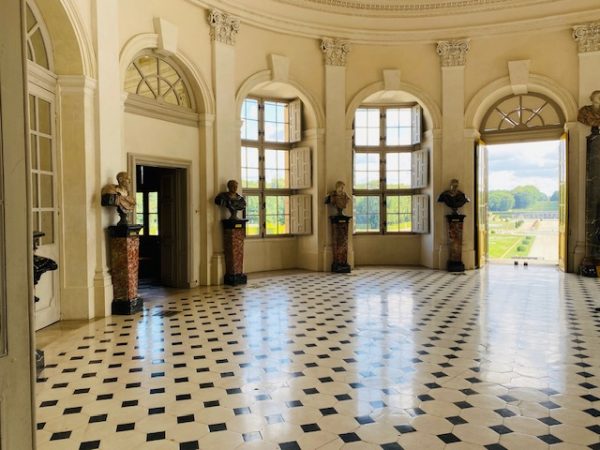
The medium and long-term inefficiencies of an “at-will economy” have several examples, many in South American economies. The US economy is moving South in several respects, with the loss of the value of the $ compared to the €, maybe even devaluation is used as a strategic economic weapon. (Image: Ballroom in Chateau Vaux-le-Vicompte, France)

Deep Fake Threat

Our Western democracies are aware that “deep fake videos”, radio, online-newspapers and most of all social media platforms are all around us already. However, more scientific voices alert us that this threat to our easy or comfortable way of life to consume information eventually threatens the survival of our democracies. Previously, interference in elections used to focus on rigged election procedures, but in the 21st century powerful other alternatives can do the dirty job to bias elections against the original intentions of the electorate. The widespread use of AI will exacerbate the already practiced ways to produce deep fakes. In a preparatory self-test of an AI-assisted chatbot I was surprised myself of the quality of the output. A person not very familiar with my original voice in a second language would assume that it is me who is being interviewed in person. Based on a fake news text, any form will be automatically translated into voice only and/or video based on basic visuals.
Statisticians used to joke some decades ago: “Don’t believe in any statistics, unless you faked it yourself.” This is meant to encourage people to be aware of dangers of the use of statistics to influence opinions or official decision-making, like in policy making of central banks, which might be based on biased accounting for shrinkflation, cheatflation or greedflation to name just a few,
Hence, the need to strengthen awareness, analytical skills and critical thinking should be high on the agenda to defend our democracies. There are not only external military threats, but additional ones masked as internal threats.
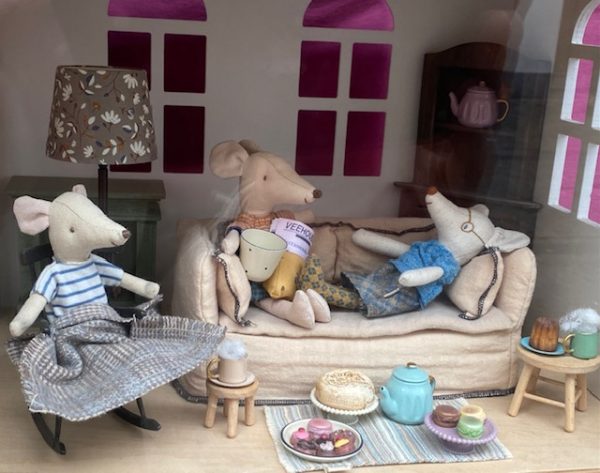
(Image:: mice as humans in living room 2 couch potatos 1 on rocking chair, tea time)
Fontainebleau library

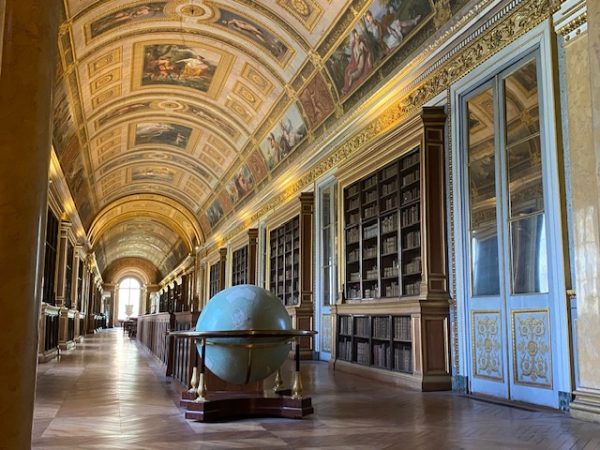
The “Galerie de Diane” in Fontainebleau has been built during Napoleon’s reign. It hosts the library with a large collection of books. The function of the books seems to be more to intimidate the persons passing by rather than ready for inspection. The globe at the entrance reflects the ambition of the ruler. The fact that you have to walk some stairs upwards increases the impression to be little compared to this universe of knowledge. It is great that libraries have flipped this perspective and today we study the period of Napoleon’s reign with our democratic values in mind. The top-down approach was the incarnation of Napoleon’s style of government. Despite the revival of such governance styles in the 21st century across the globe, they are unlikely to last for more years than Napoleon’s fate. A simple reason for this may be the only representative or intimidating role of knowledge in such forms of governance rather than an open mind approach. 

Korean Independence

The independence of a country is sometimes a long struggle. At particular points in time, a window of opportunity may open up, which allows to change the course of history. In many cases the opportunity to gain independence has been prepared for several decades, at least from 1919 onwards to come to fruition only after the end of the Pacific war, shortly after the Nazi-regime was defeated. The long and relentless preparation of the Korean Provisional Government ensured that a consensual constitution was ready to be adopted and elections to be held. The resulting division of Korea into 2 parts (South and North), just like East and West Germany, is rather long lived on historical time scales. For that matter, the hope of a peaceful unification needs to be reiterated again and again. The informative exhibition of the Korean Cultural Center to Belgium and the EU highlights the continued “Dream of Peace” which continues even after more than 100 years.