Artists Robots

We know that the scientific and artistic dealings with robots have a long tradition. Whereas art of impressionism took up the challenge to paint the world outside the studio and embellished technological achievements like bridges and trains post hoc, modern extensions of science fiction to the world of robotics has extrapolated from the present. Artists became forerunners of technical evolution and thereby contributed to the acceptance of artificial intelligence to broader audiences. In 2018 The “Grand Palais” in Paris hosted an exhibition on “Artists & Robots” (Pdf booklet). Jérôme Neuters contributed an essay to the catalog of the exhibition on “L’imagination artificielle” which identified a additional role for artists in combination with AI. Some of the early adopters of the new possibilities of robots assisting artists, Nicolas Schoeffer is quoted to state: “l’artiste ne crée plus une oeuvre, il crée la création”. Like an invention of painting techniques or light or perspective in painting, robots allow a new way of representation of emotions or space. (Image Manfred Mohr, 1974 video Cubic Limit, Artists & Robots p.92-93)

Planned Inspiration

There many ways to search for inspiration. “Moi aussi, comme les peintres, j’ai mes modèles” wrote Jacques Prévert a famous French poet years ago. Scientists find inspiration in data or theories, or in the combination of both. The planning of inspiration is, however, an other issue. You plan for something you don’t know what it is going to be. This makes the endeavor more risky and at the same time me exciting. As a social scientist going out into the “real” life is a sort of inspiration as multiple challenges await an explanation or deconstruction. The overview of current exhibitions through the scanning of catalogues from ongoing exhibitions is a welcome source to organize inspiration for the months to come. A glance through the catalogues gives a fairly good impression of what will be on display. The ideas can fly to distant locations and bring back more food for thought. It is a great service from the Munt library in Brussels. The combination of work and travel for inspiration is an interesting field of study in itself.

Searching Beauty

The search for beauty is an endless story of humanity. We have searched for it almost everywhere. Depicting beauty is probably the oldest form of artistic endeavors. We have invented numerous ways to find and represent beauty in a rather restless manner. We tend to find it in other persons of the same or other gender. The challenge is to keep trying to see the beauty in persons when others don’t, or don’t admit to it. Andy Warhol made this search for beauty his primary aim in his life as well as for his artistic work. The “Neue Nationalgalerie” in Berlin presents the, at times controversial, perspectives on beauty through the eyes and artwork of this exceptional artist. Beauty is at times a holistic concept or a detail by detail, piece by piece approach. Being open to other visions and versions of beauty is the major thrust of Warhol’s work. There is so much beauty around we just have to bother to focus on it. If not satisfied design it yourself. Start with a tour of exhibitions and experience the endless scope of imagination through the eyes of artists. (Image from Warhol exhibition in Berlin 2024 Neue Nationalgalerie, series „Ladies and Gentlemen“ 1975)

Deutsche Kinemathek

Just in the vicinity of the Potsdamer Platz in Berlin you’ll find the Deutsche Kinemathek, the museum movies, actors, actresses, directors and the history of cinema in Germany. There is a small specialized library in the Kinemathek that allows to dive not only into journals and books, but also video material, scenarios and accessories. Of course, you will find a lot of material on all sorts of movie stars (heroines) over more than a hundred years. The “Divas” of the industry take up a large part of the exhibition. “Marlene Dietrich” much more than “Hildegard Knef“, the former born and the latter lived for a long time in Berlin-Schöneberg (Berlin-Pretty-Hill as some locals call it nowadays). The 2 Divas probably caused the funny translation. Anyway, the hall in the Kinemathek which is exclusively devoted to Marlene Dietrich impresses with a lot of glamour and mirrors around.
For those with not only a biographical, but also life course interest in cinema cherish the public access to the library. The most impressive table there is the desk with access to the Ukrainian movies and about cinema in Ukraine. A list with QR-codes allows you to readily approach the recent developments before and during the Russian aggression on Ukraine (See image below). After all Potsdamer Platz in Berlin was a hot-spot of the cold war period in the divided Berlin. A little bit of a “Metropolis-atmosphere” can still be felt. The Kinemathek explains well what this is all about.

Surrealist 100

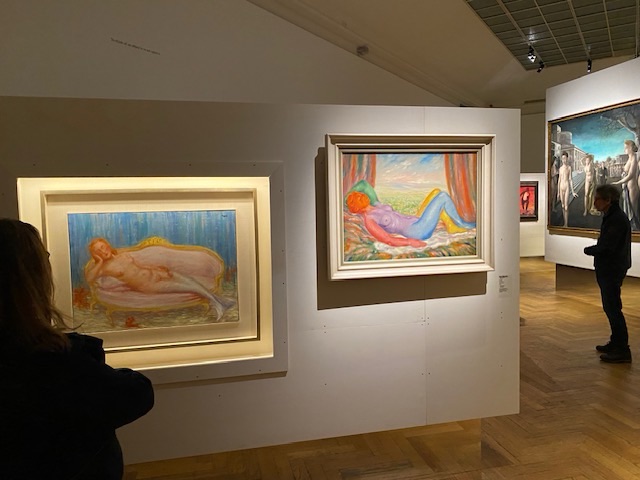
Belgium celebrates 100 years of surrealism with a special exhibition in Brussels at Bozar in 2024. The arts movement has much more to offer than just paintings from Magritte. Many other painters and intellectuals that were instrumental to create and perpetuate the movement are represented there. The French philosopher Breton as spiritus rector of the movement contributed innovative ideas and challenged the artists to do further and further on their journey to explore freedom of expression and freedom of association. The exhibition is centered around the surrealist idea to explore the association of words and images. This time the words are on the walls of the rooms and the images put up in the rooms as kind of obstacles on your journey. Keep challenging, keep questioning the sense of things and our imagination. The journey goes on and there are many artists who are still influenced by surrealism, for example Folon. The texts and images take you along on the journey into the surrealists’ world. If you want to challenge your own way to see things and the associative world, this is the place or catalog to refer to.

Bozar, 2024 100 years of surrealism

L’échiquier

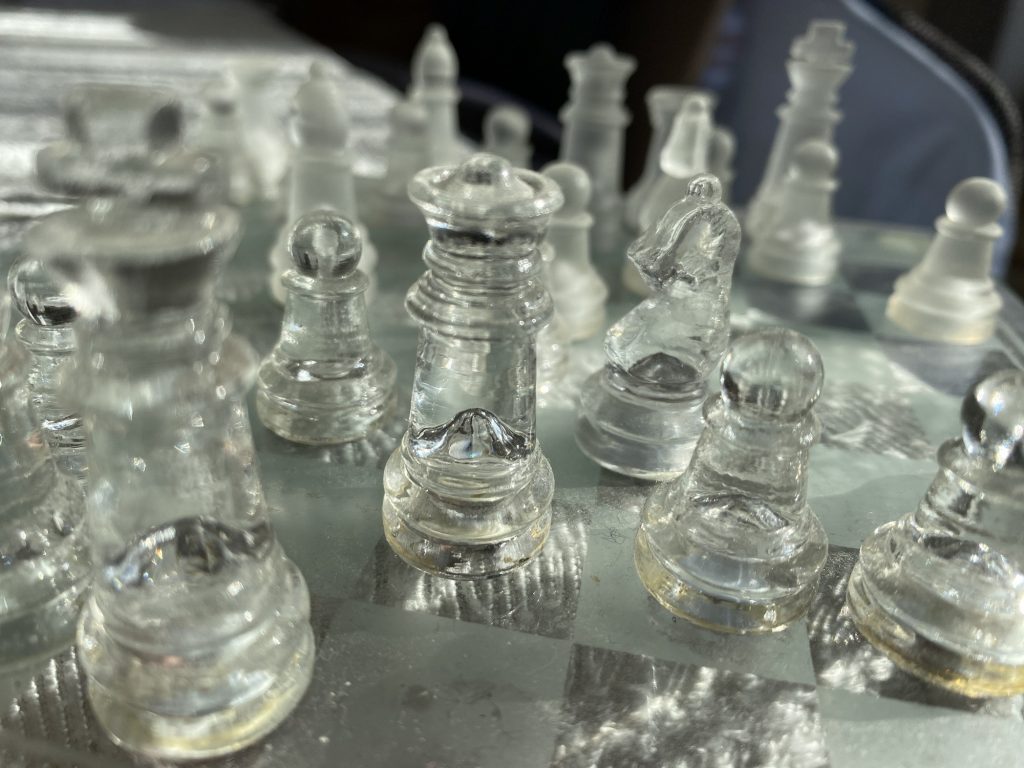
The game of chess has been subject of an ever increasing amount of literature. Not only historically the game, where two kings fight against each other, but the queens are the most powerful figures on the chessboard attracted a great deal of attention. We studied chess in books and watched live tournaments between the best players of the world. Most of this has successfully moved online and we have gotten used to losing against computers for almost all human beings some time ago. The internal federation of chess FIDE lists the top players male and female. The calendar of face to face events is still impressive. The federation operates somehow like a platform of players, as well as for players, to organize their lives as chess players. Anther kind of chess literature is the one that is constructed around the lives of chess players. Some characters get really absorbed into the mental or virtual world of the dialogue between 2 or more characters or players. The real world experience and the game on the board become intertwined or entangled. Losing or winning, to win or not to win, may unbalance whole personalities. Beyond the “Schachnovelle” von Stefan Zweig we have a new addition of fictional writing with autobiographical traits by Jean-Philippe Toussaint (2023) on our desks. « L’échiquier » is a story unfolding in 64 chapters just like the 8 x 8 spots on the chessboard. Of course, the story does not unfold in a linear fashion. It seems as if the players or opponents even change as the game unfolds. Maybe there are more than one game in action. Simultaneously as in some chess tournaments. Some games are blitz games taking just a few minutes, others go on beyond a lifetime. The experience of playing chess even against yourself has a psychological and sociological dimension. You can go round in circles for some or you are like “bowling alone” in the individualized society. About time to shed an additional light on the mystery of the chessboard. Self isolation with a chessboard was also a way of coping with the Covid pandemic. Some still suffer from long Covid and cures are not always easy to find.

L’échiquier, chessboard, Schachbrett

Folon Magritte

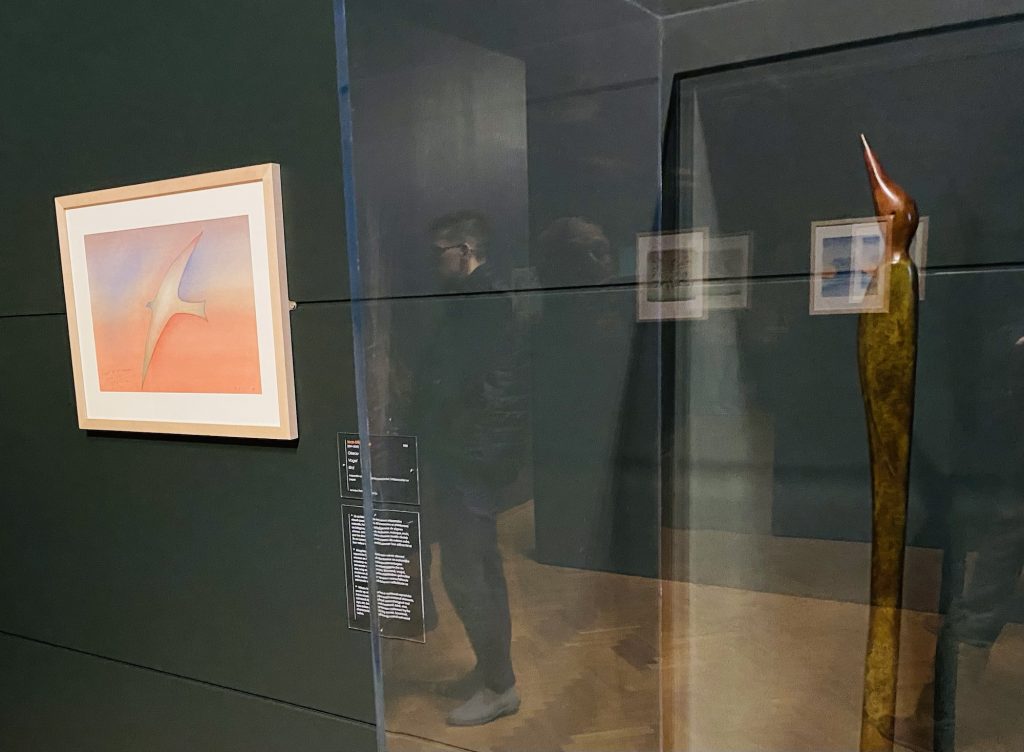
The exposition in Brussels on Folon and Magritte demonstrates the impact the latter had on the former artist. Both developed an iconic style of painting. Folon paintings apply pastel colors on paper. This style transforms images through the softened sometimes slightly blurred representations near a dream like realization. On the contrary in his sculptural work he uses hard materials to stimulate imagination and abstraction from reality. The side by side representations of Magritte and Folon is more a study in tracing influences and motifs across decades. The honor is just as much to Magritte as it is flattering Folon. Magritte had changed the life of Folon with his paintings and perspective on life beyond realism. Magritte‘s legacy lived on and Folon developed surrealism into a widely recognizable style with his paintings as well as sculptures. In walking around Brussels in 2024 you will inevitably come across some of the sculptures reflecting the work of Folon. The Folon foundation is continuing the pedagogical journey of the surrealist art movement well into today and tomorrow.

Folon Magritte Exposition Brussels MRBA 2024

Memory Management

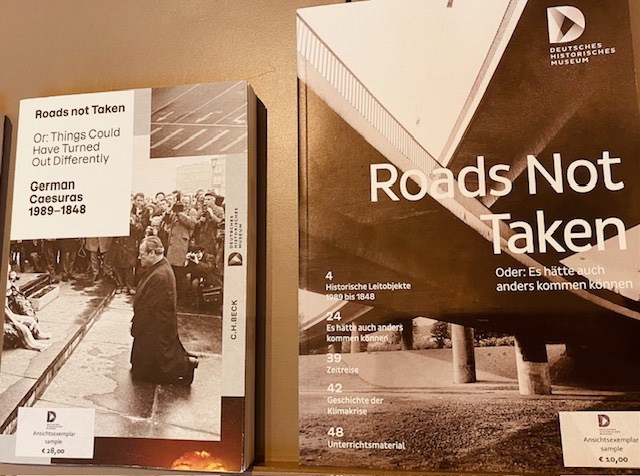
It seems a strange combination of words: memory management. In computing it has the function to allocate sufficient memory to specific tasks and has substantial implications for software performance (Yves Younan et al. 2010). It is also a security issue as what is stored somewhere might get accessed from other persons or programs with harmful intentions. Historians have a completely different approach to the issue. Individual as well as collective memories are frequently subject to memory management and manipulation. Therefore, it is necessary to critically deal with neglect and purposeful management of collective memories. In Germany we had numerous incidents of rectifying collective memories about the role of diplomats or the Wehrmacht during the Nazi period. Huge efforts were necessary to correct wrong representations of professions during and immediately after the 2WW. They are still necessary today. All children have to learn the concept of time, the past times and the concept of future. Periods after wars particularly generate a narrow focus on the present and the bare necessities of survival in societies. Dealing with and reworking the past and cherished memories is rarely attempted. It appears to be a paradox that without a coherent concept of the past the imagination about the potentials of the future are narrowed down. ‘Burned fingers’ cause additional restrictions. Literature for children and young adults has an important role to open up fictional spaces or laboratories for imagination. Freeing yourself from past restrictions while being aware of responsibilities due to the past allows a conscious way forward and human development. Sebastian Bernhardt (JuLit 3/2023) emphasised this and the Deutsches Historisches Museum had an exposition on this topic as well. Memory Management is a bit about the past but much more about the future. This is why we have to address it.

DHM 2024 Futures

Only for Kids

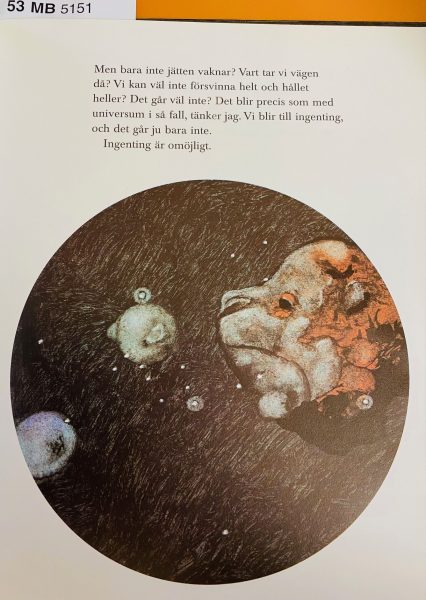
We all have, hopefully, fond memories of children books. Sometimes authors are not so keen to tell that they are just writing books for children. This is often present in many biographies of authors of books for children. This is grossly unfair. Not only is the book market for children’s books one of the best- selling part of literature, but there are lots of interesting collaborations between authors and illustrators. Most books are expensive to produce, particularly if, additionally, translations are needed to reach more children and their parents. For small countries this might be a barrier. The Scandinavian countries have a tradition to translate and publish some selected children’s books in multiple Scandinavian languages and beyond. Therefore, it is no surprise to find a children’s book entitled “Kant” by Norwegian author Jon Fosse, illustrator Roj Friberg with the text translated into Swedish and published by the Danish Editor Carlsen, all in 1990.
The illustrations allow to understand the “bilderbok med text av Jon Fosse” using an enlightening imaginative visual language. From the cover already It is clear we deal with the universe and endless open space. There are black holes in it as well. Jon Fosse deals with “möjliga och omöjliga”, possibilities and impossibilities. Tackling such philosophical questions with children needs the best authors to address these issues. How to speak of the unspeakable, things we have hardly any words for remains a challenge. Relating to the world of dreams, appealing to children and their parents, does the trick. After all, you just need to close your eyes and you start to travel the universe and make lots of exciting encounters. The book has no page numbers, interesting. The image below is from page 25, just as an appetizer.
For more insights of how to deal with “nothingness” I refer to Friedrich C. Heller (2020) “Towards nothingness. Ideen der Reduktion in zeitgenössischen Bilderbüchern” (in Benner et al. editors 2020). Susan Sontag (2005) „die Ästhetik der Stille” (in Eugen Blume 2005, editor) will also help us along on the subject of stillness and minimalism. Maybe it is these essentials we should talk more about especially with our kids.
To continue the exploration of space and stillness just go to the webpage of the hubble telescope or the James Webb Space Telescope. The journey of your dreams will be hard to stop.
World in Common

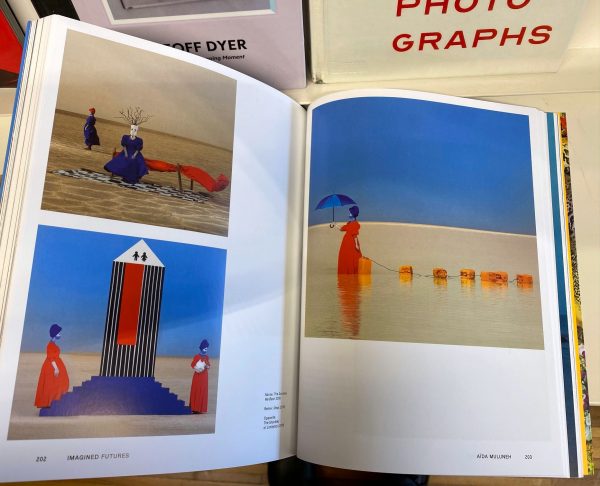
The Tate Modern Gallery in London has an exhibition of photography on display which challenges our Western view of art works. With a focus on photography and African photographers it is complementary to the many other photo exhibitions. We have a world in common, says the title of the exhibition. The images, however, reveal another vision of African photographers. Other perspectives on beauty, architecture and the distribution of wealth and waste across the world becomes explicit. Beyond the documentary effect of a lively African scene of photography and past colonialism the forward-looking vision of African photographers is also evident. Colours and Imagination of a unique kind allow us to look beyond the current state of affairs. Rising from the ashes and western waste the colours of Africa will prevail.
Only through the force to imagine a different trajectory for the continent we shall eventually be able to see new flowers blooming.
Positive images have to be put in front of the “negativity bias” in Western media when reporting about African countries. The light, the sun, the sea and coast lines, all can contribute to the rise of Africa in various ways. The photographers in the Tate exhibition demonstrate an impressive power to go beyond the day-to-day topics.
Broadening our scope of visuals with more images from Africa certainly are  fist steps to enlarge the spectrum of photography and art. A chance to browse through the catalogue allows to go back from time to time to counter our usual stereotypes. (Image taken from Tate catalogue A world in common, 2023 Muluneh Aida 2018 p. 202-3).