Family Music Days

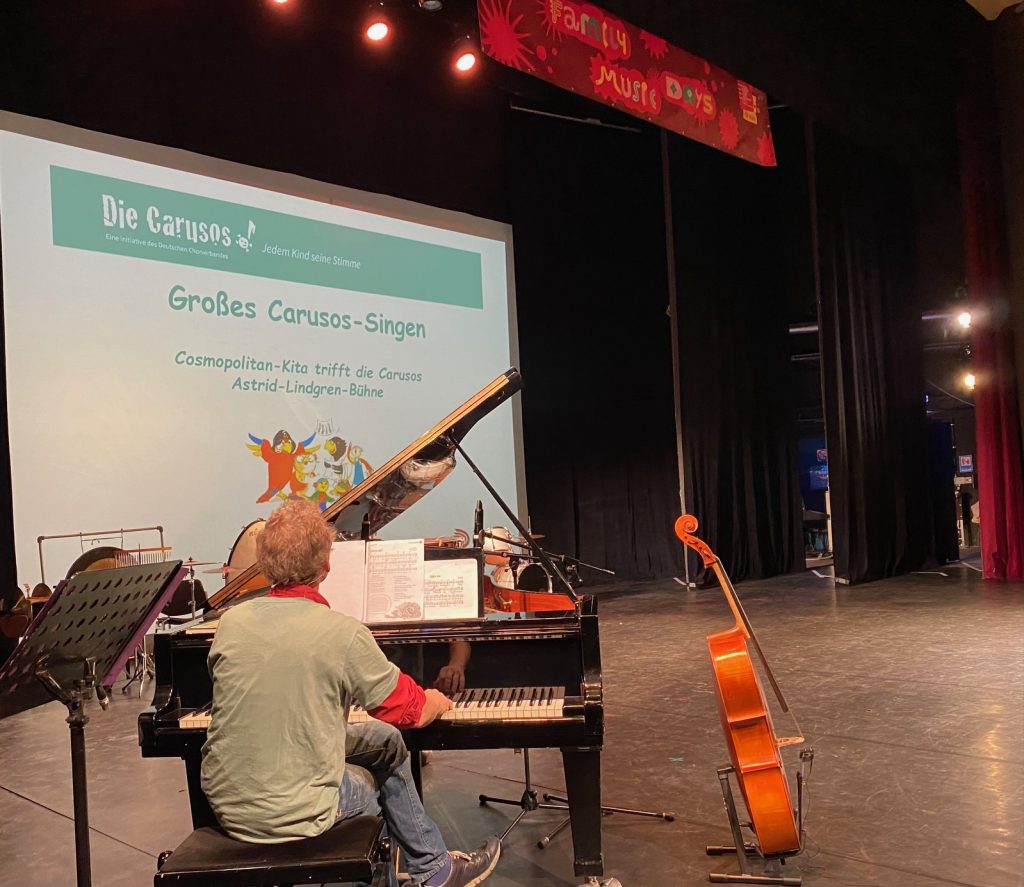
Kids are queens, kings and princesses as well as princes at the family music days in Berlin at the FEZ. Kids can enjoy the full spectrum of musical experiences from just listening to playing themselves, if they feel like it or dare to risk a sound. Just making noise is okay, too. Building your very own version of a musical instrument is a great learning experience for the young. To make music it doesn’t always have to be an expensive instrument. Your own imagination assisted by persons with patience and passion creates marvelous sound experiences. Initiating kids to the endless worlds of sound is having lasting effects on them. Great to see a concert hall full of young enthusiasts. Learning is so much fun, if taught in accessible and inclusive ways. Professional instructors joined by many volunteers make the world go round for kids. Wish you we here. Let’s spread the message.

Berlin FEZ 2024-3-16

Paper and Pastel

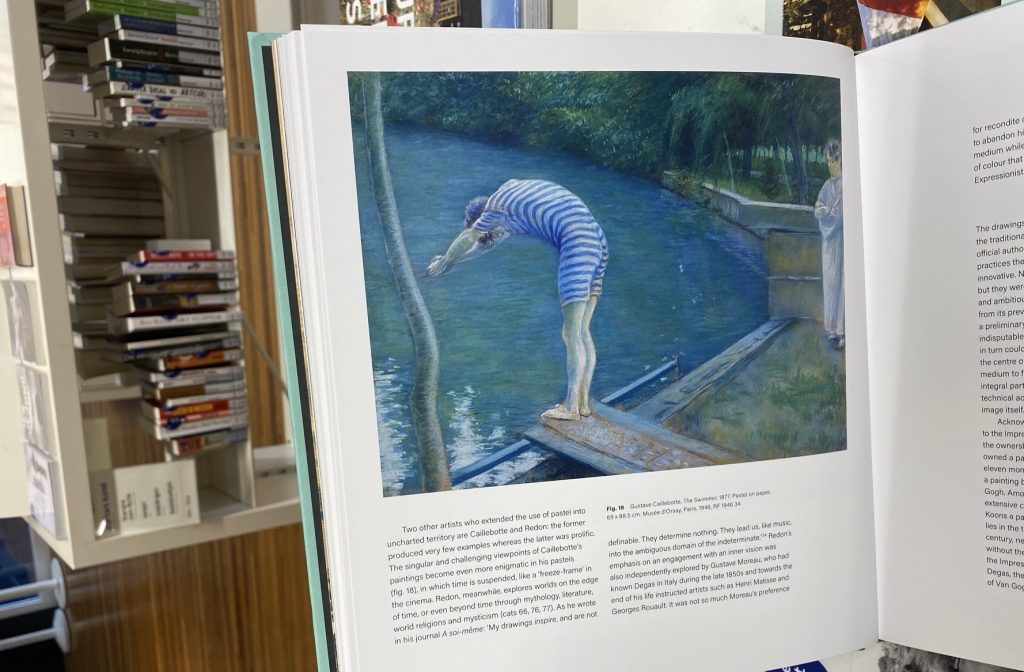
Sometimes the art is in the material. At least this could be a rapid conclusion of the exhibition presented in London at the Royal Academy of Art in 2024-1. From the informative Catalogue the importance of material is demonstrated. The ease of taking your equipment with you, like a sketchbook and out into nature have been an important feature of the impressionists’ movement. With artists challenging traditional techniques of painting and paintings as such even the apparently less noble material as paper had become a statement of being different from the established art academies making use of more noble materials. The impressionists made a convincing point with their additional use of materials accessible to all. Capture the moment and capture your very own impression of it. This is one way to immortalize the emotion and essence of the scene. In the catalogue of the exhibition I spotted “The Swimmer” drawn by Caillebotte with pastel on paper. Freezing the moment, freezing the motion and emotion is evident here, too. Testing different materials is part of the journey to find your artistic impression, expression or materialization of imagination. The ways and means are manifold.

Royal Academy, 2023: Impressionists on Paper. p 32

Force of dependency

Drugs have their particular strength in creating dependency. This is well known for tobacco or alcohol. Helping people to overcome the forces of dependency has its merits. At the same time it is big business. Vaping instead of smoking might be a way out one dependence but into another one. In the end it is an empirical question how many persons can escape the force of dependency of both types. Important to test the probability to get rid of the dependency altogether. With respect to hard, life-threatening drugs like Nitazene the death toll keeps rising in the UK. In the latter case changing the dependency is already a success. The sustainable deflection from drug dependency has to address underlying issues and health hazards. It is a rather individual issue. Society wide evaluation studies need to inform the debate also about placebo effects. The force of dependency might not only be physiological but psychological or linked to the social environment. All these potential effects have to be carefully sorted out before simple pseudo-solutions are implemented. Even the price and availability of drugs is part of the overall equation to solve the force of dependency.

Arthur Sapeck 1887 Illustration, BNF Pastiche 2023-4

Skill loss

There is a sense of skill loss in watching the trends to increase comfort. We all use washing machines and maybe dishwashers. Households can save a lot of time by using those machines. Some porcelain and clothes should not be left to the machines. The need to organize traditional washing routines is almost forgotten after 1-2 generations. The same holds for many technical skills. Bicycle and car repairs or small repairs of electrical appliances are delegated to specialized repair shops. Not using or having learned these skills puts you in a form of dependency and at the risk to pay a price for specializing on other skills. Find out and focus on what you are best at. This has been the mantra of economic theory since Adam Smith. The potential value of satisfaction with an own production rather than a bought product is frequently acknowledged for baking cakes yourself rather than simply buying one in a shop. The same rationale holds for many other skills. Autonomy of own production with possibility to improve or repair are forgotten values. The have become a luxury item or a necessity for persons lacking financial spending power to buy products from others. Many skills will be lost rapidly because products have become so cheap to replace or order for home delivery. Industrial production is desperately searching for skilled persons but losing skills is pervasive at the same time. Public schools and academic curricula will not be able to stand the tide of pervasive skill loss.

Topography of Terror

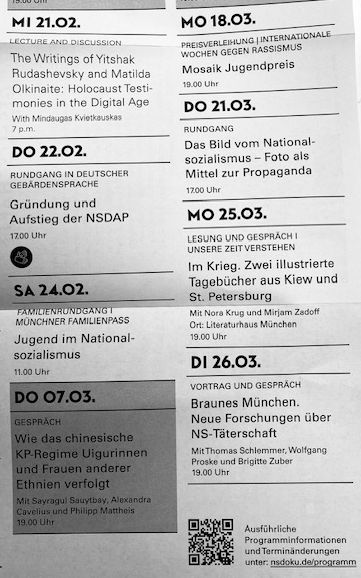
The documentation centre “Topography of Terror” in the middle of Berlin is easy to reach. The “Potsdamer Platz” is nearby and so is the “Kulturforum” with its galeries, museums and the “Berliner Philharmonie”.  The documentation centre gives easy access to the historical evolution of Nazi-dictatorship from the earl beginnings, the horrific terror spread across Europe and first insights into the prosecution of criminal acts in the immediate post-war period. The Beyond the  exhibition with audio-guide there is an easily accessible specialized library for personal or scientific research. The accompanying program of book presentations and discussions (image below) complements the busy show rooms. The external “walk through history” allows to grasp the main proceedings of the terror regime.
For special interest or research questions it is a very useful starting point. Hours in the library have to complement the research. Good to see that so many students walk through the documentation centre not only in groups from the neighbouring schools. The interest to understand when and how the terror started will allow us to better guard against those right-wing extremists who use a lot of techniques of propaganda well known and exposed in this documentation centre of the terror of the Nazi-regime.

Poster Design

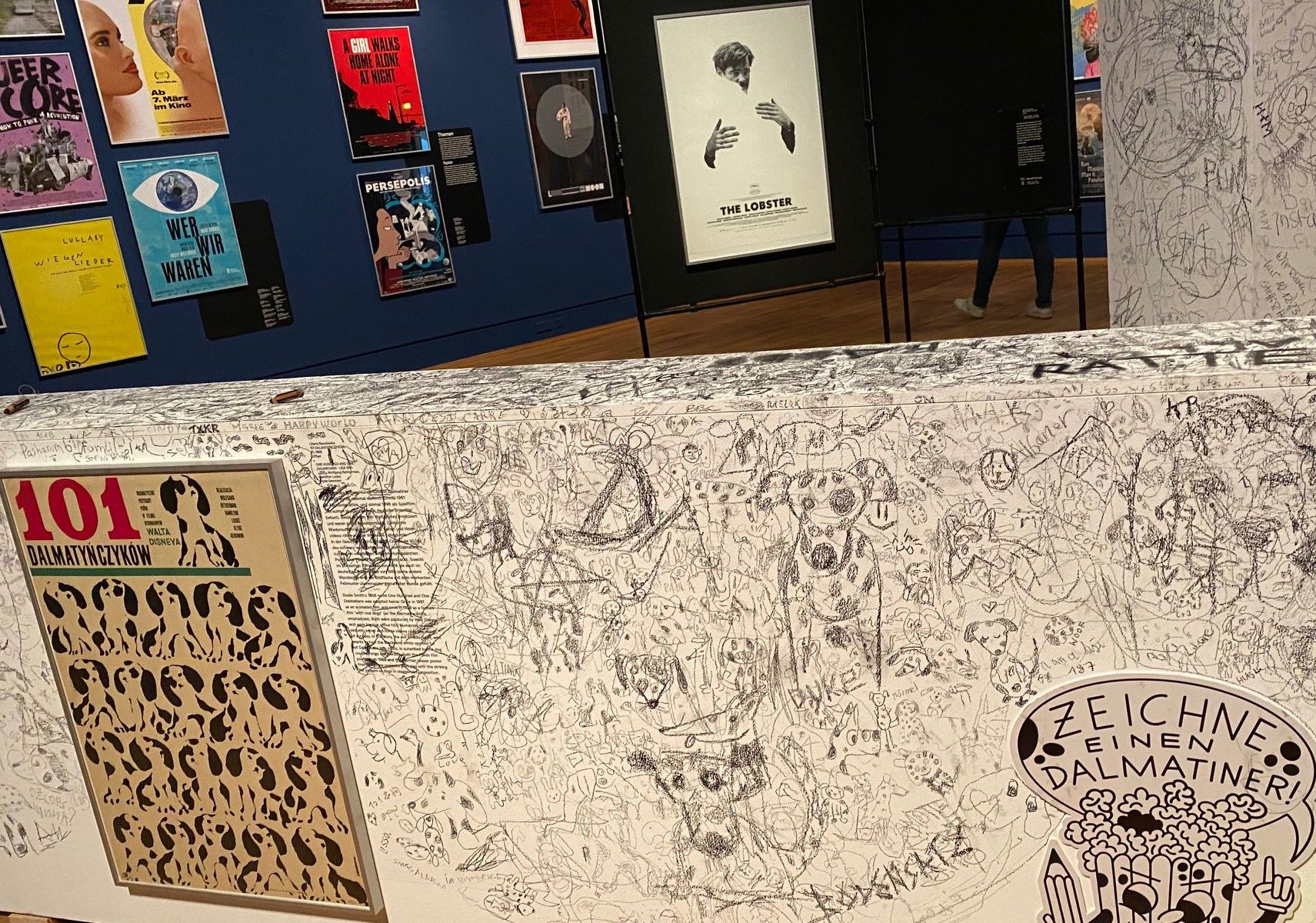
The effective use of posters in visual communication is a specific craft. Artists have been associated with poster design for more than a century. Cinemas continue this practice. For each movie produced there is an announcement posted in print or digital form. In combination with the Berlinale 2024 film festival the Kunstbibliothek in Berlin shows milestones of the history of movies and their representations in form of posters. Besides the historical approach there are many hints how to interpret the design language of posters throughout the 20th century. The encouragement to try to produce one yourself not only reserved to children is an additional activating feature of the exhibition (Link here). Cats and dogs will always catch attention and the playful approach chosen might be a start into a graphic design interest. Overall the exhibition offers a low threshold entry into the world of art and design. Instagramable image on posters evolved into short preview clips, just like instagram paved the way to tiktok video clips. In retrospect posters also provide shortcuts for our memories to recall whole movies that have accompanied us growing up and growing older.

Generationswechsel

In den öffentlichen Bibliotheken ist ein Generationswechsel der Besuchenden überfällig. Traditionell finden sich 4 unterschiedliche Gruppen von Personen in den öffentlichen Bibliotheken wieder. Da sind (1) die bildungsaffinen Rentenempfangenden, (2) die Eltern mit Kleinkind(ern), (3) Wärme- oder Kühle suchende Menschen der Umgebung und (4) die Schul-, Hochschul- oder Examensvorbereitenden. Soziologisch betrachtet ist das ein interessantes Aufeinandertreffen von gesellschaftlichen Randgruppen.
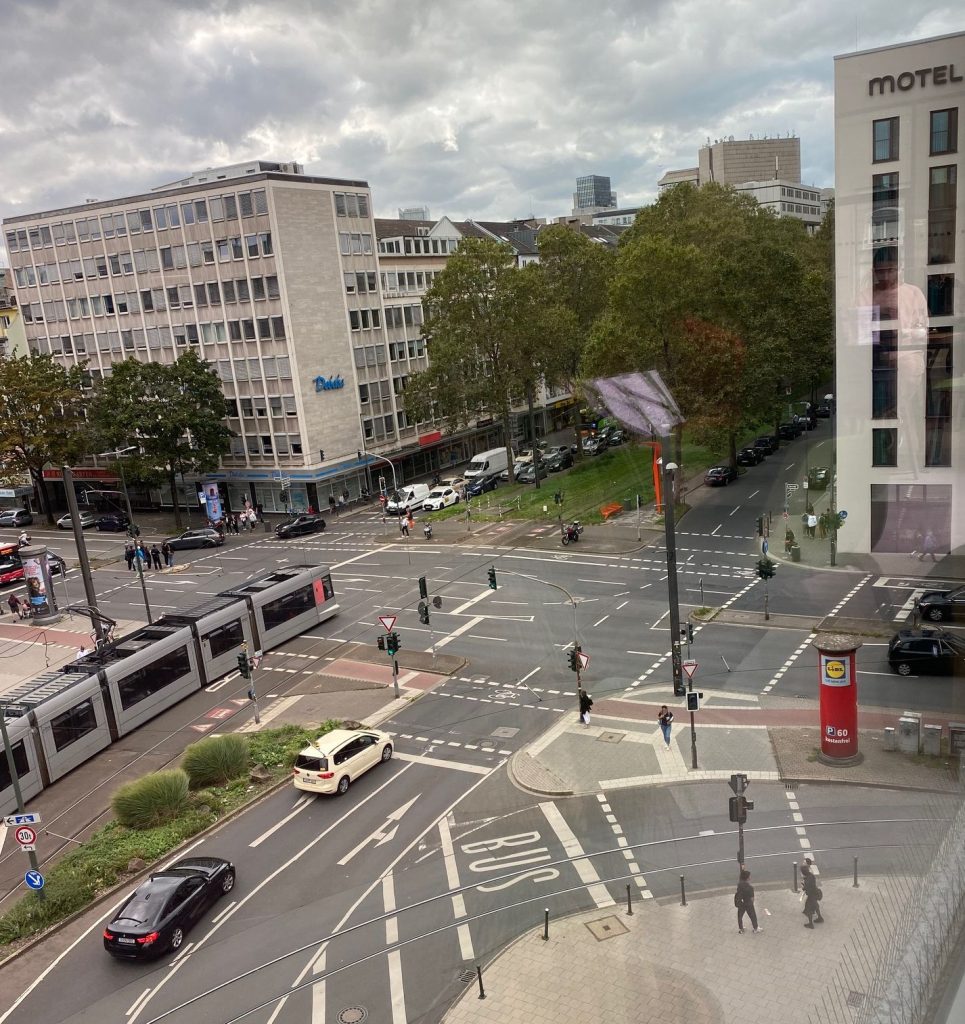
Die „Neue Zentralbibliothek im KAP1“ (Düsseldorf) hat aus diesen meist unverbunden nebeneinander operierenden Gruppen eine kommunikative Gemeinschaft produziert. Aktion und Interaktion ist nun angesagt. Der Flyer betont richtungsweisend: „Menschen, Bücher, Räume“. Fortan soll der Mensch und seine Lernfähigkeit im Vordergrund stehen, nicht mehr nur die Bücher. Dazu braucht es meistens anders oder umgestaltete Räume. Lernen war immer schon interaktiv und nur in Teilen allein im stillen Kämmerlein. Dazu braucht es Labs als Lernräume und nicht nur die Stille der „Page-turner“. Lernboxen, Lernstudio, Musikstudio sowie eine „Kreativschmiede“. Dort wird heute gepodcasted, 3D gedruckt und es werden social-media Kanäle entworfen und betrieben, immer schön generationsübergreifend. Voneinander Lernen ist das Motto nicht mehr nur nebeneinander und im Wettbewerb um die beste Bewertung. Kollaboration und gesellschaftlicher Zusammenhalt brauchen neue Räume, dem KAP1 in der Düsseldorfer Zentralbibliothek ist dabei schon viel gelungen. Die zentrale innenstädtische Lage ganz nah am Hauptbahnhof ist ein zusätzliches Asset. Ansonsten hätte ich mich wohl nicht auf der Durchreise dorthin verlaufen. Ein Random-Walk in Bahnhofsnähe, verursacht durch verpasste Verbindungen der Bahn, hat zu einer unerwarteten, bereichernden Zwischenpause geführt. Der Ausblick aus dem Café auf das übliche innerstädtische Verkehrschaos konnte umgeben von Alt und Jung richtig genossen werden.

Participative Art

Beyond participation in the performance based on Yoko Ono’s Cut piece 1964, you had the possibility to imagine yourself as a sculptor by touching a sculpture of art attached to the Genzken exposition, nothing less than the head and bust of Nefertete, also a piece transformed by Genzken and exposed, untouchable, in the exposition. You can hardly get more involved and incited to participate with hands-on experience, so to speak.
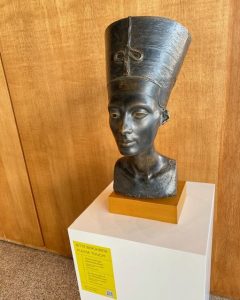
Additionally, there is the perspective from the performing artist in “Yoko Ono’s Cut Piece” to confront the spectators with a silent, stoic expression hardly moving during the more than 90 minutes performance. Imagine, what kind of vulnerability you are risking. Artists give a lot from themselves to the public. Imagination is even going beyond the act performed. Mastering your own fear of mutilation or being exposed to views, touching and multiple other forms of sensation.
This surely is an exercise of mental strength. Spectators also interact with other participants as, for example, spontaneously another spectator too the scissors to cut his own shirt in front of the performing artist and covered the shoulder of the performer. The personal interaction assures a more intense experience of art.
After all, this is a well-known principle to enhance learning experiences as well. Imagine all the people, each taking just a tiny little piece and remember their experience that they, as well, can be actively contributing to art. Reviving this participatory experience is leading beyond imagining only your participation. Democracy is built on this stimulating experience as well. It is ever so necessary to foster participation and to overcome indifference or abstention. Learning  by doing, or experiencing through touching, offer many additional insights.
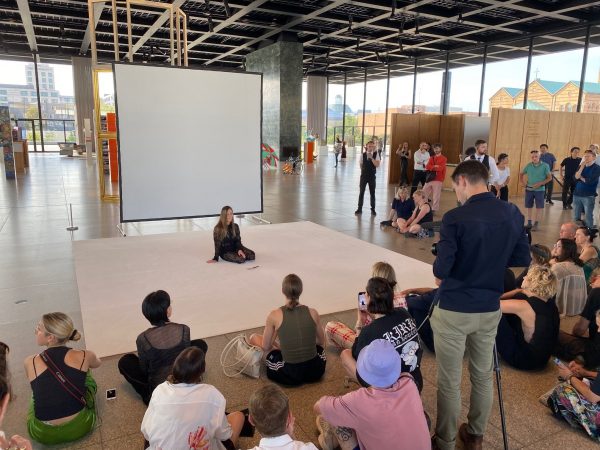
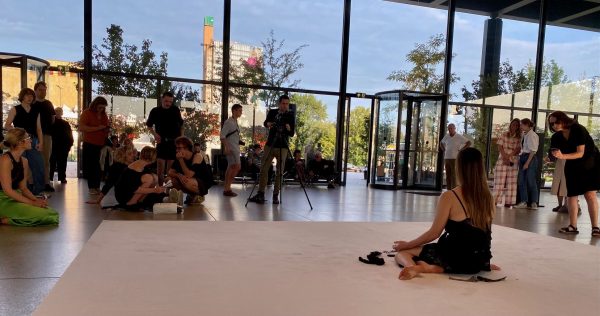
(Images and videos taken on 2023-9-12, Berlin)

Yoko Ono Cut Piece 2023 Berlin
Stabi locker

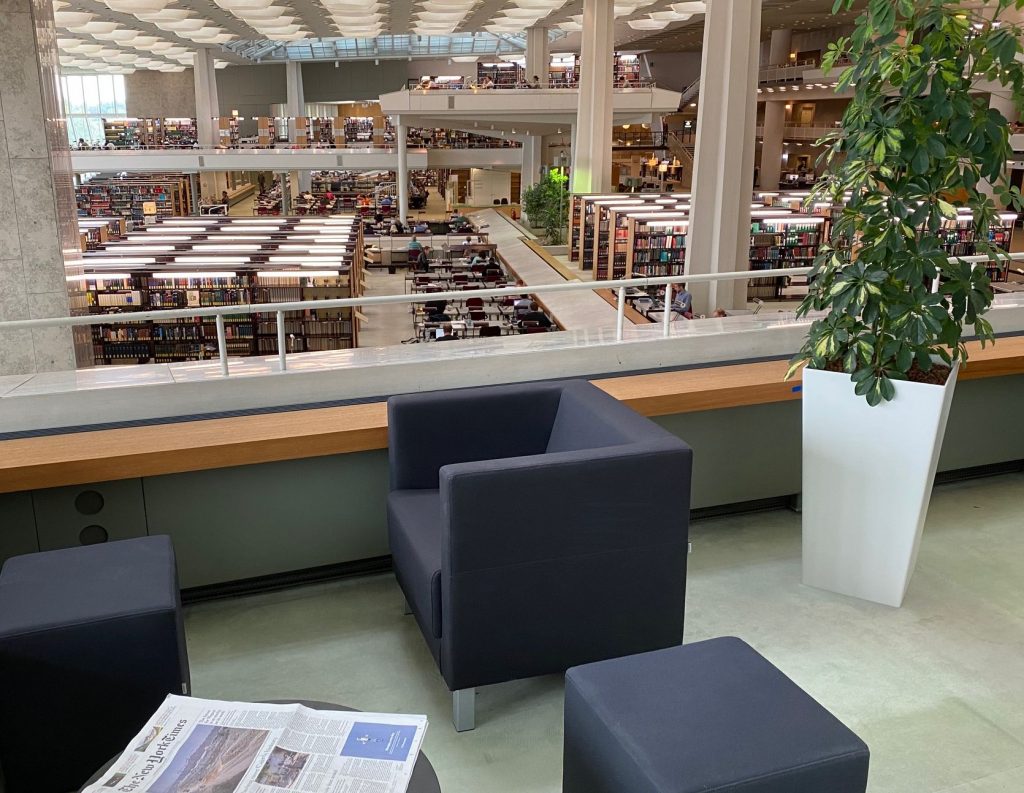
Die Staatsbibliothek Berlin in der Potsdamerstraße macht sich mal richtig locker. Neben all dem gebundenen und gebündeltem Wissen gibt es eine kleine, etwas versteckte Ecke in der richtig gechillt werden kann. Mit aktuellen Tageszeitungen in Papier und online lässt sich gut pausieren. Eine tolle Aussicht gibt es zusätzlich. Selbst eine vorübergehende Schließung wegen überfälliger Sanierung wird die Stabi bei den Wissbegierigen eine wichtige Location vermissen lassen (fehlende Bücher).
Neben Wissensmaschine ist die Stabi eine Lernanstalt erster Klasse. Die Anzahl der mitgebrachten dicken Gesetzbüchern samt Kommentaren lassen einen immer wieder staunen über den Mangel an stillen Lernorten an Universitäten und in Privatwohnungen. Die richtige Lernumgebung befördert den Ansporn, noch eine extra Meile zu gehen. Wissbegierig ja, aber es braucht auch viel Durchhaltevermögen bei ständig wachsenden Ablenkungsmöglichkeiten. Gemeinsam, einsam, allein mit sich und dem Wissen lässt sich vorzüglich dicke Bretter bohren. Das ist ein wichtiger Teil, das Lernen zu lernen. Kunst am Bau und im Bau gibt es gratis dazu. Die Nähe zur Ablenkungsindustrie am Potsdamer Platz, Kinos, Spielbank und Fresstempel kann da getrost auf ihre späteren Opfer warten. Mit Regionalzügen und S-Bahn kommt man von dort rasch wieder weit weg.

More Design

How about a subject like Design in school. Rather than the same old boring teaching manuals in art, music, economics or social science, young learners have always been attracted to making things by themselves. The theoretical context is then coming to the subjects and objects more naturally. Economics as market design, design social security for platform workers, sound or furniture design could bring in the creative potential of the learners. Lessons learned through subsequent applications or realizations of prototypes allows the link of theory and practice. A school garden would even be a fantastic cross-discipline learning opportunity.

The most difficult part is probably to find competent coaches to guide the learners exploring and designing. The world is not perfect, so why should learners not be confronted with imperfections in learning set-ups. The most fun part in science is when experiments go wrong, hopefully not too badly though. Catching learners by their curiosity is very likely to get them hooked on more thorny scientific questions as well. Across Europe holidays are coming to an end and millions of pupils go back to their benches and rigid curricula. We should really care more about the next generation.

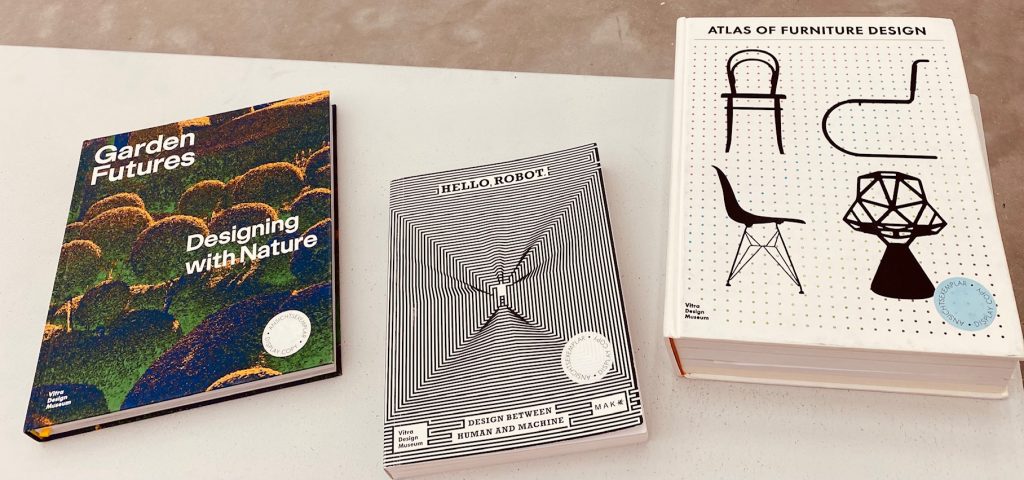
Vitra Design Exhibition and Campus 2023