Education Technology is much more than the use of tablets and Internet access in schools or in each classroom. Some schools revert to ban mobile phones access during classes or introduce specialized social media breaks during the school day. At the other end of the intelligent use of digital technology is the digital classroom with digital whiteboards in each classroom or the first fun hands-on experience with coding for primary school pupils through, for example, the “Scratch” platform. Once you are used to the power of the whiteboard to use web-based information in teaching systematically, most teachers and pupils will no longer want to miss these tools. Public libraries become important access points for those who have no speedy access at home to assist in learning. Digital tools and e-learning are an empowerment of learners to benefit from the millions of useful learning tools and platforms on the web. A first understanding of easy coding allows children to figure themselves as producer of games rather than only a consumer of fantasy games. Create your own story instead of following the stories of others is empowerment. Scratch it, if you like. The role of the teacher in classrooms is evolving fast as well beyond the 40-60 minutes slots in class. Play the games of your pupils, is a bit like a flipped classroom.
(Image: SCCON Berlin 2024 connected classroom simulation) 
Digital Zebra
It is a difficult task in all countries to bridge the digital divide in a society. On the one hand, there are so-called digital natives, those who have grown up with smartphones and notebooks all around them all the time. On the other hand, there are many persons who have not kept track of the digital turn and feel rather lost or are afraid of making mistakes using digital tools. As public services are also moving online, the need for a society-wide comprehensive mastering of digital information and tools have become a sheer necessity. It is much more than just nice to have.
As public services move online like registrations, payments or tax declarations, the need for training and/or assistance of millions of people in a country become a real challenge. This is where the innovative project “digital zebra” in Berlin comes into play. Through the network of public libraries you can get support in person to master your digital challenges.
The name of the project refers to the “zebra crossing” of a road, which assists persons to move from one side to the other side, just like crossing the digital divide. We shall need a lot of those guides and other multiplyers who can assist people to move safely online. Only through this form of taking people with you on the move towards online public services we shall close the gap of the digital divide. It is probably going to widen before we can narrow it again, unless we breeding digital zebras in a rapid way.
(Image: SCCON 2024-10, Berlin) 
Happy Employee
The research on happiness, subjective well-being or overall satisfaction with your life is also an empirical question. Analyses of being happy donot only focus of overall happiness, but look much more into the details of happiness. Beyond the tricky longitudinal observations of happiness it is common scientific practice to deal with subdomains of happiness like satisfaction of employees with their job, satisfaction with one’s job beyond the honeymoon and hangover effect, best known from family studies.
Each of those subdomains has a significant effect on overall happiness. The novel “Happy Life” by David Foenkinos is an interesting example which focuses mainly on the subdomains of job satisfaction, satisfaction with private and romantic partners as the major domains of a happy life. As developed in the novel, people make job changes to re-orientate professional careers or reset their private life. A low point on the happiness scale in one domain might be compensated by higher levels in another domain. These impact from one domaine to another might have substantial time lags involved as well. More drastic resets (à la Foenkinos) can be avoided through focus on other subdomains of overall happiness as well.
How happy are you with your housing situation, neighborhood, your pet, your physical health? There a multiple +/-spill-over effects to overall happiness. Reading a novel might be one as well, just take time reserved to yourself.(Image BnF expo “women in sport”, 20024)

Nutrition Competence
Nutrition is a good example of how a long lasting disregard in education and learning systems has led to huge medical costs for individuals and societies nowadays. The obesity pandemic calls for urgent action and policy changes in the field of nutrition policies and learning goals for children and adults. Medical doctors have mostly discarded that it is also their responsibility to provide medical guidance on nutrition, as this is highly controversial at times and asks for behavioural changes of the patient. School teachers see little scope to act on the issue due to increasing demands in fields of literacy, numeracy, problem-solving, digital and communication skills. Hence, the hope is to fill the instruction and learning gaps with a hybrid approach of nurses taking on both roles and communicate with children as well as adults alike. This is a tough challenge for these persons, but hopes a high that they can make a significant improvement to the nutrition competences of individuals, pupils, their parents and specific target groups.
The starting point is to recognize that there is an issue with nutrition. The next to establish the best evidence and based on this to develop a curriculum for the nurses to be well-prepared for the challenge in the field. Even with the differentiation of different levels of competences, the learning has to be rather encompassing several related fields as well. Individual, behavioural as well as society-level factors like biology, technology, religious beliefs, economic and social factors determine nutritional choices and consumption. Just because there are so many factors to consider does not justify to keep nutrition out of school curricula for example. Nutrition is a fine example of a topic which links disciplines across a broad range. It is a tasty, at times spicy mixture of issues to learn and apply. The former is the beginning, the latter the real challenge which needs ample and repeated guidance or coaching. (Image: Extrait of Abraham Mignon, 1640-1679, Undergrowth with flowers, animals and insects, MRBA Brussels) 
Competence Nature
Nature can be approached without competence. Emotional attachment is fine. If we delve deeper into the issue, we realize that a lot of processes that have evolved over years or even centuries are hard to study. The learning about nature is manifold and many scientific disciplines deal with nature in the broad sense of the word.
Today the study of nature is scattered across so many disciplines that an overall view of the field seems hard to achieve. This creates a problem to teach a competence to deal with topics around nature. Water, air, species, soil, climate or reproduction are all topics in which we have to make far-reaching individual and collective choices. This requires adequate competences to allow judgments about opportunities and risks involved.
For more than 100 years now we have researched education systems and processes, but the competences to talk and explain basic processes in nature are still scarce. Classification systems are a static way to sort nature into categories. Processes of evolution and development have more or less human input.
We all gain if we keep an eye on education and learning processes that have been applied years ago. The field of the history of education provides clues about some forgotten approaches. Learning about nature and how to acquire competence in the field has been an issue in this field for at least 100 years. It is time to test some of these approaches again to see what went wrong in learning about nature. Man-made climate change is only at the end of a causal chain of things and people moving in the wrong direction. We probably have to press the reset button and start from scratch with the learning and the tracing of wrong decisions. Maybe, the start is the appreciation of a splendid bouquet of flowers. Want to know more? Try to grow and assemble them yourself. 

Competence Gardening
Primary Schools in Berlin have the possibility to participate in the “Gartenarbeitsschule”, the school with learning goal of gardening. It is an interesting option to go out into the real world and deal with nature, sustainability, consumption, climate and many other topics. Voltaire could complement the curriculum in philosophy with his biographical links to gardening. The access to the fields is easy next to one of the central train stations and a larger urban reforestation project as just one example of the 15 overall in Berlin in 2024. (Südkreuz, Südgelände). Hands-on experience of gardening can address multiple forms of problem-solving competencies. Beyond the use of AI, a major advantage is the possibility to train collaborative problem-solving. Beyond the multifactorial approach in determining what to plant, the organization of the implementation and individual contributions towards the realization, all these elements are learning goals. The scope of learning qualifies gardening for learning well beyond primary school as well. It is a nice example of lifelong and lifewide learning even a hundred years after their wider applications in Berlin.

Narratives
In psychology it is a long-established field to study narratives of persons as they age. To make sense of individual narratives might even be considered as one of the foundations of psychological research since its starting times. “The Cambridge handbook of cognitive aging : a life course perspective” has 2 entries that enlighten the issue of personal life stories or narratives. We have to consider the importance of our personal past to the construction and reconstruction of our personal narratives. As persons age reconstruction of narratives becomes a more frequent exercise as life experiences and new evidence continue to accumulate. The chapter on “narratives and identity” supports the view of plasticity in old age, which means that narratives and identity are an adaptive process. “Processes of evaluation and reinterpretation of personal memories enable people to maintain a sense of self”. The importance of recalling personal life events and positive self-regard is a well-established link in this research tradition. The self-memory system consists of the autobiographical memory, the self-concept and the working self as its components. It is evolving in most persons as part of the construction and reconstruction of the self, as well as narratives of it.
As persons age our brain and memory functions age as well. This starts earlier than most people expect. “Many studies in gerontology have shown that being able to remember, evaluate, and integrate personal memories and thereby dynamically maintain identity is related to mental health and well-being in later life (Westerhof et al., 2010).” (p.392). Reconstruction of narratives is a process that is hard work for our brain, therefore as people age many seem to shun away from these tasks. It is easier to clinch on to the old narratives of the self.
The chapter on emotion recognition and aging of the social brain summarises the research (p.369) by Ruffman et al. (2012, 2016) which shows that older persons were not as good as young persons to detect lies due to difficulties with emotion recognition. “Finally, we examined right-wing authoritarianism (Ruffman et al., 2016), that is, the tendency to hold conservative social attitudes (e.g., believing that women should have to promise to obey their husbands when they get married). Older adults had more pronounced right-wing attitudes than young adults, and even within the older adult group, these attitudes were entirely explained by their worse emotion recognition”.
The causal link, however, is less clear. The positivity bias in old age might be a major factor. The positivity bias describes the fact that older persons prefer to look at positive stimuli and avoid negative stimuli. The evidence is rather inconclusive about this effect. Probably persons have a positivity bias all along their life course as part of their personality traits. The other explanations of brain region decline and activation seem to receive a bit more empirical support (p.375). In any case, men seem to be even at higher risks.
Archives of personal diaries, letters, correspondence of persons are a valid additional source to study the process of the construction and reconstruction of the self. Biographical accounts of life histories serve as empirical material to analyse narratives and historical validity of narratives. The better the story, the more scepticism should be applied. 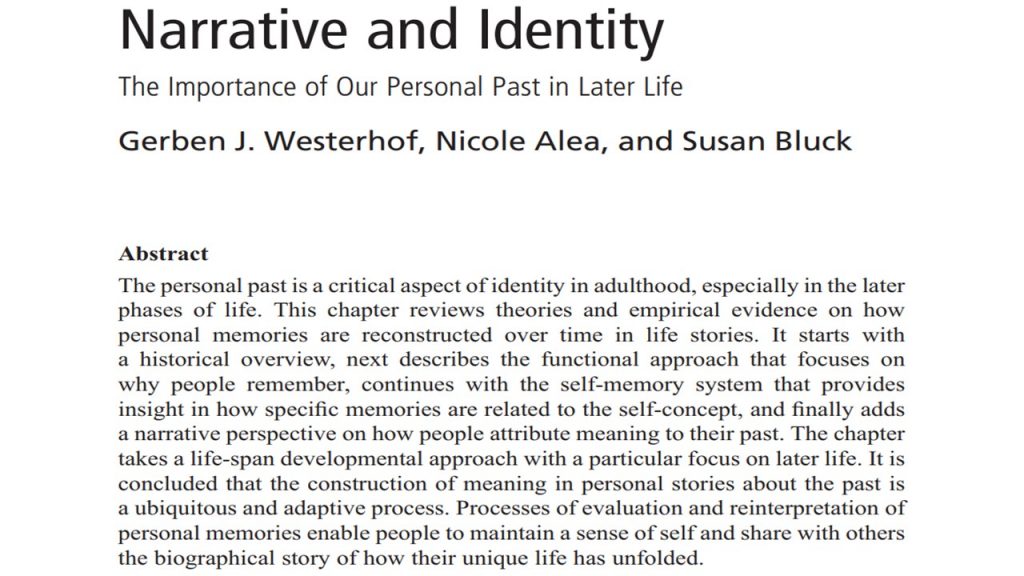
Luftschloss
Im K21 der Kunstsammlung Nordrhein-Westfalen ist ein Luftschloss eingebaut worden. Es ist das einzige mir bekannte Luftschloss, das für alle Besuchenden begehbar und fühlbar ist. In wahrhaft luftiger Höhe von 25+ Metern über der Eingangshalle der Kunsthalle K21 und zentral unter der gläsernen Dachkuppel platziert, lässt sich mal so richtig abhängen. Nahezu schwebend kann die weiträumige Installation von Tomás Saraceno erklommen werden. Die Schritte und wippenden Bewegungen der anderen BesucherInnen lassen sich unvermittelt ebenfalls erspüren. Du bist nicht allein, im originären Sinne des Wortes. Die buchstäbliche Vernetzung mit allen anderen Personen werden durch Schwingungen des Netzes zu anderen Kletternden oder Chillenden übertragen. Eine unmittelbar erlebbare Erfahrung der Verbundenheit mit unbekannten, anderen Menschen stellt sich ein. Die Verbundenheit innerhalb einer Gesellschaft wird eindringlich verdeutlicht. Die Angst, durch die Höhe verursacht, weicht rasch der freudigen Erfahrung der Schwebung und der kindlichen Erfahrung der Suspension. Nahezu freischwebend in der Luft, im Orbit erlebt jede/r sein eigenes Luftschloss inmitten von transparenten Kugeln, die wie Planeten wirken. Gleichsam real, aber dennoch imaginär durchwandern wir die Installation immer im Bewusstsein, dass andere um uns sind, die unsere Schritte, Möglichkeiten und Haltungen mit beeinflussen. Vom Luftschloss träumen oder im Luftschloss träumen, beides ist dort machbar.
CO2 freundlich lässt sich die Erfahrung in der APP Aerocene fortsetzen. Der für unser Wetter so bedeutsame Jetstream wird zur imaginären Flugerfahrung genutzt und mit recht aktuellen Daten gespeist. Die Verbindung zu „Earth and Space Sciences“ ermöglicht die Einbettung der sozialen Erfahrung in einen noch weiteren Kontext.
Die eigenen 4 Wände sind die Grenze. Das galt schon früher nicht. Weit darüber hinaus lassen sich neue Möglichkeiten erschließen, die nicht umweltbelastend sind. Selbst die Reichstagskuppel in Berlin sehe ich plötzlich mit ganz anderen Augen. Mehr als Möglichkeitsraum, statt der traurigen Vergangenheit und der zerstrittenen Gegenwart. Was wäre die Kunst, wenn sie nicht zum Träumen anregen würde. 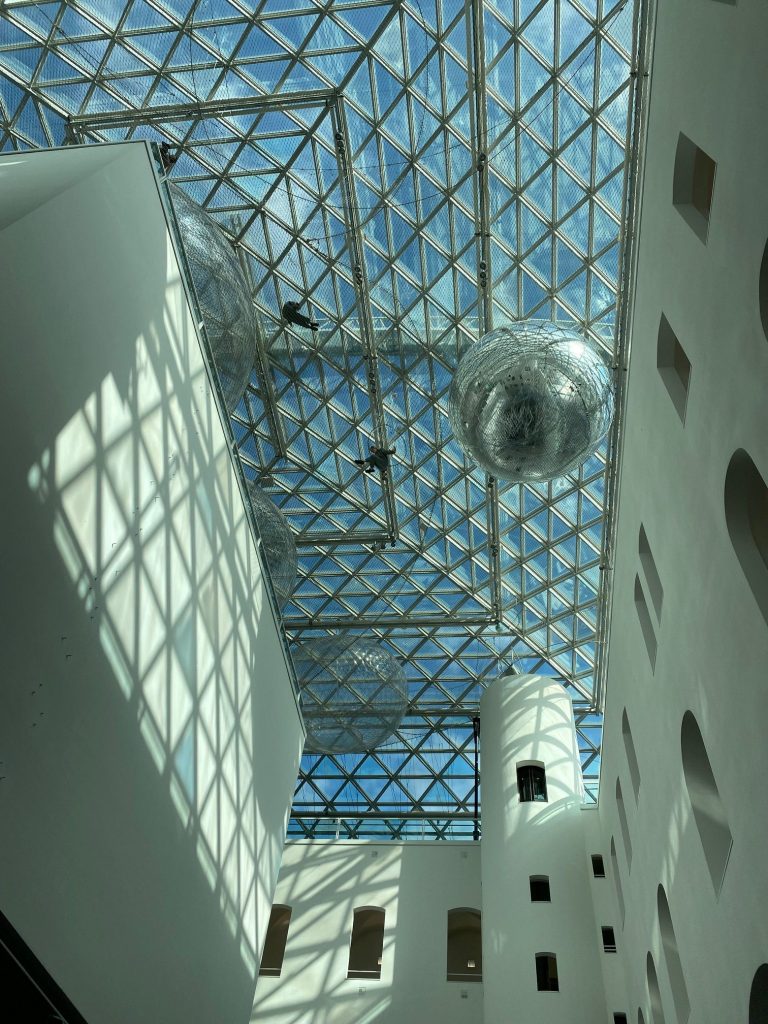
Generationswechsel
In den öffentlichen Bibliotheken ist ein Generationswechsel der Besuchenden überfällig. Traditionell finden sich 4 unterschiedliche Gruppen von Personen in den öffentlichen Bibliotheken wieder. Da sind (1) die bildungsaffinen Rentenempfangenden, (2) die Eltern mit Kleinkind(ern), (3) Wärme- oder Kühle suchende Menschen der Umgebung und (4) die Schul-, Hochschul- oder Examensvorbereitenden. Soziologisch betrachtet ist das ein interessantes Aufeinandertreffen von gesellschaftlichen Randgruppen.
Die „Neue Zentralbibliothek im KAP1“ (Düsseldorf) hat aus diesen meist unverbunden nebeneinander operierenden Gruppen eine kommunikative Gemeinschaft produziert. Aktion und Interaktion ist nun angesagt. Der Flyer betont richtungsweisend: „Menschen, Bücher, Räume“. Fortan soll der Mensch und seine Lernfähigkeit im Vordergrund stehen, nicht mehr nur die Bücher. Dazu braucht es meistens anders oder umgestaltete Räume. Lernen war immer schon interaktiv und nur in Teilen allein im stillen Kämmerlein. Dazu braucht es Labs als Lernräume und nicht nur die Stille der „Page-turner“. Lernboxen, Lernstudio, Musikstudio sowie eine „Kreativschmiede“. Dort wird heute gepodcasted, 3D gedruckt und es werden social-media Kanäle entworfen und betrieben, immer schön generationsübergreifend. Voneinander Lernen ist das Motto nicht mehr nur nebeneinander und im Wettbewerb um die beste Bewertung. Kollaboration und gesellschaftlicher Zusammenhalt brauchen neue Räume, dem KAP1 in der Düsseldorfer Zentralbibliothek ist dabei schon viel gelungen. Die zentrale innenstädtische Lage ganz nah am Hauptbahnhof ist ein zusätzliches Asset. Ansonsten hätte ich mich wohl nicht auf der Durchreise dorthin verlaufen. Ein Random-Walk in Bahnhofsnähe, verursacht durch verpasste Verbindungen der Bahn, hat zu einer unerwarteten, bereichernden Zwischenpause geführt. Der Ausblick aus dem Café auf das übliche innerstädtische Verkehrschaos konnte umgeben von Alt und Jung richtig genossen werden. 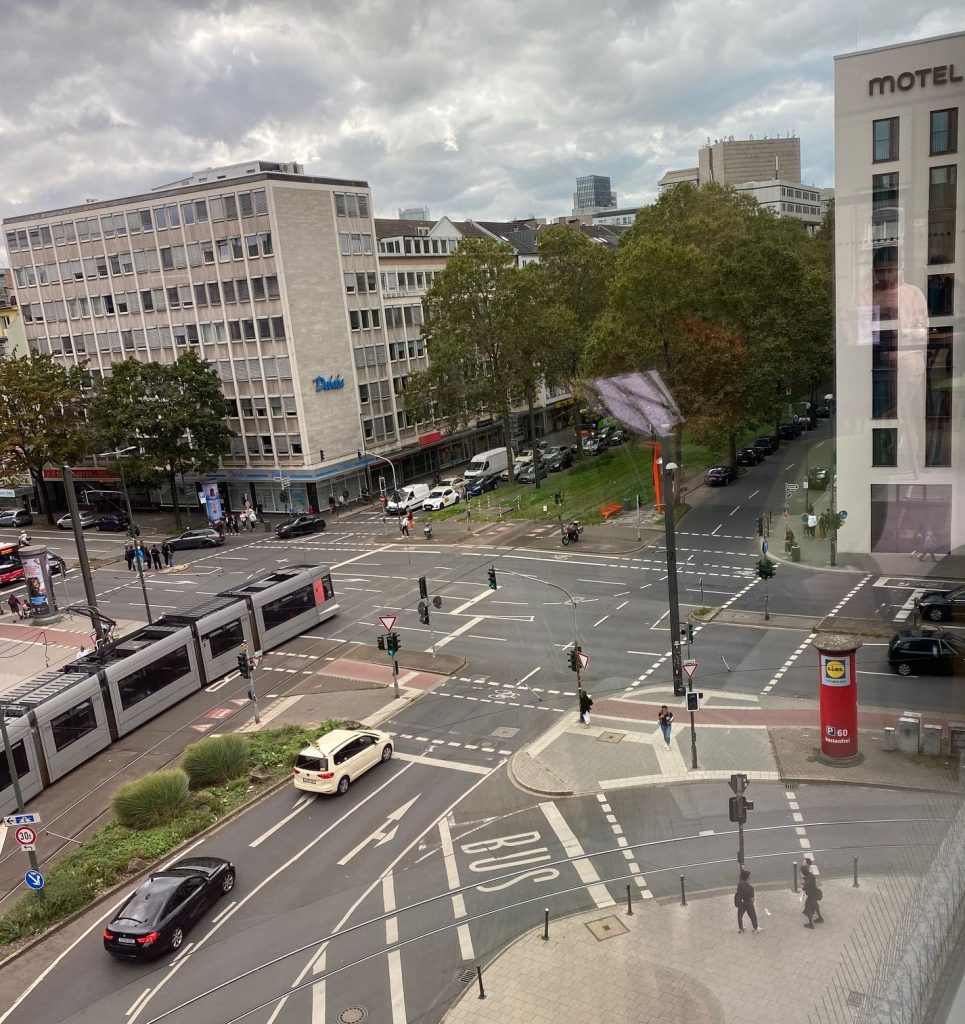
Stabi locker
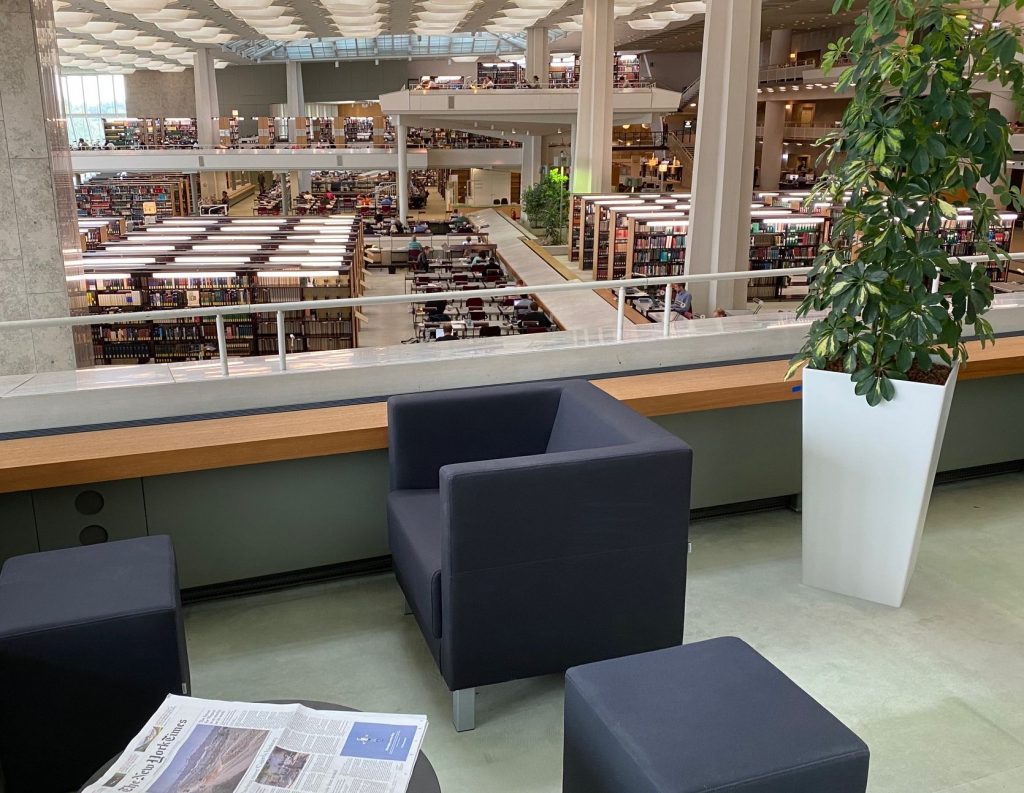
Die Staatsbibliothek Berlin in der Potsdamerstraße macht sich mal richtig locker. Neben all dem gebundenen und gebündeltem Wissen gibt es eine kleine, etwas versteckte Ecke in der richtig gechillt werden kann. Mit aktuellen Tageszeitungen in Papier und online lässt sich gut pausieren. Eine tolle Aussicht gibt es zusätzlich. Selbst eine vorübergehende Schließung wegen überfälliger Sanierung wird die Stabi bei den Wissbegierigen eine wichtige Location vermissen lassen (fehlende Bücher).
Neben Wissensmaschine ist die Stabi eine Lernanstalt erster Klasse. Die Anzahl der mitgebrachten dicken Gesetzbüchern samt Kommentaren lassen einen immer wieder staunen über den Mangel an stillen Lernorten an Universitäten und in Privatwohnungen. Die richtige Lernumgebung befördert den Ansporn, noch eine extra Meile zu gehen. Wissbegierig ja, aber es braucht auch viel Durchhaltevermögen bei ständig wachsenden Ablenkungsmöglichkeiten. Gemeinsam, einsam, allein mit sich und dem Wissen lässt sich vorzüglich dicke Bretter bohren. Das ist ein wichtiger Teil, das Lernen zu lernen. Kunst am Bau und im Bau gibt es gratis dazu. Die Nähe zur Ablenkungsindustrie am Potsdamer Platz, Kinos, Spielbank und Fresstempel kann da getrost auf ihre späteren Opfer warten. Mit Regionalzügen und S-Bahn kommt man von dort rasch wieder weit weg.