In French cinema Jean Gabin is a much adored person. Equally, Marlene Dietrich had, probably an even more far reaching international career. Both were accomplished and successful actors long before the 2nd world war broke out. In the U.S both fell in love and had a long lasting romance together. Their war time activities and “engagement” in fighting Nazi-Germany were extraordinary. It meant that both took active roles to use their charisma to mobilize people and soldiers to fight for freedom.
Shortly after the war then, both made a last attempt to work together in a movie production, but it could not unite the couple again. The “Deutsche Kinemathek” displays currently a page from the Diary of the “Diva” to underscore to what extent “Dietrich” was depressed about the break-up of their longer lasting love affair. Some say Gabin was the only person who quit her, all (most?) other relationships were terminated by the Diva. The junctions of biographies are hard to predict. The circumstances of the 2nd world war and internalized civic obligations to fight for freedom and democracy were wholeheartedly shared by both, but eventually they grew apart nevertheless. Tough experiences even for the much adored persons on the forefront of the stages worldwide. There seem to be many instances of repetition of the same story not only in movies, but also in real life.
Image: Deutsche Kinemathek Museum 2024-5 
Family Kafka
100 years after Franz Kafka’s death nearly all facets of his life and writings have been analyzed. The archives of the editor Wagenbach and the publishing house have now opened an exhibition at the “Stabi Ost” in Berlin adding a family picture book description of Kafka’s life (Curator Hans-Gerd Koch). This is of interest because Kafka himself had written an extensive letter to his father (Brief an den Vater) in which he tries to understand his intricate relationship with his father and other family members.
Nowadays, some people would try to analyze Kafka’s life through the parapsychological technique of family constellations. The far-reaching and pan-European family networks of the Kafka (father) and Löwy (mother) families were more than just an excellent source of inspiration. 2 younger brothers died in their first year. 3 younger sisters followed more traditional evolutionary patterns within families. The television series on Kafka’s life add to the understanding of his sources of inspiration and “parallel worlds” he created and lived in. The exceptional “fictionalization” of his own life and existence in the spirit of André Breton’s surrealism remains a milestone in the history of literature.
Kafka himself thought he was not really “instagrammable”at the time, but his image has reached and still reaches millions of people (Link to Picture archive). He himself would probably have defended the thesis that the most powerful images are within us. … and they are hard to escape from.
(Image from Exposition in Staatsbibliothek Berlin 2024-4, QR-code links to reading in originals!) 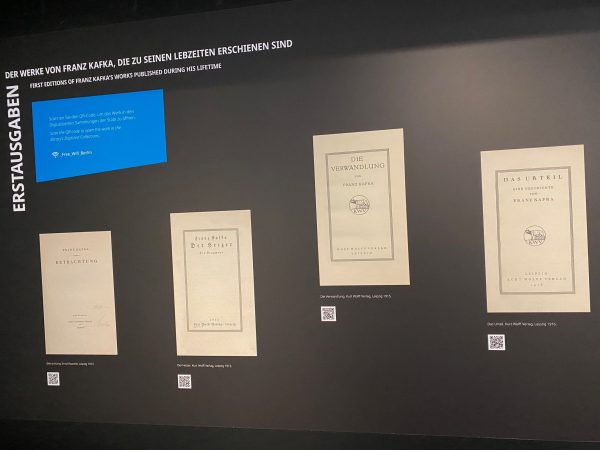
Das Meer
Wir haben vielfältige Beziehungen zum Meer. Diese reichen von romantisch geprägten Gefühlen zum Meer, den Wellen und den Fischen bis zur wissenschaftlichen Befassung mit den Meeren, Mangroven und dem Klimawandel. 71% der Erdoberfläche besteht aus Meeren. Das sollte den Festlandbewohnenden eigentlich klar machen, wie wichtig Meere für unseren Planeten sind. „Ocean Literacy“ nennt die UNESCO das. Neben Lesen, Schreiben und Rechnen sollte die Literalität auf unsere Ozeane ausgedehnt werden bevor es zu spät ist. Verschmutzung der Meere passiert hauptsächlich im Verborgenen. Lediglich Beobachtung aus dem Weltraum kann die weitläufigen Routen der Verschmutzenden zumindest teilweise nachverfolgen. Vielleicht hilft die Rückkehr zu der romantischen Sicht auf die Meere eines „William Turner“ zu einer höheren Wertschätzung der Meere, dem Licht und den Wellen.
Die kleine Sammlung von Gedichten „Das Meer“, erschienen im Reclam Verlag, ist eine gute Reisebegleitung für Begeisterte des Meeres. Darin findet sich eine Vielzahl von renommierten Schreibenden, die ihre Faszination des Meeres zum Ausdruck bringen. Mein momentaner Favorit ist Wolfgang Borchert darin (S.41-42) „Muscheln, Muscheln“.
Muscheln, Muscheln, blank und bunt,
findet man als Kind.
…
Muscheln, Muscheln, bunt und blank,
fand man einst als Kind! 
L’échiquier
The game of chess has been subject of an ever increasing amount of literature. Not only historically the game, where two kings fight against each other, but the queens are the most powerful figures on the chessboard attracted a great deal of attention. We studied chess in books and watched live tournaments between the best players of the world. Most of this has successfully moved online and we have gotten used to losing against computers for almost all human beings some time ago. The internal federation of chess FIDE lists the top players male and female. The calendar of face to face events is still impressive. The federation operates somehow like a platform of players, as well as for players, to organize their lives as chess players. Anther kind of chess literature is the one that is constructed around the lives of chess players. Some characters get really absorbed into the mental or virtual world of the dialogue between 2 or more characters or players. The real world experience and the game on the board become intertwined or entangled. Losing or winning, to win or not to win, may unbalance whole personalities. Beyond the “Schachnovelle” von Stefan Zweig we have a new addition of fictional writing with autobiographical traits by Jean-Philippe Toussaint (2023) on our desks. « L’échiquier » is a story unfolding in 64 chapters just like the 8 x 8 spots on the chessboard. Of course, the story does not unfold in a linear fashion. It seems as if the players or opponents even change as the game unfolds. Maybe there are more than one game in action. Simultaneously as in some chess tournaments. Some games are blitz games taking just a few minutes, others go on beyond a lifetime. The experience of playing chess even against yourself has a psychological and sociological dimension. You can go round in circles for some or you are like “bowling alone” in the individualized society. About time to shed an additional light on the mystery of the chessboard. Self isolation with a chessboard was also a way of coping with the Covid pandemic. Some still suffer from long Covid and cures are not always easy to find.

Only for Kids
We all have, hopefully, fond memories of children books. Sometimes authors are not so keen to tell that they are just writing books for children. This is often present in many biographies of authors of books for children. This is grossly unfair. Not only is the book market for children’s books one of the best- selling part of literature, but there are lots of interesting collaborations between authors and illustrators. Most books are expensive to produce, particularly if, additionally, translations are needed to reach more children and their parents. For small countries this might be a barrier. The Scandinavian countries have a tradition to translate and publish some selected children’s books in multiple Scandinavian languages and beyond. Therefore, it is no surprise to find a children’s book entitled “Kant” by Norwegian author Jon Fosse, illustrator Roj Friberg with the text translated into Swedish and published by the Danish Editor Carlsen, all in 1990.
The illustrations allow to understand the “bilderbok med text av Jon Fosse” using an enlightening imaginative visual language. From the cover already It is clear we deal with the universe and endless open space. There are black holes in it as well. Jon Fosse deals with “möjliga och omöjliga”, possibilities and impossibilities. Tackling such philosophical questions with children needs the best authors to address these issues. How to speak of the unspeakable, things we have hardly any words for remains a challenge. Relating to the world of dreams, appealing to children and their parents, does the trick. After all, you just need to close your eyes and you start to travel the universe and make lots of exciting encounters. The book has no page numbers, interesting. The image below is from page 25, just as an appetizer.
For more insights of how to deal with “nothingness” I refer to Friedrich C. Heller (2020) “Towards nothingness. Ideen der Reduktion in zeitgenössischen Bilderbüchern” (in Benner et al. editors 2020). Susan Sontag (2005) „die Ästhetik der Stille” (in Eugen Blume 2005, editor) will also help us along on the subject of stillness and minimalism. Maybe it is these essentials we should talk more about especially with our kids.
To continue the exploration of space and stillness just go to the webpage of the hubble telescope or the James Webb Space Telescope. The journey of your dreams will be hard to stop. 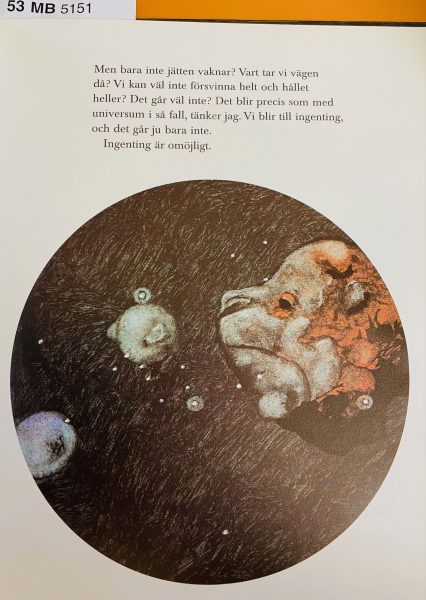
Tears mastered
Not many authors find decent ways to write about sad moments and the mastering of tears. Can we master tears? Should we even try to? For authors the question poses itself of a different kind. How do I write about emotions in which a person bursts in tears or sheds a single tear. 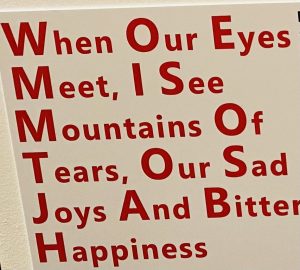 Even mastering tears or the delayed unmastered tears give rise to ample drama. Have you found a poet or author to whom you relate through the sorrows s/he expresses? Reading itself is a process of mastering tears due to the possibility to go through a wide spread of negative and positive emotions.
Towards the end of her life Cata Dujšin – Ribar wrote a poem that links to the imagery of the Norwegian poet Jon Fosse. Thanks to the exposition of her paintings and writing in the Zagreb City Museum Cata can become known to a wider audience. 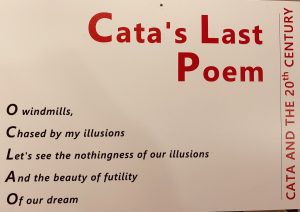 Hardly any traces in the internet of her writings in English make her even more of a local hero and an early female role model. The windmills are powered by the nothingness of our illusions. The beauty of futility is revealed in our dream. She puts it so much better. The biography and work of Cata Dujšin – Ribar summarises to some extent the whole history and misery of the 20th century beyond the Balkan region in a few words.
Meta-language
Some writers accomplish the formidable task to draft a text that encompasses more than one language. Samuel Beckett surely is one of them. Arnaud Beaujeu (2011) exposes the meta-language that Beckett creates through his reductionism and minimalist style. It is first a deconstruction of language or languages expressed in French and/or English at times. There is an underlying discourse dealing with the link and sometimes opposition, but always a relationship between at least these 2 languages. Beaujeu reveals 2 other languages: « the trivial and the spiritual ». The reductionism of Beckett leads to a conscious expression of the obvious, the trivial in conversations. This, however, he turns in the theatre piece “cette fois” (original “That Time”) into a ritual, spiritual version of 3 persons A, B, C in a prayer like liturgy. In taking out the sentence structure and obligations of grammar more generally the text becomes a rhythmic reading of words. Today we might say a Rap-version of a text.
The meta-language is the spiritual experience and another kind of access and questioning of memory, eventually even reconstructing a collective memory. Maybe the meta-language is the attempt to collectivise and internalize the dialogue that has turned into a trilogue.
It is out of the memory of persons or historical evolutions that Beckett builds his meta-language. Adorno (1974) put this in a relationship to Shakespeare’s dramatic work and the experience of the horrors of Nazi-Germany. Sarcastically put, the question to Adorno was not ” to be or not to be”, but “to die or to die”. Beckett travelled in Germany extensively in the year 1936 and faught in the 2nd World War with the French resistance.
„Paroles, musique, mémoire“ (Beaujeu, 2011) span a triangle which allows for a profound, albeit mostly empty space. Beckett offers a safety net to bridge the gap by way of reconstructing a language reduced to basics as well as meditative silence. The script lies in the meta-language and poetry is the more common access to this meta or essential level of our existence. Listening to the meta-language is like listening to polyphonic music. Some find it very disruptive, others a spiritual experience. Meta-language is all around us, like it or not. (Image: Französische Friedrichstadtkirche Berlin, Exhibition Princesses, 2023)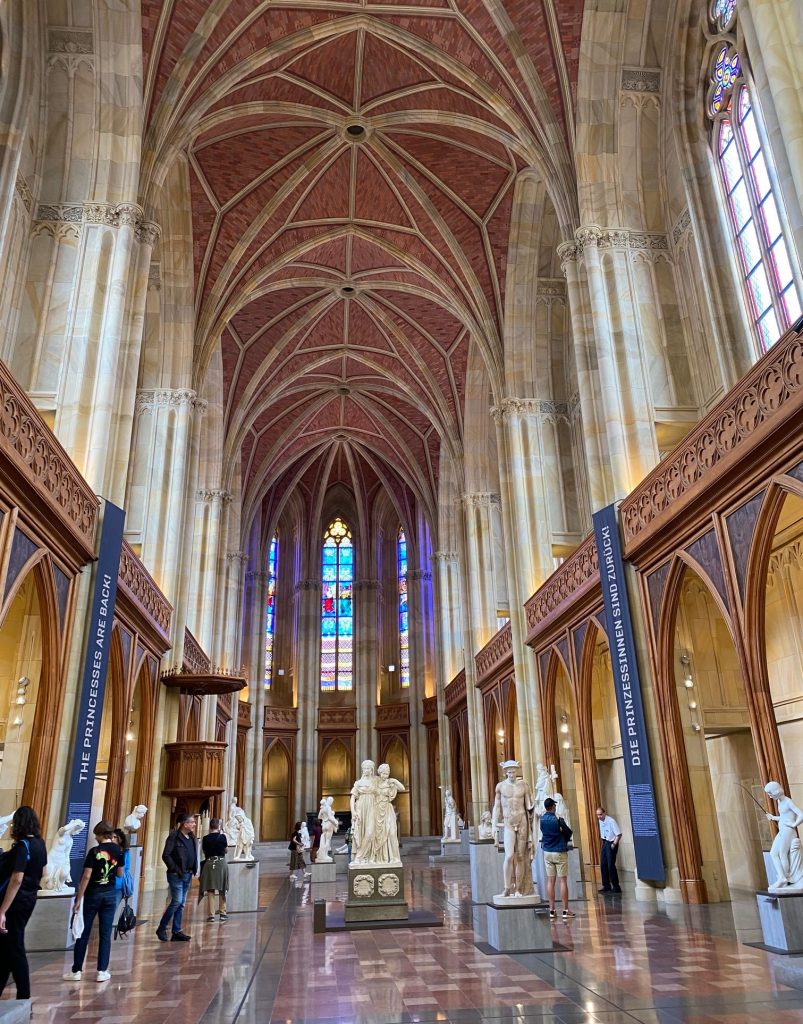
Beckett by Beckett
There is an interesting discourse in literature about how to define irony. This really begins with Plato commenting on Sokrates who makes use of the term “eirôneia”. In the history of the idea of irony comes next the philosopher Kierkegaard with his not-ironic treatise “The Concept of Irony. With Constant Reference to Socrates”. Reading philosophy can be really entertaining. It is, therefore, no surprise to find a publication entitled “Ironic Samuel Beckett” (Pol Popovic Karic, 2009). Following Karic there are 3 defining elements of irony: (1) “The message should be intentionally created, …(2) The meaning of an ironic message needs to be “covert”,… (3) During the analysis of a stable irony, the reader can assume that the first interpretation of the ironic message is correct.” (Pol Popovic Karic, 2009 p.49).
Additionally, to understand irony it might be necessary to know more about the context of the statement. Sometimes the ironic statement can only be interpreted as such if you have additional knowledge about the biography of the author (p.47). To understand Beckett better it is advisable to read about his life course in the many biographies available nowadays.
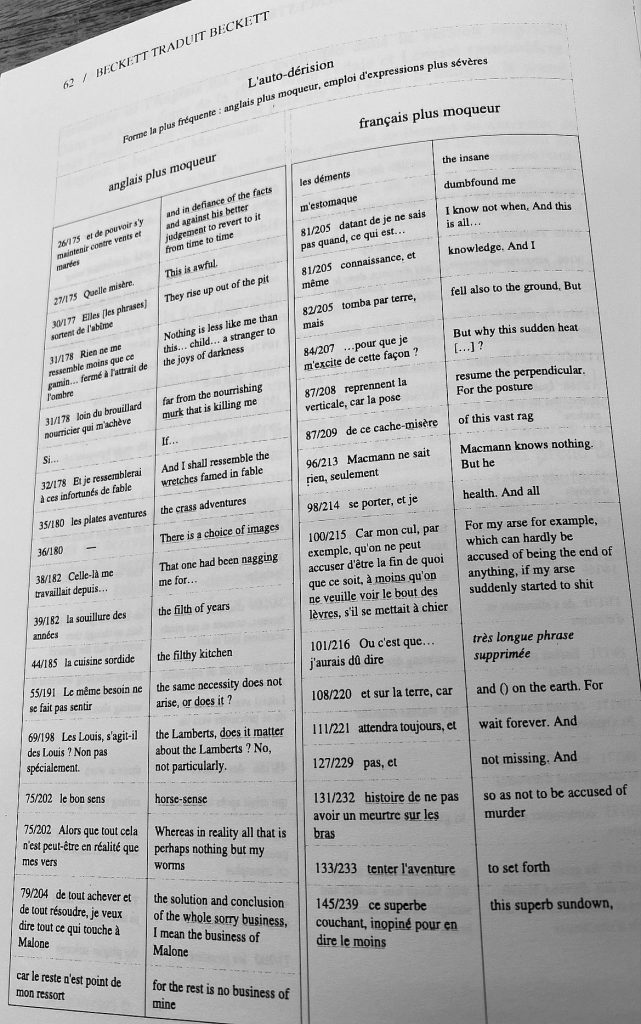
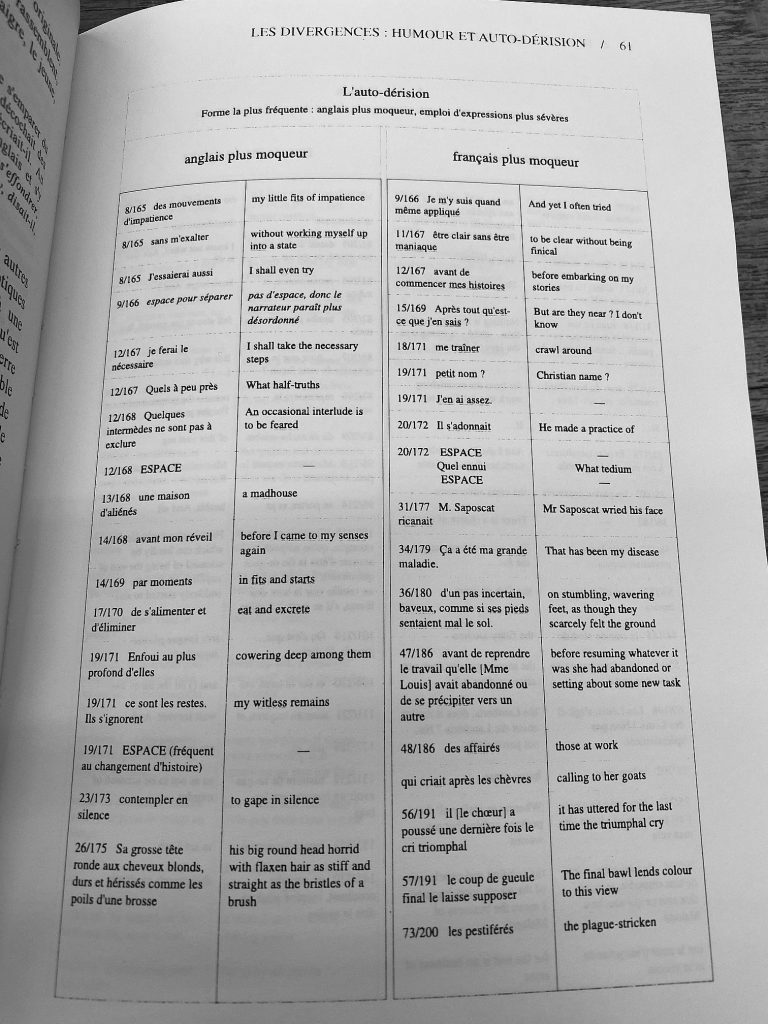
Beckett by Beckett, meaning the translation of Beckett by Beckett himself yields many fruitful insights into his kind of irony and constant reflection and laughing about himself as his very own form of irony. This becomes most evident in the many helpful tables Linda Collinge (2000) presents in her book on “Beckett traduit Beckett”. Translating irony is a tricky endeavour. Many of the translations do not seem to be straightforward at all and can only be understood from the perspective of the whole translation of a piece and the underlying “Haltung”, ironic attitude of the author to his own work. Beckett by Beckett remains a master piece for translaters beyond those from French to English. (Images: Linda Collinge, 2000, p.61-2).
Beckett and philosophy
Beckett and philosophy is the title of challenging read of usually unconnected literatures. Richard Lane embarks on the challenge “theorising Beckett and Philosophy” in Part 1 of the book. This is followed by 2 other parts on “Beckett and French thought” and “Beckett and German thought”. The whole book constitutes an attempt to identify the links between seemingly unrelated work. Sometimes spurred by tiny citations, the importance of influences becomes apparent.
Beckett like Rousseau favours speech over writing. Speech giving access to nature. This, Beckett has taken from French thought traditions. Redefining philosophy after the 2nd world war links Beckett to the thoughts of Adorno and Habermas (early writings). Posing Nietzsche’s thoughts as a post-modern project of endless questioning, Beckett himself enters into a kind of Socratic dialogue with Nietzsche. Spoken words become writing, the written word resembles an unspeakable void. The borders between void and silence, between spoken and written, become blurred. The essence is the world in-between.
It appears like irony and yet it is our very existence. We probably need somebody to translate Beckett for us in order to better understand his philosophical stance. “Beckett translates Beckett” is such a book title. It invites us to study Beckett’s own efforts to translate himself, at least from one language to the other. 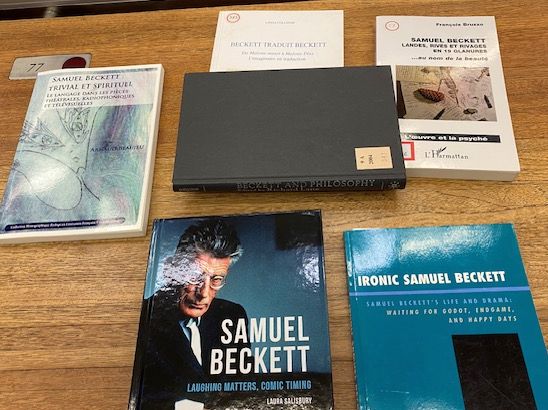
Laughing Matters
It is time to dig out our copies of Samuel Beckett. Jon Fosse refers his work back to a tradition of Samuel Beckett. It is interesting to re-read some of the plays of Beckett. The famous “Waiting for Godot” or “Endgame” figure prominently on the reading list and theatres even today. Laura Salisbury (2012) honours Beckett in devoting a book on Beckett with the subtitle: Laughing matters, comic timing. She refers to a tradition founded by Aristotle: “man is the only animal that laughs”. Even in the most horrible scenarios of war and suffering, the human brain brings up thoughts containing jokes. Laughing makes us a part of the human species. Humour then becomes the “locus and limit of the human” (Salisbury, p. 4).
It is obvious that the basic problem of jokes like most of our communication has a “sender” versus “receiver” problem. People just do not have the same sense of humor in many instances. We might even go as far as stating that a person feels at home, if cracking a joke is readily understood by surrounding people. Test your cross-cultural competence by trying and sharing laughter. It is hard to do.
Beckett succeeds in a formidable way on a philosophical level even to bridge cultures and spread his way to look at the world from a meta-perspective.
Waiting … for what? Endgame … what is the game? Is it a game? These are laughing matters. Not for all, but for many on the way, trying to learn about existential matters that define humanity.
Through choices Samuel Beckett made in his lifetime, it becomes clear that he did not shun away from the most existential choices. In World War II he joined the French resistance movement and risked his life to save our laughter. Jon Fosse appears in the footsteps of Beckett, who decided to seek the silence and remoteness to develop his work for years also in the tiny village of “Ussy sur Marne” near Meaux and a bit further away, from Paris.
In Beckett’s own words he defines what a comic spirit is;
“comic spirit: oscillation between equilibrium and lack of it” (Salisbury, p.20), referring back to Racine and Molière. It is a social skill and it is not always easy to master, like for example to suppress laughter. Aging might play additional tricks on us (reduced strength of affect inhibition). There is a cognitive element in laughter, but also an affective and a spontaneous mix of reactions.
Affect inhibition is linked to the ability to resist spontaneous impulses like laughter.
Resisting impusles, but also resistance on a philisophical kind is in Beckett’s work “a resistance to the given world, while nevertheless displaying all its violent administrations;”. (Salisbury, p.172-3). In asking what remains after we abandon belief makes it necessary to foster a resistance to brutal deviance from humanity. Laughing may matter here more than we might want to acknowledge.
Source: Salisbury, Laura (2015). Samuel Beckett: laughing matters, comic timing. Edinburgh : Edinburgh University Press.
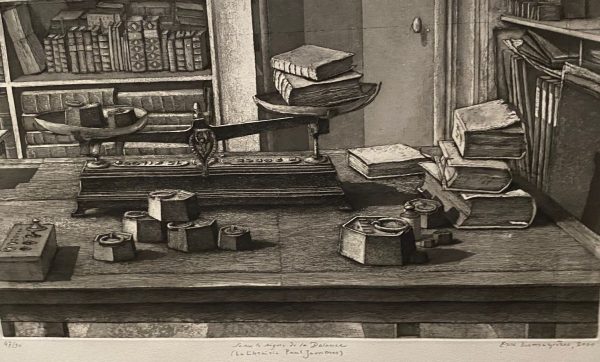
Image: extrait Eric Desmasière, 2000 Sous le signe de la balance.