
Dream Peace

To dream about peace is as old as humanity. However, the people who work on the development of weapons and train to use them vastly outnumbers those who think or dream up peace. The strategies and advice about warfare ranging from Aurel to Clausewitz have been studied carefully and the short-cut summary “if you want peace, prepare for war” sounds like a plausible solution to many problematic war-like situations (hybrid wars) even today. Let’s give it a try and dream up peace. There exits already an extensive literature on peace-keeping (forces) an the difficult role of the UN in these efforts. How about a challenge to this conventional wisdom. Voting in the UN should be weighted. The weights are inverse-proportional to a country’s amount of production and trade in arms measured over the last 10, 50, 100, 251 or 2501 years. The probability to favour peace in such a reformed voting system of the UN would shift further peace rather than arms trade and use of weapons in conflict. Of course, a crucial point is the definition of what is a weapon. Hybrid war and dual-use technologies could undermine the new balance of power at the UN. If countries with no arms production and arms trade get the upper hand at the UN decision-making, the peace-keeping force could still be mandated and delegated to joint forces. This could work as a disincentive for Trump to try to sell arms and enter into large-scale arms trade between the US and China. (Image: Ikarus-by-Picasso-at-UNESCO-headquarters-2024-Paris).


Ikarus-by-Picasso-at-UNESCO-headquarters-2024-Paris.jpeg

Autonomous drones

The weapon industry is shifting rapidly. Beyond slow moving tanks, modern warfare has adopted and applies autonomous drones in the battlefield. On the title page of the NYT of 2026-8-26 we learn about a Russian autonomous drone with US hardware technology (Nvidia Jetson Orin microPC) to kill 3 civilians without them being really the target. These drones are trained to select their target autonomously without a human in control. It is the pre-trained machine which decides on the target and whether to “take-out” the target. Disguised objects may survive for longer. People disguised as useless objects have a higher probability to escape detection if you do not fit into the drone’s visual identification. Autonomy based on artificial intelligence has its limits too. Military intelligence will continue to rely a lot on human intelligence to protect us from the realities of autonomous drones.  

Hiding from drone attack at BNF Paris 2026-8

Dronification

In a long row from californication, gentrification, desertification and electrification, not to mention quantification, juridification or enshittification,  we have arrived at “dronification” in the 2020s. Spurred by the extremely successful use of drones by the Ukrainian army to o bring to a halt the illegal invasion of Ukraine by Putin’s Russia,  conventional weapons like tanks and artillery lost out to the widespread use of drones. Few military observers, even experts of military equipment, thought prior to 2020 this would be possible. The lower costs involved, precision targeting and different skill sets needed for the orchestration of a drone based defense and attack, have made a strong case for the dronification of warfare.
As with many innovations, there are dual-use potentials. In this case the civilian use of drones received a considerable push in technology and acceptance. Rescue robots or delivery of provisions to frontline positions are part of the “everything-drone-thinking” during war. The surveillance of frontiers and territory is applicable to agriculture, properties and urban planning. Droughts and other environmental impacts on a large scale can be monitored in a  timely fashion as well. 4D imaging becomes more feasible as well in many domains. The potential in architecture is vast as well. Public infrastructure and distribution of frequency ranges is a crucial precondition to ensure an  orderly coexistence of military, security and civilian use cases.
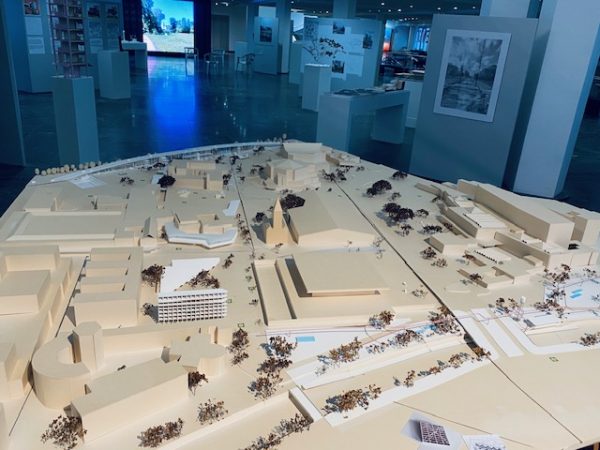
(Image: Exhibition: atelier le balto, Die Kunst des Gartens VI: FREI(B)AUM at Kulturforum Berlin 2026-1)

Defense strategies

Technological developments of drones, aircrafts, rockets and satellites take a lot of time. In order to produce not only prototypes, but ready-to-use weapons, it needs advanced engineering competencies and capacities as well. The arrival of hypersonic rockets, that fly at the speed of 5 Mach necessitate a rethinking of defense strategies to be able to react in ever shorter time spells to external threats. The European Defence Fund intends to spend almost 3 billion € over 7 years to prepare our defense strategies in the EU for the next generation of lethal weapons.
On 2026-3-4 the Iran-regime made use of such a fast rocket, but it was possible to intercept its flight just in time by NATO-allies. Yes, unfortunately “rocket science” is back on the research agenda. In fact, this research has been ongoing across the world, just a bit more below the public radar.
Missions to the moon or mars have been intensified in recent years. This is not surprising or spectacular fact. For some it is surprising, that the number of countries (for example India) which are active in rocket science is increasing and spreading further across the globe. The multipolarity of the international political arena seems more evident in 2026-3.

Interconnected multipolarity

In a very long-term anthropological perspective on the balance of power on the globe, the period that mankind lived on this globe has been characterised by an unconnected multipolarity. People lived in their more or less isolated communities before the Egyptian, Roman, Chinese, Australian, African or Japanese empires and people of the world became connected through new means of transport and communication networks.
In the 21st century the world wide web has broad us closer together and suddenly we realize that unipolarity or bipolarity might be options again through the unipolar dominance in airspace and radio frequencies. Even if unconnected multipolarity has been by far the longest period of mankind, the new developments in international politics resemble more a world of interconnected multipolarity than an American dominated unipolar or bipolar world of the Cold War period until the collapse of the Soviet Union. Stephen Walt (2026) and Raja Mohan (2026) discuss the concept of multipolarity in the same issue of Foreign Affairs (Vol. 105 Nr.2). Whereas Walt emphasises the USA as a “predatory hegemon”, Mohan describes the USA as being tempted and actually currently going it alone in international politics.
The current military image of world politics seems to be dominated by unipolarity again, maybe just before the longer run realities of economic, demographic, financial, trade and productivity developments, already reflected already in such data, take the upper hand again. The spectrum of the unipolar, bipolar, multipolar world privots around multipolarity in the long run, even if bipolar or unipolar intermezzi are part of the historical evolution.
(Image: view of Obzorno-geografceskij globus, Moskau 1994, Stabi Berlin 2026-1)

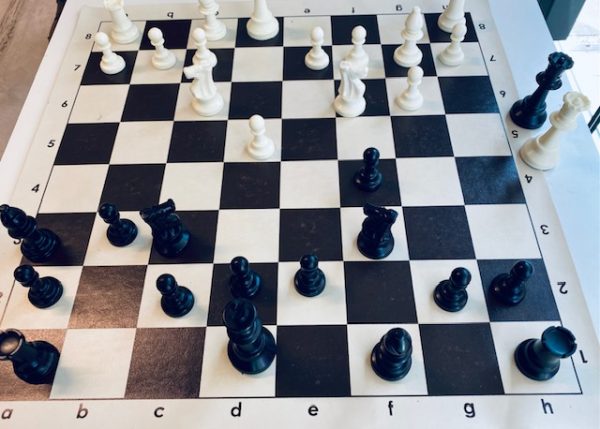
Chess without Queen

It is perfectly possible to play chess without a player having a queen on the chessboard. This certainly gives an advantage to the opponent, but in case of a lack of an adequate strategy or being overly confident to win, the advantage can be compensated by the party who does not have a queen in the arsenal of weapons. The paper by Lissner & Warden (2026, p.109) on the new way of war following the Russian invasion of Ukraine in 2022-2-24 states that “nuclear weapons have not given Moscow the coercive leverage many assumed they would.” Nuclear weapons hit the civilian population without differentiation the hardest, just as much as taking nuclear power plants as strategic war targets would do. What we have seen so far in Russia’s strategy is to use civil infrastructures of water and heating as targets within Ukraine as part of a kind of psychological warfare against the Ukrainian civil population. The more committed Ukrainian soldiers, even with the lack of a nuclear weapon, seem to hold the line against the Russian aggressor that so far has restrained from the nuclear option, if the Tschernobyl disaster has not been a precursor of a weaponisation of nuclear infrastructure.

Future Conflicts

Since 2014-2-27 Russia has occupied the Crimean peninsula. This invasion had started with an undercover mission of unmarked soldiers to take full control of Crimea about 3 weeks later. Russia did not officially declare a war, although the intentions were identical to a land grabbing war. The western world did not react much to this violation of international law. Apparently, this contributed to the next cynical “special operation” by the Russian army to fully invade Ukraine on 2022-2-24 in a failed “Blitzkrieg”, a rapid invasion, which attempted and failed to annex the whole of Ukraine. According to Lissner & Warden (2026) the Russian invasion of Ukraine bears 4 lessons for future conflicts: (1) the risk of using nuclear weapons is real, (2) in addition to nuclear options, prolonged and very destructive conventional wars remain an option, (3) escalation thresholds emerge and evolve over the duration of the conflict, (4) allies and partners in war keep adjusting their risk tolerance as well as escalation options. The authors argue from a US perspective and add a practical comment: “The USA cannot go this alone, but should coordinate closely with allies and partners in time before another conflict arises. Multilateralism seems a valid option and even more so as we move into a multipolar power play on the global scale propelled by AI.
(Image: Musée Orsay, Paris – Archer, Bogenspannende)

Peace and war again

“If you want peace, prepare for war”. This is one of the famous citations from Vegetius an early Roman general. For centuries we have been aware that peace and war are not opposites in a broader sense. Preparation for war can resemble war, if a country’s economy is already heavily turning towards production of weapons and intensifies research in dual use technologies. Political terminologies that shift to a vocabulary using more belligerent language may also be interpreted as a early signs of a shift in balance between peace and and early warnings on war. 4 years of the war of Russia on Ukraine territory have left traces in our vocabulary as well as budgets devoted to the preparation of a defense in Europe.
More countries of the EU state openly what is in their “national interest”, as if they were ready to go to war (Charap & Haukkala 2026) to in case major elements of the national interest were endangered. In going back to Clausewitz’s writing, a long historical line can be drawn from the Crimean War(s) to Putin’s imperialist war of 2014 and 2022 trying to capture Ukrainian territory, irrespective of enormous human losses.
Another lesson from these historical events might be: Let’s not forget to prepare for peace during the hot conflict.

Short circuit electrification

The electrification of the automotive industries is well under way. However, there is still the resistance of a few warriors from a village called “Gaulle” that fight the imperial forces that dominate these markets. The abundance of cars with batteries and electricity-based traction keeps growing, More utility vehicles shift over to this technology as well. With India and China making significant shifts in this direction, the market has made a significant technological shift until the beginning of 2026. The share of hybrid or solely electric power in cars has risen sharply, but a small segment (10% of diesel engines seems to survive or is only slowly petering out in the coming decade. The publication by Béla Galgóczi (editor) demonstrates the challenges this poses to the companies, their employees and the automotive sector as a whole, as it comprises a large amount of employment and technologies in the traditional supply chain as well. The need for a substantial and costly shift has started, but the downsizing of companies, as electric cars need far fewer pieces than conventional ones, could offer an opportunity, if the skilled employees can be converted to other productive use.
A single sector study offers a lot of “deep” insights into a sector, but the opportunities and openings in other not to distant sectors tend to be overlooked. The European sovereignty in the area of military, standardised technology, which is also still based on many precision and metal components might come as a rescue not only to Ukraine, but to Europe as a whole.

Failure time

In mechanical as well as medical components it is interesting to know about the usually hidden failure time of a product. The failure time simply means probability the component will seize to function properly or altogether. Usually, this probability of failure increases with the duration and the intensity of use. We might know this from cars or heating systems, but airplanes and heart valves obey the aame basic statistical models. Programmed failure time is a nuisance, which works against all efforts of sustainability, Over-engineered products would work much longer than the actual use case. Locomotives with steam engines that still function well even today might serve as an example of the latter case. The issue becomes a bit more complex if we consider not only the product but each single component. Maximizing profits often leads to taking risks with failure times or failure rates over a fixed time (a more general term than the guaranteed lifetime of a product). This sounds rather abstract thinking, but in modern military equipment the consideration of failure time, self-destruction or destruction by enemy play an important role again. Failure time of military equipment has moved to the forefront of issues of equipment and is part of strategic planning, like it or not.