Democracy or Democrisis

Measured on a global scale, democracy is in retreat. The report by the “Varieties of Democracy Institute” indicates that there are fewer people on the globe who enjoy the freedom and benefits of democracy overall. This is measured in domains like freedom of expression and the democratic quality of elections. The prevalence of democratic decision-making in opposition to autocratic ruling is closely related to the possibility to freely elect a new government in regular time intervals. The V-Dem Report 2026 indicates that 18 countries are on a favourable democratic development trajectory, whereas democracy is on the retreat in 44 countries. The freedom of expression suffered most (44 countries) and the quality of elections suffered in 22 countries. The positive developments (11 for freedom of expression, 7 for quality of elections) were outnumbered by negative ones. The cases of big countries with negative trends towards or tightening of autocratic ruling deteriorates the overall number of countries and specifically the number of people living in democracies in 2025 on the globe.
For all those living in lively democracies this should be a warning message (South Korea), that democracy is not a given. The enemies of democracy are working continuously from external territories to undermine a country’s democratic structures and decision-making. It is urgent to raise the quotas and limits by which fundamental democratic rules can be abandoned before it is too late. Let’s prepare a “defensive democracy doctrine” in Europe and the EU to signal more forcefully our willingness to stand up for freedom and democracy as fundamental values of humanity rather than an “Animal Farm“.

Press in the 1970s

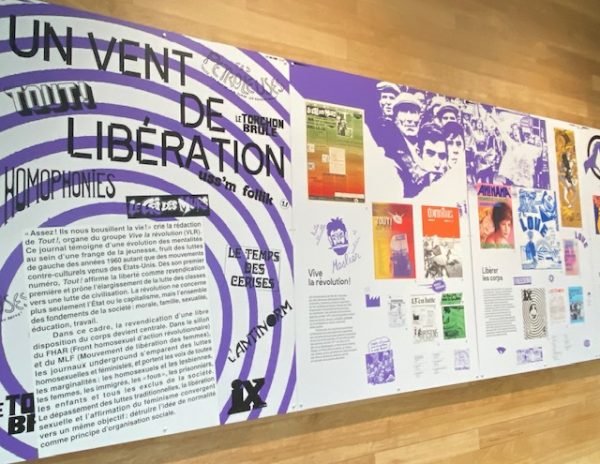
In the 70s there were many so-called underground or alternative papers printed. For people in bigger cities or in cities with universities, the 70s flourished with independent journalism which addressed small audiences. Each access to printing materials and paper allowed to go it alone for groups of society that did not feel they were adequately represented by established media. Some of these “underground” papers published texts that could be considered going against the dominant legal principles. Topics like feminism, birth control, abortion or more left wing political statements against private property had to fight to reach their audiences. The cold war period created another overarching threat to the representation of all opinions. Hence some groups we t underground to function as they wanted and how they interpreted the freedom of expression and being published. (Image: BNF Exhibition Underground 2026-6). 

Light Locomotion

There are many politicians who have an innate tendency to move in the direction of any flash light or camera. Tenagers in the age of the “not-so-social media” have a similar reflex. More seriously, Science Advances, has presented a fully autonomous robot with such a behavior. In fact this form of light locomotion is named the “twirlbot”. It has been developed by Chi Chen et al. (2026) as a new kind of robot that can be directed using light impulses, as only energy source for moving towards the light source. The from of locomotion is inspired by nature (bionics) and more precisely the “tumbleweed” way of moving, better rolling forward, driven by wind energy. The tumbleweed-inspired rolling robot, short “twirlbot”, does not need mechanical devices, just energy in a specific frequency range of light, which provides the heat for the photoactive, otherwise passive, bilayer strips. The polyhedral geometry of the twirlbot allows omni-directional locomotion. It really resembles the light active politician or any posing in the spotlight while doing the “loco-motion” (Video Link performance by “Little Eva” in the early 60s or a late 80s version by Kylie Minogue).

Critique of Maps

From a sociological perspective on maps we learn for example, that maps are also instruments to reflect property rights. This can be past claims of imperialism or recent claims of independence. A depiction as a map has historical and societal implications. Superposition of maps according to political, cultural or linguistic communities often reveal contested areas of domination and liberation movements. The specialized field of the history of maps can sharpen the senses for a critical view of maps in the 21st century. (Image:  Brankiza Zilovic, Nusquama 1984 exhibition “Cartes imaginaires’ BNF Paris).

Interests in failures

Decades or centuries after a successful or unsuccessful innovation, an evaluation of the reasons and circumstances of a temporary or permanent failure is informative. In the energy sector we observe another round of a power play in 2026. The more decentralized energy production and energy consumption models have been quickly put aside shortly after the oil crises of 1973 and 1979. The innovations using wind energy or solar energy of the 1980s have been discarded and were commonly considered as failures to provide cheap and reliable energy. An open international economy with expanding global markets for energy were perceived as a superior conventional solution. A country’s balance sheet of imports of energy and exports of higher value goods and services was the predominant economic rational and standard knowledge of the mainstream theory of trade. Other solutions, like a distributed “prosumer” model of energy might have ecological benefits, but would not show up in national GDP-statistics as a large part is home-produced energy and not accounted for in statistical measures of GDP, just like the home produced meals, health and care provided by mostly women. Societies, however, have a choice and an obligation to evaluate the interests in failures as economic and social development hinges on it in the medium to long run.

Antichambrer

In political circles it has been a common practice to “antichambrer”. It traditionally meant that topics are discussed in smaller circles before they are presented to the ruling royals or aristocrats. In modern democracies this role of more or less open “antichambre” (lobbying) is probably best translated as a form of consulting, which builds on personal contacts and small group discussions.
Scientists play a specific role in this political endeavor as they have to offer theories, hypotheses and evidence to support lines of argumentation to convince decision makers. Spin doctors, who know how to turn (around) an argument are, of course, present as well. All this represents the political, religious and business arena. All this happens in splendid locations that are part of the game of convincing, just as much as diplomacy.
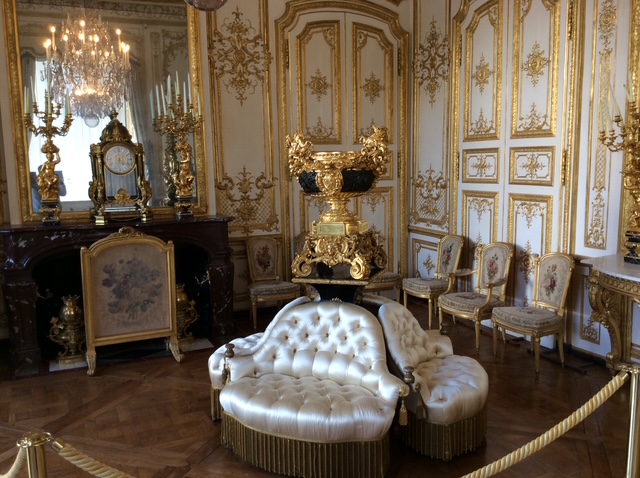
The theater play “L’antichambre” by Jean-Claude Brisville, (produced by Alpha Théâtre in Paris 2026) sets the play in a historical 18th century scenario to unfold the intricacies of “antichambrer”, less in the political arena, but in view of the personal turbulence in may engender. (Image: Château Chantilly Antichambre)

Totalitarian Totality

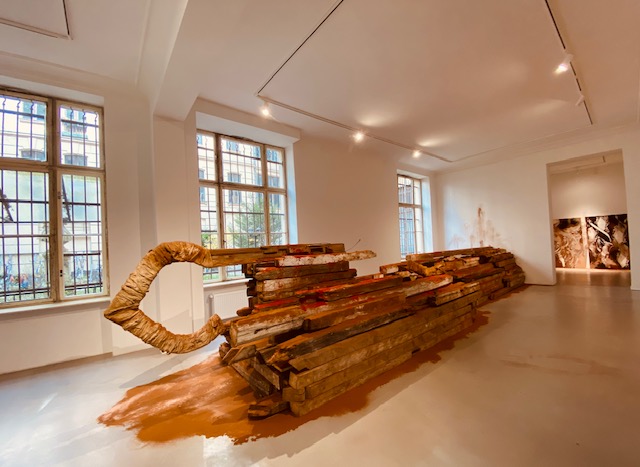
In political science we study totalitarian regimes across history in order to better understand how the decline into authoritarian and then totalitarian regimes occurred. But it is not only a matter of historical interest. Authoritarian regimes can get worse, like the Nazi-terror demonstrated and it propagated and applied “total war”. Across the world it is necessary to keep monitoring the war like situations of hybrid war and whether we might have to face again totalitarian regimes entering into all encompassing terror and war. It is the people, no matter from which country, who will suffer the most. The installation by Monia Ben Hamouda in the art gallery ChertLuedde allows us to think beyond or what remains “After totality” (image below from 2026-3-24). Maybe the challenge to make people think beyond the totality is the only way to prevent it from happening or totality being repeated. The experience of the installation is impressive and encourages us to question every attempt of totality especially of totalitarian regimes. 

Urban rural voters

On Sunday 2026-3-22 local elections of the 2nd round took place in France and some parts and cities in Bavaria. The voters have in both instances confirmed the hypothesis that voters have very different preferences for political parties along the cleavage of urban versus rural voters. The sociological issue consists in the different socioeconomic as well as educational backgrounds of the populations. Across the 2 countries inner cities have environmental issues, safe transport and rents as major concerns. In rural areas a feeling of being disconnected and left behind is frequently the predominant concern, often in terms of lacking transportation infrastructure. Voters on the local level have a more direct connection to their elected politicians and scrutinize implementation as well as promises more closely. This is a much more complex issue for voters on the national level as more topics enter the equation. The political agenda, therefore, differs substantially for urban and rural voters. This is a tough challenge for the nationwide campaign teams to test the validity of their agenda locally as well. 

National interest

Especially in times of international conflicts, it is customary that politicians refer to “the national interest” as a justification for their actions beyond the state borders, commonly named foreign policy. There is a huge literature on the subject, in which the concept of the national interest is useful, (1) because it suggests some higher ranking political goal, (2) because it clarifies and prioritizes a country’s goals, particularly at times of military interventions and (3) because it “arouses the support necessary to move towards a realization of the goals” (Rosenau 1968, Int. Encycl. p.34).
A critical assessment of this concept in international relations should start with the democratic perspective that a country’s government is subject to regular elections, whereby the goals a previous majority had put forward, might substantially change as a new majority takes the lead. Continuation of the same foreign policies is not excluded, but at least subject to revision. In authoritarian regimes the definition of the national interest is probably more stable, because authoritarian leadership does not hesitate to define the national interest in “splendid isolation” from its people.
Overall, the concept appears to serve mainly communication purposes, both internally as well as towards the outside as in communicable foreign policy goals. Conflicts between countries can thus be named and become subject to diplomacy and international treaties. But we have to fill this with substance over and over again as new topics arise like climate change and global warming.

Interconnected multipolarity

In a very long-term anthropological perspective on the balance of power on the globe, the period that mankind lived on this globe has been characterised by an unconnected multipolarity. People lived in their more or less isolated communities before the Egyptian, Roman, Chinese, Australian, African or Japanese empires and people of the world became connected through new means of transport and communication networks.
In the 21st century the world wide web has broad us closer together and suddenly we realize that unipolarity or bipolarity might be options again through the unipolar dominance in airspace and radio frequencies. Even if unconnected multipolarity has been by far the longest period of mankind, the new developments in international politics resemble more a world of interconnected multipolarity than an American dominated unipolar or bipolar world of the Cold War period until the collapse of the Soviet Union. Stephen Walt (2026) and Raja Mohan (2026) discuss the concept of multipolarity in the same issue of Foreign Affairs (Vol. 105 Nr.2). Whereas Walt emphasises the USA as a “predatory hegemon”, Mohan describes the USA as being tempted and actually currently going it alone in international politics.
The current military image of world politics seems to be dominated by unipolarity again, maybe just before the longer run realities of economic, demographic, financial, trade and productivity developments, already reflected already in such data, take the upper hand again. The spectrum of the unipolar, bipolar, multipolar world privots around multipolarity in the long run, even if bipolar or unipolar intermezzi are part of the historical evolution.
(Image: view of Obzorno-geografceskij globus, Moskau 1994, Stabi Berlin 2026-1)